If you have ever heard the phrase “asset mix” or “asset allocation” and felt your eyes glaze over, you are in good company. It sounds technical, but the idea underneath it is simple. Asset mix just means how your money is divided among a few basic types of investments. Get comfortable with that one idea, and with how asset mix and risk tolerance fit together, and a lot of investing advice starts to make a lot more sense.
This article walks through the three building blocks almost every investor uses (stocks, bonds, and cash), what makes each one different, and how the right mix of the three tends to change depending on where you are in life. No finance degree required.
Key takeaways
- Your asset mix is how your money is divided among stocks, bonds and cash.
- Stocks offer the most growth and the biggest swings, cash the least of both, and bonds usually sit in between.
- Spreading money across all three smooths the ride but does not prevent losses.
- Your goals, time horizon and risk tolerance shape your mix, which usually grows more conservative as retirement nears.
The Three Building Blocks
Nearly every investment you own falls into one of three broad categories. Each one behaves differently, and understanding that difference is the whole foundation of building a portfolio you can actually live with.
Stocks
When you buy a stock, you are buying a small ownership slice of a company. If the company grows and becomes more valuable, your slice tends to become more valuable too. If the company struggles, your slice loses value along with it.
Stocks have historically offered the highest growth potential of the three building blocks over long periods of time. That growth potential comes with a real cost though: stock prices can swing up and down a lot, sometimes sharply, in a short amount of time. This up and down movement is often called volatility, and it is the main risk that comes with owning stocks. You could open your account on a random Tuesday and see it worth noticeably less than it was the week before, even though nothing is “wrong” with your long term plan.
Bonds
A bond works differently. When you buy a bond, you are essentially lending money, often to a government or a company, in exchange for a promise that you will be paid back later, plus interest along the way. Because a bond is a loan with a set schedule of payments, its value generally does not swing around as wildly as a stock’s does.
Bonds are not risk free, though. Two risks matter most. The first is interest rate risk: when interest rates in the broader economy rise, existing bonds that pay a lower rate become less attractive, so their value can dip. The second is credit risk, which is simply the chance that whoever you lent the money to cannot pay you back. A bond from a stable government is generally considered safer on this front than a bond from a struggling company.
Cash and Cash Equivalents
This category includes money sitting in a savings account, a money market fund, or a short term certificate of deposit. Cash is the steadiest of the three building blocks. Its value does not swing around, and you can usually get to it quickly when you need it.
That stability comes at a price too. Cash typically earns the lowest return of the three, and over time, inflation (the gradual rise in the cost of everyday goods) can quietly erode what that cash can actually buy. A dollar sitting in a low interest account today may not stretch nearly as far in twenty years. So while cash feels the safest day to day, holding too much of it for too long carries its own long term risk: the risk of falling behind.
Risk and Return: The Trade Off at the Heart of Investing
Notice a pattern in the descriptions above. Stocks tend to offer the most growth potential and the most short term ups and downs. Cash offers the least growth potential and the least short term ups and downs. Bonds usually sit somewhere in the middle on both counts. This relationship, more potential reward generally coming with more short term risk, is one of the most consistent ideas in investing.
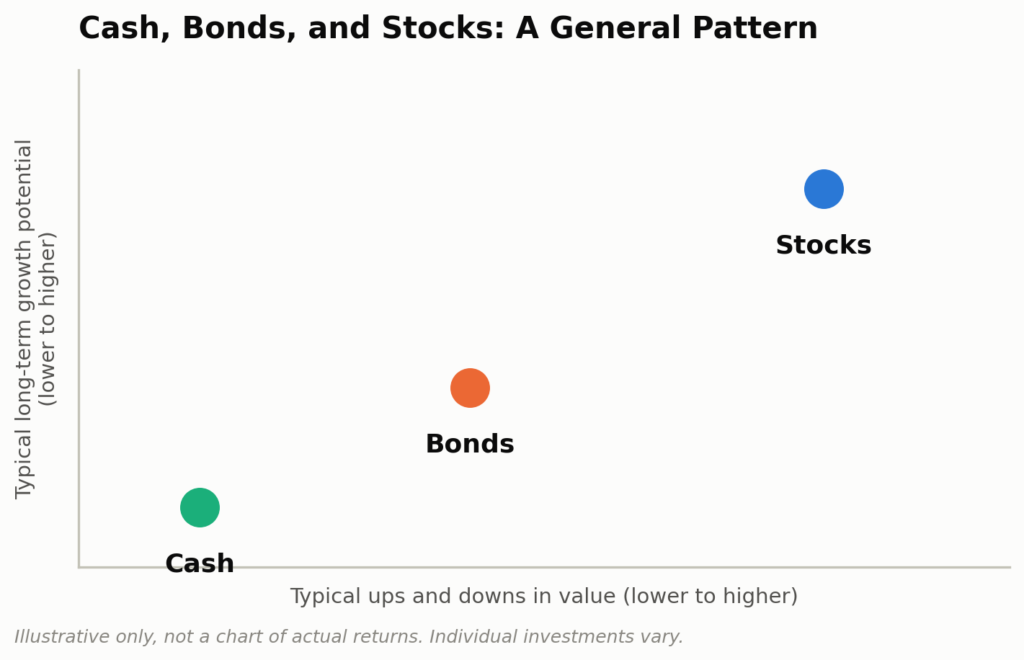
A general pattern, not a promise. Actual results for any investment can vary widely, and past performance never guarantees future results.
There is no version of investing that gives you stock like growth potential with cash like stability. Every choice you make about your asset mix is really a choice about how much short term uncertainty you are willing to sit with in exchange for a shot at greater long term growth.
Why Spreading It Out Helps: A Word on Diversification
Here is where the three building blocks work together. Stocks, bonds, and cash do not typically move in the same direction at the same time, and they do not respond to the economy in the same way. When the stock market is falling because of an economic slowdown, bonds sometimes hold steady or even gain value, because investors often move money toward safer, income producing investments during uncertain times. When interest rates rise sharply, bonds can lose value while a strong economy pushes stock prices higher.
Spreading your money across all three, rather than putting it all in one, is called diversification. It will not prevent your portfolio from ever losing value, and it will not make you rich overnight either. What it does is smooth out the ride. Because different asset classes tend to perform differently under different economic conditions, a diversified mix is less likely to be badly hurt by any single event, whether that is a stock market downturn, a spike in interest rates, or a stretch of high inflation. Diversification is less about chasing the highest possible return and more about managing how much you are exposed to any one kind of risk at any one time.
Three Questions That Shape Your Own Mix
There is no single asset mix that is right for everyone, and anyone who tells you otherwise is oversimplifying. The right mix for you depends on the honest answers to three questions.
- Your investment goals. Are you investing for something decades away, like retirement, or something closer, like a home down payment in three years? Money you will need soon generally has less room for short term ups and downs than money you will not touch for a long time.
- Your time horizon. This is simply how many years stand between now and when you plan to use the money. A longer time horizon gives your investments more time to recover from a rough stretch, which is why it usually supports a larger share in stocks.
- Your risk tolerance. This is the emotional and practical side of the equation: how much short term loss can you actually stomach without panicking and selling at the worst possible time? Two people with the exact same goal and timeline can reasonably choose different mixes if one loses sleep over market dips and the other shrugs them off.
Balancing risk and return is really just balancing these three questions against each other, honestly, for your own situation rather than someone else’s.
How This Plays Out at Different Ages and Stages
The same three building blocks apply to everyone. What tends to change over time is the mix. Here is one common way of thinking about it, broken into three broad life stages.
If You Are Young
If retirement or another major goal is decades away, time is your biggest advantage. A market downturn that happens this year has years, often decades, to be followed by a recovery before you actually need the money. That long runway is exactly why many younger investors lean more heavily toward stocks: there is more time to ride out the short term ups and downs in exchange for stronger long term growth potential.
This does not mean ignoring bonds and cash entirely. Even early on, a modest allocation to bonds and a small cash cushion for emergencies still matters. But the overall tilt, for someone with a long time horizon and a genuine tolerance for short term swings, often leans growth focused.
If You Are 5 to 10 Years From Retirement
This stretch of time deserves special attention, and it is often overlooked. Your time horizon is shrinking, but it has not run out. A portfolio that is still heavily weighted toward stocks at this stage carries real risk: a sharp downturn right before you retire can be much harder to recover from than one that happens twenty years earlier, simply because you have fewer years left to let your investments bounce back before you start relying on them.
Many people gradually shift some of their mix from stocks into bonds during this window, adding more stability while still keeping enough growth potential to keep pace with a retirement that could last another twenty or thirty years. It is a balancing act rather than an abrupt switch, and it usually happens gradually rather than all at once.
If You Are Already Retired
Once you are retired and drawing on your savings for income, the priorities shift again. Preserving what you have and generating steady, dependable income generally becomes more important than maximizing growth. This usually means a larger share in bonds and cash than earlier in life.
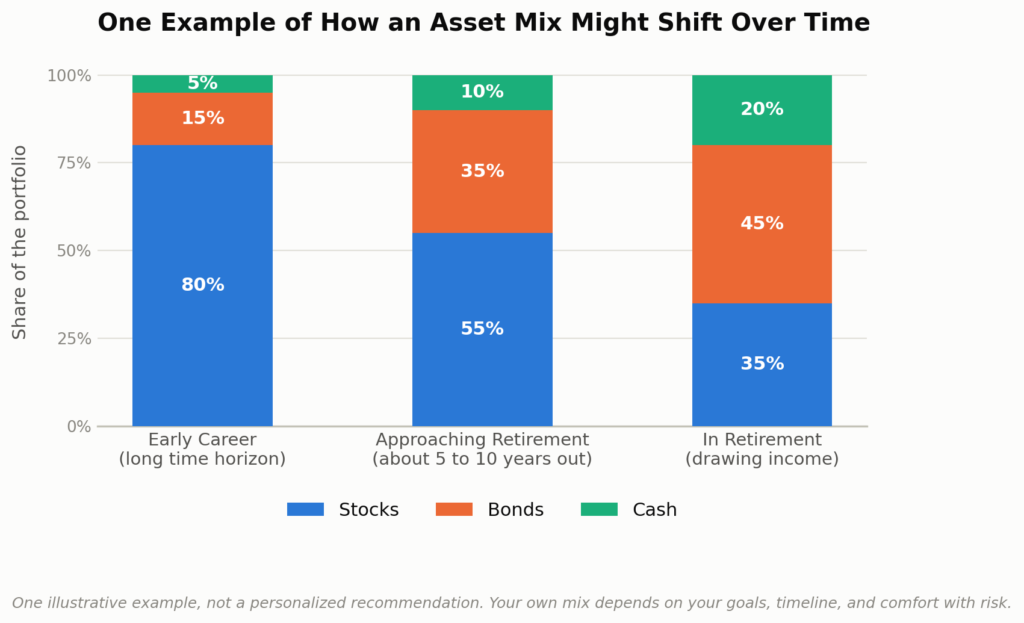
That said, retirement can easily last two or three decades, and inflation does not pause just because you have stopped working. Cutting stocks out of the picture entirely can leave a retiree exposed to a different risk: running short of money later in retirement because the portfolio never grew enough to keep up with rising costs. Most retirees benefit from keeping some allocation to stocks even after they stop working, just a smaller share than they held earlier in life.
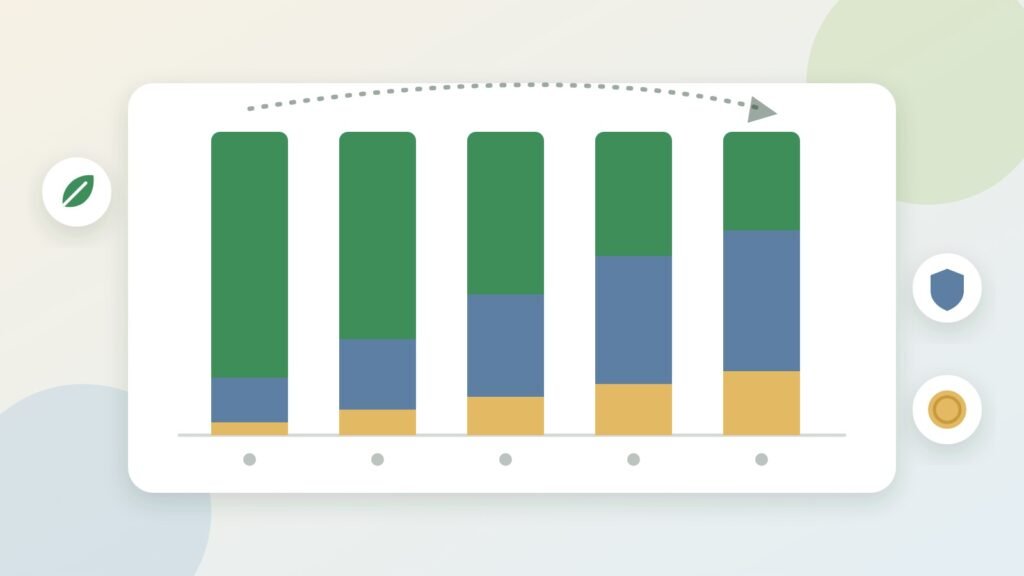
One illustrative example of how a mix might shift over time. It is not a recommendation, and it leaves out details, like other income sources or account types, that would shape a real plan.
There Is No Single Right Mix, and That Is Fine
The numbers in the chart above are meant to illustrate a general pattern, not to prescribe an exact formula for you to copy. Your own goals, time horizon, and comfort with risk are what should actually drive your mix, and those three things are personal and can shift over the years. A health scare, a change in income, a market downturn that hits harder emotionally than expected: any of these can be a reasonable reason to revisit your mix, not just your birthday.
The most useful habit is not finding the perfect allocation once and forgetting about it. It is checking in on your mix every year or so, asking whether it still matches your goals, your timeline, and how much risk you can genuinely live with, and adjusting when the answer has changed.
This article is educational and general in nature. It is not individualized investment, financial, or tax advice, and the example allocations shown are illustrative only, not a recommendation for any specific person. Investing involves risk, including the potential loss of principal, and past performance does not guarantee future results. A financial advisor can help you apply these ideas to your own goals, timeline, and risk tolerance.