Most people spend their working years thinking about taxes exactly once a year, in the weeks before the April deadline. In retirement, that changes. Nearly every dollar you take out of a retirement account has a tax consequence attached to it, and unlike a paycheck, nothing is automatically withheld unless you ask for it. Understanding how taxes affect retirement withdrawals, step by step, is one of the few areas where a little planning can put real money back in your pocket every single year, not just once.
This guide walks through exactly how a withdrawal moves through the tax system, explains tax brackets in plain terms with no assumed background, and covers the specific tools retirees use to legally lower their taxable income, from Health Savings Accounts to Roth conversions to charitable giving directly from an IRA.
Key takeaways
- Tax brackets work in layers, so a withdrawal is taxed at your marginal rate on top of your other income.
- Withdrawals can also make more of your Social Security taxable, an effect sometimes called the tax torpedo.
- Roth conversions in low-income years can fill a lower bracket without spilling into the next one.
- Health Savings Accounts and qualified charitable distributions from an IRA can lower your taxable income.
The Big Idea First: Marginal Rate, Not Average Rate
Before anything else, one concept makes everything in this article click into place. The United States uses a marginal tax system, which means your income is not all taxed at one single rate. Instead, it is taxed in layers, often called tax brackets, and each layer has its own rate that only applies to the income that falls inside that specific layer.
Picture your income filling up a set of stacked buckets from the bottom. The first bucket fills at the lowest rate. Once it is full, any additional income spills into the next bucket, which is taxed at a higher rate, but only on the amount that lands in that bucket. Your first dollar of income and your last dollar of income are very likely taxed at completely different rates, and the rate on that last dollar is called your marginal rate. It is the single most important number for retirement tax planning, because it tells you exactly what an additional withdrawal will actually cost you.
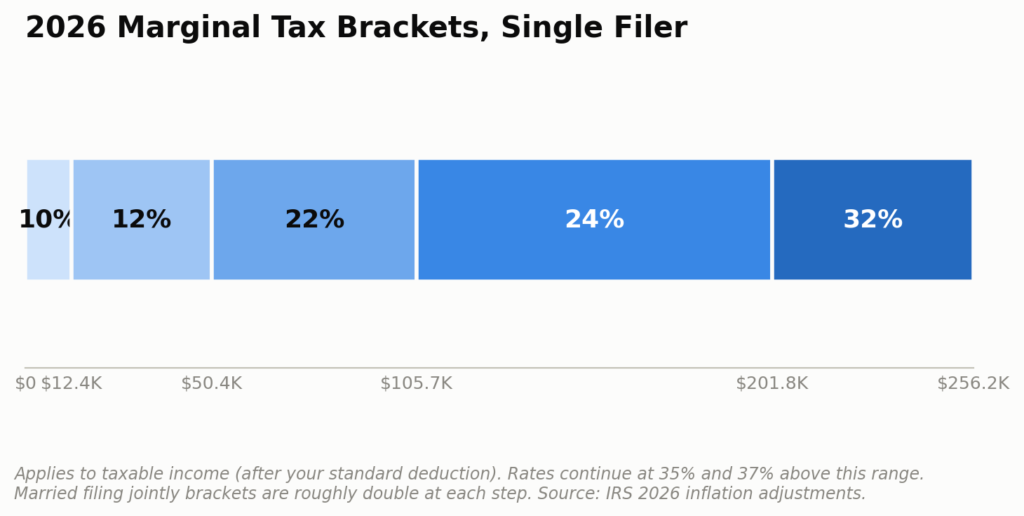
2026 federal tax brackets for a single filer, applied to taxable income after the standard deduction. Source: IRS 2026 inflation adjustments.
Here is what that looks like for a single filer in 2026. The first $12,400 of taxable income is taxed at 10%. The next layer, from $12,400 up to $50,400, is taxed at 12%. Income from $50,400 to $105,700 is taxed at 22%, and so on up through 24%, 32%, 35%, and finally 37% on income above $640,600. For someone married and filing jointly, each of these thresholds is roughly double. Notice that word taxable. This is income after your standard deduction has already been subtracted, which for 2026 is $16,100 for a single filer and $32,200 for a married couple filing jointly. That deduction effectively creates a stretch of income at the very bottom that is not taxed at all.
Step by Step: How a Withdrawal Actually Gets Taxed
1. Start with your other income for the year. This usually includes any pension, part of your Social Security benefit (more on that below), interest, dividends, and anything else that counts as taxable income before you touch your retirement accounts.
2. Subtract your standard deduction (or itemized deductions, if those are larger). What is left is your taxable income before any withdrawal.
3. Add your withdrawal on top of that taxable income. This is the key step people miss: your withdrawal does not get its own separate tax rate. It stacks directly on top of everything else you already have coming in, and gets taxed starting exactly where your other income left off.
4. Find your marginal rate, which is the rate that applies to the bracket your total income now reaches into. If the withdrawal is large enough to spill across a bracket line, part of it is taxed at one rate and the rest at the next rate up.
5. Repeat every year, because your other income, the bracket thresholds, and your own plans can all change from one year to the next.
An example makes this concrete. Say a single retiree already has $40,000 of other taxable income for the year and then withdraws an additional $25,000 from a traditional IRA. That $40,000 already fills up through part of the 12% bracket. The withdrawal does not start over at 10%. Instead, the first chunk of it finishes filling the 12% bracket, and the rest spills into the 22% bracket.
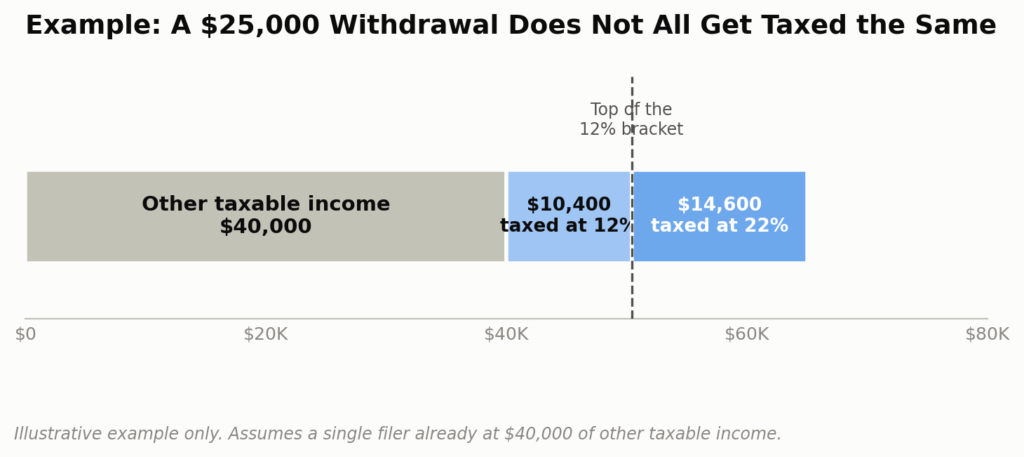
An illustrative example only, using 2026 single filer brackets. Real results depend on your full income picture.
In this example, $10,400 of the withdrawal is taxed at 12% and the remaining $14,600 is taxed at 22%. The blended, or average, rate on the full withdrawal works out to less than 22%, but the part that matters for planning is the marginal rate on the top slice, since that is the rate that applies to your next dollar of income too. Once you can see your own numbers this way, a lot of retirement tax strategy becomes about one simple goal: controlling how much of your income spills into the next, more expensive bucket.
A Wrinkle Retirees Often Miss: How Social Security Gets Taxed
Unlike a paycheck, Social Security has its own separate set of rules, and they catch a lot of retirees by surprise. Up to 85% of your Social Security benefit can be taxable, but whether any of it is taxed depends on something called your provisional income, which is your other taxable income, plus any tax exempt interest, plus half of your Social Security benefit.
For a single filer, if that provisional income is under $25,000, none of your Social Security is taxed. Between $25,000 and $34,000, up to 50% of your benefit can become taxable. Above $34,000, up to 85% can be taxed. For a married couple filing jointly, those thresholds are $32,000 and $44,000. Here is the part that surprises people: these thresholds have not been adjusted for inflation since the 1980s and 1990s, so more retirees fall into the taxable range every year simply because incomes have grown while these particular numbers have not moved at all. A withdrawal that seems modest on its own can quietly pull more of your Social Security into taxable territory at the same time, which is sometimes called the tax torpedo.
Strategies That Actually Lower Your Taxable Income
With the mechanics out of the way, here are the specific tools retirees use to keep more of what they withdraw.
Roth Conversions
A Roth conversion means moving money from a traditional, tax deferred account into a Roth account, paying ordinary income tax on the amount converted now, in exchange for that money growing and eventually coming out completely tax free later. The classic opportunity is a low income year, often the stretch between retiring and when Social Security or Required Minimum Distributions begin, when your other income is unusually low and you have extra room left in a lower bracket. Converting just enough to fill that bracket, without spilling into the next one, is one of the most common and effective forms of retirement tax planning.
Health Savings Accounts
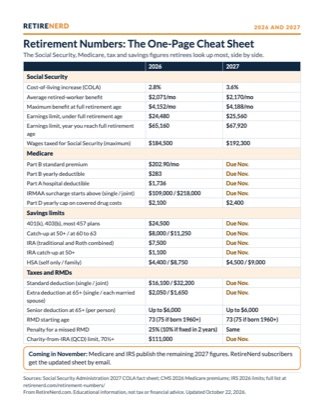
If you contributed to a Health Savings Account during your working years, it is worth knowing it does not stop being useful in retirement. Money goes in tax free, grows tax free, and comes out tax free as long as it is spent on qualified medical expenses, a combination sometimes called a triple tax advantage that no other account offers. For 2026, the contribution limit is $4,400 for self only coverage or $8,750 for family coverage, plus an extra $1,000 if you are 55 or older. After age 65, you can also withdraw HSA funds for any purpose without penalty, though non medical withdrawals are taxed as ordinary income at that point, similar to a traditional IRA.
Qualified Charitable Distributions
If you are 70 and a half or older and already give to charity, a Qualified Charitable Distribution lets you send money directly from your IRA to a qualifying charity, up to $111,000 per person in 2026. The amount never shows up as taxable income at all, and if you are past the age when Required Minimum Distributions apply, it counts toward satisfying that year’s requirement. For anyone who takes the standard deduction rather than itemizing, this is often a meaningfully better outcome than withdrawing the money, paying tax on it, and then donating what is left.
Managing Capital Gains in Taxable Accounts
Long term capital gains have their own separate brackets, and for 2026, a single filer with taxable income under $49,450 pays a 0% rate on long term gains, with that threshold roughly doubling to $98,900 for married couples filing jointly. In a lower income year, this creates a real opportunity to sell appreciated investments in a taxable brokerage account and pay no federal tax at all on the gain, effectively resetting your cost basis higher for free. The same low income years that make Roth conversions attractive often make this worth checking too, though the two strategies compete for the same limited room in your lower brackets, so it is worth deciding which one earns that space each year.
Watching the Medicare Premium Cliff
Medicare premiums are not flat for everyone. Once your income crosses certain thresholds, an income related surcharge called IRMAA kicks in and raises your Medicare Part B and Part D premiums, sometimes substantially. For 2026, that surcharge begins at $109,000 for a single filer and $218,000 for a married couple filing jointly, based on your tax return from two years earlier. Because it is based on a specific dollar threshold rather than a gradual bracket, crossing it by even a single dollar in a given year can trigger a real jump in premiums for the following year, which is one more reason a large, one time withdrawal deserves a second look before you take it. Our IRMAA guide has the full bracket table.
The New, Temporary Senior Deduction
A recent tax law added an extra deduction specifically for retirees age 65 and older, on top of the regular standard deduction. It is worth up to $6,000 for a single filer or $12,000 for a married couple where both spouses qualify, though it begins phasing out above $75,000 of modified adjusted gross income for single filers and $150,000 for married couples filing jointly, and disappears entirely above $175,000 and $250,000, respectively. This deduction is currently scheduled to apply only through the 2028 tax year, so it is worth using deliberately while it is available rather than assuming it is a permanent feature of the tax code.
Putting It Together: A Simple Year by Year Checklist
1. Estimate your total taxable income for the year before deciding how much to withdraw, including any pension and the taxable portion of Social Security.
2. Check how much room is left in your current tax bracket before the next, more expensive one begins.
3. Decide whether that room is better used for a Roth conversion, realizing capital gains at 0%, or simply taking a smaller withdrawal this year.
4. If you are charitably inclined and old enough, consider a Qualified Charitable Distribution before taking a regular withdrawal for the same purpose.
5. Keep an eye on the Medicare IRMAA thresholds, especially in the two years before a big one time withdrawal, sale, or conversion.
6. Revisit the whole plan every year. Your other income, the tax brackets themselves, and the rules around deductions like the senior deduction can all shift, sometimes more than people expect.
None of these strategies work in isolation, and the right combination depends heavily on your own numbers: your account balances, your other income, your age, and your state’s own tax rules on top of the federal ones covered here. But the underlying idea is simple enough to hold onto. A withdrawal is not a fixed cost. It is an amount that lands somewhere specific in your own personal stack of tax brackets, and with a bit of planning, you often get real say in where that landing spot is.