
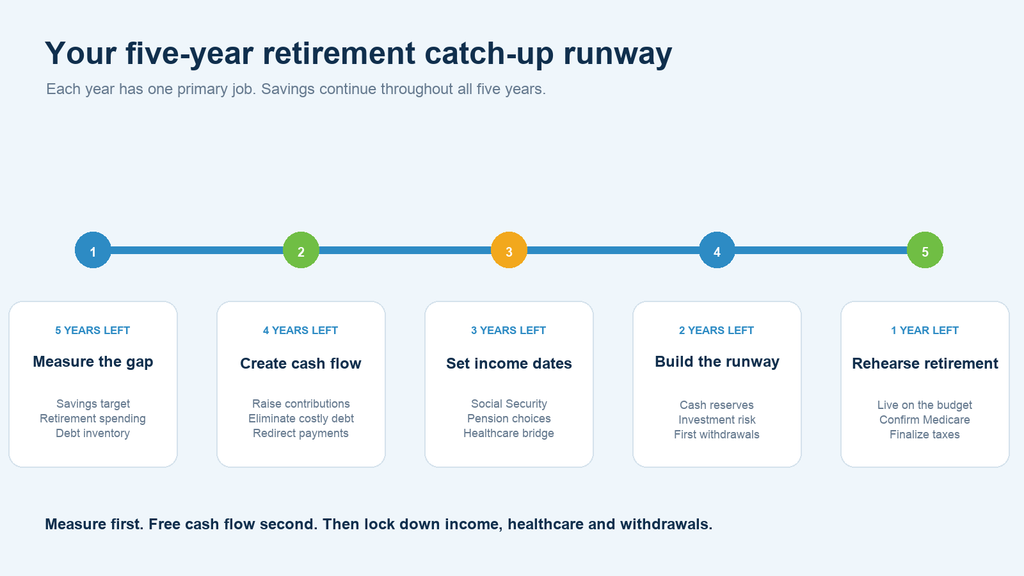
Five years before retirement can feel uncomfortably close. You may look at your savings, compare them with a large target and wonder whether you have already missed your chance. A five-year retirement catch-up plan can still make a real difference.
You have not run out of useful moves.
Five years may be too short for compounding alone to repair every shortfall. It is still enough time to raise contributions, remove expensive debt, improve the retirement date, verify Social Security and pension income, prevent a healthcare surprise, build cash reserves and decide where the first retirement checks will come from.
That combination matters. A stronger retirement is not created by one heroic investment return. It is created by making several parts of the plan work together.
The goal of a five-year catch-up plan is not to reach an arbitrary account balance. It is to reduce the amount your savings must provide while increasing the resources available to provide it.
Use this plan one year at a time. If your hoped-for date does not work after the numbers are tested, you will know why, and which change gives you the most control.
Key takeaways
- Five years is enough to make useful moves: raise contributions, pay down expensive debt, firm up income sources and plan healthcare.
- Start by measuring the gap: retirement spending minus Social Security, pensions and other reliable income.
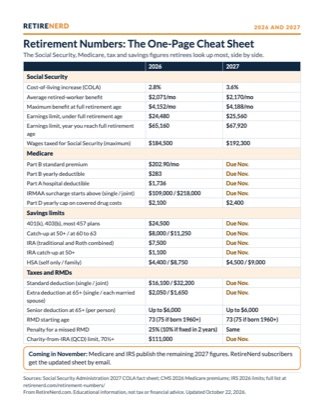
- In 2026, people 50 and older can add an $8,000 catch-up to the $24,500 401(k) limit, or $11,250 if they turn 60 to 63.
- Set a target retirement date, the earliest date the numbers support and a backup date.
Before Year 1: Measure the real gap
Do not begin with “How can I earn more?” Begin with “What must this retirement fund?”
Gather these numbers:
- Every retirement and investment account balance
- Your annual contributions and employer match
- High-interest and required monthly debt payments
- A realistic annual retirement spending estimate
- Social Security estimates at several claiming ages
- Pension amounts, survivor options and start dates
- The cost and timing of health coverage before Medicare
- Large expenses expected during the first five retirement years
Then calculate the annual amount that savings may need to provide:
Retirement spending − Social Security, pension and other reliable income = amount needed from savings
If planned spending is $70,000 and reliable income will eventually be $35,000, savings must provide about $35,000 a year after all income begins. But if Social Security starts several years after retirement, savings may need to provide much more during the bridge years.
This is why a single “retirement number” is not enough. You need an annual cash-flow map with dates.
Year 1: Turn fear into a measured plan
The first year is for diagnosis. Give every important number a source instead of relying on memory or a rule of thumb.
Build a retirement spending estimate
Start with what you spend now. Remove costs that truly end after work and add costs that may rise or become more visible:
- Health insurance, Medicare premiums and out-of-pocket care
- Income taxes on withdrawals and benefits
- Home maintenance and repairs
- Vehicle replacement
- Travel and hobbies
- Help for family members
- Irregular expenses that do not appear in an ordinary month
Separate the total into three groups:
- Essential: housing, food, utilities, insurance, taxes and healthcare.
- Important: spending that makes retirement feel worthwhile but can be adjusted.
- Optional: spending that could pause during a difficult market or expensive year.
The U.S. Department of Labor notes that no income-replacement rule fits everyone. Your expenses, debt, healthcare needs and desired retirement determine what you actually need.
Check whether your current path is close
Project current savings and future contributions through the intended retirement date using more than one return assumption. Use a lower-return case as well as a middle case. Do not make an optimistic return the solution to a savings gap.
Compare the result with a rough portfolio target and then test the plan in more detail. A rough target is only a checkpoint; retirement length, taxes, investment mix, inflation, income timing and poor early returns all affect the outcome.
Set three dates
Write down:
- The date you would like to stop full-time work
- The earliest date the numbers could support
- A backup date if markets, employment or health change
Having a backup date is not admitting defeat. It prevents one difficult year from forcing a rushed decision.
End-of-Year-1 result: a measured gap, a realistic spending range and retirement dates you can test.
Year 2: Create cash flow for the catch-up
The second year is about redirecting money. A five-year plan needs specific monthly actions, not a promise to “save whatever is left.”
Capture the full employer match
If your workplace plan offers a match, confirm the formula and whether your current contribution receives all of it. Also check whether contributions made too early in the year can affect the match and whether the plan offers a year-end true-up.
Use catch-up contribution room carefully
For 2026, the IRS says the basic employee contribution limit for many 401(k), 403(b) and governmental 457 plans is $24,500. Eligible participants age 50 or older may be able to contribute an additional $8,000. A higher $11,250 catch-up applies to eligible participants who turn 60, 61, 62 or 63 during 2026. IRA rules and income limits are separate.
These are legal limits, not personal recommendations. Increase contributions only after checking cash flow, debt costs, emergency savings and plan eligibility.
Attack debt that competes with retirement
List each debt with its balance, interest rate, minimum payment and expected payoff date. High-interest revolving debt often deserves urgent attention because it consumes money that could support retirement and can carry directly into the retirement budget.
For each debt, ask two questions:
- How much interest could be avoided before retirement?
- How much monthly cash flow will disappear when the debt is paid?
Paying off a $600 monthly obligation before retirement does more than improve net worth. It can reduce the annual income the retirement plan must produce by $7,200.
Do not automatically empty retirement accounts to eliminate debt. Withdrawals can create taxes, penalties or lost future growth. Compare the complete cost first.
Redirect every finished payment
When a car, credit card or personal loan is paid off, redirect the old payment automatically. Split it intentionally among retirement contributions, emergency savings and any remaining expensive debt.
End-of-Year-2 result: a higher automatic savings rate, an active debt-payoff schedule and no “freed” payment disappearing into routine spending.
What a contribution increase can change
Consider a worker with $300,000 saved and five years remaining. If savings grow at an assumed 4% a year after inflation and contributions occur at year-end:
| Annual contribution | Approximate value after five years |
|---|---|
| $18,000 | $462,490 |
| $30,000 | $527,486 |
| Difference | $64,996 |
The higher path requires an additional $1,000 a month. It adds $60,000 of contributions over five years; the remainder of the illustrated difference comes from growth on those earlier contributions.
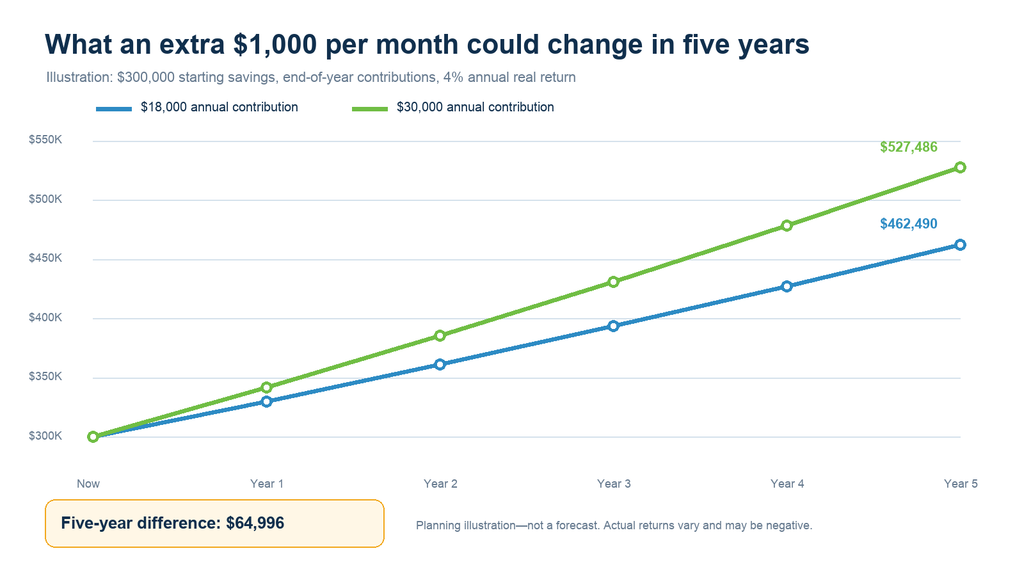
This does not mean everyone should contribute $30,000 or expect 4% real growth. It shows why a concrete increase is more useful than saying “I need to catch up.” Test an amount your budget can sustain.
Year 3: Lock down Social Security, pensions and healthcare
By the third year, replace estimates from articles or calculators with information tied to your own work and coverage history.
Compare Social Security at real claiming ages
Use your personal my Social Security account to compare estimated benefits at 62, full retirement age and 70. The Social Security Administration lets you adjust expected future earnings, which matters when you are still working.
Do not choose a claiming age by monthly benefit alone. Test:
- How you would fund spending while waiting
- Whether you expect to work before full retirement age
- The effect of the higher earner’s choice on a surviving spouse
- Taxes and withdrawals during the waiting years
- Health and longevity considerations
Retirement age and Social Security claiming age can be different. The years between them need funding.
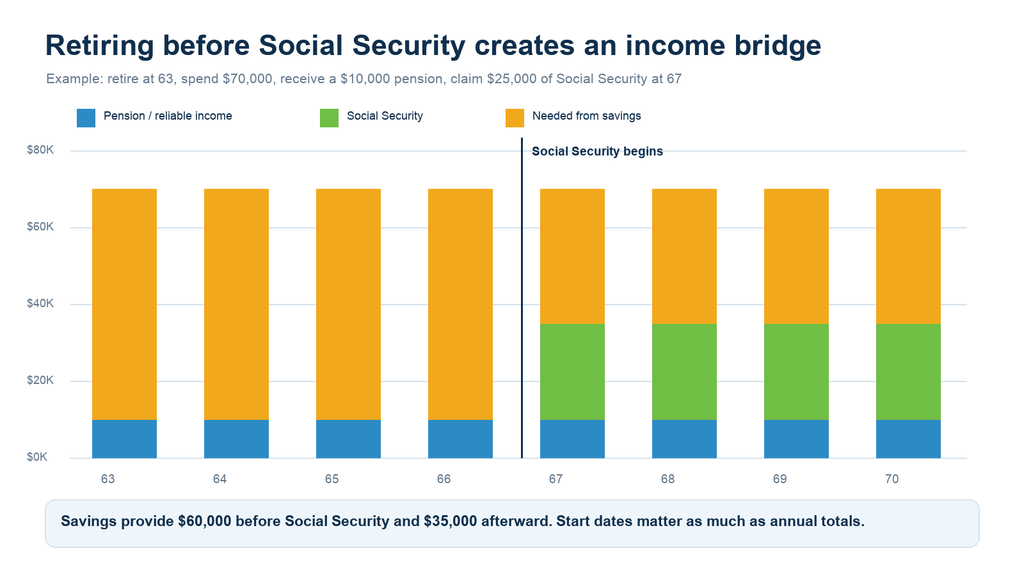
In this illustration, retirement begins at 63 and Social Security begins at 67. Savings must provide $60,000 annually for four years, then $35,000 after Social Security starts. Looking only at the later $35,000 gap would understate the early withdrawals by $100,000 across the bridge.
Get the pension decision in writing
Request estimates for the retirement dates you are considering. Compare single-life and survivor options, inflation adjustments, lump-sum choices and the financial strength or guarantees that apply. Record the exact start date and whether the first payment is delayed.
Map health coverage through Medicare
If retirement could occur before 65, price the entire bridge month by month. Compare employer or spouse coverage, COBRA and Marketplace coverage using premiums, deductibles, likely care and subsidy assumptions.
Medicare’s Initial Enrollment Period generally lasts seven months: the three months before the month you turn 65, your birthday month and the three months after. Working beyond 65 can change the rules. Medicare advises people with job-based coverage to verify when to enroll; after work or coverage ends, an eight-month Part B Special Enrollment Period may apply. COBRA does not extend that Part B window.
If you contribute to an HSA and Medicare enrollment may be retroactive, review the timing before making contributions. Medicare advises some workers to stop HSA contributions six months before retiring or applying for Social Security benefits.
End-of-Year-3 result: documented income choices, exact start dates and a priced healthcare path.
Year 4: Build the retirement runway
The fourth year shifts from accumulation to launch preparation.
Decide how much cash needs protection
Keep emergency reserves separate from money set aside for planned retirement withdrawals. The amount depends on job stability, spending flexibility, reliable income and investment risk.
A practical structure might include:
- An emergency reserve for unplanned expenses
- Cash for known purchases during the first retirement years
- A withdrawal reserve intended to reduce forced selling during a market decline
Cash creates stability, but excessive cash can lose purchasing power and reduce long-term growth. Give every reserve a purpose and a refill rule.
Review investment risk against the withdrawal date
An allocation that felt reasonable while contributing may feel very different when withdrawals begin. Review the percentage in stocks, bonds and cash across every account, not one account at a time.
Ask:
- Would a major decline just before retirement force the date to change?
- Could essential spending continue without selling depressed investments?
- Is the portfolio concentrated in an employer stock, sector or small group of funds?
- Does the investment mix match the spending flexibility in the plan?
Avoid reacting to fear by moving everything to cash. The plan may need to support decades of spending and inflation.
Draft the first 24 months of withdrawals
Write down which source pays each part of spending:
- Paychecks or part-time work
- Pension and Social Security payments actually active at that time
- Cash designated for withdrawals
- Taxable brokerage assets
- Traditional retirement accounts
- Roth accounts
The order is a draft, not a universal prescription. Taxes, tax credits, Medicare premiums, required distributions and investment conditions can change the best sequence.
Identify possible tax-planning years
The years after paychecks stop but before Social Security or required minimum distributions begin may create a lower-income window. Model whether realizing gains or completing partial Roth conversions could help. Roth conversions generally make untaxed converted amounts taxable in the conversion year, so the decision belongs in a multi-year tax plan.
The IRS says traditional IRAs and many workplace retirement accounts generally become subject to required minimum distributions at 73, or at 75 for people born in 1960 or later, under current rules, while an owner’s Roth IRA and designated Roth workplace account generally do not require lifetime distributions. Birth year, account type and employment can affect timing.
End-of-Year-4 result: named reserves, a reviewed investment mix, a first-withdrawal map and a list of tax decisions to model.
Year 5: Rehearse the retirement before submitting notice
The final year is for testing whether the plan works in ordinary life.
Live on the retirement spending plan
For several months, route the difference between current take-home pay and the planned retirement budget into savings. This tests whether the budget is realistic while increasing reserves.
Track what breaks the plan. Home repairs, family help, annual insurance premiums and travel often reveal more than ordinary monthly bills.
Confirm every administrative deadline
Create a calendar for:
- Employer notice and final work date
- Health coverage termination
- Medicare applications and supplemental coverage decisions
- Social Security and pension applications
- HSA contribution cutoff
- Retirement-plan rollover or distribution decisions
- Estimated tax payments
- Beneficiary and estate-document reviews
Do not assume benefits begin automatically or on the date you leave work.
Run three retirement scenarios
Test at least:
- Expected case: your current spending, income and investment assumptions.
- Difficult start: poor early investment returns plus a large expense.
- Flexible response: the difficult start with planned spending reductions or temporary income.
A plan does not need to look perfect in every simulation. It needs a response when conditions are worse than expected.
Set a go, adjust or wait decision
Use three clear outcomes:
- Go: essential spending, healthcare and the first withdrawals are funded under reasonable assumptions.
- Adjust: retirement can proceed with a specific change, such as lower optional spending, part-time work or a different claiming date.
- Wait: the gap still threatens essential spending or healthcare, and another working period materially improves the plan.
“Wait” should include a date and a measurable target. Replace “maybe one more year” with “work until next June, contribute $2,000 monthly, eliminate the car payment and add $15,000 to reserves.”
End-of-Year-5 result: a rehearsed budget, completed enrollment calendar, tested scenarios and a decision supported by numbers.
If five years still does not close the gap
A remaining shortfall is information, not a personal verdict. Saving more is only one lever.
Compare these changes one at a time:
- Retire six, twelve or twenty-four months later
- Reduce a specific flexible expense
- Eliminate a debt payment before retirement
- Add temporary or part-time income
- Change the Social Security claiming date
- Downsize or relocate only after comparing total housing costs
- Separate an essential-spending floor from the preferred budget
- Reduce investment fees or unnecessary tax costs
Avoid solving the gap by assuming unusually high returns, ignoring healthcare, counting home equity you do not plan to use or treating future Social Security as though it begins on retirement day.
If no reasonable combination funds essential spending, the plan needs a larger change or professional review. Finding that out with five years remaining is far better than discovering it after the last paycheck.
Your five-year catch-up dashboard
Review this dashboard every three months:
| Measure | Starting point | Current | Retirement target |
|---|---|---|---|
| Retirement savings | $_____ | $_____ | $_____ |
| Annual contributions plus match | $_____ | $_____ | $_____ |
| High-interest debt | $_____ | $_____ | $0 or planned balance |
| Required monthly debt payments | $_____ | $_____ | $_____ |
| Emergency reserve | _____ months | _____ months | _____ months |
| First-withdrawal reserve | $_____ | $_____ | $_____ |
| Essential annual retirement spending | $_____ | $_____ | $_____ |
| Reliable income active at retirement | $_____ | $_____ | $_____ |
| Annual amount needed from savings | $_____ | $_____ | $_____ |
Progress may show up in several places. A smaller debt payment, a later benefit start with a funded bridge, or a more realistic spending estimate can strengthen the plan even before the investment balance changes dramatically.
The five-year checklist
- [ ] Calculate retirement spending and the annual amount savings must provide
- [ ] Project savings under lower and middle return assumptions
- [ ] Increase automatic contributions by a specific amount
- [ ] Capture the complete employer match
- [ ] Create payoff dates for expensive debt
- [ ] Redirect finished debt payments automatically
- [ ] Download personalized Social Security estimates
- [ ] Request pension choices and start dates in writing
- [ ] Price healthcare through Medicare eligibility
- [ ] Review HSA and Medicare enrollment timing
- [ ] Name emergency, purchase and withdrawal reserves
- [ ] Review the total investment allocation
- [ ] Map the first 24 months of retirement income and withdrawals
- [ ] Identify possible tax-planning years
- [ ] Rehearse the retirement budget
- [ ] Run expected, difficult and flexible-response scenarios
- [ ] Set a specific go, adjust or wait decision date
Start with the next action, not the entire five years
Fear makes every retirement question feel urgent at once. The plan becomes manageable when the next action is small and dated.
This week, gather the account balances, annual contributions, debt payments, retirement spending estimate and personalized Social Security amounts. Then use the RetireNerd Retirement Savings Checkpoint to measure the current path.
Next, use the RetireNerd Retirement Planner & Modeler to test savings, investments, retirement dates, Social Security, spending, withdrawals, taxes, healthcare and difficult markets together.
You do not need to solve retirement today. You need to make the next decision clearer than it was yesterday, and repeat that process for five years.
Sources
- IRS: Retirement topics—catch-up contributions
- IRS: Required minimum distributions
- Social Security Administration: Get a benefits estimate
- Medicare: When does Medicare coverage start?
- Medicare: Working past 65
- U.S. Department of Labor: Savings Fitness
- Investor.gov: Compound Interest Calculator
RetireNerd provides educational information and planning illustrations. This article does not provide individualized financial, investment, tax, legal, Social Security or healthcare advice. Rules, limits and personal circumstances can change; verify current requirements with the relevant agency or a qualified professional before acting.