Which Account Should You Tap First in Retirement?
If you’ve diligently saved for retirement, there’s a good chance your money isn’t in a single place. You might have a regular brokerage or savings account here, a 401(k) or traditional IRA there, and perhaps a Roth account as well. Once you retire, no one hands you an instruction manual on which account to withdraw from first. Your retirement withdrawal order can quietly impact how much you retain after taxes and how long your savings last.
This isn’t a topic with one universally correct answer. But it is a topic with a way of thinking about it that will serve you far better than picking an account at random, or draining whichever one feels easiest to log into.
Key takeaways
- The order you draw from taxable, tax-deferred and Roth accounts affects your lifetime tax bill, not just one year's.
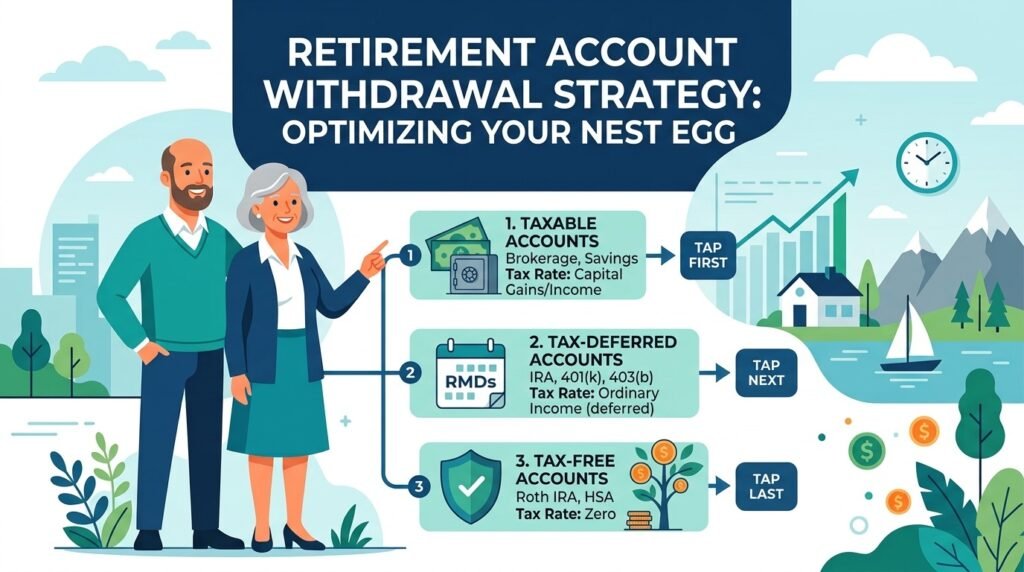
- A common default is taxable accounts first, then tax-deferred, with Roth last.
- Draining one account type at a time can let tax-deferred balances grow until required withdrawals push you into a higher bracket.
- Blending withdrawals to fill your current bracket, sometimes with partial Roth conversions, can lower taxes over time.
Why the Order Even Matters
Every retirement account you own falls into one of three tax categories, and each one behaves differently once you start pulling money out.
- Taxable accounts, such as regular brokerage or savings accounts, are funded with after-tax money. Therefore, you only pay taxes on the investment growth when you sell it, and often at a reduced rate compared to ordinary income.
- Tax-deferred accounts, such as traditional 401(k)s or IRAs, allow you to defer paying taxes on the contributions you make. However, when you withdraw the funds, the entire amount is taxed as ordinary income.
- Tax-free accounts, such as Roth 401(k)s or Roth IRAs, are funded with after-tax money. In most cases, you won’t owe taxes on that money, including any growth it generates.
Since each bucket is taxed at a different time and in a different manner, the order in which you draw from them affects your total tax bill throughout retirement, not just in a single year.
The Common Starting Point
Most financial planners begin with a straightforward approach: prioritize spending on taxable accounts, followed by tax-deferred accounts, and save tax-free (Roth) accounts for last. The rationale behind this strategy is simple: the longer money remains in a tax-deferred or tax-free account, the longer it accumulates growth without the burden of taxes. Roth accounts are saved for last because they benefit the most from additional years of untouched growth, and there’s no legal requirement to withdraw from them on a specific schedule.
As a starting point, this is a reasonable default. As a rule you follow mechanically for twenty or thirty years of retirement without ever revisiting it, it can quietly work against you.
Where the Simple Version Breaks Down
Here’s the issue with draining one bucket completely before moving on to the next: tax-deferred accounts eventually necessitate required withdrawals, regardless of whether you need the money that year. If you’ve spent a decade solely relying on a taxable account while your tax-deferred account continues to compound without interruption, that account can grow significantly large. Consequently, the required withdrawals alone could push you into a higher tax bracket than you had anticipated, potentially leading to additional costs associated with your income, beyond just your tax liability.
In other words, strictly sequencing your withdrawals by fully draining one account type before moving on to the next can trade a small, manageable tax bill every year for a much larger, less avoidable one later. The account balances end up dictating your tax situation, instead of the other way around.
A Better Way to Think About It: Blend, Don’t Sequence
Instead of treating this as “which account first,” it’s often more useful to ask a different question each year: which tax bracket am I in right now, and is there room in it?
Many retirees discover that after covering their essential expenses, there’s still room in their current tax bracket before the next one takes effect. By withdrawing from a tax-deferred account, even if you don’t urgently need the funds that year, you’re effectively moving money out of an account that will become increasingly expensive to access later. This move allows you to take advantage of a tax rate that suits your current financial situation.
Some retirees take this a step further with partial Roth conversions: deliberately moving a slice of a tax-deferred account into a Roth account each year, paying the tax now while you control the rate, so that money grows tax-free from that point on. It’s not the right move for every year or every person, but it’s a tool worth knowing exists, especially in the years after you retire but before other income sources like Social Security begin.
Other Things That Can Shift the Order
A few other factors commonly change the “right” order for a given year:
- Social Security timing. Many retirees deliberately spend down other accounts first specifically so they can delay claiming Social Security, since a larger monthly benefit later is one of the few guaranteed ways to increase lifetime income.
- Healthcare and Medicare costs can be significant. In the years leading up to Medicare eligibility, keeping taxable income low can help manage health insurance expenses. However, after Medicare begins, unusually high income in a given year can lead to increased premiums a few years later. Regardless, income level, not just tax bracket, should be closely monitored.
- What you plan to leave behind. If leaving money to heirs matters to you, Roth accounts are often the most valuable thing to leave, since your heirs generally won’t owe income tax on it either. That’s sometimes a reason to preserve a Roth account longer than the “spend last” default would suggest.
- Keeping some cash on hand. Regardless of the broader strategy, it usually helps to keep a taxable or cash cushion available, so a market downturn doesn’t force you to sell investments at a bad time just to cover expenses.
This Is a Good Problem to Have — and a Good One to Get Help With
Needing to think carefully about withdrawal order means you did the hard part already: you saved, and you saved in more than one type of account. That alone puts you ahead of a purely default approach.
Where it’s beneficial to seek professional help is in transforming this general reasoning into a comprehensive year-by-year plan tailored to your actual account balances, other sources of income, and the tax regulations of your state. A financial planner or tax professional possesses the expertise to perform the necessary calculations that a general article cannot, and even minor adjustments made in this plan can accumulate significantly over the course of a potentially decades-long retirement.
There’s rarely one “wrong” order to start with. The mistake to avoid is picking an order once and never looking at it again. Revisiting the plan each year, with your actual numbers in front of you, is what actually protects the money you worked to save.