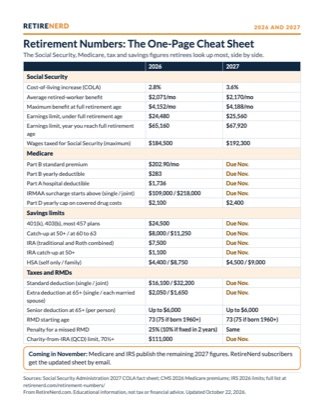

Trying to estimate retirement spending is difficult because retirement is not simply your current life without a paycheck.
Some costs may fall. Commuting, payroll deductions and retirement contributions can change or disappear. Other costs can rise or become easier to overlook: health coverage, travel, help for family, home repairs, taxes on withdrawals and replacing a car after the paychecks stop.
A useful estimate should answer four questions:
- What will an ordinary month cost?
- Which expenses are essential and which are flexible?
- Which large bills will arrive only once or twice a year?
- How much of the total will reliable income cover, and how much may need to come from savings?
You do not need a perfect number on the first try. You need a complete first draft that you can test and improve.
Key takeaways
- Start with reliable income such as Social Security and pensions, then see how much your savings must cover.
- Build an essential spending floor first: housing, food, transportation, insurance and required debt payments.
- Give healthcare and taxes their own lines, since neither disappears when the paycheck stops.
- Use today's dollars or future dollars, and use the same basis for both spending and income.
Step 1: Decide which dollars you are using
Choose one basis for the whole estimate:
- Today’s dollars describe what goods and services cost now. This is usually easiest when retirement is several years away.
- Future dollars include estimated inflation through the retirement date.
Do not enter today’s expenses beside future inflated Social Security or portfolio values without adjusting them to the same basis. That can make the plan appear stronger or weaker than it is.
The RetireNerd Spending Planner uses the amounts you enter as one consistent snapshot. If you enter today’s spending, use today’s estimates for income too. A full retirement model can then apply inflation over time.
Step 2: Enter reliable retirement income
Start with income you expect to arrive without selling investments:
- Your Social Security benefit
- A spouse’s Social Security benefit
- Pensions
- Annuity income
- Net rental income
- Part-time work or business income you realistically expect
- Other dependable recurring income
Use monthly amounts and pay attention to start dates. If you retire at 63 and Social Security begins at 67, those benefits do not fund the first four years. The early-retirement gap needs a separate plan.
Do not count planned IRA or 401(k) withdrawals as reliable income in this step. The point of the calculation is to discover how much the portfolio may need to provide.
Step 3: Build the essential spending floor
Essential spending is the part of the budget that is difficult to cut quickly. It is the minimum cost of keeping your household, health and obligations functioning.
Housing and utilities
Include:
- Mortgage or rent
- Property taxes
- Homeowners or renters insurance
- HOA or condominium fees
- Electricity, water, heating and trash
- Phone and internet
- Routine maintenance
Paying off a mortgage does not make housing free. Property tax, insurance, utilities and maintenance remain. If you expect to move or downsize, build one estimate for staying and another for moving. Do not reduce the housing number until the plan to reduce it is concrete.
Everyday living
Include groceries, household supplies, basic clothing and personal care. Review recent statements instead of relying on memory. Small recurring purchases can be easy to miss and meaningful over a full year.
Transportation
Include car payments, insurance, fuel, registration, maintenance, parking and public transit. Even if you expect to drive less, a vehicle eventually needs repairs or replacement.
Debt payments
Include credit cards, personal loans, student loans and any other required payment that will continue after retirement. Then make a second version of the budget showing what changes if the debt is paid before retirement. The annual payment reduction is the direct value of that payoff to the retirement plan.
Step 4: Estimate healthcare as its own budget
Healthcare deserves more than one line labeled “medical.” Separate:
- Insurance or Medicare premiums
- Prescription drugs
- Copays, coinsurance and deductibles
- Dental care
- Vision care and glasses
- Hearing care and hearing aids
- Services or equipment not fully covered
- Long-term care insurance, if applicable
Medicare costs depend on the coverage chosen, services used, providers and income. Original Medicare does not have one universal annual out-of-pocket limit unless other coverage supplies that protection. Medicare Advantage and drug-plan premiums, deductibles, networks and cost sharing vary by plan. Use actual plan options available where you expect to live rather than one national guess.
If you retire before Medicare eligibility, price the bridge coverage separately. Employer retiree coverage, COBRA and Marketplace coverage can have very different premiums and out-of-pocket exposure.
Step 5: Put taxes into the spending plan
Taxes do not necessarily disappear when work ends. Traditional retirement-plan distributions and pensions may be taxable, and part of Social Security may be taxable depending on other income and filing status. Qualified Roth distributions can receive different treatment. State rules also vary.
For a first estimate, add a separate annual tax provision. Then improve it by estimating withdrawals by account type. A $50,000 withdrawal from a traditional IRA does not create the same tax result as $50,000 from qualified Roth distributions or taxable-account principal.
Avoid subtracting an old payroll withholding percentage from retirement income. Payroll withholding may have included taxes that change after work, while retirement withdrawals can create taxes that were not visible in your paycheck.
Step 6: Add the retirement you want to live
A budget made only of required bills is not a retirement plan. Add the spending that gives retirement its purpose:
- Travel and visits with family
- Hobbies, clubs and classes
- Dining and entertainment
- Gifts and charitable giving
- Help for children, grandchildren or parents
- Home projects you have postponed
Mark these expenses flexible, but do not pretend they are zero. A plan that works only after removing everything you value is telling you something useful: the desired retirement and the current resources do not yet match.
Flexible spending can still help manage risk. You might plan a normal travel budget and a difficult-market budget that temporarily reduces it. That creates a decision rule instead of an emergency reaction.
Step 7: Convert irregular costs into monthly averages
Many retirement budgets fail because they include the electric bill but forget the roof.
List costs that do not arrive every month:
- Home repairs and major maintenance
- Vehicle replacement
- Dental, vision and hearing expenses
- Insurance paid annually or semiannually
- Travel
- Gifts and holidays
- Technology and appliance replacement
- Family support
- Pet care
- Professional fees and tax preparation
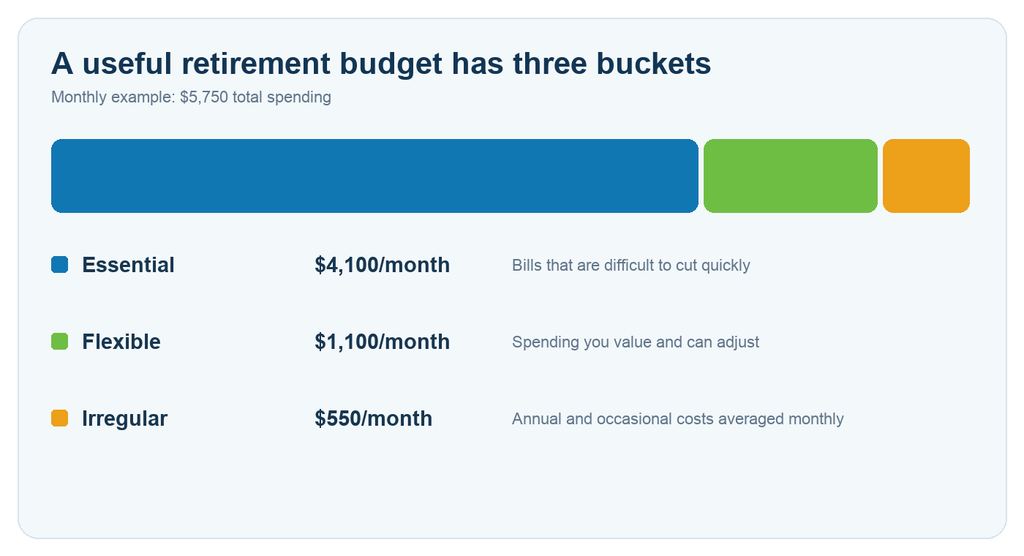
Estimate a yearly amount and divide by 12. A $6,000 annual travel plan is $500 a month. A $12,000 roof or major-home reserve spread over 10 years is $100 a month. The money does not have to leave the account monthly; the monthly average keeps the future bill visible.
Step 8: Compare spending with reliable income
Now calculate:
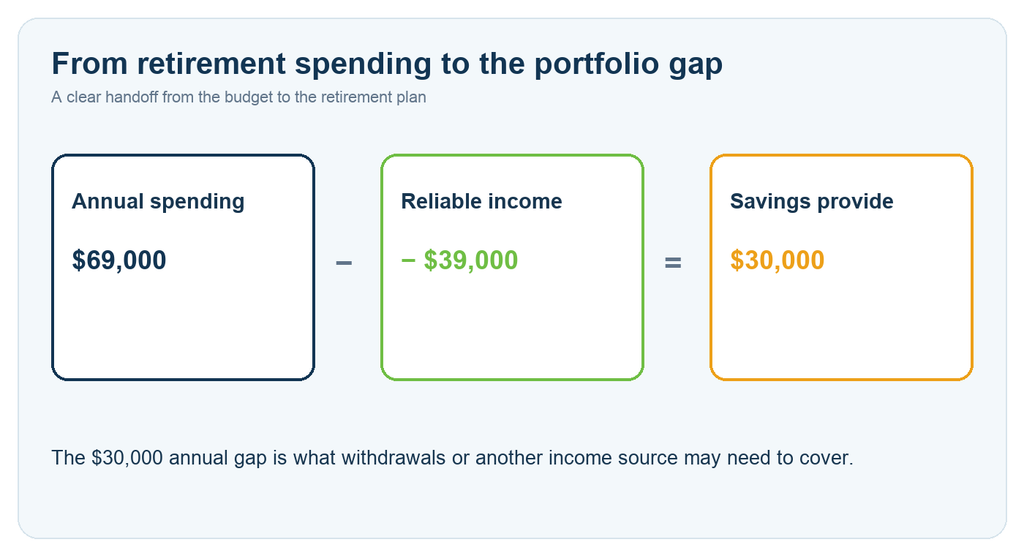
Annual retirement spending − annual reliable income = annual amount savings need to provide
Consider this example:
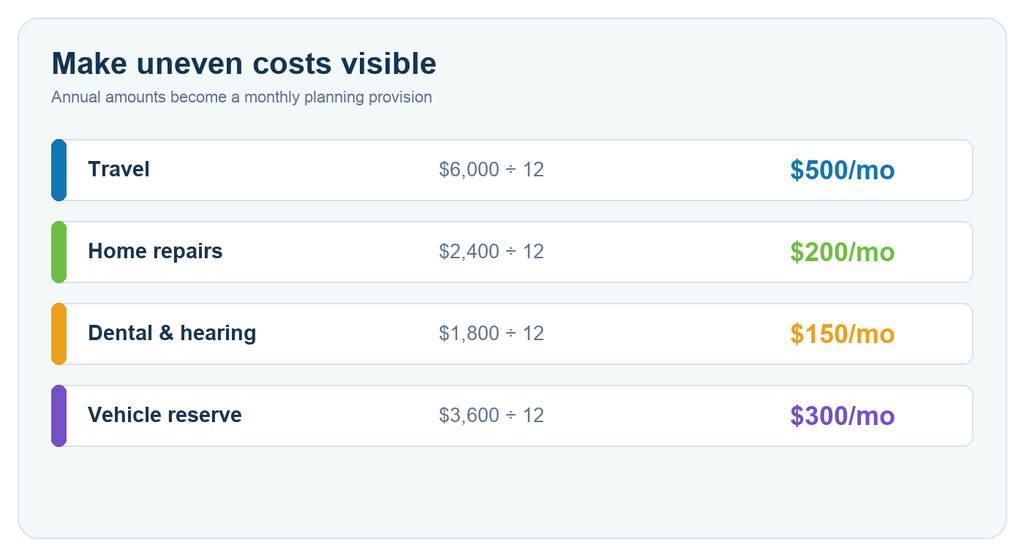
| Retirement spending | Monthly | Annual |
|---|---|---|
| Essential expenses | $4,100 | $49,200 |
| Flexible lifestyle | $1,100 | $13,200 |
| Irregular costs | $550 | $6,600 |
| Total spending | $5,750 | $69,000 |
Reliable Social Security and pension income total $3,250 a month, or $39,000 a year.
$69,000 spending − $39,000 reliable income = $30,000 annual portfolio spending gap
That $30,000 is the first useful handoff to the retirement plan. It tells you what investments or another income source may need to provide in the first retirement year.
Step 9: Understand the rough portfolio checkpoint
The Spending Planner turns the annual gap into a simplified portfolio checkpoint:
Annual amount needed from savings ÷ starting withdrawal rate = rough portfolio checkpoint
Using the $30,000 gap and a 4% starting withdrawal-rate assumption:
$30,000 ÷ 4% = $750,000
This means a $750,000 portfolio multiplied by 4% produces a $30,000 first-year withdrawal. It does not guarantee that the money will last. It does not account for the order of market returns, taxes, inflation, fees, longevity, healthcare changes or large future purchases.
Use the checkpoint to understand the relationship between spending and savings. Every permanent $1,000 reduction in the annual portfolio gap reduces a 4% checkpoint by $25,000. Every new $1,000 of annual reliable income has the same simplified effect.
Then use a full retirement model to test whether withdrawals remain workable across time and difficult markets.
Step 10: Build three versions of retirement
One budget hides the choices available to you. Build three:
Essential plan
What must be paid if markets are difficult? Keep housing, food, healthcare, taxes, insurance, essential transportation and required debt. Include a realistic share of repairs and irregular costs.
Expected plan
This is the retirement you expect to live in ordinary years. Add normal travel, hobbies, dining, gifts and other valued spending.
Higher-spending plan
Add the years when travel, projects or family help may be greater. Early retirement often includes more active spending, while later years can bring higher healthcare or support costs. Spending rarely stays perfectly flat.
The difference between the essential and expected plans is your flexibility. That matters because a household with $12,000 of adjustable annual spending has more options after a market decline than a household whose entire budget is fixed.
Where can you improve the plan?
The best improvement is not always the largest cut. Look for changes that reduce uncertainty or permanently lower the amount the portfolio must provide.
Verify the largest categories first
If housing is half the budget, refining a streaming-service estimate will not change the conclusion. Use real insurance quotes, property-tax bills, loan statements and healthcare options for the largest categories.
Separate a debt payoff from an investment decision
Paying off a required $600 monthly debt before retirement reduces annual spending by $7,200. At a 4% withdrawal-rate checkpoint, that is equivalent to reducing the rough portfolio need by $180,000. Taxes, liquidity and payoff costs still matter, but the budget effect should be visible.
Create reserves for known unknowns
A roof is not an emergency if you know it eventually wears out. Vehicle replacement, major home work and annual travel can have designated reserves. Keep a separate emergency reserve for events you cannot reasonably schedule.
Test housing decisions honestly
Downsizing can reduce expenses, release equity or both, but transaction costs, moving costs, HOA fees, taxes and the price of the next home matter. Compare the full before-and-after budget.
Improve income timing
The annual average can hide a temporary gap. Map when Social Security, pensions and annuity payments actually begin. If reliable income starts later, decide which account funds the bridge.
Protect meaningful flexible spending
Do not cut every pleasure from the base case. Identify which spending you most want to protect, then rank what could be reduced temporarily. That turns flexibility into guidance.
A retirement spending checklist
- Use one dollar basis throughout the estimate
- Enter Social Security and pension amounts with correct start dates
- Include housing costs that remain after the mortgage
- Price health coverage before and after Medicare
- Add premiums, deductibles, copays and uncovered care
- Include a separate tax provision
- Add travel, hobbies and family spending you actually want
- Convert annual and irregular costs into monthly averages
- Separate essential, flexible and irregular spending
- Calculate the amount reliable income will not cover
- Build essential, expected and higher-spending versions
- Test the result in a full retirement model
Build your retirement spending picture
Use the RetireNerd Retirement Spending Planner to enter income and expenses step by step. The dashboard shows your monthly and annual spending, reliable-income coverage, the amount savings may need to provide, a rough portfolio checkpoint and the categories that deserve another look.
When the spending estimate is complete, take it to the RetireNerd Retirement Planner & Modeler to test investments, taxes, inflation and difficult market scenarios.
Sources
- U.S. Department of Labor: Taking the Mystery Out of Retirement Planning
- Medicare.gov: Medicare costs
- Medicare.gov: Understanding health plan costs
- IRS: Tax on normal retirement-plan distributions
- IRS: Seniors and retirees
RetireNerd provides educational information and simplified planning tools. This article does not provide individualized financial, investment, tax, medical or legal advice. Review estimates and decisions in light of your circumstances.