Ask someone why they want to retire in another country and the first answer is almost always about money: a pension that stretches further, healthcare that costs less, a lower price tag on everyday life. All of that is true and worth planning around carefully. But talk to people who have actually made the move, and a different story usually comes out first. It is about finally living somewhere they fell in love with on a single trip decades ago. Learning a language they always meant to learn. Waking up somewhere warm, or coastal, or slower, or simply new, after a lifetime of the same commute and the same four seasons. Retirement is one of the few times in life when a long held dream and a practical opportunity line up at the same time, and the countries with retirement visas offer the legal doorway that makes it possible.
This guide walks through how retirement visas actually work, which countries make the process reasonably approachable, which ones are in such high demand that getting in has become genuinely hard, what the real numbers say about how many people make this move, and what the people who regret it wish they had known first.
Key takeaways
- Most retirement visas ask for some mix of minimum monthly income, a deposit or investment, and proof of health insurance.
- Requirements vary widely: Panama's Pensionado visa asks for $1,000 a month in pension income, while Mexico's bar is about $4,400 a month.
- People who move back most often cite homesickness, not the visa process.
- Live in a place for a few months, through more than one season, before you apply.
Why People Really Choose to Retire Abroad
Interest in retiring overseas has grown enormously. A 2025 Harris Poll found that 44% of U.S. adults say they have seriously considered relocating abroad, with 14% actively planning a move within the next two years. For comparison, back in 1974 only about 4% of Americans over 55 said they would even consider resettling outside the country. Something has clearly shifted, and it is not only about tight budgets.
For a lot of people, the appeal is a genuine second act. After thirty or forty years of building a career and raising a family, retirement is a rare, real chance to reinvent daily life on your own terms. Some people are chasing a place they visited once and never stopped thinking about. Others want mountains, or ocean, or a walkable town where they do not need a car. Some want to be closer to family who already moved abroad. Some simply want proof, to themselves as much as anyone else, that this new chapter is genuinely theirs to shape.
None of that makes the financial angle any less real. It just means the decision usually works best when both halves are honest: what you are hoping to feel and experience, and what the numbers actually allow. A retirement visa sits at the intersection of both.
What a Retirement Visa Actually Is
A retirement visa, sometimes called a pensionado visa or a retiree residency permit, is simply a country’s legal path for letting foreign retirees live there long term, usually in exchange for proof that you can support yourself without needing to work locally or draw on that country’s social safety net. Almost every program asks for some combination of the same three things: a minimum monthly income or pension, a lump sum held in a local account or investment, and proof of health insurance. Age minimums vary widely. Some countries do not set one at all, while others require you to be 50, 55, or even 66 before you qualify.
Getting the visa is rarely the finish line, either. Most countries require it to be renewed annually or every few years, and a handful convert into permanent residency only after a set number of years living there. It is worth treating a retirement visa as the beginning of an ongoing relationship with a country’s immigration system, not a one time application.
Countries That Make the Process Reasonably Approachable
Panama
What it takes: A pension of at least $1,000 a month qualifies you for Panama’s well known Pensionado visa. There is no age minimum, the visa does not expire once granted, and it comes bundled with real discounts on flights, healthcare, entertainment, and more.
Portugal
What it takes: The D7 visa asks for passive income of roughly $830 a month, one of the lower bars among Western European countries. It is renewable, takes two to four months to process, and allows remote or freelance work on top of the passive income you are relying on.
Costa Rica
What it takes: The Pensionado route needs $1,000 a month in pension income, while the Rentista route needs about $2,500 a month from other sources or a $60,000 deposit. Either way, enrollment in the public CAJA healthcare system is required, which for many retirees ends up being one of the program’s biggest practical benefits.
Mexico
What it takes: Mexico’s temporary resident visa is the fastest to obtain on this list, often approved in two to four weeks, though the income bar is higher at roughly $4,400 a month or about $74,700 in savings. After four years of temporary residency, permanent status becomes available.
Thailand
What it takes: The Non Immigrant O-A visa is built for retirees 50 and older, requiring about $1,800 a month in income or an $22,000 deposit in a Thai bank account, plus proof of health insurance. It renews annually rather than offering a longer initial grant.
Malaysia
What it takes: The Malaysia My Second Home program runs on fixed deposits rather than income, starting around $150,000 for the entry tier and rising to $500,000 or $1 million for longer, more flexible tiers. In exchange, foreign source income is not taxed, which can matter a great deal depending on where your retirement income comes from.
The Philippines
What it takes: The Special Resident Retiree’s Visa asks for a deposit of $15,000 to $50,000 depending on your age and pension status, and it is open to applicants 50 and older. Once approved, it does not expire.
The Other Side: Countries in High Demand and Hard to Enter
Not every country wants, or needs, to make this easy. Some of the most desirable destinations have deliberately built retirement and residency programs that are slow, expensive, or highly discretionary, precisely because so many people want in.
New Zealand
What it takes: New Zealand’s retirement visa options are genuinely demanding. The Temporary Retirement Visitor visa requires NZ$750,000 invested locally plus another NZ$500,000 in maintenance funds and NZ$60,000 in annual income, and it never converts to permanent residency. The Parent Retirement Resident visa asks for NZ$1 million invested for four years, plus the same income and maintenance requirements, and also requires an adult child who is already a New Zealand citizen or resident.
Switzerland
What it takes: Switzerland does not publish one universal financial threshold. Instead, each canton decides case by case whether your resources comfortably exceed what a Swiss citizen in the same situation would need to avoid needing public assistance, factoring in local housing and health insurance costs. Non EU or EFTA applicants must be at least 55 and typically need to show a meaningful personal connection to the specific canton they are applying to. The result is a process that is genuinely selective rather than formula driven.
A Broader Trend: Doors That Are Closing
High demand has also been reshaping some of Europe’s most popular investment based residency programs. Spain officially ended its golden visa program in April of 2025, citing housing pressure in cities like Madrid and Barcelona as the reason. Portugal eliminated the real estate route to its own golden visa back in October of 2023, once the single most popular path into the country, and now channels investors toward regulated funds or cultural donations instead. Hungary closed its direct real estate purchase option in January of 2025. None of these changes eliminated retirement visas outright, but they are a clear sign that as interest in relocating grows, some governments are tightening the door rather than widening it.
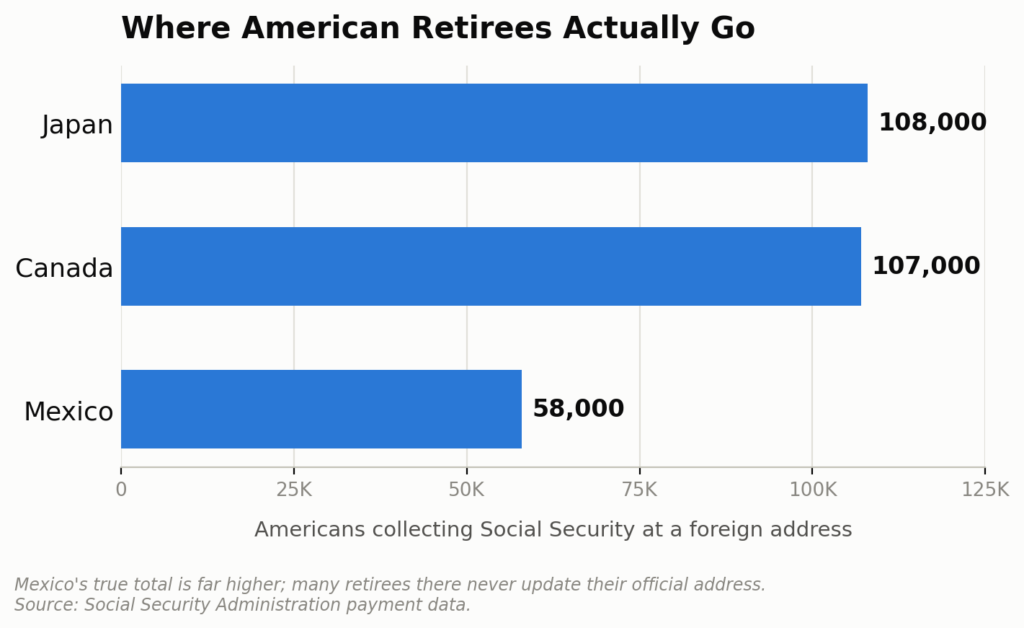
Social Security Administration payment data, foreign addresses on file.
By the Numbers: How Many People Actually Make the Move
It can feel like everyone is talking about retiring abroad, but the reality is more modest than the conversation suggests. Roughly 712,000 Americans currently receive Social Security benefits at a foreign address, which is barely 1% of all Social Security beneficiaries nationwide. Experts believe the real number living abroad is somewhat higher, since updating an official address abroad can complicate taxes and other paperwork, so plenty of retirees simply do not report the change.
Mexico is the clearest example of that gap. An estimated 1.6 million U.S. citizens live there, yet only about 58,000 collect Social Security at a Mexican address. Among retirees who do report a foreign address, Japan and Canada each host just over 100,000 beneficiaries, and Europe as a whole accounts for roughly 38% of all overseas recipients. The takeaway is not that retiring abroad is rare exactly, it is that a great many more people seriously consider it than actually go through with it, and fewer still make it fully official on paper.
The Pitfalls: What Regret Actually Looks Like
A large analysis of expat experiences, drawing on nearly 2,900 personal accounts and more than 7,000 specific reasons people gave for eventually moving back home, found a clear pattern. It was not, in most cases, about the visa process itself.
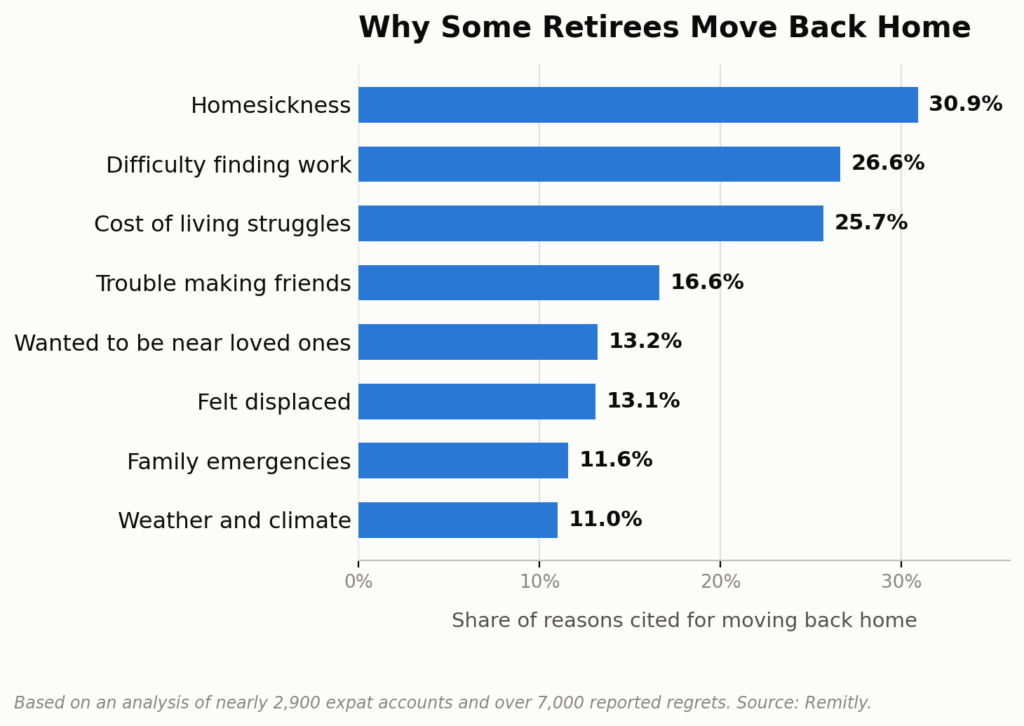
Homesickness topped the list at 30.9%, ahead of practical struggles like difficulty finding work (26.6%) and cost of living surprises (25.7%), where the destination turned out to be more expensive in practice than it looked from a distance. Trouble making close friends came in at 16.6%, and a meaningful share of people, 13.2%, simply missed being near family and long time friends more than they expected to. Smaller but still real shares cited feeling permanently like an outsider, family emergencies that pulled them back, and climate or weather that wore on them over time.
None of this means retiring abroad tends to go badly. It means the reasons it sometimes does are rarely about paperwork, and almost always about the parts of a big move that are genuinely hard to test in advance: whether a place still feels right after the novelty fades, whether you can build a real social circle from scratch later in life, and whether being far from family is something you can live with once it stops being hypothetical.
Making the Dream Sustainable, Not Just Appealing
None of this is a reason to talk yourself out of a long held dream. It is a reason to test it before you commit fully to it. Spend an extended stretch of time, ideally a few months and through more than one season, actually living in a place before applying for a visa there. Get real quotes on health insurance and understand exactly what it does and does not cover. Talk to other retirees who already made the move, not just the ones featured in glossy articles, but people who will tell you honestly what surprised them. Keep a financial cushion and a plan B in case the first year does not feel the way you imagined.
The people who end up genuinely happy with this decision tend to be the ones who let both halves of the motivation do their job: the dream that gets them looking seriously at a country in the first place, and the clear eyed planning that makes staying there sustainable once the excitement of the move itself has worn off.