Updated for 2026
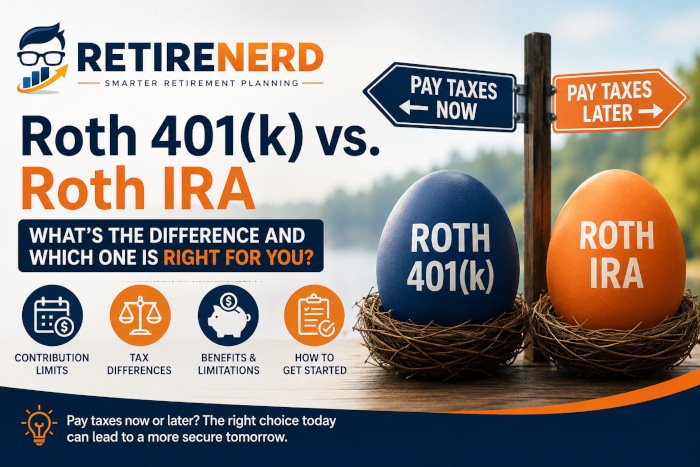
Roth 401(k) vs. Roth IRA: What’s the Difference and Which One Might Be Right for You?
If you’re getting closer to retirement, you’ve probably heard the word Roth more than once: Roth IRA, Roth 401(k), traditional IRA, regular 401(k). It can start to sound like financial alphabet soup.
Fortunately, the basic idea behind a Roth account is actually pretty simple. You pay taxes on the money now so that, if you follow the rules, qualified withdrawals can be tax-free later.
That’s very different from the way a traditional 401(k) or deductible traditional IRA generally works. With those accounts, you may receive a tax benefit today, but you’ll generally owe income tax when you withdraw taxable money in retirement.
Neither approach is automatically better. A big part of the decision comes down to a simple question: Would you rather receive the tax benefit now or later?
First, What Does “Roth” Actually Mean?
A Roth account isn’t a special investment. Think of it as a tax wrapper around your retirement investments. Inside a Roth account, you might own mutual funds, index funds, stocks, bonds, or other investments available through your account.
What makes the account “Roth” is how the taxes work.
The simple version:
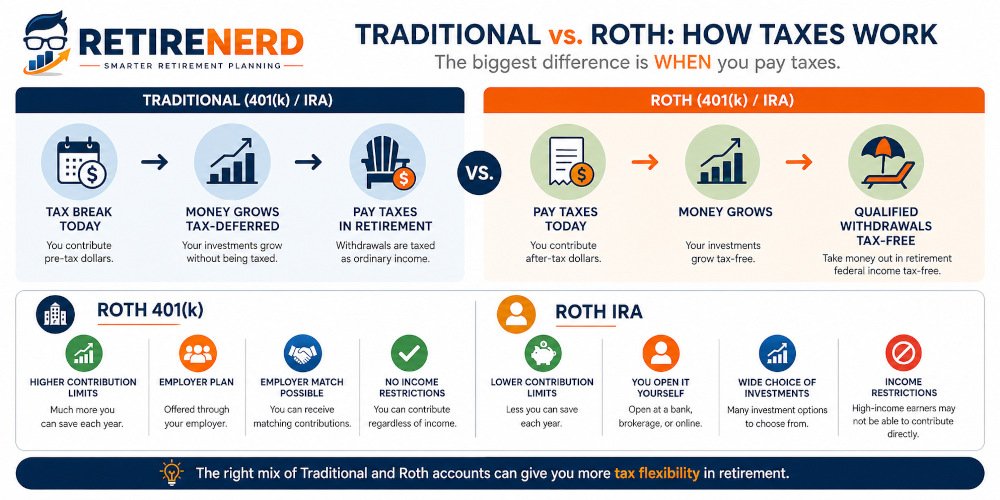
Traditional retirement account: You may receive a tax benefit now, while taxable withdrawals are generally taxed later.
Roth retirement account: You pay taxes now, while qualified withdrawals can be tax-free later.
A Simple Example
Imagine you’re earning $100,000 a year and decide to put $10,000 into your workplace retirement plan. If that $10,000 goes into a traditional pre-tax 401(k), the contribution generally reduces the income subject to federal income tax for the year. The trade-off comes later, because taxable distributions from the account are generally treated as ordinary income.
Put that same $10,000 into a Roth 401(k), and you don’t receive the upfront federal income-tax reduction. You’re paying the tax bill today. But if you later meet the requirements for a qualified Roth distribution, both your contributions and the investment earnings can come out free of federal income tax.
That’s the basic Roth bargain: give up the tax break today in exchange for the possibility of tax-free retirement income tomorrow.
So What Is a Roth 401(k)?
A Roth 401(k) is a Roth option inside an employer-sponsored retirement plan. You normally don’t open one yourself at a bank or brokerage; your employer’s retirement plan has to offer the Roth feature.
If it does, you may be able to tell your employer that some or all of your future 401(k) contributions should go into the Roth side of the plan. The money still comes directly from your paycheck, but Roth 401(k) contributions are made with after-tax money.
What Is a Roth IRA?
A Roth IRA also uses after-tax money, but it isn’t tied to your employer. IRA stands for Individual Retirement Arrangement, and you generally open the account yourself through a brokerage, bank, or other financial institution that offers IRAs.
That usually gives you more control over where the account is held and what investments are available. However, a Roth IRA has two important differences from a Roth 401(k): the annual contribution limit is much lower, and your income can limit or eliminate your ability to contribute directly.
What Is a Traditional 401(k)?
A traditional 401(k) is the type of workplace retirement account many people have used for decades. Traditional contributions are generally taken from your paycheck before federal income tax, which can lower your taxable income today.
Your investments then grow tax-deferred. When you eventually withdraw taxable money from the account, you generally pay ordinary income tax on those distributions. A traditional 401(k) can therefore be attractive if you expect to be in a lower tax bracket after you retire.
And What Is a Traditional IRA?
A traditional IRA is an individual retirement account that you generally open yourself. Depending on your income, tax filing status, and whether you or your spouse participate in a retirement plan at work, your contribution may be fully deductible, partially deductible, or not deductible at all.
That’s why it’s misleading to simply say, “IRA contributions are tax deductible.” Sometimes they are, and sometimes they aren’t.
Roth 401(k) vs. Roth IRA vs. Traditional 401(k) vs. Traditional IRA
See the 401(k) & Savings page for more deatails
| Feature | Roth 401(k) | Roth IRA | Traditional 401(k) | Traditional IRA |
|---|---|---|---|---|
| Where you get it | Employer | You open it | Employer | You open it |
| Contributions | After-tax | After-tax | Generally pre-tax | May be deductible |
| Tax break today? | No | No | Generally yes | Depends |
| Qualified withdrawals tax-free? | Yes | Yes | No | No |
| Employer match possible? | Yes | No | Yes | No |
| Income limit to contribute? | No | Yes | No | No contribution income limit, but deduction limits can apply |
| Investment choices | Employer plan menu | Usually broad | Employer plan menu | Usually broad |
How Much Can You Put Into a Roth 401(k) in 2026?
For 2026, the regular employee contribution limit for a 401(k) is $24,500. If you’re age 50 or older, the normal catch-up contribution is another $8,000, potentially allowing you to contribute as much as $32,500.
There’s also a higher catch-up limit for people ages 60 through 63. In 2026, that catch-up amount is $11,250, potentially allowing total employee deferrals of $35,750.
One important detail: the contribution limit applies to your combined traditional and Roth 401(k) employee contributions. You don’t receive a separate $24,500 limit for each account type.
Example: If you’re under 50 and put $14,500 into your traditional 401(k), you could put another $10,000 into your Roth 401(k), reaching the $24,500 employee contribution limit for 2026. You couldn’t put $24,500 into each.
How Much Can You Put Into a Roth IRA in 2026?
The 2026 IRA contribution limit is $7,500. If you’re age 50 or older, you can contribute an additional $1,100, bringing the limit to $8,600.
The IRA limit is separate from the 401(k) limit, so participating in a workplace 401(k) doesn’t automatically stop you from contributing to an IRA. However, Roth IRA income limits can affect whether you’re allowed to make a direct Roth IRA contribution.
2026 Roth IRA Income Limits
This is where Roth IRAs become a little more complicated. For 2026, the ability to contribute directly to a Roth IRA begins phasing out at higher income levels.
- Single and head-of-household filers: phaseout begins at $153,000 of modified adjusted gross income and ends at $168,000.
- Married filing jointly: phaseout begins at $242,000 and ends at $252,000.
Special, much stricter rules apply to many married people who file separately. A Roth 401(k), however, doesn’t have these Roth IRA income restrictions.
Can You Have a Roth 401(k) AND a Roth IRA?
Yes. If you meet the eligibility rules, you can contribute to a workplace Roth 401(k) and also contribute to a Roth IRA. The two accounts have separate contribution limits.
For someone age 50 or older in 2026, that could mean as much as $32,500 into a 401(k) plus $8,600 into an IRA, or $41,100 in total contributions. That’s before counting employer contributions. Someone age 60 through 63 who qualifies for the larger 401(k) catch-up could potentially contribute even more.
Can You Have Both a Traditional 401(k) and Roth 401(k)?
Yes, assuming your employer’s plan offers both. You don’t necessarily have to choose one or the other. You could put all of your contributions into traditional, all into Roth, or divide your contributions between the two.
For example, you might direct 60% of your contributions to your traditional 401(k) and 40% to your Roth 401(k). Having both can create what we like to call tax flexibility.
Instead of reaching retirement with every dollar sitting in an account that creates taxable income when withdrawn, you may have different buckets of money available with different tax treatment.
Why Roth Money Can Be Valuable in Retirement
Imagine you’re retired and need an extra $20,000 one year. Maybe you need a new roof, you’re taking the family on a big trip, or life simply got more expensive than expected.
If all your retirement savings are in traditional tax-deferred accounts, taking out that extra $20,000 could increase your taxable income. Depending on your situation, taxable retirement withdrawals can also affect how much of your Social Security is taxable and, at higher income levels, future Medicare premiums.
A qualified Roth withdrawal generally doesn’t add to your federal taxable income. That gives retirees another financial lever to pull, and that flexibility can be extremely useful when you’re managing taxes over a retirement that may last 20 or 30 years.
How Do I Enroll in a Roth 401(k)?
If your employer offers one, enrolling is usually straightforward. Log into your employer’s retirement-plan website and look for a section called Contributions, Contribution Elections, or something similar.
- Check whether the plan offers a Roth 401(k) or Roth contribution option.
- Choose how much of your paycheck you want to contribute.
- Choose your investments if required.
- Review your election carefully.
- Submit the change.
If you don’t see a Roth option, contact your HR department or the company that administers your retirement plan. Not every 401(k) plan offers Roth contributions.
How Do I Open a Roth IRA?
A Roth IRA isn’t normally opened through your employer. You choose a bank, brokerage, or other financial institution that offers IRAs, open the account, connect a bank account, and make your contribution.
But don’t stop there. Putting money into a Roth IRA and investing the money are two different things. A surprisingly common mistake is depositing money into an IRA and leaving it sitting in cash because the owner didn’t realize an investment still needed to be selected.
Once the money is in the account, decide how it should be invested based on your goals, time horizon, and tolerance for risk.
What Happens to My Employer Match If I Choose Roth?
Choosing Roth contributions does not necessarily mean giving up your company match. Your employer can generally use your Roth 401(k) contributions when determining whether you’ve contributed enough to qualify for the match.
The tax treatment and structure of employer contributions can vary by plan, so check your plan documents or benefits department to see exactly how your employer handles matching contributions. The important point is this: don’t assume choosing Roth means losing your employer match.
The Five-Year Rule: Don’t Ignore This One
Tax-free Roth withdrawals come with rules. For a Roth 401(k) qualified distribution, the distribution generally must occur after the applicable five-year period and after you reach age 59½, become disabled, or die.
Roth IRAs also have five-year rules, although their withdrawal rules aren’t identical to Roth 401(k) rules. This is one area where people can get into trouble by assuming that “Roth” automatically means, “I can withdraw everything tax-free whenever I want.” That’s not how it works.
One Big Roth IRA Advantage: Access to Contributions
A Roth IRA has a particularly useful feature: your regular Roth IRA contributions can generally be withdrawn without tax or penalty because you’ve already paid tax on that money. Earnings are different and can be subject to tax and penalties if the distribution isn’t qualified.
That flexibility is one reason some people like having a Roth IRA in addition to their workplace retirement plan. But it doesn’t mean your Roth IRA should become your emergency checking account. Money removed today loses the opportunity to grow and compound for retirement.
Do Roth Accounts Have Required Minimum Distributions?
Under current federal law, Roth IRAs don’t require distributions while the original owner is alive. Beginning in 2024, designated Roth accounts in employer plans also stopped being subject to lifetime required minimum distributions for the original account owner.
That can make Roth accounts especially useful for people who may not need all of their retirement savings immediately after they stop working.
When Might a Roth 401(k) Make Sense?
A Roth 401(k) may deserve a closer look if you believe your tax rate could be higher in retirement, you’re currently in a relatively low tax bracket, or most of your existing retirement savings are already pre-tax. It can also be useful if you want more tax-free income options later or your income is too high to contribute directly to a Roth IRA.
But there is another side to the decision.
When Might a Traditional 401(k) Be Better?
A traditional 401(k) may be attractive if you’re currently in a high tax bracket, expect your taxable income to fall significantly after retirement, or strongly value the tax reduction today. It may also make sense if using Roth contributions would make your current household budget too tight.
And sometimes the most sensible answer isn’t Roth or traditional. It may be both.
What About Someone Getting Close to Retirement?
This question becomes especially interesting when you’re in your 50s or early 60s. Suppose you’ve worked for decades and nearly all of your retirement savings are sitting in a traditional 401(k). After you retire, you may eventually have Social Security, taxable 401(k) withdrawals, and perhaps other income arriving at the same time.
Adding some Roth savings during your final working years could give you another source of money that receives different tax treatment. But don’t automatically switch every contribution to Roth simply because retirement is approaching.
You still need to consider your current tax bracket, expected retirement income, Social Security, future withdrawals, other savings, and how much cash flow you need today.
Roth 401(k) vs. Roth IRA: Which Should I Fund First?
There isn’t one answer for everyone, but there’s a useful place to start: don’t casually leave employer matching money on the table. If your employer matches your 401(k) contributions, understand how much you need to contribute to receive the full available match.
After that, you can compare a Roth IRA with additional 401(k) contributions. A Roth IRA may give you more investment choices and more control over where your money is held. A Roth 401(k), on the other hand, has a much higher contribution limit and doesn’t have the Roth IRA income restriction.
For some households, the answer is to use both.
A Common Mistake: Thinking “Roth” Means Better
Roth accounts are excellent retirement tools, but they’re not magic. If you’re paying a high tax rate on Roth contributions today only to avoid what would have been a much lower tax rate later, Roth may not have been the better tax decision.
On the other hand, someone paying a relatively low rate today who eventually faces higher rates may be very happy to have built a large pool of tax-free retirement money.
The goal isn’t simply to pay no taxes today, and it isn’t simply to pay no taxes later. The goal is to manage taxes intelligently over your lifetime.
Traditional vs. Roth: The Simple Version
Traditional 401(k)
Earn money → Contribute pre-tax → Grow tax-deferred → Withdraw in retirement → Pay tax on taxable withdrawals
Roth 401(k)
Earn money → Pay tax today → Make Roth contribution → Money grows → Qualified retirement withdrawals can be tax-free
Before You Make the Switch
Before changing your contributions, think about your entire retirement picture rather than looking at the Roth decision by itself.
- What tax bracket am I in today?
- What might my taxable income look like after I retire?
- How much of my retirement savings is already pre-tax?
- Do I expect a pension or other taxable retirement income?
- When will I claim Social Security?
- Would paying more tax today hurt my monthly budget?
- Would having tax-free money later give me useful flexibility?
Those questions are much more useful than simply asking, “Is Roth better?”
The Bottom Line
If there’s one thing to remember, make it this: a traditional retirement account generally gives you the tax benefit earlier, while a Roth generally gives you the tax benefit later.
A Roth 401(k) lets you save considerably more each year than a Roth IRA and doesn’t have the Roth IRA income limits. A Roth IRA gives you independence from your employer, broad investment choices at many providers, and more flexible rules for withdrawing regular contributions.
And you don’t necessarily have to choose just one. For many people approaching retirement, having a mixture of traditional and Roth money can create valuable flexibility when it’s finally time to turn decades of savings into retirement income.
The best mix depends on your taxes, income, savings, retirement date, and what you expect your finances to look like after the paychecks stop.
Frequently Asked Questions
Can I contribute to a Roth 401(k) and Roth IRA in the same year?
Yes. If you’re eligible for the Roth IRA and your employer offers a Roth 401(k), you can contribute to both. Each has its own contribution rules and limits.
Can I contribute to both a traditional and Roth 401(k)?
Yes, if your plan offers both. However, your employee contributions to the two accounts share the same annual 401(k) employee contribution limit.
Does a Roth 401(k) lower my taxes today?
Generally, no. Roth 401(k) contributions are made with after-tax dollars. That’s the trade-off for potentially receiving qualified withdrawals tax-free later.
Does a Roth IRA give me a tax deduction?
No. Roth IRA contributions aren’t deductible.
Is there an income limit for a Roth 401(k)?
No. Unlike a Roth IRA, there isn’t an income limit that prevents a high-income worker from making Roth 401(k) contributions if the employer’s plan offers them.
Is a Roth 401(k) always better than a traditional 401(k)?
No. Which one is more attractive depends heavily on your current and future tax situation. Some people benefit from using a combination of both.
Can I change from traditional 401(k) contributions to Roth?
If your employer’s plan offers Roth contributions, you can generally change how your future contributions are directed according to the plan’s rules. Changing future contributions doesn’t automatically convert your existing traditional 401(k) balance into Roth money.
Important: Retirement and tax rules can change. The dollar limits in this article are for 2026. This article is for general educational purposes and isn’t individualized tax, investment, or financial advice. Consider speaking with a qualified tax or financial professional about your particular situation.