
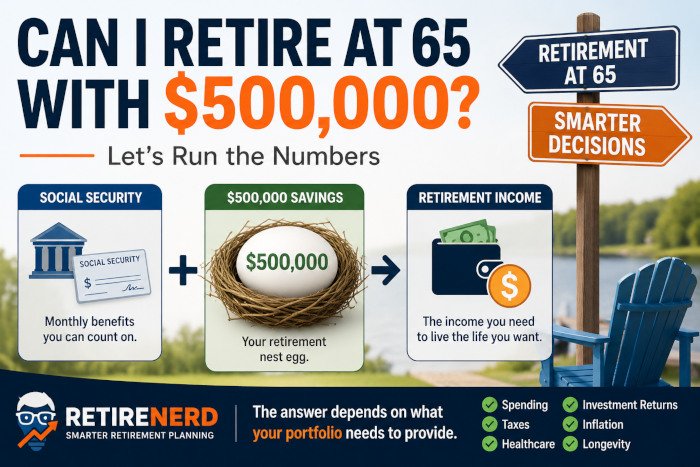
Can I Retire at 65 With $500,000? Let’s Run the Numbers
You’re 65 years old. You have $500,000 saved for retirement. Maybe you’ve been staring at that number in your 401(k) for years, wondering whether it is finally enough to stop working.
So, can you retire?
Possibly. For some people, $500,000 can support a comfortable retirement. For others, it may not be nearly enough. The surprising part is that the difference often isn’t the $500,000 itself. What matters most is how much money you need to take from that $500,000 every year.
Social Security, housing costs, taxes, healthcare, investment returns and your lifestyle can completely change the answer.
Instead of guessing, let’s run some numbers.
The Quick Answer: Is $500,000 Enough to Retire at 65?
If you have $500,000 at age 65, the first question shouldn’t be, “Is $500,000 enough?” A much better question is:
“How much money will I need from my $500,000 each year after Social Security and other dependable income?”
That number is your retirement spending gap.
A simple way to think about it:
Annual spending − Social Security − pension or other dependable income = amount your savings need to provide
For example, suppose you want to spend $60,000 per year and expect $40,000 from Social Security. Your investments need to provide about $20,000 during the first year.
With $500,000 saved, a $20,000 withdrawal equals 4% of the portfolio.
Now suppose you want to spend $75,000 but receive only $30,000 from Social Security. Your savings need to provide $45,000. That’s a 9% initial withdrawal from a $500,000 portfolio.
Same $500,000. Completely different retirement.
What Could $500,000 Provide in Retirement?
You may have heard of the 4% rule. In its simplest form, it suggests starting retirement by withdrawing roughly 4% of your portfolio during the first year and then adjusting withdrawals for inflation in later years.
Using 4% as a simple starting point, $500,000 would produce:
$500,000 × 4% = $20,000 during the first year
That does not mean $500,000 automatically gives you a safe $20,000 paycheck every year for the rest of your life. The 4% rule is a planning guideline, not a guarantee. Your investment mix, retirement length, inflation, market returns, taxes and spending patterns all matter.
But $20,000 gives us a useful starting point.
Now Add Social Security
This is where the retirement picture can change dramatically.
Suppose your Social Security benefit is $2,500 per month. That’s $30,000 per year before considering taxes.
Add a $20,000 first-year portfolio withdrawal and you get:
Social Security: $30,000
Portfolio withdrawal: $20,000
Total: $50,000 per year
Suddenly, retiring with $500,000 doesn’t sound quite as impossible.
And a married couple receiving two Social Security benefits could have a very different picture from a single retiree with the exact same $500,000 portfolio.
Three Retirees. Same $500,000. Very Different Results.
Here’s an easy way to see why the savings balance alone doesn’t answer the question.
| Retiree A | Retiree B | Retiree C | |
|---|---|---|---|
| Savings at 65 | $500,000 | $500,000 | $500,000 |
| Social Security | $36,000/yr | $30,000/yr | $24,000/yr |
| Desired spending | $48,000 | $60,000 | $72,000 |
| Needed from portfolio | $12,000 | $30,000 | $48,000 |
| Initial withdrawal rate | 2.4% | 6.0% | 9.6% |
| Starting picture | Much stronger | Needs careful planning | High pressure on savings |
These are simplified examples for illustration. They don’t include taxes, investment returns, inflation or changing expenses.
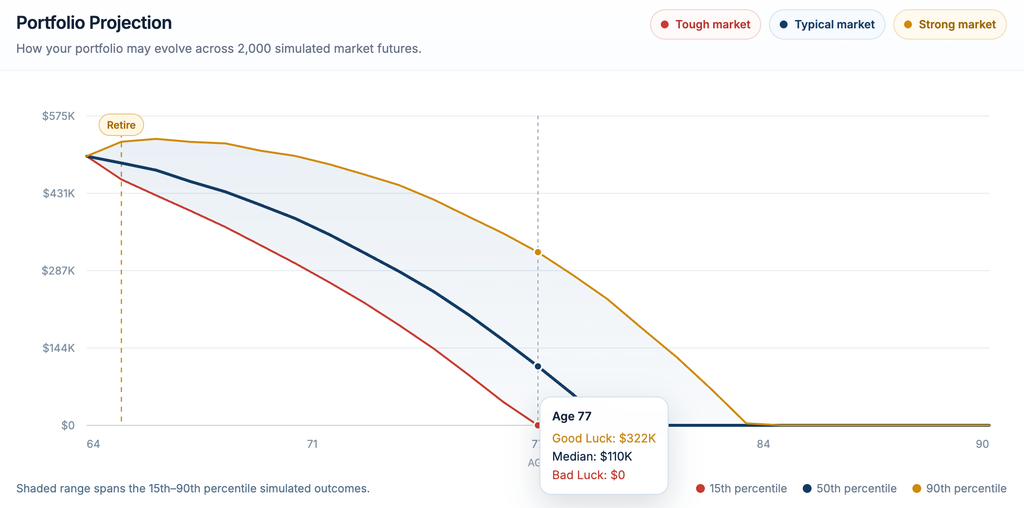
The Monte Carlo projection above is based on 60/40 portfolio, $500K – $2500 SSC – $60,000 Desired Spending. At age 77 it shows that in a bad luck market, it depletes all the funds. At age 84, every market condition depletes the funds.
Using the 4% rule
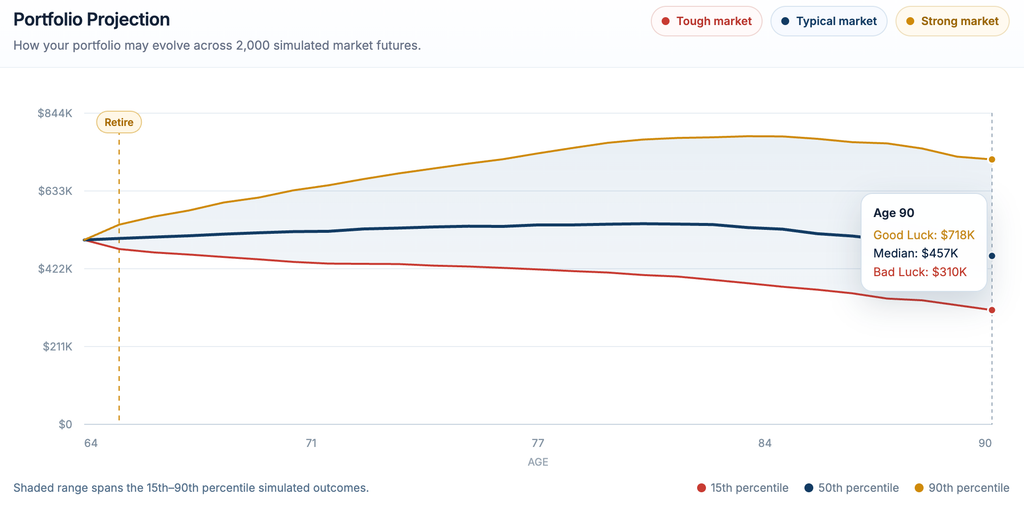
The Monte Carlo projection above is based on 60/40 portfolio, $500K – $2500 SSC – 4% Withdrawal. 100% of the 2,000 simulated futures lasted through age 90 without running out of money.
Retiree A needs only $12,000 from the portfolio during the first year. Retiree C needs four times as much.
That’s why asking whether $500,000 is “enough” without looking at spending and guaranteed income can be misleading.
Your Spending May Matter More Than Your Savings Balance
People often focus on reaching a magic retirement number: $500,000, $750,000, $1 million or perhaps $2 million.
But retirement isn’t really about hitting a magic number. It’s about whether your available income and assets can support the life you plan to live.
Someone spending $45,000 a year with a paid-off house may be in a stronger position with $500,000 than someone with $1 million who needs $100,000 every year.
Before deciding whether you can retire, take a serious look at what you actually spend. Include groceries, housing, insurance, transportation, travel, entertainment, taxes, healthcare, home repairs and the expenses that don’t conveniently arrive every month.
Housing Can Change the Answer
Housing is often one of the largest differences between retirees.
Imagine two people who both reach age 65 with $500,000 invested.
Retiree #1 owns a home with no mortgage and has relatively low property taxes and insurance. Retiree #2 has a $2,200 monthly mortgage payment.
That’s $26,400 per year of additional cash flow before considering any other differences.
It doesn’t automatically mean you need to pay off your mortgage before retiring. A low-rate mortgage may sometimes be perfectly manageable. But the monthly payment needs to be included honestly in your retirement plan.
Don’t Forget Taxes
Another common mistake is treating $500,000 in a traditional 401(k) as if it were the same as $500,000 sitting in a checking account.
It isn’t.
Withdrawals from traditional 401(k)s and traditional IRAs are generally taxable as ordinary income. Roth accounts can receive different tax treatment when withdrawal requirements are satisfied.
Social Security can also be taxable depending on your overall income.
So if your retirement budget says you need $60,000 available to spend, you may need more than $60,000 of gross income to produce it.
Plan around what you can actually spend after taxes, not simply what you can withdraw.
Retiring at 65 Doesn’t Mean You Have to Claim Social Security at 65
This is an important distinction.
Your retirement age and your Social Security claiming age do not have to be the same.
You could stop working at 65 and claim Social Security immediately. Or you could retire at 65, use some savings for a period of time, and delay Social Security.
For many people retiring today, age 65 is actually before their Social Security full retirement age. That means claiming at 65 may produce a smaller monthly benefit than waiting until full retirement age.
On the other hand, delaying Social Security means your portfolio may need to provide more income during the years you’re waiting.
Neither decision is automatically right. Health, longevity, marital status, other income and the strength of your investment portfolio all deserve consideration.
Age 65 Has Another Big Milestone: Medicare
One advantage of retiring at 65 rather than several years earlier is that most Americans become eligible for Medicare around this age.
But Medicare does not mean healthcare becomes free.
You may still have premiums, deductibles, copays, prescription costs and expenses for services Medicare doesn’t fully cover. Depending on how you structure your coverage, you may also pay for a Medicare Advantage plan, Medigap coverage or Part D prescription coverage.
Healthcare deserves its own line in your retirement budget. Don’t simply assume, “I’ll have Medicare, so healthcare is covered.”
How Long Does the $500,000 Need to Last?
If you retire at 65 and live to 95, you’re asking your portfolio to help support approximately 30 years of retirement.
And nobody knows their expiration date.
A good retirement plan shouldn’t work only if you live to 78. It should consider what happens if you live much longer than expected.
This is called longevity risk: the possibility that you outlive the assumptions behind your retirement plan.
That’s one reason Social Security can be so valuable. Unlike an investment account that can be depleted, Social Security retirement benefits can continue for life.
Inflation Doesn’t Retire When You Do
Imagine you need $50,000 during your first year of retirement. If prices continue rising over the years, that same lifestyle could eventually cost considerably more.
Groceries get more expensive. Insurance premiums rise. Property taxes can increase. Cars need replacing. Home repairs don’t stop because you’re retired.
That means a retirement plan shouldn’t simply ask whether $500,000 covers today’s expenses. It should consider how spending may increase over a retirement that could last decades.
The Market Could Fall Right After You Retire
This is one of the risks that doesn’t get enough attention.
Suppose you retire with exactly $500,000 and the stock market performs poorly during your first few years. At the same time, you’re withdrawing money to pay your bills.
You’re now selling investments from a shrinking portfolio, leaving fewer assets available to participate in a future recovery.
This is called sequence-of-returns risk.
The order in which investment returns occur can matter tremendously once you’re taking withdrawals. Two retirees can earn similar average returns over many years but experience very different outcomes simply because one encountered a major downturn near the beginning of retirement.
That’s Why a Simple Average Return Isn’t Enough
A retirement projection that assumes your portfolio earns exactly 6% every year may look reassuring, but real markets don’t behave that way.
You might get +18%, -12%, +4%, -20% and +25% over different years. The average matters, but when you’re withdrawing money, the order of those returns matters too.
A stronger retirement analysis tests the plan against many different market paths and difficult historical periods rather than assuming a smooth line upward every year.
What If $500,000 Isn’t Quite Enough?
Finding out that your current plan is tight doesn’t necessarily mean you have to work another decade.
Small changes can sometimes have a surprisingly large effect.
- Work one or two more years. You get more time to save and fewer retirement years to fund.
- Spend a little less. Reducing recurring expenses can lower the amount your portfolio must provide every year.
- Delay Social Security. Depending on your circumstances, delaying can increase your eventual monthly benefit.
- Work part-time. Even $10,000 or $15,000 of annual income during the first few retirement years can reduce pressure on your investments.
- Reduce housing costs. Downsizing or relocating can change both your monthly expenses and available assets.
- Adjust discretionary spending during bad markets. A flexible retirement budget can be more resilient than one that demands the same inflation-adjusted withdrawal regardless of market conditions.
The important point is that retirement planning isn’t always a simple yes-or-no decision. Sometimes a few reasonable adjustments can move a plan from uncomfortable to much more manageable.
A Better Retirement Question
Instead of asking only:
“Can I retire at 65 with $500,000?”
Try asking:
“Can my Social Security, other income and $500,000 portfolio support the amount I actually need to spend for the rest of my life?”
That’s the question that matters.
Before Retiring at 65 With $500,000, Know These Numbers
You don’t need a finance degree to start evaluating your retirement. But you should know a few important numbers:
- Your expected annual retirement spending
- Your estimated Social Security benefit at different claiming ages
- Any pension or other dependable income
- Your 401(k), IRA, Roth and other investment balances
- Your cash and emergency savings
- Your mortgage or rent
- Your expected healthcare costs
- Your estimated taxes
- Your investment allocation
- How long you want the plan to be able to support you
Once you have those numbers, $500,000 stops being an abstract number on a statement. You can begin testing whether it actually supports your retirement.
Don’t Guess — Test Your $500,000 Retirement
Two people can retire at the same age with the same $500,000 and have completely different outcomes. That’s why a simple retirement calculator that assumes one fixed investment return can only tell you so much.
RetireNerd’s Portfolio Analyzer & Withdrawal Simulator lets you look more deeply at your retirement plan. You can test your spending, Social Security, portfolio withdrawals, investment allocation and different retirement scenarios, including difficult market conditions.
Try your own numbers instead of relying on somebody else’s retirement example.
So, Can You Retire at 65 With $500,000?
Yes, it may be possible. Someone with modest spending, meaningful Social Security income, manageable housing costs and a well-planned withdrawal strategy may be able to build a workable retirement around a $500,000 portfolio.
But $500,000 isn’t automatically enough simply because you reached age 65. If your spending is high, Social Security is relatively low, housing costs are large or you’re relying heavily on portfolio withdrawals, the plan could face much more pressure.
The goal isn’t to find a magic retirement number. It’s to understand the relationship between what comes in, what goes out, and what your savings have to provide in between.
Once you understand that, you’ll have a much better answer than any rule of thumb can give you.
Frequently Asked Questions
Is $500,000 a lot of money to retire with?
$500,000 is a meaningful retirement portfolio, but whether it’s enough depends heavily on your spending and other income. Someone who needs only $15,000 per year from the portfolio is in a very different position from someone who needs $50,000 per year.
How much income can $500,000 generate in retirement?
A 4% initial withdrawal would equal $20,000 during the first year. That’s a useful planning example, but it isn’t guaranteed income and shouldn’t be treated as a promise that the portfolio will last for a particular number of years.
Can I retire at 65 with $500,000 and Social Security?
Possibly. Social Security can make a major difference because it reduces the amount your investment portfolio must provide. Compare your expected annual spending with your Social Security and other dependable income to estimate the amount you’ll need from savings.
How long will $500,000 last in retirement?
There isn’t one answer. It depends on how much you withdraw, investment returns, inflation, taxes and how your spending changes. Withdrawing $15,000 per year creates a very different outcome from withdrawing $50,000 per year.
Should I take Social Security at 65 if I retire at 65?
Not necessarily. Retiring and claiming Social Security are separate decisions. Depending on your birth year, age 65 may be before your Social Security full retirement age. Your health, finances, marital situation, life expectancy and ability to fund the years before claiming should all be considered.
What is the biggest danger of retiring with $500,000?
One major risk is needing too much from the portfolio, particularly if poor investment returns occur early in retirement. Inflation, longevity, taxes and unexpected healthcare or housing expenses can also put pressure on the plan.
Social Security claiming age – Medicare – Withdrawal Strategies
Important: The examples in this article are simplified illustrations and are not predictions or guarantees. Retirement outcomes depend on investment performance, taxes, inflation, spending, Social Security, healthcare costs and many other factors. This article is for general educational purposes and isn’t individualized investment, tax or financial advice.