

When one spouse turns 65 several years before the other, the household does not move into Medicare together. The older spouse may leave an employer plan or Marketplace policy for Medicare while the younger spouse still needs separate coverage. Premiums, deductibles, provider networks and enrollment deadlines can all change at once.
The age difference itself is rarely the hardest part. The difficult part is coordinating two healthcare systems with one retirement date, one household income and one tax return. A workable plan gives each spouse a coverage path, identifies the handoff dates and tests the combined cost rather than assuming Medicare solves healthcare for the entire household.The key distinction
Medicare eligibility belongs to the individual. Marriage does not let a younger spouse join the older spouse’s Medicare. The younger spouse needs employer coverage, a Marketplace plan, COBRA or another eligible source until reaching Medicare eligibility.
Why age-gap couples need two healthcare timelines
Suppose Alex is 67 and Jordan is 60. Alex can qualify for Medicare based on age. Jordan cannot use Alex’s Medicare and still has five years before turning 65. If they retire together, they must solve two different problems:
- Which Medicare arrangement should Alex use?
- What coverage will protect Jordan until 65?
- How will their combined income affect Marketplace assistance for Jordan?
- Will either spouse remain covered through current employment?
- When should HSA contributions stop?
- How much should the retirement budget reserve for premiums and out-of-pocket costs?
A single line called “healthcare” in a retirement budget hides too much. Build a year-by-year schedule for each spouse instead.
Medicare does not offer family coverage
Employer insurance commonly covers an employee, spouse and dependents under one family contract. Medicare works differently. Each person qualifies and enrolls separately. Each spouse has an individual Part B premium, an individual prescription-drug decision and an individual choice between Original Medicare and Medicare Advantage.
One spouse’s work record can help the other qualify for premium-free Part A if the marriage and work-history requirements are met. However, that does not create a joint Medicare plan. The younger spouse must still wait until eligible by age or another qualifying circumstance.
This also means spouses do not have to choose the same Medicare arrangement when the younger spouse eventually reaches 65. One may prefer Original Medicare with Medigap and Part D while the other chooses Medicare Advantage. Their doctors, prescriptions, travel patterns and risk preferences may differ.
Start with the source of coverage today
The correct transition depends less on which spouse is older and more on why the household has insurance now. Four situations appear often.
Both spouses use the older spouse’s active employer plan
If the older spouse keeps working, the couple may be able to remain on that employer plan after the older spouse turns 65. Whether the older spouse can delay Part B without a penalty generally depends on having group health coverage based on current employment. Employer size and plan coordination rules matter, so the benefits administrator should explain in writing whether Medicare or the employer plan pays first.
Delaying Part B can be reasonable when the employer plan remains strong and the extra family cost is competitive. Yet enrolling in premium-free Part A may interfere with HSA contributions. Anyone contributing to an HSA should review Medicare’s retroactive Part A rules before enrolling.
Both spouses use the younger spouse’s active employer plan
The older spouse may be able to delay Part B while covered through the younger spouse’s current employment. Medicare recognizes qualifying active-employment coverage through a spouse. Again, confirm that the plan qualifies and ask how it coordinates with Medicare. Retiree insurance, COBRA and individual coverage do not follow the same Part B Special Enrollment Period rules.
The couple buys Marketplace coverage
When the older spouse becomes eligible for Medicare, that spouse usually transitions off the Marketplace policy. The younger spouse can remain enrolled through the Marketplace. The application should still include the entire tax household and its expected annual income, even though only the younger spouse needs Marketplace coverage.
Update the Marketplace when the Medicare enrollment date is known. Do not simply cancel the whole family policy, because that could terminate the younger spouse’s coverage. The Marketplace or state exchange can end coverage for the Medicare-eligible spouse while continuing the younger spouse’s plan.
The couple is retiring and losing employer insurance
Loss of job-based coverage can create enrollment opportunities, but the clocks are different. The Medicare-eligible spouse may use a Part B Special Enrollment Period if the prior coverage was based on current employment. The younger spouse may qualify for a Marketplace Special Enrollment Period or elect COBRA. The couple should coordinate effective dates so neither spouse has an uninsured month.
The younger spouse’s bridge to 65
The younger spouse usually compares four paths. No option wins for every household.
| Coverage path | Why it may work | What to investigate |
|---|---|---|
| Active employer plan | May preserve the same doctors and cover both spouses | Employee premium, family premium, employer size, HSA eligibility and Medicare coordination |
| ACA Marketplace | Offers guaranteed-issue coverage and possible income-based premium tax credits | Household MAGI, subsidy eligibility, network, prescriptions, deductible and annual out-of-pocket limit |
| COBRA | Temporarily keeps the same employer plan and network | Full premium, duration, when it can end, and the fact that COBRA does not extend the older spouse’s Part B enrollment deadline |
| Other group coverage | A new job or eligible spouse plan may provide a longer bridge | Waiting periods, affordability, minimum value, network and impact on Marketplace assistance |
Compare the total household cost and enrollment rules, not the premium alone.
Short-term medical plans and healthcare-sharing arrangements may appear cheaper, but they do not necessarily provide the protections or comprehensive benefits of ACA-compliant coverage. Read exclusions and renewal rules carefully before treating one as a retirement bridge.
How Marketplace subsidies work when one spouse has Medicare
A common misunderstanding is that once one spouse joins Medicare, only the younger spouse’s income matters for Marketplace savings. In a married household filing jointly, Marketplace assistance generally uses household income and family size. The Medicare spouse remains part of the tax household even though that person is not enrolled in the Marketplace plan.
However, the premium tax credit applies only to eligible household members enrolled in qualified Marketplace coverage. The spouse eligible for Medicare generally cannot receive a premium tax credit for Marketplace coverage for months of Medicare eligibility. The younger spouse may still qualify if the other requirements are met.
For 2026, federal premium-tax-credit eligibility generally returns to the statutory range of 100% through 400% of the federal poverty level after the temporary enhanced rules expired at the end of 2025. State rules and Medicaid eligibility can change the result. Because Congress can change subsidy law, verify the current year before making an irreversible retirement decision.
Marketplace modified adjusted gross income can include wages, pensions, taxable interest, dividends, realized capital gains, taxable Social Security, traditional IRA withdrawals and Roth conversions. Qualified Roth withdrawals generally do not add to federal AGI. Spending money and taxable income are therefore different numbers.
Why a large retirement-account withdrawal can be expensive
Assume the younger spouse receives an advance premium tax credit based on projected household income. Later that year, the couple takes a large traditional IRA distribution to buy a car or pay off a mortgage. The distribution raises household income. It may reduce the credit or push income beyond the eligibility limit, creating repayment when the couple files Form 8962 with its federal tax return.
The better approach is to estimate the entire calendar year before choosing a withdrawal source. Consider wages earned before retirement, severance, unused vacation pay, dividends, gains, conversions, pension income and the taxable portion of Social Security. Then leave room for surprises.Income planning is healthcare planning
During the younger spouse’s Marketplace years, a Roth conversion, capital gain or traditional IRA withdrawal can change health-insurance assistance. Model the tax cost and the lost subsidy together.
A five-year age-gap couple example
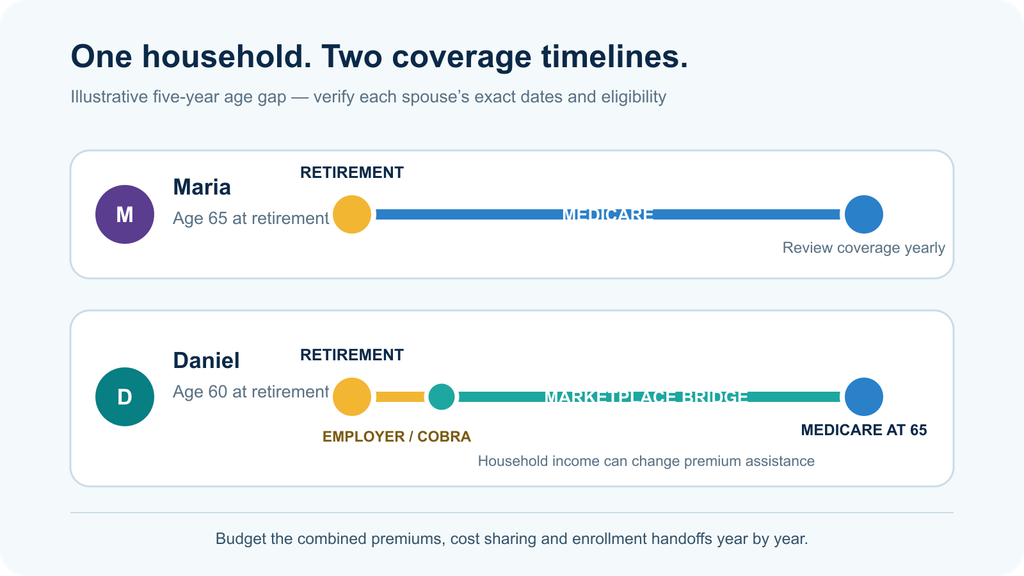
Consider Maria, 66, and Daniel, 61. Maria has already retired. Daniel plans to leave work at the end of June. His employer plan currently covers both of them. They expect to spend $84,000 a year and have $1.1 million across cash, taxable investments, traditional retirement accounts and Roth accounts.
Step 1: Separate the coverage paths
Maria confirms that her Part A and Part B can begin when the employer coverage ends. She compares Original Medicare plus Medigap and Part D with Medicare Advantage using her doctors, prescriptions and travel needs. Daniel prices a Marketplace plan beginning the day after employer coverage ends. COBRA remains a backup if a current specialist is outside the Marketplace networks.
Step 2: Build the transition-year income estimate
Daniel will have six months of wages. The couple also expects interest, dividends and a small capital-gain distribution. Those amounts count toward the Marketplace estimate even though Daniel needs coverage for only part of the year. Maria’s Medicare coverage does not remove her income from the household calculation.
Step 3: Choose spending sources deliberately
For the first full retirement year, the couple plans to use cash reserves and withdrawals from a taxable account with high cost basis for part of its spending. This may produce less taxable income than taking the same amount from a traditional IRA. They preserve Roth money as another flexible source, subject to the account’s distribution rules.
They do not automatically avoid traditional IRA withdrawals. Instead, they compare three costs: current income tax, lost Marketplace assistance and future taxes from leaving more money in pretax accounts. A carefully sized Roth conversion might still make sense, but they will test it against Daniel’s subsidy range before acting.
Step 4: Budget both systems
The household budget includes Maria’s Part B premium, her chosen supplement or Medicare Advantage premium, Part D if applicable, and expected cost sharing. It separately includes Daniel’s net Marketplace premium, deductible exposure and prescription costs. The couple keeps a reserve for the possibility that the final premium tax credit differs from the advance amount.
Step 5: Repeat the handoff at Daniel’s 65th birthday
Several months before Daniel turns 65, they begin his Medicare comparison. They do not wait for the Marketplace plan to end automatically. They coordinate the Medicare start date, terminate only Daniel’s Marketplace coverage and update the retirement budget again.
This strategy does not guarantee a subsidy or identify the cheapest plan. It creates an orderly process and prevents one spouse’s enrollment from being mistaken for a household-wide solution.
Medicare enrollment dates to put on the calendar
A person’s Initial Enrollment Period generally spans seven months: the three months before the month they turn 65, the birthday month and the three months after it. Coverage timing can depend on when enrollment occurs. A person whose birthday is on the first day of a month is treated differently for Medicare start timing, so verify the date directly.
If the older spouse delays Part B because of qualifying current-employment group coverage, the Part B Special Enrollment Period generally lasts eight months after the employment or that coverage ends, whichever happens first. COBRA does not extend that deadline. To reduce the risk of a gap, Medicare advises enrolling before the employer coverage ends when coverage should begin immediately afterward.
Prescription coverage also needs attention. Going too long without creditable drug coverage can create a Part D late-enrollment penalty. Keep every annual notice that states whether employer drug coverage is creditable.
HSA complications for the Medicare-eligible spouse
Medicare enrollment and HSA contributions require special coordination. Once enrolled in Medicare, a person generally cannot contribute to an HSA. Premium-free Part A can be retroactive for as many as six months when someone enrolls after 65, but not earlier than the first month of eligibility. A person planning to enroll after delaying Medicare may need to stop HSA contributions in advance to avoid excess contributions.
The younger spouse may remain HSA-eligible if enrolled in an HSA-qualified high-deductible health plan and otherwise eligible. Yet contribution limits depend on the coverage and eligibility months. Do not assume the household can keep making the same family contribution after one spouse moves to Medicare.
Should the older spouse stay on employer coverage?
Some couples keep the older spouse on the employer plan so the younger spouse can remain covered. Others move only the older spouse to Medicare because removing that spouse lowers the employee premium. Compare at least these figures:
- The payroll deduction with both spouses enrolled
- The payroll deduction for the younger spouse alone
- The older spouse’s Part B and optional coverage premiums
- Each plan’s deductible and out-of-pocket limit
- Employer HSA contributions
- Provider and prescription access
- Which plan pays first
For employers with fewer than 20 employees, Medicare often pays first for an employee or spouse age 65 or older. A job plan may reduce or deny payments if the Medicare-eligible person does not enroll. Do not rely on a coworker’s experience; obtain the plan’s answer in writing.
Doctor and prescription coverage may split
The couple may have used the same doctors under one employer network. After the split, Maria’s cardiologist might accept Medicare while Daniel’s Marketplace plan uses a narrow network. A prescription may sit on different formularies with different prior-authorization rules.
Before enrolling, check each spouse separately:
- Search the plan directory.
- Call the medical practice and ask about the exact plan, not just the insurer’s name.
- Confirm hospitals, labs and ancillary providers.
- Enter every prescription, dosage and preferred pharmacy.
- Check prior authorization, step therapy and specialty-drug rules.
- Estimate a normal year and a high-use year.
A lower premium can be a poor bargain if it disrupts active treatment or creates much higher out-of-pocket exposure.
Common mistakes age-gap couples make
Assuming the younger spouse can join Medicare
Medicare has no spouse add-on. Price the younger spouse’s bridge before either person retires.
Treating COBRA as active-employment coverage
COBRA may preserve coverage temporarily, but it does not generally protect the older spouse’s Part B Special Enrollment Period after active employment ends.
Canceling the entire Marketplace policy
Remove the Medicare-eligible spouse while preserving the younger spouse’s coverage. Confirm the effective dates before canceling anything.
Estimating only retirement income
The transition year can include wages, bonuses, severance, gains and conversions. Marketplace assistance uses annual household income, not income after the retirement date.
Ignoring the subsidy when planning Roth conversions
A conversion can still be worthwhile, but the true cost may include federal and state tax plus reduced Marketplace assistance.
Budgeting only premiums
Add deductibles, copays, coinsurance, prescriptions, dental, vision, hearing and care outside the network.
A planning checklist for the 12 months before the split
- Draw two timelines. Mark retirement, employer-coverage end dates, each 65th birthday and each Medicare start.
- Ask the employer for written coordination rules. Confirm whether coverage is based on current employment and which plan pays first.
- Collect benefit estimates. Price employee-only, spouse-only and family coverage.
- Compare the younger spouse’s bridge. Review Marketplace, COBRA and any available active-employer coverage.
- Build a full-year income estimate. Include wages, pensions, taxable investment income, gains, retirement withdrawals and conversions.
- Check doctors and drugs under each plan. Do not assume the spouses will retain one network.
- Coordinate HSA contributions. Account for Medicare enrollment and possible retroactive Part A.
- Create enrollment reminders. Start several months before each handoff and keep confirmation records.
- Reserve for reconciliation. Marketplace advance credits are reconciled on the tax return.
- Update the retirement plan. Recalculate healthcare costs when the younger spouse reaches Medicare.
How this fits with a retirement plan
The healthcare bridge interacts with almost every retirement decision. Retiring one year later may preserve employer insurance. Claiming Social Security may raise household cash flow and taxable income. A Roth conversion may reduce future RMDs while reducing a current Marketplace credit. Paying off a mortgage with an IRA withdrawal can create the same problem.
Start with RetireNerd’s health insurance before Medicare guide for the broader bridge-coverage strategy. Use the complete ACA guide for early retirees to compare Marketplace plans, networks, costs and subsidy rules. Then model both spouses’ dates, income and healthcare expenses in Compass.
The best plan is a coordinated handoff
An age-gap couple does not need one insurance answer. It needs two compatible answers that change on known dates. The older spouse’s Medicare enrollment, the younger spouse’s coverage bridge and the household’s income plan should be built together.
Write down who is covered by what, when each policy starts and ends, what each plan costs in a normal and difficult year, and which income decisions could change assistance. That turns an anxious five-year gap into a series of manageable handoffs.
Reviewed: October 2026. Medicare, Marketplace, tax and subsidy rules can change. Verify current enrollment dates and eligibility with Medicare, the Marketplace, the employer plan and a qualified tax professional before acting.