
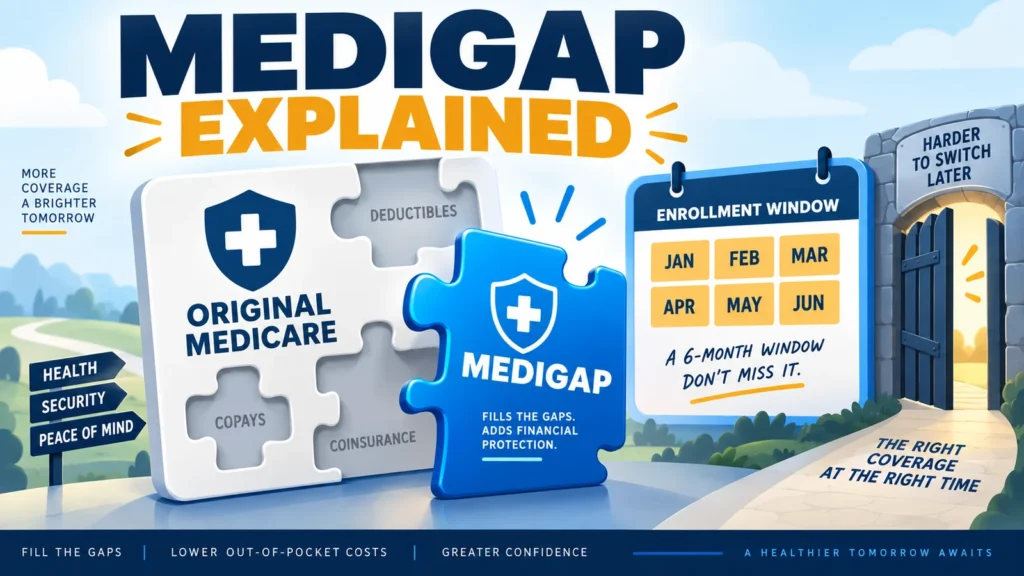
Medigap can make the deductibles and coinsurance left by Original Medicare more predictable. The most important fact, however, is not a plan letter or premium: your strongest federal right to buy coverage generally lasts only six months, and switching later may require medical underwriting.
That surprises people who assume Medicare’s annual fall enrollment period lets them move freely between every type of coverage. It does not. You can change certain Medicare Advantage and Part D choices during designated enrollment periods, but those dates do not automatically give you a new right to buy any Medigap policy without health questions.
Medigap in plain English
Original Medicare decides whether a service is covered and generally pays first. A private Medigap policy then pays some of the deductibles, copayments and coinsurance left by Original Medicare, according to the lettered plan you purchased.
Medigap is also called Medicare Supplement Insurance. It works only with Original Medicare Part A and Part B. It is not Medicare Advantage, it does not replace Medicare, and it usually does not include prescription drug coverage.
What Medigap does—and does not do
| Medigap can help with | Medigap generally does not cover |
|---|---|
| Part A hospital coinsurance and additional hospital days, according to plan benefits | Long-term custodial care |
| Part B coinsurance or copayments | Routine dental and vision care |
| The first three pints of blood | Hearing aids and ordinary glasses |
| Hospice coinsurance or copayments | Private-duty nursing |
| Skilled nursing facility coinsurance under many plans | Outpatient prescription drugs in policies newly sold after 2005 |
| Part A deductible under many plans | Services Original Medicare excludes merely because you have a supplement |
| Foreign-travel emergencies under certain plans and limits | A spouse’s medical bills; each spouse needs a separate policy |
Medigap addresses cost sharing for covered care. It does not turn an excluded service into a Medicare-covered service. RetireNerd’s guide to what Medicare does not cover explains the separate reserves needed for long-term care, dental, vision and hearing.
The lettered plans are standardized
In most states, Medigap policies are standardized as Plans A, B, C, D, F, G, K, L, M and N. A Plan G sold by one company provides the same standardized medical benefits as a Plan G sold by another company. The premium, customer service, discounts, financial strength, pricing method and history of rate increases can differ.
Massachusetts, Minnesota and Wisconsin standardize Medigap differently. Not every company offers every plan, and Plans C and F are generally unavailable to people who became newly eligible for Medicare on or after January 1, 2020 because those plans cover the Part B deductible.
The plans readers most often compare
| Plan design | General structure | Main trade-off to examine |
|---|---|---|
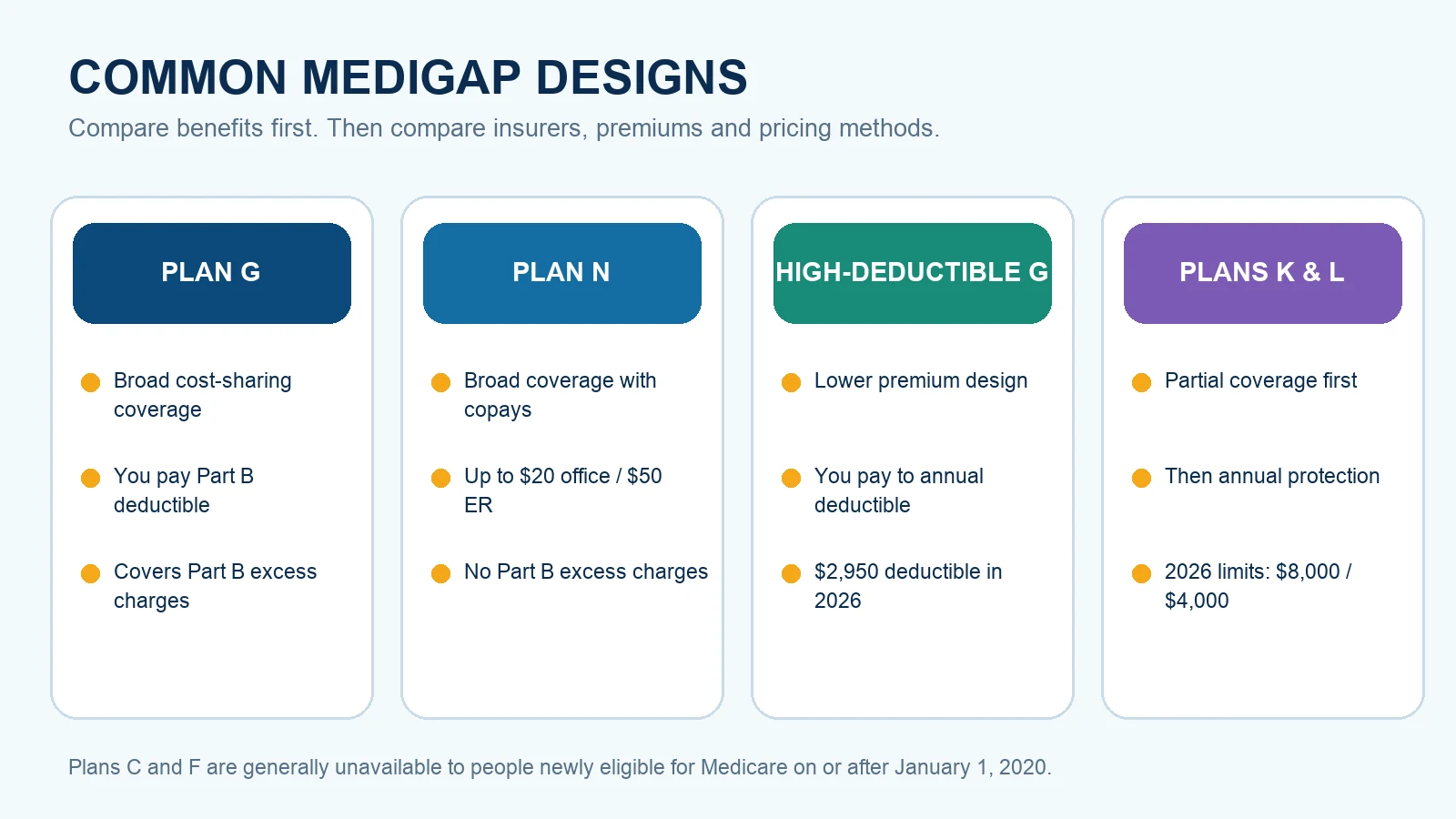
| Plan G | Broad standardized coverage after the Part B deductible; includes Part B excess charges | Often higher premium in exchange for predictable covered medical costs |
| Plan N | Broad coverage but permits up to $20 for some office visits and up to $50 for certain emergency-room visits; does not cover Part B excess charges | Potentially lower premium with more cost sharing and attention to assignment |
| High-deductible Plan G | You pay Medicare-covered costs up to the annual high deductible before the policy pays | Lower premium but substantially more early-year exposure; 2026 deductible is $2,950 |
| Plans K and L | Pay a percentage of several benefits until the annual plan limit and Part B deductible are met, then pay 100% of covered services for the rest of the year | Partial coverage before the limit; 2026 limits are $8,000 for K and $4,000 for L |
| Plans C and F | Broad legacy designs that include the Part B deductible | Generally limited to people eligible for Medicare before January 1, 2020 |
This is a starting comparison, not a recommendation. Plan availability and premiums depend on location. Use Medicare’s official comparison chart for every benefit and confirm the current deductible and limits before applying.
The six-month window that matters most
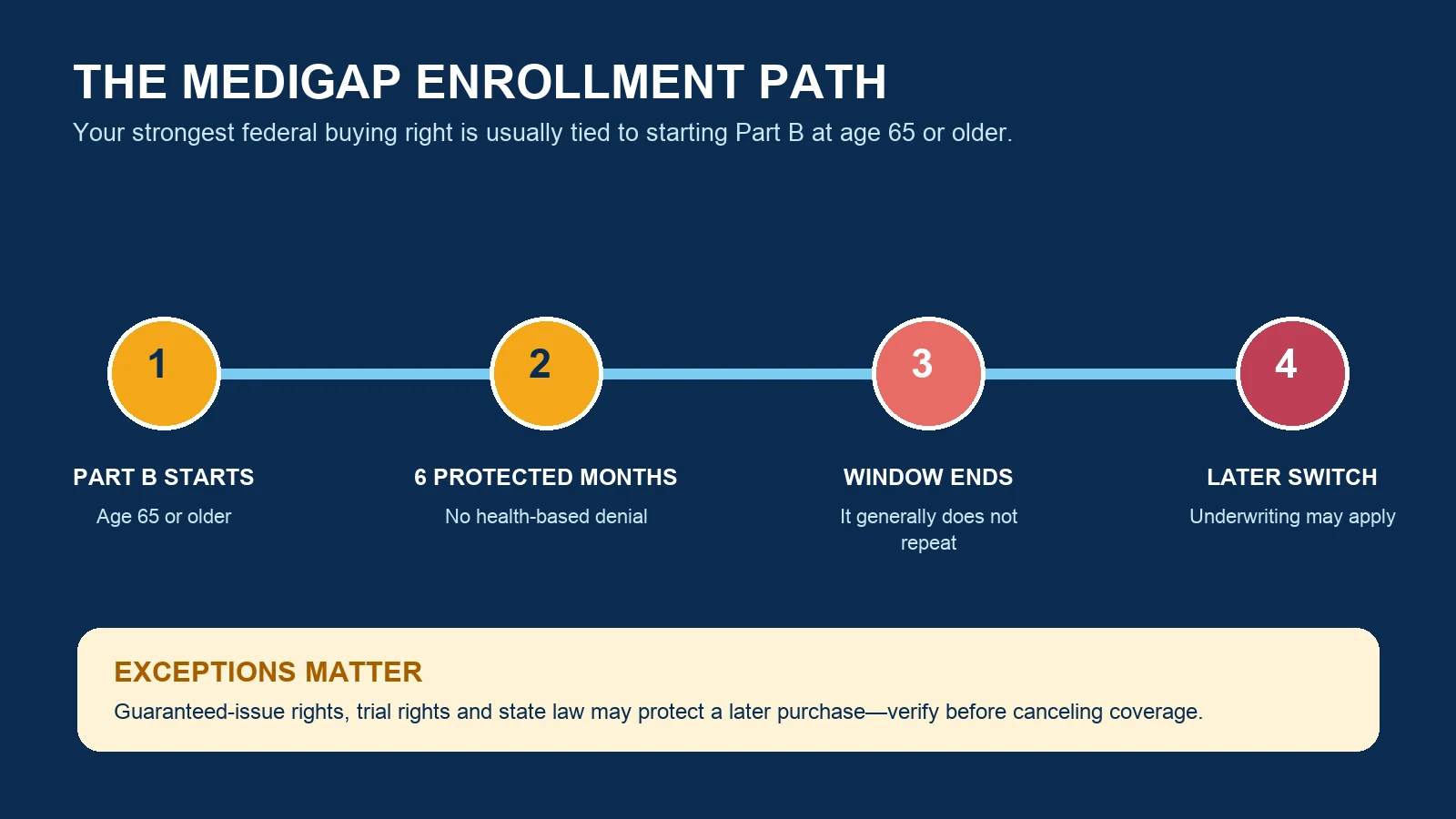
Under federal law, the one-time Medigap Open Enrollment Period begins the first month you are both:
- 65 or older, and
- enrolled in Medicare Part B.
It lasts six months. During this protected window, you can buy any Medigap medical policy an insurer sells in your state. The insurer cannot reject the application or charge more because of current or past health problems.
This is not the October 15–December 7 enrollment period
Medicare’s fall Annual Enrollment Period concerns Medicare Advantage and Part D plan choices. It does not create a fresh six-month Medigap Open Enrollment Period. Your federal Medigap window generally cannot be changed or repeated.
What if you work past 65?
If you delay Part B because you or your spouse has qualifying coverage based on current employment, your Medigap Open Enrollment Period generally begins when you later enroll in Part B at age 65 or older. Do not start Part B merely to start the Medigap clock without first understanding how the employer plan coordinates with Medicare. The guide to Medicare enrollment while working explains the timing questions.
Can a pre-existing condition cause a waiting period?
Even during Medigap Open Enrollment, an insurer may in some circumstances delay Medigap payment for costs related to a pre-existing condition for up to six months. The look-back generally concerns a condition treated or diagnosed during the six months before the policy starts. Prior creditable coverage can shorten or eliminate that waiting period, and guaranteed-issue protections require coverage of pre-existing conditions without that waiting period. Original Medicare continues covering Medicare-covered services during any Medigap waiting period; you would be responsible for the relevant cost sharing.
Why switching later can be difficult
After the protected enrollment period, federal law generally does not guarantee the right to switch from one Medigap policy to another or to buy Medigap after leaving Medicare Advantage. An insurer may use medical underwriting where permitted. It may ask health questions, review medications and recent treatment, charge more or decline the application.
State law can provide broader protections, including additional open enrollment, birthday or anniversary switching rules, continuous or annual guaranteed issue, or protections for people under 65. These rules vary significantly. Check the State Insurance Department and SHIP before assuming a national rule applies.
Never cancel the old policy before the new one is secured
Apply for the replacement first. Get the acceptance, premium and effective date in writing. When switching Medigap policies, federal guidance generally provides a 30-day “free look” period in which you can decide whether to keep the new policy. You may need to pay both premiums during that overlap. Canceling first can leave you without either policy if the new application is declined.
Guaranteed-issue rights: important but limited
A guaranteed-issue right is a situation in which an insurer must sell you certain Medigap policies, cover pre-existing conditions and cannot charge more because of health. Common federal situations include:
- Your Medicare Advantage plan leaves Medicare, stops serving your area, substantially changes its network, or you move outside its service area and return to Original Medicare.
- You have Original Medicare plus employer, retiree, union or COBRA coverage that pays after Medicare, and that coverage ends.
- You move outside a Medicare SELECT policy’s service area.
- Your Medigap insurer becomes bankrupt or coverage ends through no fault of your own.
- You leave a plan because the company broke the rules or materially misled you.
- You qualify for one of the federal trial rights described below.
The right may apply only to certain plan letters and has a short application period. In many situations, the federal window begins before the old coverage ends and closes no more than 63 days afterward. Keep termination letters, notices, claim denials and their postmarked envelopes because the insurer may request proof.
The two federal trial rights
Trial right 1: You chose Medicare Advantage when first eligible at 65
If you joined Medicare Advantage when first eligible for Part A at 65 and decide within the first year that you want Original Medicare, you can generally buy certain Medigap coverage under a trial right. The right is time-limited and requires switching to Original Medicare.
Trial right 2: You dropped Medigap to try Medicare Advantage for the first time
If you dropped a Medigap policy to join Medicare Advantage for the first time and return to Original Medicare within the first year, you generally have the right to recover the former Medigap policy if the same insurer still sells it. If it is unavailable, the federal protection permits certain alternatives. This trial right is generally available only once.
Do not rely on a trial right without confirming dates, the policy you can buy and the application deadline. Coordinate the Medicare Advantage disenrollment, Original Medicare effective date, Medigap start and Part D coverage so the pieces begin together.
How insurers set Medigap premiums
Two insurers can charge very different premiums for the same standardized lettered benefits. Ask how the policy is priced:
| Pricing method | How age is used | What to ask |
|---|---|---|
| Community-rated | People generally pay the same base premium regardless of age | How often has the block increased because of inflation, claims or other factors? |
| Issue-age-rated | Premium is based on age when the policy is purchased and does not rise merely because you get older | What increases have occurred for reasons other than aging? |
| Attained-age-rated | Premium is based on current age and can rise as you get older | How frequently does age increase the premium, in addition to other increases? |
All three methods can experience increases from medical costs, inflation and other factors. Also ask about household discounts, tobacco status, payment-method discounts, enrollment fees, expected rate changes and whether the quote assumes a discount that could disappear.
A practical way to compare policies
- Confirm eligibility. You need Original Medicare Part A and Part B; identify whether you are in open enrollment, have guaranteed issue, or face underwriting.
- Choose the lettered benefit design. Compare standardized benefits before comparing company names.
- Get several quotes for the same letter. A cheaper Plan N should be compared with other Plan N policies, not casually against a different benefit design.
- Ask how the premium is rated. Compare present price and the mechanism for future increases.
- Review rate history. It cannot predict the future, but it can reveal how the policy block has behaved.
- Check discounts and fees. Identify which price reductions are temporary or conditional.
- Confirm effective dates in writing. Coordinate Part B, Medigap and Part D.
- Keep every document. Save the application, outline of coverage, acceptance, policy and proof of guaranteed-issue rights.
Questions to ask the insurer or agent
- Am I applying during Medigap Open Enrollment or under a guaranteed-issue right?
- Will medical underwriting apply?
- Could a pre-existing-condition waiting period apply?
- Is this exactly Plan G, Plan N or another standardized letter—not Medicare Advantage?
- Is the premium community-rated, issue-age-rated or attained-age-rated?
- What discounts are included, and can they expire?
- What were the policy’s rate increases during the last five years?
- Is there an enrollment, household or payment fee?
- Does the policy include any nonstandard extras, and can those extras change?
- What is the exact effective date?
- If replacing a policy, when should I cancel the old one?
Medigap or Medicare Advantage?
Medigap and Medicare Advantage are different coverage paths. You cannot use Medigap to pay Medicare Advantage copayments, and it is generally illegal for an insurer to sell Medigap to someone known to be enrolled in Medicare Advantage unless that person is switching back to Original Medicare.
Original Medicare plus Medigap usually offers broad provider access and more predictable cost sharing in exchange for separate premiums for Part B, Medigap and usually Part D. Medicare Advantage may have a low additional premium and extra benefits, but commonly uses networks, prior authorization and plan-specific copayments. Use RetireNerd’s complete Original Medicare versus Medicare Advantage comparison before choosing the path.
Frequently asked questions
Does Medigap have an annual open enrollment period?
Not like Medicare Advantage and Part D. The federal Medigap Open Enrollment Period generally lasts six months beginning when you are 65 or older and have Part B. It is ordinarily a one-time window.
Can I switch Medigap companies whenever I want?
You can apply, but outside a protected period or guaranteed-issue situation the new insurer may use medical underwriting where allowed, charge more or decline the application. State protections may provide additional opportunities.
Is one company’s Plan G better than another company’s Plan G?
The standardized medical benefits are the same in most states. Premiums, pricing method, service, discounts, financial strength and rate history can differ.
Does Medigap cover prescription drugs?
New Medigap policies sold after 2005 do not include outpatient prescription drug coverage. People who want drug coverage generally enroll separately in Part D.
Can spouses share one Medigap policy?
No. Medicare and Medigap cover individuals. Each spouse buys a separate policy and can choose a different plan or insurer.
Official resources
- Medicare.gov: Medigap Open Enrollment and buying rights
- Medicare.gov: Compare Medigap plan benefits
- Medicare.gov: How Medigap works
- Official Choosing a Medigap Policy guide
- SHIP: Free Medicare counseling
- NAIC: Find your State Insurance Department
- Medicare Plan Compare
Reviewed September 2026. Medigap availability, underwriting and switching protections vary by state. Plan deductibles and limits can change annually. Confirm your rights, application dates, premium and effective date with Medicare, SHIP, the State Insurance Department and the insurer before ending existing coverage. This article is general educational information, not individualized insurance, medical, financial, tax or legal advice.