
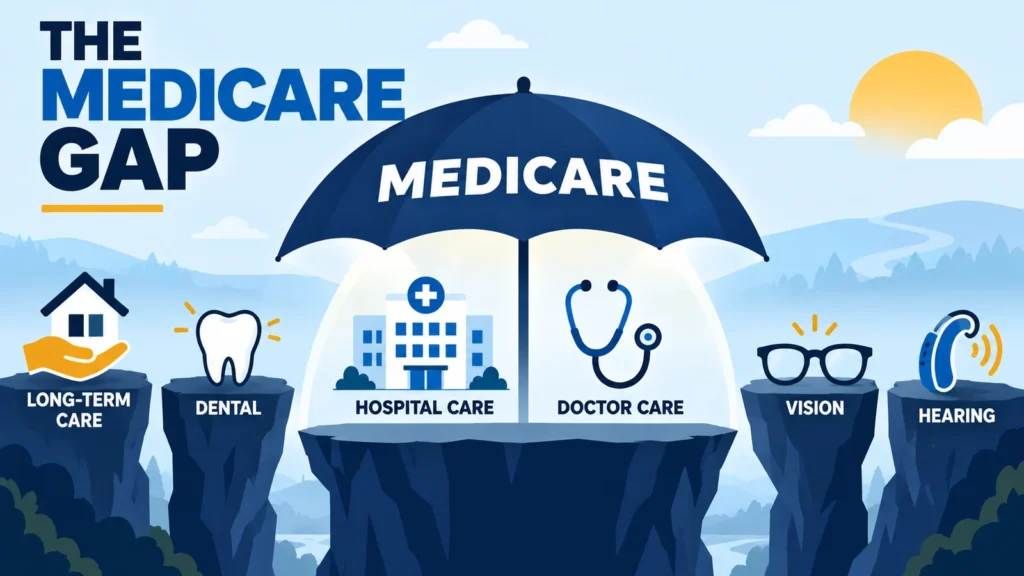
Medicare covers hospital care, doctors and many medically necessary services. It does not cover every expense that becomes common later in life—and the largest gap, long-term custodial care, can cost more in one year than many households spend on everything else.
The planning mistake is treating a Medicare card like an all-inclusive retirement healthcare plan. Original Medicare has exclusions, deductibles and coinsurance. It also has no annual out-of-pocket maximum for covered Part A and Part B services. Medicare Advantage plans must cap out-of-pocket spending for covered Part A and Part B care, but that cap does not turn every excluded service into a covered one.
The misconception gap in one sentence
Medicare is health insurance. It is not a long-term care plan, a dental plan, a vision plan or a hearing-aid plan.
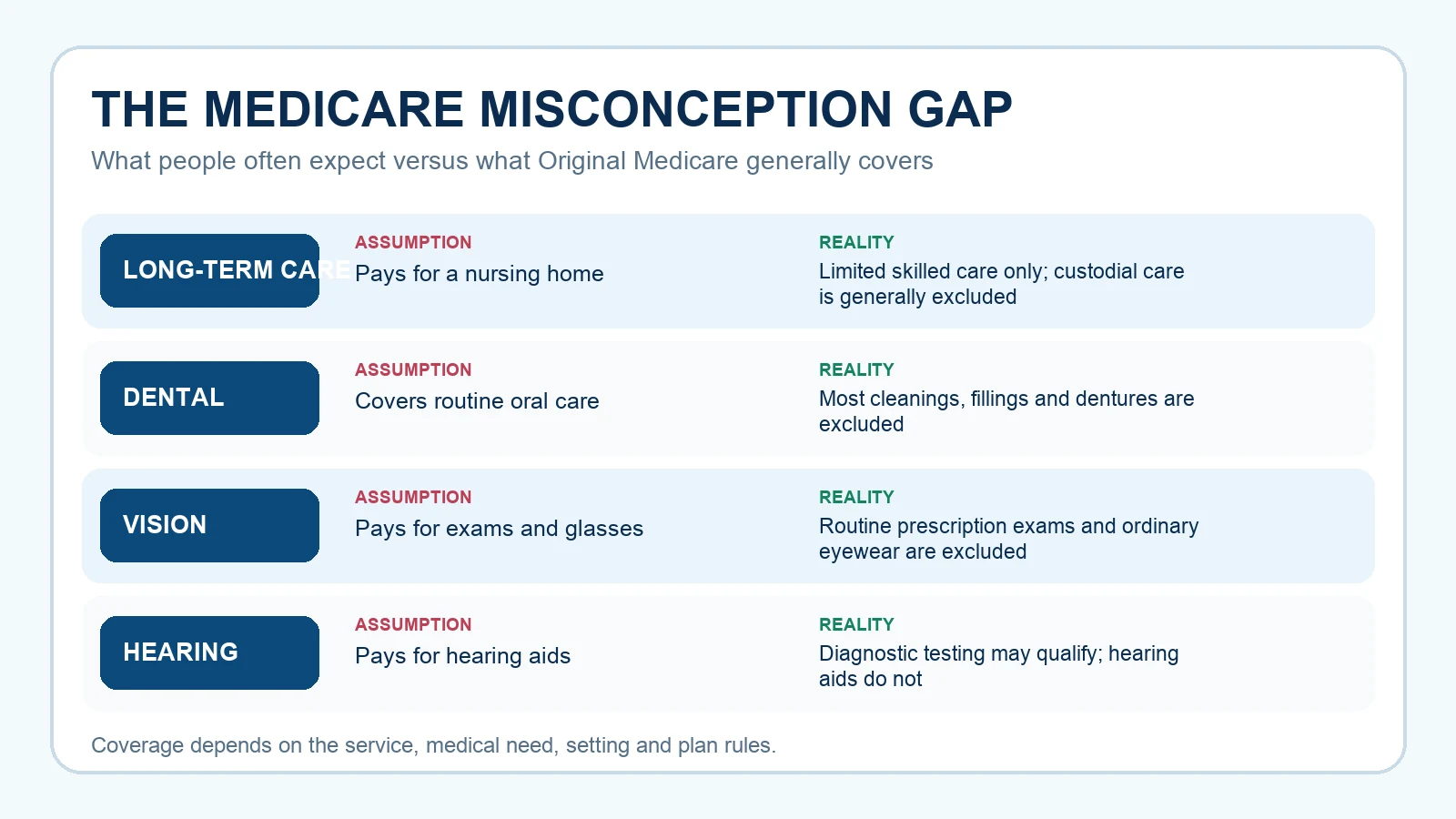
Some medically necessary services involving the mouth, eyes or ears are covered. Some short-term skilled nursing and home health services are covered. The ordinary care people assume is included often is not.
What people assume—and what Medicare actually does
| Common assumption | What Original Medicare generally does | What to plan for |
|---|---|---|
| “Medicare will pay if I need a nursing home.” | Covers limited skilled nursing facility care only when coverage rules are met; it does not pay for ongoing custodial care. | A separate long-term care funding plan. |
| “Home health means someone can stay with me every day.” | Covers eligible intermittent skilled care and limited aide services tied to skilled care—not 24-hour help or personal care when that is the only need. | Private-pay home care, family help, Medicaid or long-term-care coverage. |
| “Dental is part of healthcare, so Medicare covers it.” | Most cleanings, fillings, extractions and dentures are excluded, with narrow medically connected exceptions. | Cash reserve, standalone coverage or a plan benefit with clear limits. |
| “Medigap fills every Medicare gap.” | Medigap mainly helps with your share of costs for Medicare-covered services. | Separate money for excluded services. |
| “Medicare Advantage dental, vision and hearing means no bill.” | Benefits may have networks, allowances, frequency limits, prior authorization and annual maximums. | Read the Evidence of Coverage and price the amount left over. |
The biggest gap: long-term custodial care
Custodial care means ongoing help with ordinary activities such as bathing, dressing, eating, using the bathroom, moving safely or supervision because of cognitive impairment. That help can be delivered at home, in assisted living or in a nursing home. When custodial care is the only care needed, Medicare generally does not pay for it.
This is different from skilled care, which requires trained medical professionals. Medicare Part A can cover a skilled nursing facility stay when its conditions are met. Coverage is limited to a benefit period and depends on the person needing daily skilled care. In 2026, covered days 1–20 have no daily coinsurance; days 21–100 require $217 per day; after day 100, the person pays all facility costs for that benefit period. These rules do not promise 100 days, and they do not create coverage for a permanent nursing-home residence.
Medicare home health is also narrower than many families expect. Eligible homebound beneficiaries may receive intermittent skilled nursing, therapy and limited home health aide services. Medicare does not cover 24-hour home care, meals, homemaker services unrelated to the care plan, or personal care when that is the only service needed.
What long-term care can actually cost
The 2025 CareScout Cost of Care Survey reported these national medians. Local prices can be much higher or lower, and the in-home figure assumes 44 hours of care per week.
| Care setting | 2025 national monthly median | 2025 national annual median | Typical Medicare payment for ongoing custodial care |
|---|---|---|---|
| Non-medical caregiver at home | $6,673 | $80,080 | Generally $0 |
| Adult day health care | $2,058 | $24,700 | Generally $0 when it is custodial/social care |
| Assisted living | $6,200 | $74,400 | Generally $0 for room, board and custodial care |
| Nursing home, semi-private room | $9,581 | $114,975 | Generally $0 after limited covered skilled care ends |
| Nursing home, private room | $10,798 | $129,575 | Generally $0 after limited covered skilled care ends |
The $217 skilled-nursing copay is not the long-term care bill
That 2026 daily coinsurance applies only to covered skilled nursing facility days 21–100. It does not mean Medicare will pay for assisted living, ongoing supervision or a permanent nursing-home stay. When skilled coverage ends—or the care is custodial from the start—the private-pay amount can jump to the facility’s full rate.
Dental: routine and major work can both be out of pocket
Original Medicare generally does not cover routine cleanings, fillings, ordinary extractions, dentures or implants. It may cover certain dental services that are closely connected to covered treatment, including some services connected with an organ transplant, heart-valve procedure, cancer treatment or dialysis. A medical connection does not automatically make every dental charge covered, so ask the provider to verify the exact service and billing code.
The most useful real-world number is not a universal price list because dental fees vary widely and one major procedure can dominate the year. KFF’s analysis of 2023 Medicare Current Beneficiary Survey data found that community-dwelling Original Medicare beneficiaries who used dental services spent $1,107 out of pocket on average. That is an average among users, not a safe ceiling. Crowns, dentures, root canals, periodontal treatment or implants can make an individual bill much larger.
For a deeper explanation of the narrow exceptions and plan limits, use RetireNerd’s guide to Medicare coverage for dental, vision and hearing.
Vision: medical eye care is different from routine eyewear
Original Medicare generally does not cover routine eye exams performed to prescribe eyeglasses or contacts, and it usually does not pay for ordinary frames and lenses. Part B can cover certain diagnostic and treatment services for conditions such as glaucoma, diabetic eye disease and macular degeneration when coverage rules are met. After cataract surgery with an implanted intraocular lens, Medicare may cover one pair of standard corrective glasses or contacts from a Medicare-enrolled supplier.
Budget for the complete purchase: routine exam, refraction if billed separately, frames, lenses, coatings and contacts. If a plan advertises a vision allowance, check whether it is annual or biennial, whether the provider is in network and how much of premium frames, progressive lenses or contacts remains your responsibility.
Hearing: testing may be covered while hearing aids are not
Original Medicare does not cover hearing aids or exams solely for fitting them. Part B may cover diagnostic hearing and balance exams when a doctor or other eligible provider orders them to determine whether medical treatment is needed. That distinction can produce a covered diagnostic visit followed by a fully private-pay hearing-aid purchase.
KFF found that Original Medicare beneficiaries who used hearing services spent $564 out of pocket on average in 2023. Medicare Advantage enrollees who used hearing services still spent an average of $212. Again, these are averages among users. The cost depends on whether a person chooses over-the-counter or prescription devices, needs one or two aids, and receives bundled fitting, follow-up and replacement services.
Other gaps that can surprise a retiree
- Routine physical exams. The “Welcome to Medicare” preventive visit and annual wellness visit are not traditional head-to-toe physicals. Covered preventive services have eligibility and frequency rules.
- Most care outside the United States. Original Medicare has only limited exceptions. Some Medigap policies include limited foreign-travel emergency coverage.
- Massage therapy and most cosmetic surgery. Medical necessity and coverage rules matter.
- Concierge membership fees. Medicare may cover eligible services from a participating clinician, but the membership or retainer fee itself is not a Medicare benefit.
- Providers who opt out of Medicare. Except for limited emergency or urgent circumstances, you may be responsible under a private contract.
- Ordinary cost sharing. Even a covered service can leave deductibles and coinsurance. Original Medicare by itself has no annual Parts A and B out-of-pocket maximum.
RetireNerd’s current Medicare cost guide covers premiums, deductibles and drug-cost rules. Keep those ordinary Medicare expenses separate from the excluded-service reserve built below.
How people actually fill the gaps
Original Medicare plus Medigap
Medigap helps pay some deductibles, copayments and coinsurance for services Original Medicare covers. That can make covered medical bills more predictable. It generally does not cover long-term care, routine dental or vision care, hearing aids, glasses or private-duty nursing. Someone choosing Original Medicare, Part D and Medigap therefore still needs a separate plan for the exclusions in this article.
Medicare Advantage
A Medicare Advantage plan provides Part A and Part B benefits through a private insurer and usually includes Part D. Plans have an annual out-of-pocket limit for covered Part A and Part B services and may add dental, vision and hearing benefits. Those extras can reduce costs, but the words “included” and “covered” do not reveal the value.
- Is the dentist, optometrist, audiologist or hearing-aid supplier in network?
- Is the benefit an allowance, a percentage of negotiated charges or a fixed copay?
- What is the annual maximum?
- Are major dental services covered immediately, or is there a waiting period or prior authorization?
- How often are exams, lenses, frames or hearing aids available?
- Are premium lens options, implants or advanced hearing devices excluded?
- Does unused allowance carry over?
In KFF’s 2023 data, Medicare Advantage users still averaged $571 out of pocket for dental services and $212 for hearing services. Compare the entire medical plan—doctors, hospitals, drugs, networks, authorization, premium and maximum exposure—not just the extra benefits. The Original Medicare versus Medicare Advantage guide walks through that choice.
Standalone coverage and discount arrangements
Standalone dental or vision insurance, employer or retiree coverage, veterans benefits, Medicaid and community programs can help eligible people. Compare premium plus cost sharing against the plan’s annual benefit. A policy with a modest maximum may improve cash flow without protecting against a very large bill. Dental discount plans are not insurance; they may provide negotiated prices from participating providers.
Self-funding predictable gaps
Self-funding means deliberately reserving money instead of assuming each bill will fit into the monthly budget. It works best for bounded expenses such as exams, glasses and routine dental care. Use a monthly sinking fund plus a separate major-work reserve. An HSA can be valuable if money was accumulated before Medicare eligibility, because qualified medical withdrawals can remain tax-free under current rules. Once enrolled in Medicare, a person cannot continue contributing to an HSA.
A separate long-term care strategy
Dental and glasses can be annual budget lines. Long-term care is a different class of risk because the duration and total cost are uncertain. Possible resources include savings and home equity, traditional or hybrid long-term-care insurance, family support, Medicaid after state eligibility rules are met, veterans benefits for eligible people, and community-based programs. Medicare Advantage and Medigap are not comprehensive long-term custodial care policies.
Someone planning to self-fund long-term care should decide which assets are reserved, what care setting those assets could support, how a spouse’s housing and income would be protected, and what happens when the reserve is exhausted. Local costs—not national medians—should drive the decision.
Worksheet: estimate your true uncovered costs
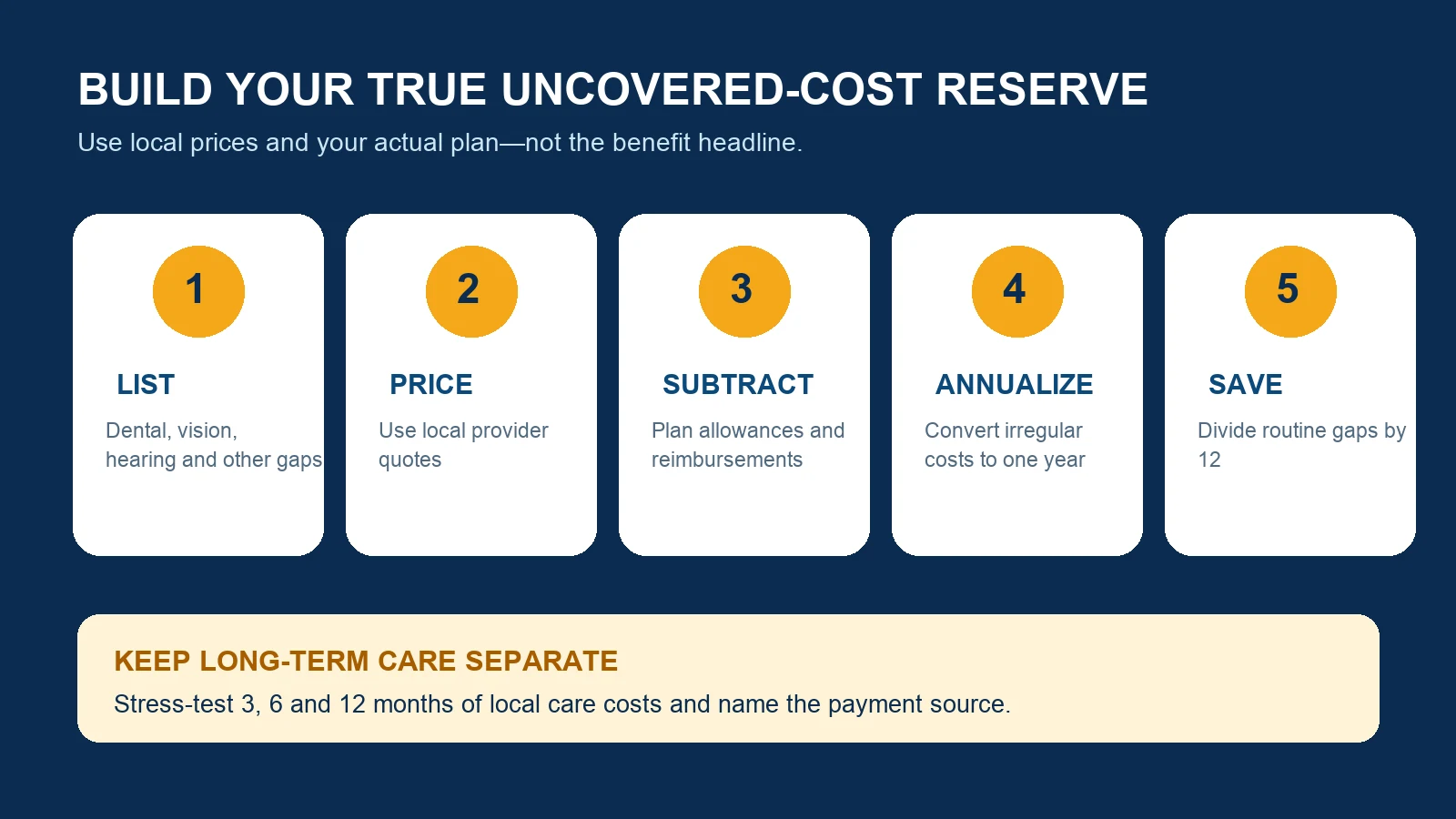
Use quotes from local providers and the actual plan documents. Do not enter $0 merely because a plan advertises a benefit. Enter the amount you expect to pay after the allowance, network discount, coinsurance and annual maximum. medicare uncovered cost worksheet printable
| Cost line | Frequency | Expected price | Insurance or allowance | Your annual gap |
|---|---|---|---|---|
| Dental exams and cleanings | ___ per year | $___ | − $___ | $___ |
| Major dental work reserve | Annual reserve | $___ | − $___ | $___ |
| Routine eye exam/refraction | Every ___ years | $___ | − $___ | $___ |
| Frames, lenses or contacts | Every ___ years | $___ | − $___ | $___ |
| Hearing exams and devices | Every ___ years | $___ | − $___ | $___ |
| Device batteries, maintenance and replacements | Annual | $___ | − $___ | $___ |
| Noncovered routine or concierge care | Annual | $___ | − $___ | $___ |
| Foreign travel medical coverage or reserve | Annual | $___ | − $___ | $___ |
| Short-term paid help at home | ___ hours × $___ | $___ | − $___ | $___ |
| Other uncovered services | Annual | $___ | − $___ | $___ |
| Total routine annual gap | $___ | |||
| Monthly sinking-fund target | Total ÷ 12 | $___ |
Then run three stress tests
- A routine year: cleanings, ordinary vision and device upkeep.
- A major-work year: add a crown, dentures, advanced lenses or replacement hearing aids. Use an actual local estimate.
- A care year: add three, six and twelve months of local home care, assisted living or nursing-home care. Then identify the source of payment for each scenario.
Keep the long-term care reserve outside the routine monthly healthcare number. A $1,500 dental surprise and a $115,000 nursing-home year should not be treated as the same type of expense.
Questions to ask before choosing coverage
- Which services do I use every year, and which large expenses am I trying to insure?
- What is excluded even after I add Medigap or choose Medicare Advantage?
- What is the plan’s annual dollar maximum for dental, vision and hearing?
- Which local providers accept the benefit?
- What would I pay in a normal year and a difficult year?
- What is my plan if I need help with bathing, dressing or supervision for six months?
- Could one spouse’s care costs destabilize the other spouse’s retirement?
- Do I qualify for Medicaid, Medicare Savings Programs, veterans benefits, PACE or local assistance?
- When will I review the plan again?
Frequently asked questions
Does Medicare pay for assisted living?
Generally, Medicare does not pay the room, board and custodial-care charges of assisted living. It may cover eligible medical services a resident receives, just as it would in another setting.
Does Medicare cover 100 days in a nursing home?
It can cover up to 100 skilled nursing facility days in a benefit period only when all coverage conditions continue to be met. It does not guarantee 100 days. Days 21–100 require daily coinsurance, and ongoing custodial care is not covered.
Does Medigap cover dental, vision, hearing or long-term care?
Generally no. Medigap mainly pays some of the cost sharing attached to services Original Medicare covers. It does not ordinarily cover routine dental or vision care, glasses, hearing aids, private-duty nursing or long-term custodial care.
Will Medicare Advantage solve all of these gaps?
No. A plan may add useful dental, vision and hearing benefits, but allowances, networks and limits apply. Medicare Advantage does not become comprehensive long-term custodial care coverage.
How much should I save for uncovered Medicare costs?
There is no reliable national amount for every household. Use the worksheet with your plan benefits, providers and local costs. Build a monthly reserve for predictable expenses, a separate major-work reserve and an explicit long-term care strategy.
Sources and planning tools
- Medicare.gov: What Original Medicare does not cover
- Medicare.gov: Long-term care coverage
- Medicare.gov: Skilled nursing facility care
- Medicare.gov: Home health services
- Medicare.gov: What Medigap covers
- CMS: 2026 Medicare Parts A and B costs
- CareScout: 2025 Cost of Care Survey tables
- KFF: Medicare affordability and out-of-pocket costs
- Medicare Plan Compare
- SHIP: Free, unbiased Medicare counseling
Reviewed September 2026. CareScout figures are 2025 national medians; KFF dental and hearing amounts use 2023 data, the latest cited Medicare Current Beneficiary Survey cost file in its analysis. Medicare rules, plan benefits and prices change. Verify current coverage with Medicare and the plan, and use local provider prices. This article is general educational information, not individualized medical, insurance, financial, tax or legal advice.