

Two programs can lower Medicare costs for people with limited income and savings. Medicare Savings Programs help with Part A and Part B costs. Extra Help lowers Part D prescription-drug costs. Because they cover different bills, it is worth checking both.
The names are easy to mix up, and the application routes are different. However, the basic strategy is simple: ask your state about a Medicare Savings Program, and apply through Social Security for Extra Help if you do not already receive it automatically.
The short answer
- Medicare Savings Programs, or MSPs, can pay a Part B premium and, in some cases, Part A premiums and Medicare cost sharing.
- Extra Help, also called the Part D Low-Income Subsidy, lowers prescription-drug premiums, deductibles and copayments.
- Approval for QMB, SLMB or QI generally gives you Extra Help automatically.
- Federal figures are only a starting point. States may use higher limits or count income and resources differently.
Start with the bill you need help paying
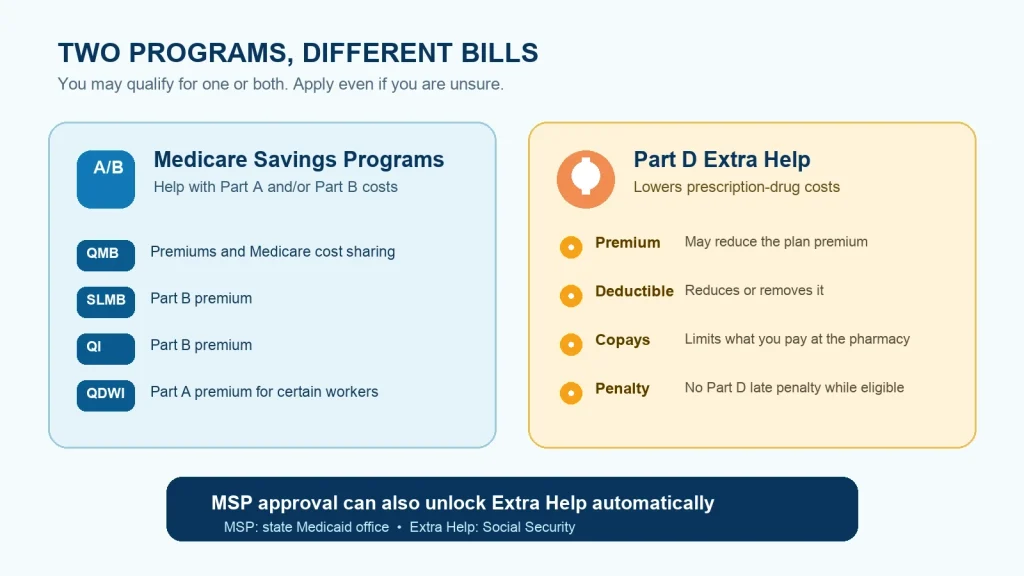
| Program | What it may pay | Where to start |
|---|---|---|
| Medicare Savings Program | Part A and/or Part B premiums; QMB also protects against most Medicare deductibles, coinsurance and copayments | Your state Medicaid or medical-assistance office |
| Extra Help | Part D drug-plan premium, deductible and prescription copayments or coinsurance | Social Security, unless you qualify automatically |
For example, someone may qualify for help with the Part B premium even if they use very few prescriptions. Another person may need Extra Help for expensive drugs but not qualify for an MSP under the state’s rules. Therefore, one denial should not stop the other application.
The four Medicare Savings Programs
QMB: the broadest protection
The Qualified Medicare Beneficiary program can pay Part B premiums, Part A premiums when a person owes them, and Medicare deductibles, coinsurance and copayments for Medicare-covered care. Providers generally may not bill a QMB member for those Medicare cost-sharing amounts. A small Medicaid copayment may apply in limited situations.
If a provider bills you anyway, do not simply pay it. Show proof of QMB status, ask the provider to correct the bill and contact the plan or 1-800-MEDICARE if needed.
SLMB and QI: help with the Part B premium
The Specified Low-Income Medicare Beneficiary program and Qualifying Individual program both help pay the Part B premium. As a result, that premium may stop being deducted from a Social Security payment after the state processes the award.
QI has special rules. Funding is limited, approvals are generally first-come, first-served, and recipients must reapply each year. In addition, a person cannot receive QI while qualifying for another Medicaid benefit. Previous QI recipients receive priority, so renewal paperwork should not be ignored.
QDWI: a narrower program for certain working people with disabilities
The Qualified Disabled and Working Individuals program can pay the Part A premium for certain people who returned to work and lost premium-free Part A tied to disability benefits. Its eligibility rules and financial limits differ from the other three MSPs. Therefore, someone in this situation should describe the loss of premium-free Part A when contacting the state.
What Extra Help changes
Extra Help reduces Medicare Part D prescription costs. It may lower or eliminate the plan premium up to a regional benchmark, remove the deductible and cap what you pay for covered drugs. It also removes the Part D late-enrollment penalty while you qualify.
Still, Extra Help does not make every prescription free. Your drug must be covered by the plan, and plan rules such as prior authorization may still apply. The plan Medicare selects for you may not be the best match for your medicines and pharmacy. Consequently, compare its formulary and network, and use RetireNerd’s guide to comparing Part D plans before deciding to keep it.
Who gets Extra Help automatically?
You generally receive Extra Help automatically if you have full Medicaid, get help from a Medicare Savings Program or receive Supplemental Security Income. Medicare sends a notice explaining the benefit and, if necessary, enrollment in a drug plan.
If you are not in one of those groups, you can apply through Social Security. Moreover, you may apply before or after joining a Part D plan. Social Security can also send information to your state to begin an MSP application unless you decline that step on the application.
A current reference—not a permanent eligibility test
The following figures are federal 2026 reference amounts. They change, and state rules may be more generous. Income means countable income under program rules, not simply the number on a tax return. Likewise, some property is excluded from countable resources.
| 2026 federal reference | Individual | Married couple |
|---|---|---|
| QMB monthly income / resources | $1,350 / $9,950 | $1,824 / $14,910 |
| SLMB monthly income / resources | $1,616 / $9,950 | $2,184 / $14,910 |
| QI monthly income / resources | $1,816 / $9,950 | $2,455 / $14,910 |
| QDWI monthly income / resources | $5,405 / $4,000 | $7,299 / $6,000 |
| Extra Help annual income / resources | $23,940 / $18,090 | $32,460 / $36,100 |
Do not screen yourself out with this table. For instance, some states have higher MSP limits, disregard certain income, or do not use a resource test for some programs. Earned-income exclusions can also matter. The state—not an online estimate—makes the MSP decision.
What usually counts as a resource?
Countable resources often include checking and savings accounts, stocks, bonds and other investments that can be converted to cash. Extra Help can also count real estate other than the home where you live. By contrast, a primary home, one vehicle, personal possessions and certain burial arrangements are generally excluded. The exact treatment depends on the program and, for MSPs, the state.
Retirement accounts deserve special attention. Social Security asks about IRA and 401(k) balances for Extra Help, while state MSP treatment can vary. Therefore, report what the application requests rather than moving, spending or giving away assets merely to fit an estimate. Ask a qualified benefits counselor or elder-law attorney before taking an irreversible step.
How to apply without getting lost
- Gather a one-page financial snapshot. Include Social Security and pension income, recent bank balances, investment and retirement-account statements, other real estate and current insurance cards.
- Call the state Medicaid office. Say that you want to apply for all Medicare Savings Programs for which you may qualify. Ask whether your state has higher limits, disregards or no asset test.
- Apply for Extra Help. Use Social Security’s online application or call 1-800-772-1213. If you already have full Medicaid, SSI or an MSP, confirm whether automatic enrollment is in process.
- Save proof. Keep the application confirmation, documents submitted, the representative’s name and the date of every call.
- Read every notice. A request for evidence has a deadline. If denied, the notice should explain the reason and appeal rights.
- Check the first corrected payment. After MSP approval, confirm that the Part B deduction changes as expected. After Extra Help begins, check the pharmacy receipt and Part D plan.
Free application help
A State Health Insurance Assistance Program counselor can help you understand notices and apply. SHIP counseling is free and is not tied to an insurance company. Find the local program through SHIPhelp.org.
Questions to ask before ending the call
- Which MSP did you screen me for?
- Does this state use different income or resource rules from the federal baseline?
- Which month could assistance begin?
- Could any past premiums or cost sharing be reimbursed?
- What document is still missing?
- Will this approval make me automatically eligible for Extra Help?
- When must I renew, and how will the renewal arrive?
- If denied, what is the appeal deadline?
Three mistakes that cost people money
Mistake 1: assuming homeownership disqualifies you
The home where you live is generally excluded from the federal resource tests discussed here. Therefore, owning a modest home does not automatically make an applicant ineligible.
Mistake 2: treating QMB bills as ordinary debt
QMB includes a strong billing protection for Medicare-covered services. If a provider sends a deductible or coinsurance bill, verify the service and QMB status before paying or placing it on a credit card.
Mistake 3: keeping an automatically assigned drug plan without checking it
Automatic enrollment gets coverage started, but formularies and pharmacy networks differ. As a result, a quick plan comparison can prevent access problems even when Extra Help keeps cost sharing low.
How this fits into a broader Medicare plan
These assistance programs lower specific Medicare costs; they do not replace health coverage. Start with RetireNerd’s complete Medicare guide if Parts A, B, C and D still feel unclear. Then review the expenses Medicare does not cover.
Finally, recheck eligibility after a major change. Retirement, the death of a spouse, a move, lower investment income or a change in household resources may produce a different result. Because rules and limits change, an old denial is not a permanent answer.
Frequently asked questions
Are Medicare Savings Programs and Extra Help the same program?
No. MSPs help with Part A and Part B costs, while Extra Help reduces Part D prescription-drug costs. However, approval for QMB, SLMB or QI generally qualifies a person for Extra Help automatically.
Can I qualify if my income is slightly above the published limit?
Possibly. States may use higher MSP limits or exclude income and resources that appear to put you over the federal baseline. Apply and let the agency make the determination.
Does Extra Help pay for Part B?
No. Extra Help is for Part D prescription costs. An MSP may pay the Part B premium.
Do I need to renew?
Renewal depends on the program and how you qualified. QI requires an annual application, and states may review MSP eligibility periodically. Extra Help generally continues when eligibility continues, but you must respond to review notices.
Official resources
- Medicare.gov: Medicare Savings Programs
- Medicare.gov: Help with drug costs
- Social Security: Apply for Extra Help
- State Health Insurance Assistance Program
This article is educational and does not determine eligibility. Income limits, resource limits, excluded assets, effective dates and renewal rules can change and may differ by state. Verify the current rules with your state Medicaid office, Social Security or Medicare before acting.