
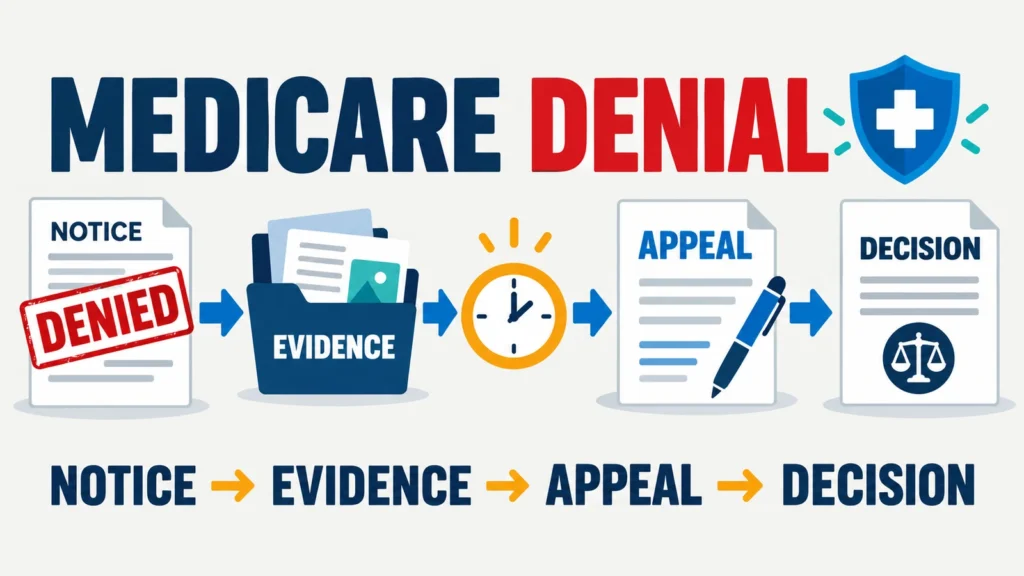
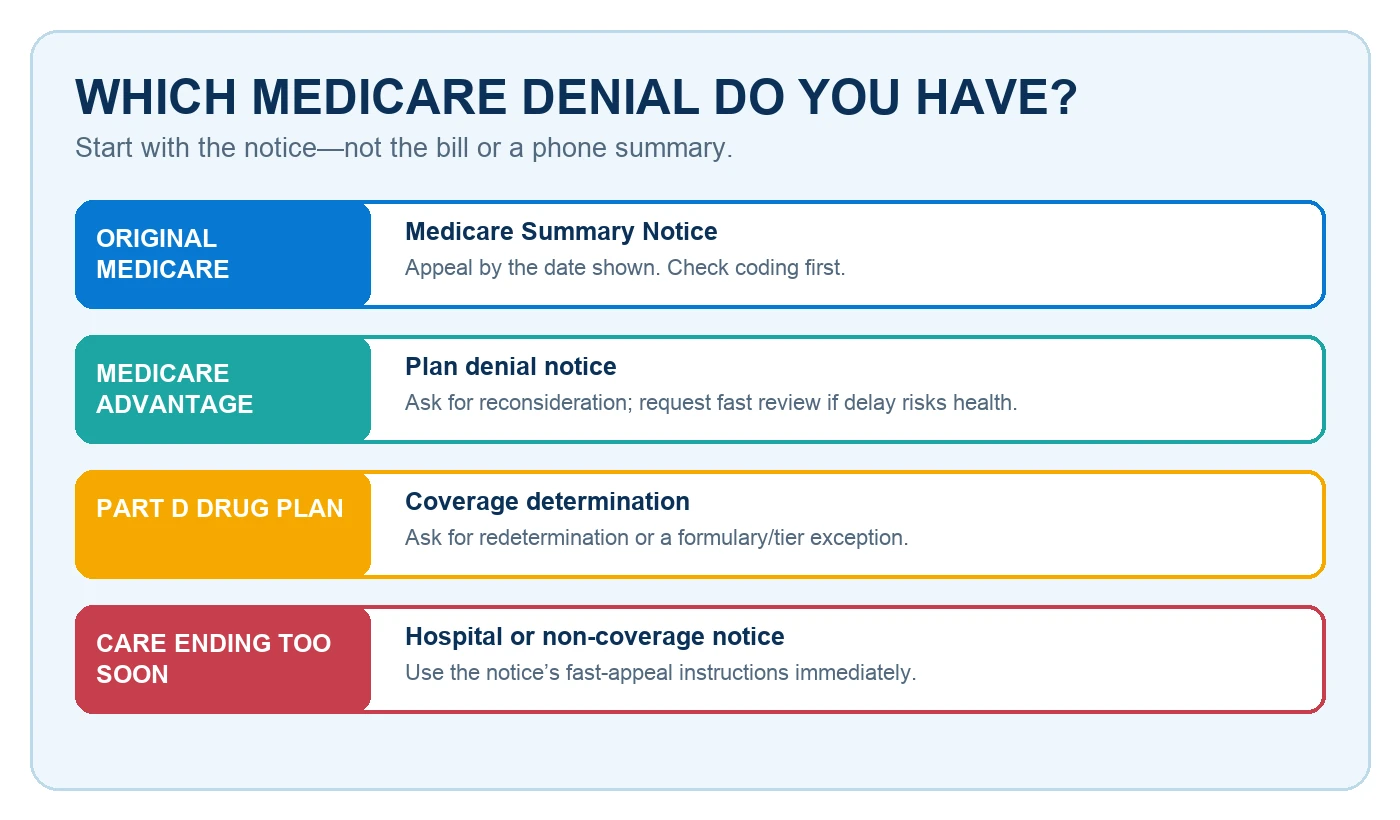
A Medicare denial is a decision you can challenge, but the correct response depends on who denied the care and whether the dispute concerns Original Medicare, Medicare Advantage, a Part D drug plan or services that are about to end. Start with the written notice. It identifies the decision, the deadline and where the appeal must go.
If waiting could seriously harm your health
Ask for an expedited or fast appeal immediately. Say why the standard timeline could seriously jeopardize your life, health or ability to regain maximum function, and ask the treating clinician to support that request. Emergency symptoms require emergency care; do not wait for an appeal decision.
What to do first
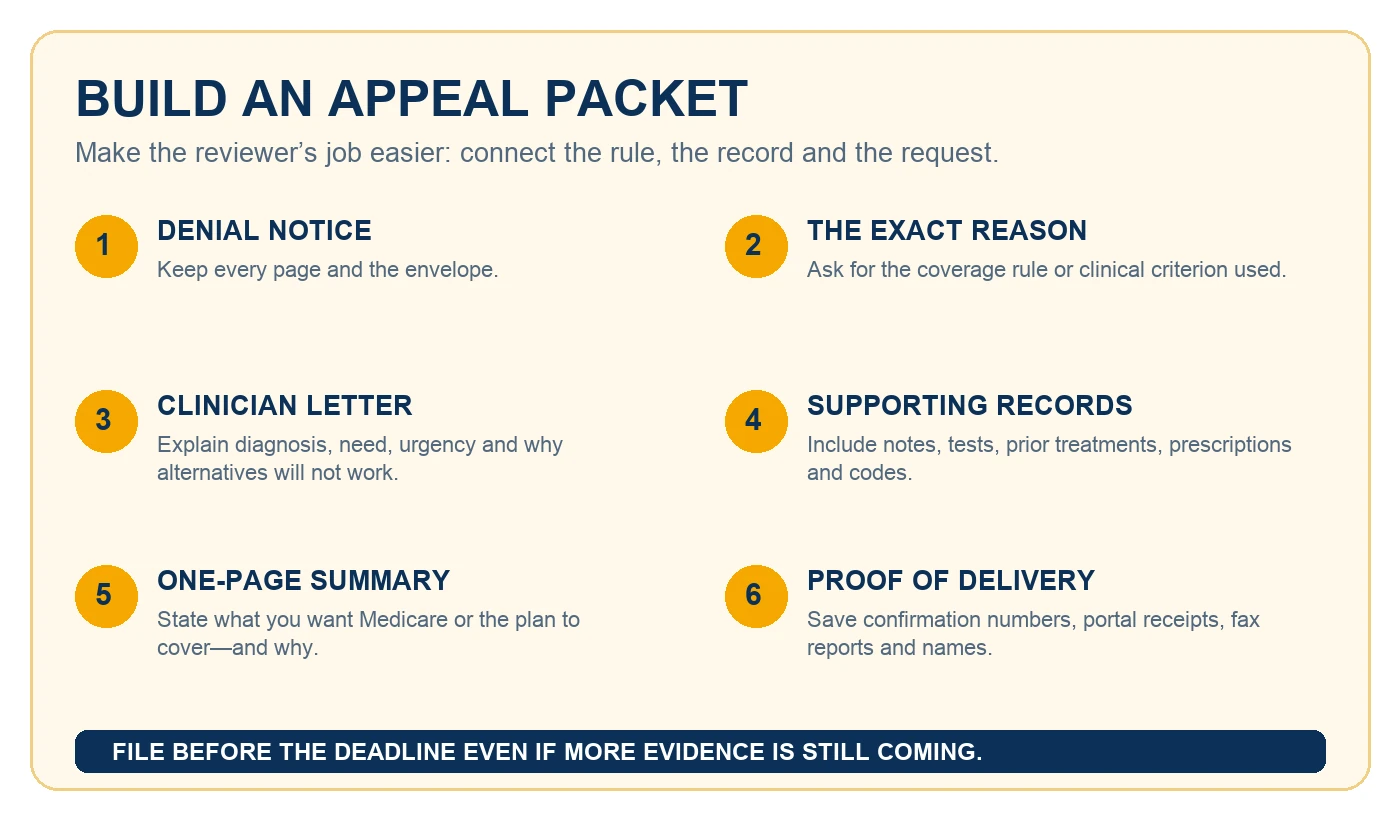
- Read the entire denial notice. Find the service, drug or claim, the reason, the filing deadline, the appeal address or portal and the case or claim number.
- Identify your coverage. Look for Original Medicare, the name of a Medicare Advantage plan, or the name of a Part D plan. The processes are not interchangeable.
- Call the provider’s billing or authorization team. Ask whether the denial resulted from a missing referral, wrong code, absent documentation, out-of-network issue or an authorization that was never submitted.
- Ask for the exact rule used. For a medical-necessity denial, request the coverage policy, clinical criterion or formulary rule—not merely “not covered.”
- Get the clinician involved. The strongest appeal usually explains why the care is medically necessary for you, what was tried, what failed and what may happen if care is delayed.
- Protect the deadline. File a clear appeal on time even if additional records will follow. Keep proof that it was received.
First determine what went wrong
| Possible problem | Useful first move | Do not assume |
|---|---|---|
| Clerical, coding or billing error | Ask the provider to correct and resubmit the claim | A corrected claim automatically extends the appeal deadline |
| Medical-necessity denial | Request the criterion and obtain a clinician letter tied to it | A general “patient needs this” note is enough |
| Missing prior authorization or referral | Ask whether retrospective review, resubmission or appeal is available | The provider’s promise of coverage binds the plan |
| Network denial | Document emergencies, unavailable in-network care or plan-directed care | All clinicians at an in-network facility are automatically in network |
| Part D formulary, tier or step-therapy denial | Request a coverage determination or exception with prescriber support | A pharmacy rejection is always the final decision |
| Hospital, skilled nursing, home health, hospice or rehabilitation care ending | Follow the fast-appeal instructions on the notice immediately | The ordinary appeal deadline applies |
If the claim was processed incorrectly, correction and resubmission may solve it faster than a full appeal. Still track the appeal deadline printed on the notice. A billing office’s resubmission does not necessarily preserve your right to appeal.
Appeal, grievance or coverage request?
- Appeal: challenges a coverage or payment decision.
- Grievance: complains about service, behavior, access, communication or another plan-quality problem that is not the coverage decision itself.
- Coverage determination: asks a Part D plan to decide whether it will cover a drug, a formulary exception, a tiering exception or another drug-coverage request.
- Organization determination: is a Medicare Advantage plan’s initial coverage decision. If you only received an informal “no,” request the written determination that carries appeal rights.
If you have Original Medicare
Use the Medicare Summary Notice (MSN). It is not a bill. It shows what the provider billed, what Medicare paid, the amount you may owe and appeal instructions. First confirm that the service, date, provider and codes are accurate.
The deadline is printed on the MSN. A first-level Original Medicare appeal is called a redetermination and is generally due within 120 days of receiving the initial determination. You may use the instructions on the MSN, submit the Medicare Redetermination Request form (CMS-20027), or send a written request containing the required information. The Medicare Administrative Contractor generally issues its redetermination within 60 days.
If the redetermination is unfavorable, the notice explains the next level and deadline. Original Medicare has five levels: redetermination, reconsideration by a Qualified Independent Contractor, review by the Office of Medicare Hearings and Appeals when the amount requirement is met, Medicare Appeals Council review and federal court review when its amount requirement is met.
If you have Medicare Advantage
A level-one appeal is a health plan reconsideration. You, your representative, or your doctor or other provider generally must file within 65 days from the date on the initial denial notice. Include the item or service, dates, why it should be covered and the clinical evidence supporting the request.
For an ordinary appeal about care you have not yet received, the plan generally has 30 days to decide. A payment appeal generally allows 60 days; an appeal involving a Part B drug generally allows 7 days. A qualifying fast appeal is generally due within 72 hours. Some deadlines can be extended in limited circumstances, and the plan must explain the extension and your rights.
If the plan upholds all or part of the denial, it automatically forwards the appeal to an Independent Review Entity for level-two review. Follow the new notice if you need to go farther. Do not restart the appeal with a different department.
If a Part D drug plan denied coverage
A pharmacy rejection may mean the drug is not on the formulary, requires prior authorization, is subject to step therapy or quantity limits, or was processed incorrectly. Ask the plan for a formal coverage determination. Your prescriber can request one and can supply the medical statement needed for an exception.
If the coverage determination is denied, request a redetermination within 65 calendar days of the coverage-determination notice. The plan generally has 7 calendar days for a standard redetermination and 72 hours for an expedited one. A payment appeal generally has a 14-day decision period. The notice explains how to request the next level if the denial is upheld.
A good exception request does more than name the preferred drug. It explains why covered alternatives were ineffective, unsafe or medically inappropriate; why a dosage or quantity limit does not fit the condition; and what harm delay could cause.
Prior authorization denials: use the reason, not a generic appeal
Prior authorization happens before a plan agrees to cover certain care. A claim denial happens after billing. The evidence can overlap, but the timing and request are different.
For plan years beginning on or after January 1, 2026, Medicare Advantage plans generally must decide standard prior-authorization requests for covered medical items and services within 7 calendar days and expedited requests within 72 hours, as quickly as the person’s condition requires. They must also give a specific reason when denying prior authorization. These federal process requirements concern medical items and services; Part D drug requests follow the separate drug-coverage rules.
- Ask for the complete denial, not just a portal status.
- Match the clinician’s response to each stated criterion.
- Correct missing records, dates, codes or failed-treatment history.
- Ask whether the plan offers a clinician-to-clinician discussion, but do not let that delay the formal appeal.
- Request expedited review when delay meets the health-risk standard.
- Keep the authorization number and approved service, provider, location and dates if the decision changes.
When care is ending: special fast-appeal rules
Do not use an ordinary claim-appeal calendar when a hospital, skilled nursing facility, home health agency, comprehensive outpatient rehabilitation facility or hospice says covered services will end.
- Hospital discharge: the Important Message from Medicare explains the fast appeal. To preserve the strongest protection, follow its instructions no later than the scheduled discharge date.
- Skilled nursing, home health, hospice or comprehensive outpatient rehabilitation: the Notice of Medicare Non-Coverage generally arrives at least two days before services end. Follow its fast-appeal instructions no later than noon on the day before the termination date.
The Beneficiary and Family Centered Care–Quality Improvement Organization (BFCC-QIO) performs an independent review. Filing on time affects both how quickly the case is reviewed and when you may become financially responsible. Use the phone number on your notice; do not wait for a regular plan appeal to finish.
How to build a stronger appeal
1. Write a one-page cover summary
State the member name and number, claim or case number, service or drug, date, decision being appealed, requested outcome and why the coverage rule is met. Keep emotion out of the summary and put the facts in date order.
2. Address the exact denial reason
If the notice says records were missing, provide them and identify the pages. If it says the service was not medically necessary, quote the relevant criterion and show where the record satisfies it. If it says an alternative must be tried first, document the trial, failure, contraindication or reason it is inappropriate.
3. Ask for a useful clinician letter
The letter should identify the diagnosis, requested care, urgency, prior treatment, objective findings, applicable coverage criterion, expected benefit, alternatives considered and likely consequences of delay. Attach supporting notes, tests and relevant records.
4. Create a paper trail
Save portal confirmations, certified-mail receipts, fax reports and screenshots. Record the date, time, phone number, representative, reference number and promised next step for each call. Send copies rather than your only originals.
A simple appeal worksheet
| Coverage type | Original Medicare / Medicare Advantage / Part D |
|---|---|
| Notice and date | ________________________________________ |
| Appeal deadline | ________________________________________ |
| Service, drug or claim | ________________________________________ |
| Exact denial reason | ________________________________________ |
| Coverage criterion or policy | ________________________________________ |
| What is missing or disputed? | ________________________________________ |
| Clinician contact | ________________________________________ |
| Fast review requested? | Yes / No — reason: _______________________ |
| Date and method filed | ________________________________________ |
| Confirmation or tracking number | ________________________________________ |
| Expected decision date | ________________________________________ |
If you missed the deadline
Do not assume the case is over. File as soon as possible and explain the reason for the late request. Medicare and plans can accept a late appeal when good cause is shown, such as serious illness, accident, disability, a notice sent to the wrong address or circumstances beyond your control. Include dates and supporting documents.
Getting help
- SHIP: State Health Insurance Assistance Programs provide free, local Medicare counseling.
- 1-800-MEDICARE: can explain notices and help identify the correct process.
- Medicare Rights Center: offers independent counseling and educational resources.
- Your clinician and provider: can correct claims and provide medical evidence, but you remain responsible for protecting your appeal deadline.
- A representative: may act for you using Appointment of Representative Form CMS-1696 or a conforming written appointment. Send it with the relevant request.
When a denial could create a large uncovered expense, include it in the broader plan for Medicare coverage gaps and out-of-pocket costs. If the denial reflects network or authorization rules, revisit the trade-offs in Original Medicare versus Medicare Advantage. RetireNerd’s guide to Medigap enrollment and switching explains why a supplement does not decide whether Medicare covers a service.
Frequently asked questions
Should I ask the provider to resubmit or file an appeal?
Ask the provider to correct and resubmit when the problem is a coding, billing or missing-information error. File an appeal when you disagree with the coverage decision. Because resubmission may not pause the appeal deadline, track both.
Can my doctor appeal for me?
Doctors and other providers can help and may request certain decisions or appeals. The rules depend on the coverage and whether care has already been provided. Confirm who is filing and obtain proof rather than assuming it was done.
Will an expedited appeal always be approved?
No. Expedited status changes the decision timeline, not the coverage standard. Explain the health risk of waiting and obtain clinician support.
Does prior authorization guarantee claim payment?
Not always. Payment can still depend on eligibility, network status, the service actually delivered, coding, medical records and the authorization’s dates and conditions. Keep the written approval and compare it with the claim.
What if I cannot manage the appeal myself?
Contact SHIP for free help and consider appointing a trusted representative. Form CMS-1696 allows a representative to present evidence, receive information and communicate about the request.
Official resources
- Medicare.gov: Appeals overview
- Medicare.gov: Medicare health-plan appeals
- Medicare.gov: Fast appeals when services are ending
- CMS: Part D redetermination rules
- CMS: 2026 prior-authorization process requirements
- Medicare appeal forms
- CMS-1696 Appointment of Representative
- SHIP: Free Medicare counseling
Reviewed September 2026. Appeal notices, deadlines and plan processes can change. Follow the instructions and date on your own notice, and verify the current process with Medicare, your plan or SHIP. This article is general educational information and is not individualized medical, legal or insurance advice.