

A 401(k) can look like a form your employer hands you and expects you to understand. It is actually one of the most powerful wealth-building tools many workers will ever receive.
The problem is that nobody gives most employees the class. They see contribution percentages, tax choices and a menu of funds with names such as “large cap,” “international” and “target 2060.” Unsure what to choose, they postpone the decision—or enroll and leave the money sitting in the plan’s default option without understanding it.
This is that missing class. You do not need to become a stock-market expert. You need to understand five things: how money enters the plan, what the employer match does, why starting early matters, how to choose a diversified investment and how fees quietly affect the result.
The 401(k) in one minute
- You choose a percentage or dollar amount from each paycheck.
- Your employer sends it to your 401(k) account.
- The plan may add an employer contribution or match.
- You select investments from the plan’s menu.
- Your account can grow tax-deferred, or potentially tax-free with qualified Roth withdrawals.
- The money is intended for retirement, so early withdrawals can create taxes and penalties.
What exactly is a 401(k)?
A 401(k) is a workplace retirement account. It is not an investment by itself. Think of it as a container with special tax rules. Inside that container, you usually choose mutual funds, collective investment trusts, target-date funds or similar investments selected by the plan.
In 2026, the basic employee contribution limit is $24,500. Workers age 50 or older may generally contribute an additional $8,000, while those who turn 60 through 63 during 2026 may have a higher $11,250 catch-up limit. Your plan can impose lower limits or different rules, so check its documents.
Traditional versus Roth 401(k)
| Traditional 401(k) | Roth 401(k) | |
|---|---|---|
| Money goes in | Generally before federal income tax | After tax |
| Effect today | May reduce current taxable income | No current income-tax deduction |
| Money comes out | Generally taxable | Qualified withdrawals generally tax-free |
| Who might consider it | Someone who values the current tax break | Someone willing to pay tax now for qualified tax-free withdrawals later |
This is not simply “traditional for older workers, Roth for younger workers.” Current and future tax rates, cash flow, state taxes and other retirement income matter. Some plans allow both, and the combined employee limit still applies.
The employer match: part of your compensation
A match means the employer contributes when you contribute. A plan might contribute 50 cents for each $1 you save, up to a stated percentage of pay. Formulas vary. Read yours.
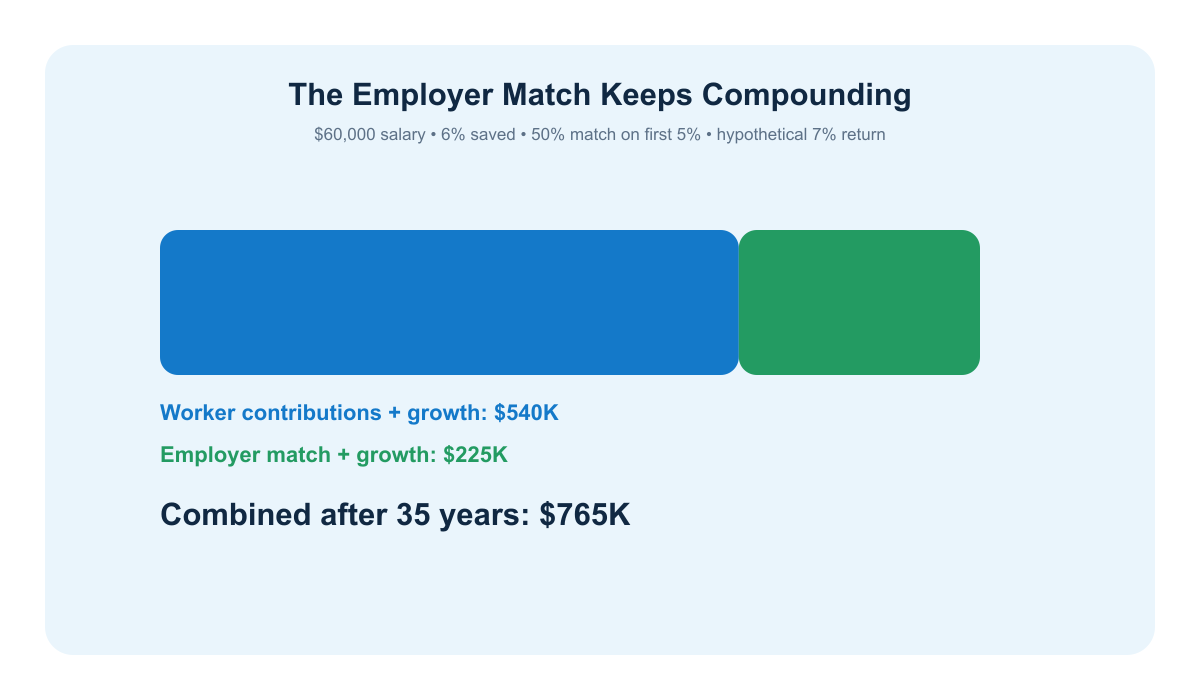
Example: You earn $60,000. You save 6%, or $3,600 per year. The company matches 50% of the first 5% of pay, adding $1,500. You contributed $300 per month; the employer added another $125 per month. At a hypothetical 7% annual return for 35 years, the employer portion and its growth could represent about $225,000 of a roughly $765,000 combined balance.
Ask HR: What is the match formula? How much must I contribute to receive the full match? Is the match calculated every paycheck or reconciled later with a “true-up”?
Vesting: when the employer’s money becomes yours
Your own contributions are yours. Employer contributions may follow a vesting schedule. If you leave before becoming fully vested, you may forfeit some employer money. Find the schedule in the Summary Plan Description. Do not turn down a match merely because vesting exists, but understand the rule when comparing jobs or planning a departure.
Why starting early matters so much
Compounding means your investment can earn returns, and later those returns may earn returns too. Time does much of the work.
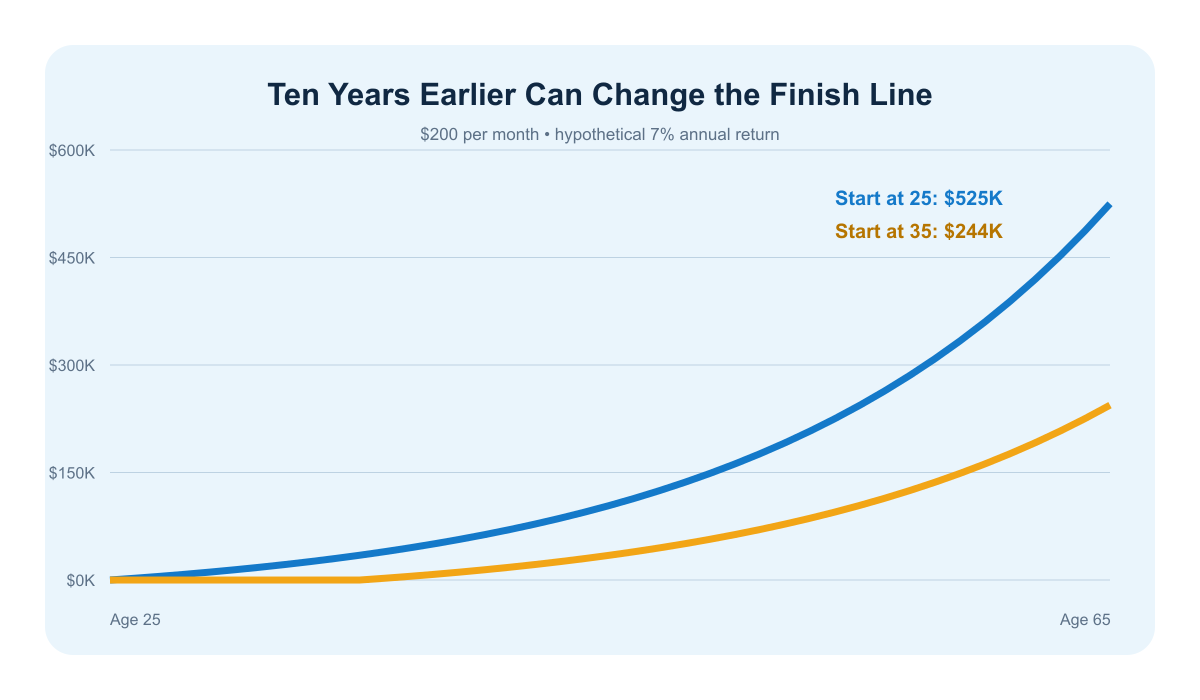
Suppose one worker invests $200 a month from age 25 to 65. Another waits until 35 and then invests the same amount until 65. At a hypothetical 7% return, the early starter finishes with about $525,000; the later starter has about $244,000. The first worker contributed only $24,000 more but finished roughly $281,000 ahead because that money had another decade to compound.
What should you invest in?
Your 401(k) menu may have 10 choices or several dozen. The fund name tells you which part of the market it generally holds. These are common categories:
| Fund type | Plain-English description | Main role and risk |
|---|---|---|
| S&P 500 or large-cap index | Large U.S. companies; an S&P 500 fund tracks that index | Core growth; can fall sharply |
| Mid-cap | Medium-size U.S. companies | Growth and diversification; volatile |
| Small-cap | Smaller U.S. companies | Higher growth potential and larger swings |
| Small-cap value | Smaller companies considered inexpensive by value measures | Distinct style; can lag for long periods |
| Growth | Companies expected to grow quickly | Can lead or fall hard; may overlap an S&P 500 fund |
| International developed | Companies in established markets outside the U.S. | Geographic diversification plus currency risk |
| Emerging markets | Companies in developing economies | Higher political, currency and market risk |
| U.S. bond | Government and corporate debt | Income and stability; still has interest-rate and credit risk |
| Stable value or money market | Lower-volatility holdings | Capital stability, but limited long-term growth and inflation risk |
| Target-date fund | A diversified portfolio selected by approximate retirement year | One-fund solution that adjusts over time; strategy and fees vary |
Asset allocation: the recipe matters more than the ingredient list
Asset allocation is the percentage assigned to stocks, bonds and cash-like investments. Diversification spreads risk across and within those groups. Owning an S&P 500 fund, a large-cap growth fund and a technology fund may look diversified, but the same giant companies can dominate all three.
A simple portfolio might use broad U.S. stocks, international stocks and bonds. The right percentages depend on time horizon, ability to tolerate losses and the rest of your finances. More stock generally means more growth potential and more severe declines. Bonds may reduce volatility but do not eliminate loss.
Target-date funds: the simplest reasonable starting point
A target-date fund holds a diversified mix and gradually becomes more conservative as its target year approaches. Someone expecting to retire around 2065 might examine the plan’s 2065 fund. The fund handles allocation and rebalancing, which can be valuable for a worker who does not want to build a portfolio.
It is not guaranteed and the year is not a promise that you will have enough. Two funds labeled “2065” can have different risks, glide paths and fees. Check whether it invests “to” retirement or continues changing “through” retirement. If you use a target-date fund as your complete portfolio, adding several other funds can accidentally undo its intended allocation.
Expense ratios: the tiny number that keeps charging
An expense ratio is the annual operating cost of a fund, expressed as a percentage of assets. A 0.05% ratio is about $5 per year for each $10,000 invested; 1.00% is about $100. The charge is reflected in fund performance rather than appearing like a monthly bill.
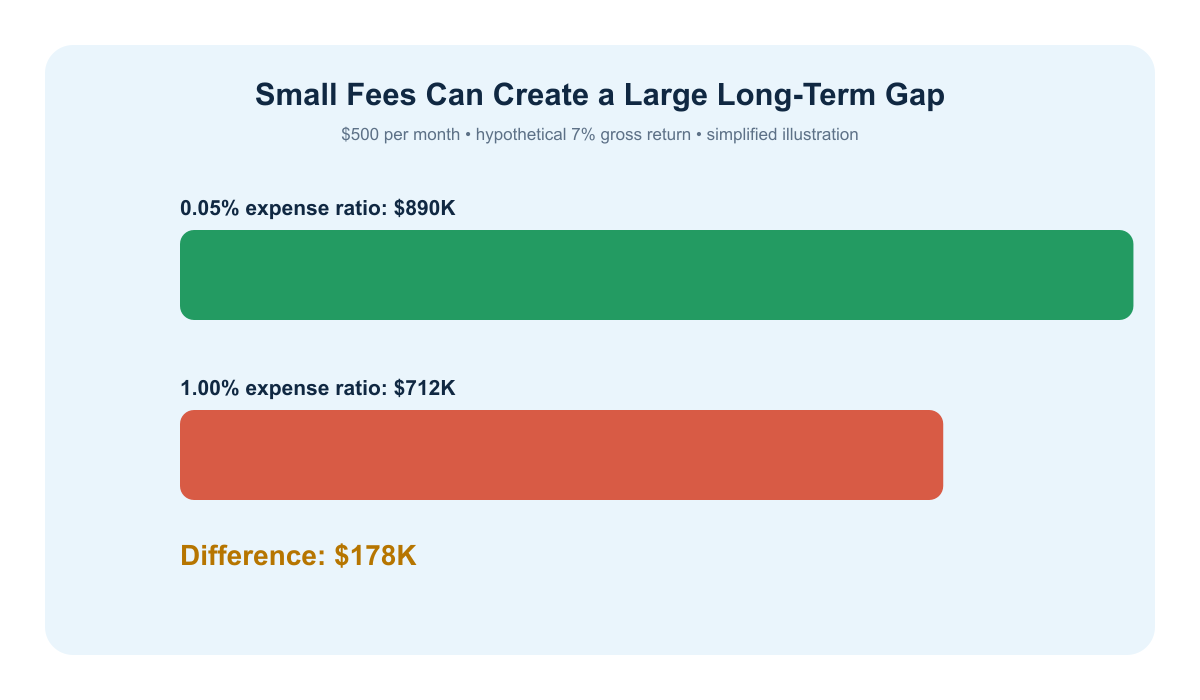
In a simplified example, $500 invested monthly for 35 years at a 7% gross return grows to about $890,000 after a 0.05% annual expense assumption, versus about $712,000 after a 1.00% expense assumption—a difference around $178,000. Real returns and fees do not arrive this smoothly, and lower cost does not automatically make a fund better, but fees deserve attention.
The pros and cons
| Advantages | Limitations |
|---|---|
| Automatic paycheck saving | Limited to the plan’s investment menu |
| Possible employer match | Plan and investment fees |
| Traditional or Roth tax advantages | Tax and possible penalty consequences for early withdrawals |
| High annual contribution limit | Employer money may require vesting |
| Potential creditor protections and institutional pricing | Rules vary by plan |
| Portability through rollovers when eligible | Loans and withdrawals can interrupt compounding |
A beginner’s five-step action plan
- Enroll. Find the benefits portal or call HR.
- Capture the full match. Identify the contribution rate required, if your budget permits.
- Choose an investment. A reasonably priced target-date fund can be a practical one-fund starting point; otherwise learn the broad stock-and-bond choices.
- Turn on automatic increases. Raising the rate by one percentage point each year or after raises can make saving less painful.
- Review once a year. Check contribution rate, beneficiary, allocation, fees and old workplace accounts.
Common mistakes to avoid
- Contributing but never selecting an investment.
- Saving below the full-match threshold without realizing it.
- Putting everything in employer stock.
- Choosing funds only because they recently performed best.
- Owning several funds that hold the same companies.
- Ignoring expense ratios and administrative fees.
- Cashing out after changing jobs instead of evaluating rollover choices.
- Borrowing from the plan without understanding repayment and job-change rules.
- Forgetting to name and update beneficiaries.
Keep learning with RetireNerd
- 401(k) and Retirement Savings Guide
- Retirement Savings Benchmarks
- Retirement Planner & Modeler
- Retirement Withdrawal Strategies
- Taxes and Paperwork
Sources
- IRS: Retirement Topics—Contributions
- U.S. Department of Labor: A Look at 401(k) Plan Fees
- Investor.gov: Target Date Funds
- FINRA: Asset Allocation and Diversification
All examples are hypothetical and exclude taxes and inflation unless stated. Investments can gain or lose value. This article provides general education, not individualized investment or tax advice.