

Medicare hospice is a coordinated benefit for comfort, symptom control and support near the end of life. It does not mean “no more care,” and choosing it does not require a person to be in the final days of life. It changes who arranges and pays for care related to the terminal illness—and that distinction matters.
Hospice in plain English
Hospice shifts the goal for the terminal illness and related conditions from curing the disease to comfort, quality of life and support for the patient and family. A Medicare-approved hospice creates a plan of care and coordinates the related services, drugs, supplies and equipment.
Who qualifies for Medicare hospice?
Medicare Part A covers hospice when all of these conditions are met:
- The person has Medicare Part A.
- The hospice doctor and the regular doctor, if there is one, certify that the person is terminally ill with a life expectancy of six months or less if the illness runs its normal course.
- The person accepts comfort-focused palliative care instead of treatment intended to cure the terminal illness and related conditions.
- The person signs a hospice election statement choosing the Medicare hospice benefit.
- Care comes from a Medicare-certified hospice.
The six-month prognosis is an eligibility standard, not a countdown or guarantee. A person can receive hospice longer than six months when the hospice physician recertifies continued eligibility. Medicare provides two 90-day benefit periods followed by an unlimited number of 60-day periods. A face-to-face encounter is required before the third benefit period and each later recertification.
What Medicare hospice covers
Coverage follows an individualized written plan of care developed by the hospice team with the patient or representative, primary caregiver and attending clinician when one is chosen. Depending on need, the benefit can include:
- Doctor, nurse practitioner and nursing services
- Medical social services
- Drugs for pain relief and symptom management
- Medical equipment, such as a hospital bed, wheelchair or oxygen
- Medical supplies for the terminal illness and related conditions
- Hospice aide and homemaker services
- Physical, occupational and speech-language therapy when used for symptom control or to maintain function
- Dietary and other counseling
- Spiritual and grief counseling for the patient and family
- Short-term inpatient care for pain or symptom management that cannot be handled elsewhere
- Short-term inpatient respite care to give the caregiver a rest
- Continuous home care during a brief period of crisis when needed to keep the patient at home
Hospice is most often delivered where the person lives: a private home, assisted-living community, nursing home or other residence. The hospice team visits and remains available for symptom crises. The benefit does not ordinarily supply round-the-clock custodial caregivers in the home.
What changes after the hospice election
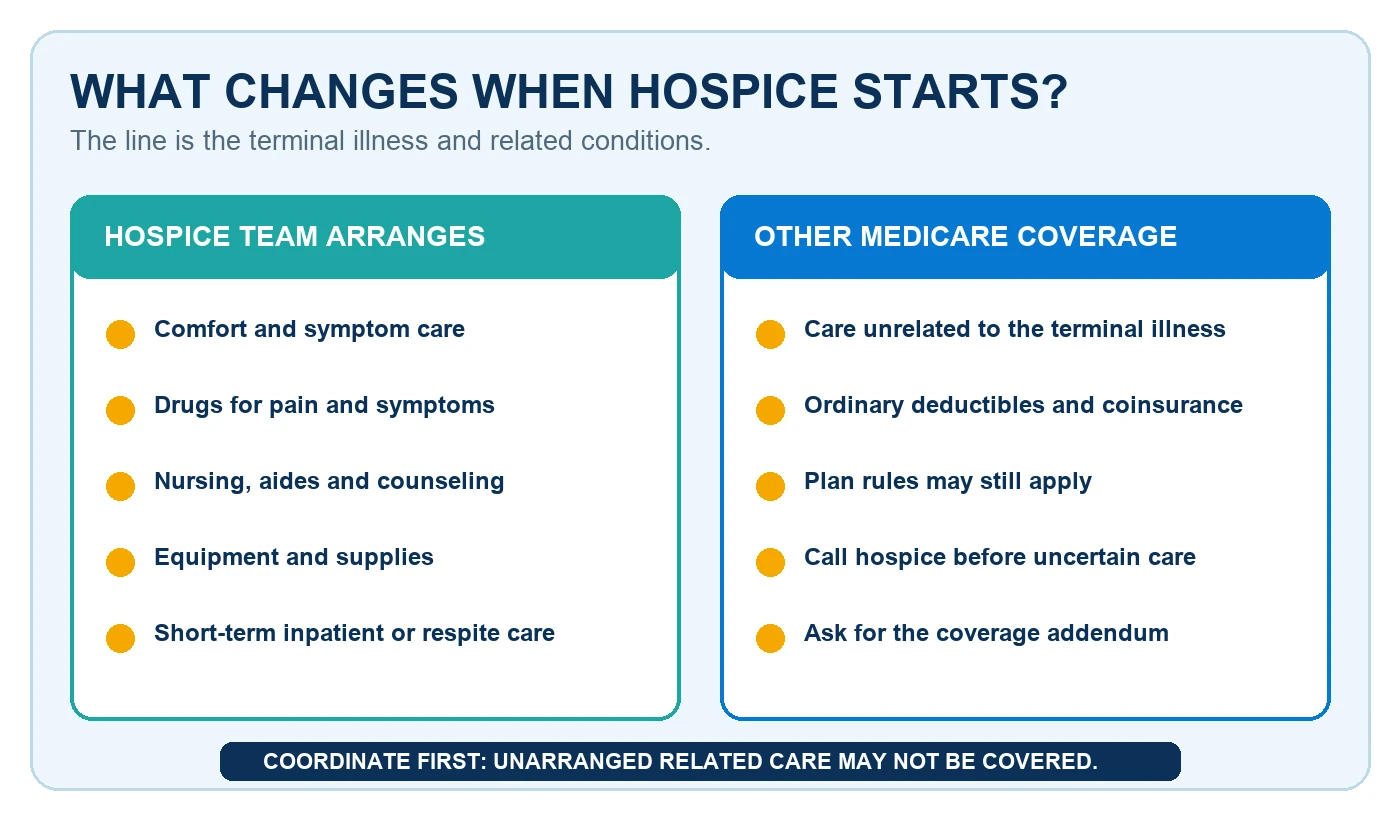
For the terminal illness and related conditions, the selected hospice becomes the coordinator. Medicare generally will not separately pay another provider for related care unless the hospice arranged it. Call the hospice before going to an emergency room, being admitted to a hospital, using an ambulance or getting care from another clinician for a possibly related problem. If the hospice does not arrange related care, the patient could be responsible for the full cost.
Care for a health problem that is unrelated to the terminal illness and related conditions can still be covered under the person’s ordinary Medicare coverage. Normal deductibles, copayments, coinsurance, network and authorization rules may apply.
Ask for the hospice election addendum
A person can request a written addendum listing the items, services and drugs the hospice has determined are unrelated to the terminal illness and related conditions, along with the reason for each determination. Medicare says the hospice must generally provide it within three to five days, depending on when it was requested. If the coverage determination changes, the hospice must provide an updated addendum.
This is one of the most useful documents for preventing disputes among the hospice, other clinicians, the drug plan and the family. Request it at election when the boundary may be unclear.
What Medicare does not cover under hospice
- Treatment intended to cure the terminal illness or related conditions. A patient who wants to resume curative treatment may revoke hospice.
- Drugs intended to cure the terminal illness. Drugs for comfort and symptom control are handled through the hospice plan of care.
- Related care from a different provider that the hospice did not arrange.
- Routine room and board. Medicare generally does not pay the rent or residential charge for a private home, assisted living, nursing home or residential hospice facility.
- Long-term custodial care or continuous household help. Hospice aides provide scheduled services under the plan of care; hospice is not a substitute for 24-hour personal care.
- Hospital, emergency-room or ambulance care related to the terminal illness unless arranged by the hospice.
Short-term general inpatient care and inpatient respite care are exceptions when the hospice team determines they are needed and arranges them. For a broader explanation of residential and custodial-care gaps, see what Medicare does not cover.
What you pay
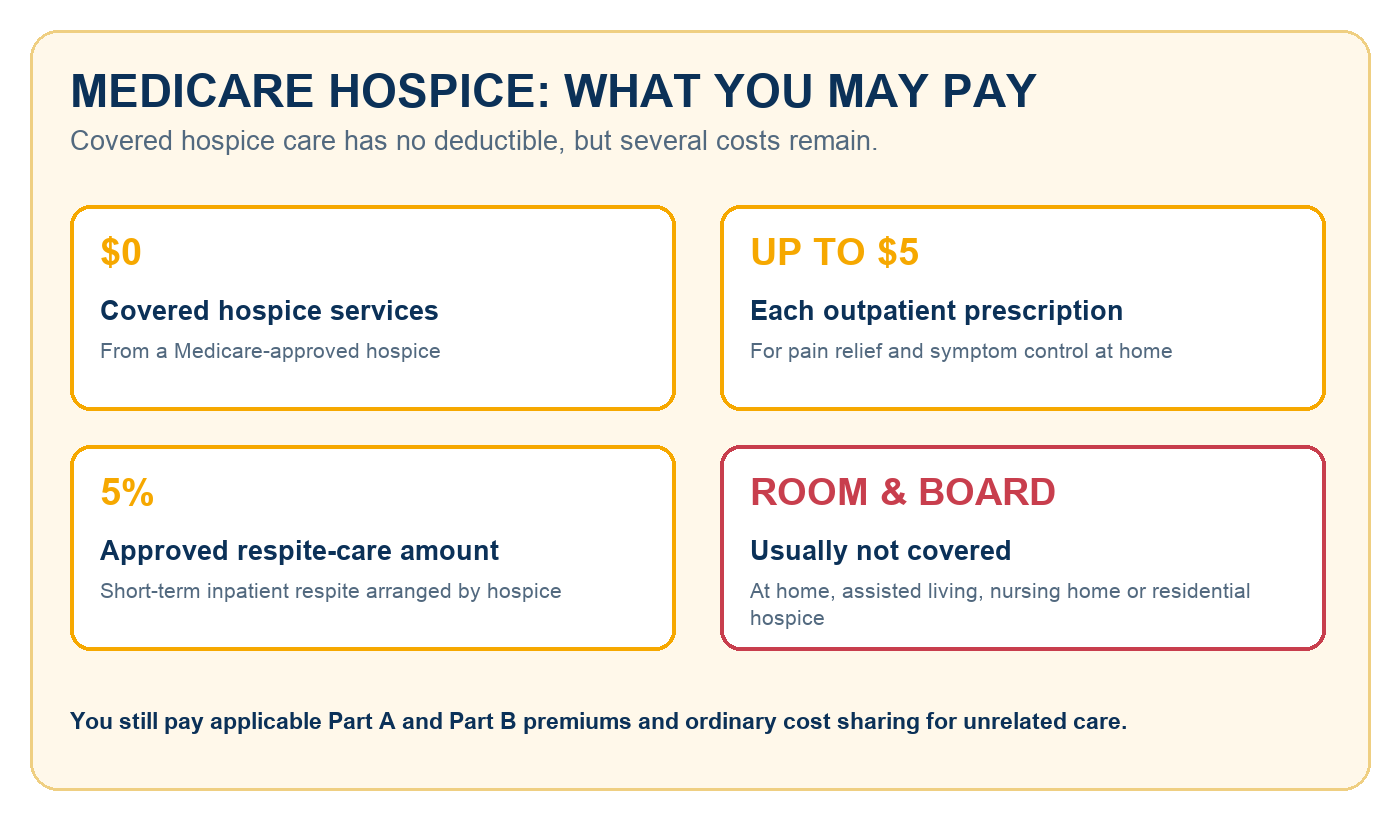
There is no deductible for the Medicare hospice benefit, and covered hospice services from a Medicare-approved hospice generally cost the patient nothing. These costs can remain:
- Medicare premiums: continue paying any Part A, Part B, Medicare Advantage, Part D or Medigap premiums that still apply.
- Outpatient hospice drugs: up to $5 for each prescription for pain relief and symptom management while at home.
- Inpatient respite care: 5% of the Medicare-approved amount. The copayment cannot exceed the inpatient hospital deductible.
- Unrelated medical care: ordinary Medicare or plan deductibles, copayments and coinsurance.
- Room and board: may remain fully payable when the person lives in a facility.
- Unarranged related care: may become the patient’s responsibility if it should have gone through the hospice.
The four levels of hospice care
| Level | Purpose | What families should know |
|---|---|---|
| Routine home care | Ongoing hospice care where the person lives | The most common level; scheduled visits and on-call support, not continuous bedside care |
| Continuous home care | Intensive help during a brief symptom crisis | Available only when clinically necessary to maintain the person at home |
| General inpatient care | Short-term management of pain or symptoms that cannot be controlled elsewhere | Hospice must determine the need and arrange the facility care |
| Inpatient respite care | Short stay to relieve an unpaid caregiver | Hospice arranges the Medicare-approved facility; Medicare guidance allows up to five days each time |
How Medicare Advantage works with hospice
A person does not have to leave a Medicare Advantage plan to elect hospice. Original Medicare is generally billed for hospice care related to the terminal illness. The Medicare Advantage plan can continue covering services unrelated to the terminal illness and any extra plan benefits, subject to the plan’s rules.
Premiums can continue even though Original Medicare pays the hospice provider. Before changing or dropping the plan, check how that would affect drug coverage, supplemental benefits, provider access and future enrollment. RetireNerd’s Original Medicare and Medicare Advantage comparison explains the broader coverage structures.
Can someone keep seeing a regular doctor?
Yes. The patient may choose a physician or nurse practitioner as the attending clinician who helps supervise hospice care. The hospice election statement identifies that choice. Other care related to the terminal illness still needs to be coordinated through the hospice plan of care.
Can someone stop hospice?
Yes. Hospice is voluntary. A patient or authorized representative can revoke the election in writing at any time. Ordinary Medicare coverage then resumes for the terminal illness starting on the effective date of the revocation. Remaining days in that benefit period are forfeited, but the person may elect hospice again later if still eligible.
A person can also change hospice providers once during each benefit period. Coordinate the transfer so there is no confusion about the effective date, medications, equipment, contact numbers or plan of care.
Can the hospice end coverage?
Hospice may discharge a patient who is no longer considered terminally ill, moves outside the service area, transfers to another hospice, revokes the benefit or in limited cases creates a documented safety or operational problem. A discharge does not mean the person loses Medicare. Ordinary coverage resumes, and hospice may be elected again if eligibility is later established.
If hospice services are ending and the patient disagrees, the written Notice of Medicare Non-Coverage explains the fast appeal. The deadline is generally no later than noon on the day before services are scheduled to end. RetireNerd’s guide to Medicare denials and fast appeals explains how to protect that deadline.
Questions to ask before choosing a hospice
- Is the hospice Medicare-certified?
- How quickly can the team start care?
- Who answers calls at night and on weekends?
- How often will nurses and aides usually visit, and how can that change?
- Which medications, equipment and supplies will the hospice provide?
- Which diagnoses and conditions does the hospice consider related?
- Can we receive the election addendum at the start?
- Which hospitals and inpatient facilities does the hospice use?
- How are symptom crises handled at home?
- How is inpatient respite requested and arranged?
- Can the current doctor remain the attending clinician?
- What help is available for family caregivers, grief and spiritual needs?
- What costs could still fall to the patient or family?
- How are complaints, transfers, revocation and discharge handled?
A family coordination checklist
- Identify the hospice’s 24-hour number and put it near the phone.
- Keep the signed election statement, addendum and plan of care together.
- List covered medications, equipment and supplies.
- Ask which symptoms require an immediate call.
- Call the hospice before related hospital, emergency or ambulance care whenever possible.
- Document the room-and-board obligation and other non-hospice costs.
- Name the family contact who will coordinate updates.
- Review advance directives, health-care proxy and preferred place of care.
- Discuss respite before the caregiver reaches exhaustion.
- Know how to request a transfer, revoke hospice or appeal a discharge.
Frequently asked questions
Does choosing hospice mean giving up all medical care?
No. Hospice provides comfort-focused care for the terminal illness and related conditions. Medicare can still cover care for unrelated conditions under the usual rules.
Does Medicare pay for a nursing home during hospice?
Medicare can pay the hospice provider for covered hospice services delivered in a nursing home, but it generally does not pay the nursing home’s routine room-and-board charge.
What happens if the patient lives longer than six months?
Hospice can continue through unlimited 60-day benefit periods when the hospice physician recertifies that the person remains terminally ill under Medicare’s standard.
Does hospice provide 24-hour caregivers at home?
Usually no. Routine hospice provides scheduled interdisciplinary visits and on-call support. Continuous home care is reserved for brief clinical crises when it is necessary to keep the person at home.
Can hospice be revoked and started again?
Yes. Hospice may be revoked at any time, and a person may elect it again later if eligible. Revocation must be in writing and affects the remaining days in the current benefit period.
Official resources
- Medicare.gov: Hospice care coverage
- Medicare Hospice Benefits booklet
- Medicare and Hospice Benefits: Getting Started
- CMS: Medicare hospice coverage and certification
- Medicare Care Compare: Find and compare hospices
- SHIP: Free Medicare counseling
Reviewed September 2026. Hospice eligibility, certification, covered services and patient costs can change. Confirm the plan of care, related-condition determination, provider certification and possible charges with the hospice and Medicare before making decisions. This article is general educational information, not individualized medical, legal, financial or insurance advice.