
In your 70s, the IRS starts requiring withdrawals, called required minimum distributions, from most retirement accounts. Here is how it works, what it costs, and how to keep more of it.
Linda saved in her 401(k) for 35 years, then rolled it into an IRA when she retired. She lives on her Social Security and a small pension, and she planned to leave the IRA alone as long as possible.
In January of the year she turned 73, a letter from her IRA company changed that plan. This year, it said, she must withdraw at least $18,868, whether she needs the money or not.
That withdrawal has a name: a required minimum distribution, or RMD. If you have money in a traditional IRA or 401(k), one is coming for you too. Here is what to expect.
Key takeaways
- RMDs start at 73 if you were born from 1951 through 1959, and at 75 if you were born in 1960 or later.
- Each RMD is your December 31 balance from the year before, divided by an IRS life expectancy factor.
- Missing one costs 25% of the shortfall, or 10% if you fix it within two years.
- Giving from your IRA to charity, Roth conversions before RMD age and tax withholding can soften the tax bite.
What is an RMD?
When you put money into a traditional retirement account, you skipped income tax on it. The IRS was patient and let it grow for decades. In your 70s, it wants its share.
So each year, you must take out at least a minimum amount, and that money counts as taxable income.
Accounts that require RMDs: traditional IRAs, SEP and SIMPLE IRAs, and workplace plans like 401(k), 403(b), and 457(b) plans.
Accounts that do not: Roth IRAs, for as long as you are alive. Roth 401(k) and Roth 403(b) accounts are also off the hook since 2024.
When do they start?
Your starting age depends on the year you were born. If you were born from 1951 through 1959, RMDs begin at 73. If you were born in 1960 or later, they begin at 75.
You can delay your very first RMD until April 1 of the following year. After that, the deadline is December 31, every year.
Be careful with that first year delay. Linda turned 73 in 2026. If she waits until April 2027 to take her first RMD, she must also take her 2027 RMD by December 31, 2027. That means two taxable withdrawals in one year, which could push her into a higher tax bracket. Many people avoid this by taking the first one in the year they reach RMD age.
Still working? If you still work and don’t own 5% or more of the company, your current employer’s plan may let you wait until you retire. This exception does not apply to IRAs.
How much do you have to take?
The math is simple. Take your account balance on December 31 of last year and divide it by a number from the IRS life expectancy table for your age.
Linda’s IRA held $500,000 at the end of 2025. Her number at age 73 is 26.5. So $500,000 divided by 26.5 equals $18,868.
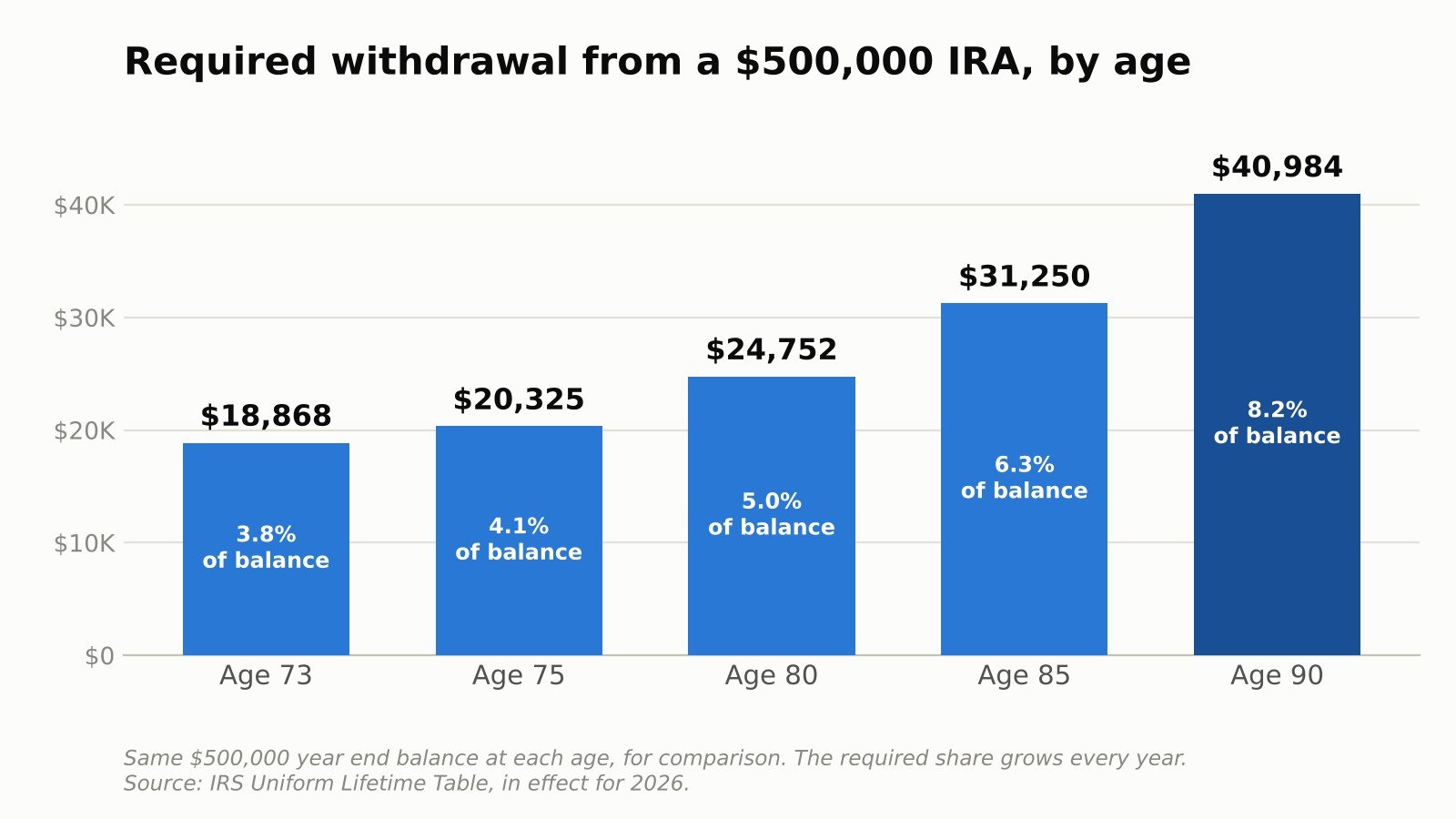
Notice the trend. At 73, Linda must take about 3.8% of her balance. By 80, it is about 5%. By 90, it is more than 8%.
Remember, it is a minimum, not a limit. You can always take more. Extra withdrawals don’t carry forward, though, so taking double this year does not lower next year’s requirement.
You also choose when during the year to take it. Some people take it all in January and stop thinking about it. Others wait until December to let the money grow a little longer. Either works, as long as it is done by December 31.
If you have several IRAs, figure the RMD for each one, add them up, and take the total from any IRA or mix of IRAs you like. Workplace plans are different. Each 401(k) must pay out its own RMD.
What happens if you miss one?
The penalty is steep: 25% of the amount you should have withdrawn. If you fix the mistake within two years, it drops to 10%. You report it on IRS Form 5329, where you can also ask the IRS to waive the penalty for an honest mistake you have already corrected.
The easiest protection is to ask your IRA company to send your RMD automatically each year. Most will do it for free.
Ways to soften the tax bite
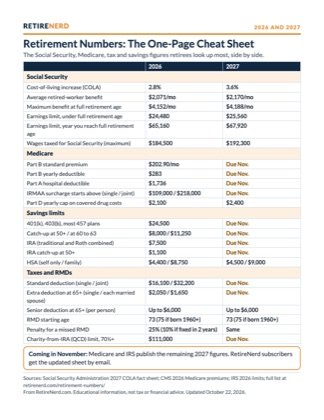
Give directly to charity. Starting at age 70 and a half, you can send money straight from your IRA to a charity. This is called a Qualified Charitable Distribution. In 2026 you can give up to $111,000 this way. It counts toward your RMD, and it never shows up as taxable income.
Convert to Roth before RMDs begin. Moving some money to a Roth account in your 60s means paying tax now, but it shrinks the balance your future RMDs are based on. RetireNerd covers this in The Roth Conversion Window Before RMDs.
Have taxes withheld. Ask your IRA company to withhold federal tax from each RMD. This can save you from making quarterly estimated tax payments.
Reinvest what you don’t spend. You must take the money out, but you don’t have to spend it. You can move it into a regular brokerage account and keep it invested. You just can’t put it back into the IRA.
Watch the ripple effects. An RMD raises your income for the year. That can make more of your Social Security taxable and can raise your Medicare premiums. Our guide How Taxes Affect Your Retirement Withdrawals explains how this works.
Frequently asked questions
Do I have to take an RMD from my Roth IRA?
No, not while you are alive. People who inherit a Roth IRA usually do have to take withdrawals, though.
What if I don’t need the money?
You still have to take it out. You can reinvest it in a regular brokerage account, give it to charity through a Qualified Charitable Distribution, or ask your IRA company to move shares instead of cash. Shares moved this way count toward your RMD at their value on the day they move, and that value is taxed the same way.
Does my RMD affect my Medicare premiums?
It can. Your RMD adds to the income Medicare uses to set Part B and Part D premiums. Medicare looks at your tax return from two years earlier, so a large RMD in 2026 can raise your premiums in 2028.
Can I take extra withdrawals early to shrink future RMDs?
Yes. Withdrawals before your RMD years don’t count toward a future RMD, but they do lower the balance future RMDs are based on. That is why some people spread withdrawals or Roth conversions across their 60s, when their tax bracket may be lower.
Your next step
Find your RMD year today. Take your birth year and add 73, or 75 if you were born in 1960 or later. Write that year down.
Then, a year or two before it arrives, sit down with your balances and decide three things: whether a Qualified Charitable Distribution fits your giving, whether Roth conversions make sense now, and whether to set up automatic withdrawals. RetireNerd’s free RMD calculator can show you roughly what your first withdrawal will be.
Linda now takes her RMD in monthly pieces, with taxes withheld. It feels less like a bill from the IRS and more like a paycheck she already earned.
Educational note: This article is general education, not individualized tax, legal, or financial advice. RMD rules have changed several times in recent years and can depend on your birth year, account type, and beneficiaries. A tax professional or financial advisor can help you apply these rules to your own situation.