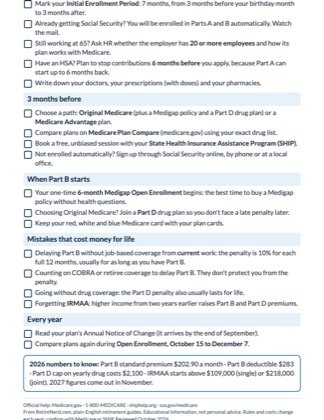

Every fall, the numbers behind retirement reset. Social Security announces its raise. Medicare sets new premiums. The IRS adjusts tax brackets and savings limits. This page keeps the figures that matter most to retirees and near retirees in one place, with 2026 and 2027 side by side.
Last updated: October 18, 2026. Social Security’s 2027 figures are final. Medicare’s 2027 premiums and the IRS’s 2027 tax brackets and savings limits are usually announced in November. Until then, those rows say Due in November and show the 2026 figure for comparison. We update this page as each number is released.
Key takeaways
- Social Security benefits rise 3.6% starting with January 2027 payments.
- In 2027 the Medicare Part D cap on covered drug costs rises to $2,400, and HSA limits rise to $4,500 and $9,000.
- Medicare's 2027 premiums and the IRS's 2027 tax brackets and savings limits are due in November.
- RMDs still start at 73, or 75 if you were born in 1960 or later.
2027 at a glance
| Number | 2026 | 2027 |
|---|---|---|
| Social Security cost-of-living increase | 2.8% | 3.6% |
| Average retired-worker benefit (January) | $2,071 a month | $2,170 a month |
| Earnings limit before full retirement age | $24,480 | $25,560 |
| Medicare Part B standard premium | $202.90 a month | Due in November |
| Medicare Part D yearly drug cost cap | $2,100 | $2,400 |
| 401(k) employee contribution limit | $24,500 | Due in November |
| IRA contribution limit | $7,500 | Due in November |
| HSA limit (self only / family) | $4,400 / $8,750 | $4,500 / $9,000 |
| Standard deduction (single / joint) | $16,100 / $32,200 | Due in November |
| Charity-from-IRA (QCD) limit | $111,000 | Due in November |
| RMD starting age | 73 (75 if born 1960 or later) | 73 (75 if born 1960 or later) |
Social Security
The 3.6% cost-of-living adjustment, or COLA, starts with the payment most people receive in January 2027. It is a raise meant to keep benefits in step with prices. A retiree receiving $2,000 a month would see about $72 more each month, before any change in the Medicare premium that many people have taken out of their check.
| Social Security number | 2026 | 2027 |
|---|---|---|
| Cost-of-living increase | 2.8% | 3.6% |
| Maximum benefit at full retirement age | $4,152 a month | $4,188 a month |
| Earnings taxed for Social Security (maximum) | $184,500 | $192,300 |
| Earnings needed for one work credit | $1,890 | $1,970 |
| Earnings limit, under full retirement age all year ($1 withheld for every $2 above) | $24,480 | $25,560 |
| Earnings limit, year you reach full retirement age ($1 withheld for every $3 above) | $65,160 | $67,920 |
| Disability work limit (not blind / blind) | $1,690 / $2,830 a month | $1,770 / $2,950 a month |
| Trial work month threshold | $1,210 | $1,270 |
| Benefit formula bend points (first eligible that year) | $1,286 and $7,749 | $1,340 and $8,077 |
Two things did not change. Full retirement age is 67 for anyone born in 1960 or later. And the income levels that decide how much of your benefit is taxable stay at $25,000 and $34,000 for single filers, and $32,000 and $44,000 for married couples filing jointly, because they are set by law and are not adjusted for inflation.
Go deeper: how Social Security calculates your benefit, claiming at 62, 67 or 70, claiming while you keep working, how benefits are taxed, Social Security for the self-employed, moving from disability to retirement benefits and Social Security after a spouse dies.
Medicare
Medicare announces next year’s premiums and deductibles in November. The drug plan numbers for 2027 are already set: no Part D plan can charge a deductible above $700, and once your own spending on covered drugs reaches $2,400, you pay nothing more for covered drugs for the rest of the year.
| Medicare number | 2026 | 2027 |
|---|---|---|
| Part B standard premium | $202.90 a month | Due in November |
| Part B yearly deductible | $283 | Due in November |
| Part A hospital deductible (per benefit period) | $1,736 | Due in November |
| Part A premium if you buy in (30 to 39 work quarters / fewer than 30) | $311 / $565 a month | Due in November |
| Skilled nursing coinsurance, days 21 to 100 | $217 a day | Due in November |
| Higher-income surcharge (IRMAA) starts above (single / joint) | $109,000 / $218,000 | Due in November |
| Part D maximum deductible | $615 | $700 |
| Part D yearly cap on covered drug costs | $2,100 | $2,400 |
IRMAA stands for income-related monthly adjustment amount. It is an extra charge on Part B and Part D for people with higher incomes, and it is based on your tax return from two years earlier. Medicare’s trustees projected a 2027 Part B premium of about $209.50, but that is an estimate. We will replace it with the official figure when it is announced.
Go deeper: what Medicare really costs, the complete Medicare guide, Original Medicare vs. Medicare Advantage, Medigap, explained, how to compare Part D plans and programs that lower Medicare costs.
Taxes
The IRS usually publishes next year’s brackets and standard deduction in October or November. Until the 2027 figures arrive, here are the 2026 numbers, which apply to the tax return most people file in early 2027.
| 2026 tax rate | Single: taxable income | Married filing jointly: taxable income |
|---|---|---|
| 10% | Up to $12,400 | Up to $24,800 |
| 12% | $12,401 to $50,400 | $24,801 to $100,800 |
| 22% | $50,401 to $105,700 | $100,801 to $211,400 |
| 24% | $105,701 to $201,775 | $211,401 to $403,550 |
| 32% | $201,776 to $256,225 | $403,551 to $512,450 |
| 35% | $256,226 to $640,600 | $512,451 to $768,700 |
| 37% | Over $640,600 | Over $768,700 |
| Tax number | 2026 | 2027 |
|---|---|---|
| Standard deduction (single / joint) | $16,100 / $32,200 | Due in November |
| Extra standard deduction at 65 or older (single / each married spouse) | $2,050 / $1,650 | Due in November |
| Senior deduction at 65 or older (per person) | Up to $6,000 | Up to $6,000 |
| 0% long-term capital gains rate applies up to (single / joint) | $49,450 / $98,900 | Due in November |
The senior deduction is a temporary deduction for tax years 2025 through 2028. It shrinks once modified adjusted gross income passes $75,000 for single filers or $150,000 for joint filers, and it is in addition to the extra standard deduction at 65. It does not change how Social Security benefits are taxed.
Go deeper: reducing taxes on retirement withdrawals and the Roth conversion window before RMDs.
Retirement account limits
| Savings limit | 2026 | 2027 |
|---|---|---|
| 401(k), 403(b) and most 457 plans: employee contribution | $24,500 | Due in November |
| Catch-up at 50 or older | $8,000 | Due in November |
| Higher catch-up if you turn 60 to 63 that year | $11,250 | Due in November |
| IRA contribution (traditional and Roth combined) | $7,500 | Due in November |
| IRA catch-up at 50 or older | $1,100 | Due in November |
| Roth IRA income phase-out (single) | $153,000 to $168,000 | Due in November |
| Roth IRA income phase-out (married filing jointly) | $242,000 to $252,000 | Due in November |
| HSA contribution (self only / family) | $4,400 / $8,750 | $4,500 / $9,000 |
| HSA catch-up at 55 or older | $1,000 | $1,000 |
Go deeper: 401(k) basics, Roth 401(k) vs. Roth IRA and a five-year catch-up plan.
RMDs and giving from an IRA
Required minimum distributions, or RMDs, are the withdrawals the IRS makes you take from traditional retirement accounts. They start at 73 if you were born from 1951 through 1959, and at 75 if you were born in 1960 or later. Roth IRAs have no RMDs for the original owner, and Roth 401(k) accounts have none since 2024.
| RMD and giving number | 2026 | 2027 |
|---|---|---|
| RMD starting age | 73 (75 if born 1960 or later) | 73 (75 if born 1960 or later) |
| Penalty for a missed RMD | 25% (10% if fixed within two years) | 25% (10% if fixed within two years) |
| Qualified charitable distribution (QCD) limit, age 70½ or older | $111,000 | Due in November |
Go deeper: required minimum distributions, explained, the inherited IRA 10-year rule and the RMD calculator.
Health insurance before Medicare
If you retire before 65, Marketplace coverage often bridges the gap. The extra subsidies that applied from 2021 through 2025 have ended, so households with income above 400% of the federal poverty level generally get no premium tax credit. Coverage for a given year uses the previous year’s poverty guidelines.
| Marketplace number | 2026 coverage | 2027 coverage |
|---|---|---|
| Subsidy cliff, 400% of poverty level (one person) | $62,600 | $63,840 |
| Subsidy cliff, 400% of poverty level (two people) | $84,600 | $86,560 |
| Out-of-pocket maximum (one person / family) | $10,600 / $21,200 | $12,000 / $24,000 |
Go deeper: ACA coverage before Medicare, health insurance if you retire before 65 and Medicare for age-gap couples.
Put the new numbers to work
Pick one January hour to update your plan with the new figures: your Social Security amount after the raise, your Medicare premium and your contribution limits. Then run the full plan in Compass, or test one decision with a RetireNerd calculator.
Frequently asked questions
When does the 2027 Social Security increase show up?
The 3.6% increase applies to December 2026 benefits, which are paid in January 2027. Supplemental Security Income (SSI) payments rise starting December 31, 2026.
When are the 2027 Medicare premiums announced?
Medicare usually announces next year’s Part A and Part B premiums and deductibles in mid November. The 2026 figures were released on November 14, 2025.
Why do some rows say “Due in November”?
We only list official figures. When an agency has not published its 2027 number yet, we show the 2026 figure next to it and update the row as soon as the official number is released.
Are these numbers the same in every state?
The figures on this page are federal. State income taxes differ, and some states use higher limits for programs such as Medicaid and the Medicare Savings Programs.
Educational note: This page summarizes official federal figures for general education. It is not tax, legal or financial advice. Rules can change, and your situation may differ. Confirm the current figures with the agency sources below, and consider talking with a tax professional or fee-only financial planner before making decisions.
Sources
- SSA: 2027 Cost-of-Living Adjustment fact sheet
- SSA: 2026 Cost-of-Living Adjustment fact sheet
- SSA: Benefit formula bend points
- CMS: 2026 Medicare Parts A and B premiums and deductibles
- CMS: Calendar year 2027 Medicare Advantage and Part D rate announcement
- IRS: 2026 401(k) and IRA limits
- IRS: Revenue Procedure 2025-32, 2026 inflation adjustments
- IRS: Revenue Procedure 2026-24, 2027 HSA limits
- IRS: One Big Beautiful Bill provisions for individuals (senior deduction)
- IRS: Required minimum distribution FAQs
- HHS: Poverty guidelines
- CMS: 2027 premium adjustment percentage and maximum out-of-pocket guidance