

Social Security benefits are not automatically tax-free—and “up to 85% taxable” does not mean an 85% tax rate. Instead, federal law uses a combined-income formula to decide how much of your benefit enters taxable income.
The calculation becomes especially important when retirement-account withdrawals, wages, pensions, interest or capital gains sit beside Social Security. However, once you understand the three inputs, you can estimate the result before a tax surprise arrives.
The rule in one line
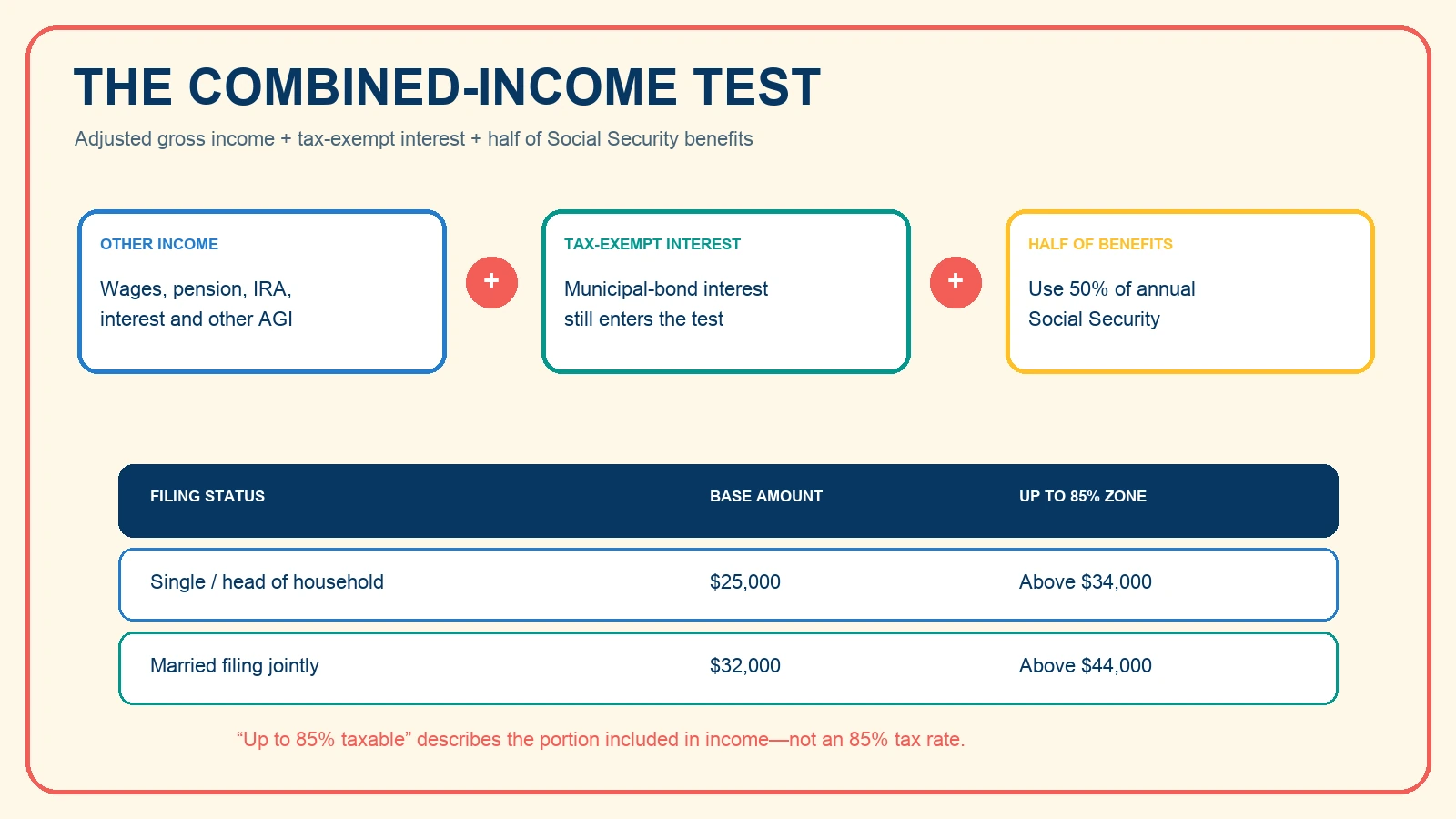
Combined income = adjusted gross income + tax-exempt interest + one-half of annual Social Security benefits.
If combined income crosses the threshold for your filing status, part of your benefits may become taxable. Even so, no more than 85% of Social Security benefits is generally included in federal taxable income.
First, separate three different percentages
Social Security taxation is easier to understand when three percentages are kept separate:
- 50% of benefits: Half of annual benefits enters the combined-income formula.
- Up to 50% or 85% taxable: Depending on combined income, that portion of benefits may be included in taxable income.
- Your tax rate: The taxable portion is taxed at the ordinary federal income-tax rates that apply to your return.
For example, if $20,000 of a $30,000 Social Security benefit becomes taxable, you do not owe $20,000 of tax. Instead, $20,000 is added to the other taxable income on the return, and the resulting taxable income is subject to the applicable tax brackets.
The federal thresholds
| Filing status | Base amount | Higher threshold |
|---|---|---|
| Single, head of household or qualifying surviving spouse | $25,000 | $34,000 |
| Married filing jointly | $32,000 | $44,000 |
| Married filing separately and lived apart for the entire year | $25,000 | Special calculation applies |
| Married filing separately and lived with spouse during any part of the year | $0 | Up to 85% may be taxable |
If combined income is at or below the base amount, benefits generally are not taxable. Once it rises above the base amount, up to 50% may become taxable. Finally, when combined income exceeds $34,000 for the individual filing statuses above or $44,000 for married filing jointly, up to 85% may become taxable.
Importantly, these are inclusion thresholds rather than tax brackets. Therefore, crossing a threshold does not cause 50% or 85% of every dollar of benefits to become taxable at once.
What counts as “other income”?
The starting point is generally adjusted gross income before Social Security benefits. Consequently, common items that can affect the calculation include:
- Wages and net self-employment income
- Taxable pension payments
- Traditional IRA and pretax retirement-plan distributions
- Required minimum distributions
- Taxable interest and ordinary dividends
- Capital gains and capital-gain distributions
- Rental or business income
- Taxable annuity income
- Other income reported in adjusted gross income
In addition, tax-exempt interest—such as interest from many municipal bonds—is added separately for this test. Thus, “federal tax-exempt” does not necessarily mean “invisible when calculating taxable Social Security.”
What generally does not enter combined income?
- The portion of Social Security excluded from taxable income
- Qualified Roth IRA or designated Roth account distributions that are not included in gross income
- Qualified charitable distributions that meet the rules and are excluded from income
- Tax-free return of basis
- Gifts and inheritances that are not taxable income to the recipient
- Supplemental Security Income, which is not Social Security income for federal tax purposes
However, each item has its own rules. For instance, a Roth distribution that is not qualified may include taxable earnings, while an IRA distribution intended for charity must satisfy the qualified-charitable-distribution requirements to remain excluded.
Three worked examples
Example 1: benefits are not taxable
Maya files as single. She receives $24,000 of Social Security and has $10,000 of other income with no tax-exempt interest.
- Other income: $10,000
- Tax-exempt interest: $0
- Half of Social Security: $12,000
- Combined income: $22,000
Because $22,000 is below the $25,000 base amount, none of Maya’s Social Security is generally taxable.
Example 2: a portion becomes taxable
Leon files as single. He receives $24,000 of Social Security and has $18,000 of pension and interest income.
- Other income: $18,000
- Tax-exempt interest: $0
- Half of Social Security: $12,000
- Combined income: $30,000
His combined income is $5,000 over the base amount but below the higher threshold. Therefore, the preliminary taxable amount is generally limited to half of that $5,000 excess, or $2,500, subject to the full IRS worksheet.
Example 3: married couple in the 85% zone
Elena and Chris file jointly. Together, they receive $42,000 of Social Security, $30,000 of pension income, a $12,000 traditional IRA distribution and $1,000 of taxable interest.
- Other income: $43,000
- Tax-exempt interest: $0
- Half of Social Security: $21,000
- Combined income: $64,000
Since $64,000 is above the $44,000 higher threshold, part of their benefits falls into the 85% calculation. Using the standard worksheet framework, about $23,000 of their $42,000 benefit would be taxable in this simplified example—not the full 85% maximum. Nevertheless, their actual return could differ because deductions and special situations affect the final calculation.
Use the IRS worksheet for the tax return
These examples explain the mechanics. However, the taxable amount should be calculated with the Social Security Benefits Worksheet in the Form 1040 instructions or the applicable worksheet in IRS Publication 915. Special worksheets can apply when IRA deductions or certain exclusions interact with the calculation.
Why one extra dollar can have an outsized effect
Inside the phase-in ranges, another dollar of IRA withdrawal, interest or wages can cause part of an additional Social Security dollar to become taxable. This effect is sometimes called the Social Security tax torpedo.
For example, $1 of additional income can make as much as another $0.85 of benefits taxable while the calculation is phasing in. Consequently, taxable income may rise by as much as $1.85 even though cash income rose by only $1. That does not continue forever; once 85% of benefits is taxable, the extra inclusion effect stops.
Still, the temporary effect can raise the effective marginal tax rate on a particular withdrawal. Therefore, retirement tax planning should look at the whole return rather than only the ordinary bracket printed in a tax table.
Planning moves that may change the result
Coordinate pretax withdrawals
Traditional IRA withdrawals and required minimum distributions generally enter adjusted gross income. As a result, a large withdrawal can make more Social Security taxable and may also affect Medicare premiums in a later year.
Use Roth accounts thoughtfully
Qualified Roth distributions generally do not enter gross income. Therefore, Roth money can provide spending without directly increasing combined income. On the other hand, a Roth conversion is generally taxable in the conversion year, so it can increase taxable Social Security that year.
Manage capital gains
Even a capital gain taxed at a 0% long-term capital-gain rate can increase adjusted gross income. Consequently, it can cause more Social Security to become taxable even when the gain itself receives a favorable rate.
Consider qualified charitable distributions
For an eligible IRA owner, a qualified charitable distribution sent directly to an eligible charity can satisfy applicable requirements while keeping the qualifying amount out of income. Thus, it may produce a different Social Security tax result than taking a taxable IRA distribution and later claiming a charitable deduction.
Choose the timing of large income events
Part-time work, a business sale, large gains, Roth conversions and retirement-account withdrawals can cluster income in one year. Before acting, compare the current year with nearby years. Sometimes grouping income is useful; in other cases, spreading it reduces interactions.
Should taxes be withheld from Social Security?
You can pay estimated taxes, increase withholding from another income source or request voluntary federal withholding from Social Security. Currently, Social Security offers withholding choices of 7%, 10%, 12% or 22% of the monthly benefit.
However, the best percentage depends on the whole tax return, not just Social Security. For example, a household with pensions and IRA withdrawals may already have enough withheld elsewhere. Conversely, a person with little other withholding may prefer deductions from the monthly benefit to avoid a large balance due.
Social Security allows beneficiaries to start, change or stop voluntary withholding through a personal account or by contacting the agency. In addition, Form W-4V remains relevant for voluntary withholding requests in applicable situations.
What about state income tax?
Federal and state rules are separate. Most states do not tax Social Security benefits, while some tax them with income-based exemptions or other limits. Because state laws change, verify the current rule for your state of residence and any state involved in a move.
Moreover, a state that exempts Social Security may still tax pensions, IRA withdrawals or investment income. Therefore, compare the complete state return rather than using Social Security treatment alone to judge a state’s retirement taxes.
Lump-sum and repayment situations
A retroactive Social Security payment can include benefits for earlier years. Although the payment is reported in the year received, the IRS provides a lump-sum election that may reduce the taxable amount by using earlier-year information. Publication 915 explains the election and worksheets.
Meanwhile, repayment of benefits can create another special calculation, particularly when repayments exceed gross benefits received during the year. Keep every SSA-1099, corrected statement and repayment notice; then use the current IRS instructions or professional help.
Your annual Social Security tax worksheet
- Enter total net benefits from Box 5 of all Forms SSA-1099.
- Multiply that total by 50%.
- Add taxable income other than Social Security.
- Add tax-exempt interest.
- Compare combined income with the thresholds for your filing status.
- Use the official worksheet to calculate the taxable portion.
- Estimate federal tax using the full return.
- Check whether withholding or estimated payments are sufficient.
- Review the separate rule for your state.
- Model planned IRA withdrawals, gains or conversions before year-end.
Common mistakes
- Calling 85% a tax rate. It is the maximum portion generally included in taxable income.
- Ignoring a spouse’s income. Joint filers combine both spouses’ income and benefits.
- Leaving municipal-bond interest out. Tax-exempt interest still enters combined income.
- Assuming a 0% capital-gain rate has no effect. The gain can still raise adjusted gross income.
- Confusing SSI with Social Security benefits. SSI is not taxable Social Security income.
- Using only a monthly benefit. The formula uses annual benefits and annual income.
- Forgetting Medicare interactions. The same income event can affect future Medicare income-related premiums under separate rules.
Ultimately, Social Security taxation is an interaction problem. The benefit amount matters, but the timing and type of every other income source determine how much enters the tax return.
Related RetireNerd guides
- How Social Security Calculates Your Benefit
- Should You Claim Social Security and Keep Working?
- Social Security for Self-Employed Workers
- How to Check and Correct Your Social Security Earnings Record
- Social Security at 62, 67 or 70
- Which Accounts Should You Withdraw From First in Retirement?
Official sources
- IRS Publication 915: Social Security and Equivalent Railroad Retirement Benefits
- SSA: Must I pay taxes on Social Security benefits?
- SSA: Request voluntary tax withholding
- IRS Publication 590-B: IRA distributions and qualified charitable distributions
- IRS: Required minimum distribution FAQs
This article provides general educational information and simplified examples. Tax law and state treatment can change, and special worksheets apply in some situations. Use current IRS instructions and consult a qualified tax professional for advice about your return.