

A portfolio can drift quietly. Stocks rise, bonds lag and the mix that once matched your retirement plan becomes more aggressive than you intended. Rebalancing brings the portfolio back toward its target—but doing it carelessly can create capital gains, raise income-based costs or trigger a wash-sale problem.
The solution is not to avoid rebalancing. It is to treat every household account as one portfolio and use a tax-aware order of operations. Often, you can correct much of the drift with cash flows and trades inside retirement accounts before selling anything in a taxable brokerage account.The central idea
Rebalancing decides what to buy and sell. Tax-aware rebalancing also decides which account should make each trade, which tax lot to use and whether the adjustment can happen gradually.
What does rebalancing a retirement portfolio mean?
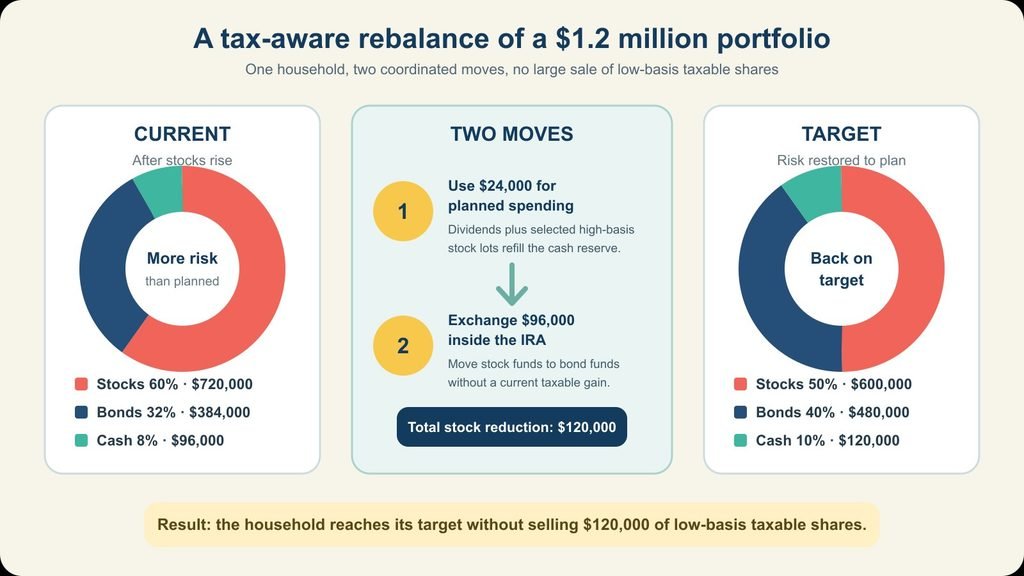
Rebalancing restores a portfolio toward its chosen mix of stocks, bonds and cash. Suppose your plan calls for 50% stocks, 40% bonds and 10% cash. After a strong stock market, the portfolio may reach 60% stocks, 32% bonds and 8% cash. You now hold more stock risk than the plan intended.
You could rebalance by selling some stocks and buying bonds and cash. However, that is only one method. Investor.gov also describes using new money to buy underweight investments or redirecting contributions toward them. Retirees can extend that idea by directing dividends, interest, withdrawals and required distributions where the household needs them.
Rebalancing is different from changing your target. A move from 60% stocks to 40% stocks because your spending, risk tolerance or time horizon changed is a new investment decision. Returning from 60% to an existing 50% target is rebalancing.
Why taxes make retirement rebalancing harder
A trade inside a traditional IRA, 401(k) or Roth IRA generally does not create a current capital gain. By contrast, selling an appreciated investment in a taxable account realizes a gain. The holding period, cost basis and chosen tax lot help determine how that gain is taxed.
Realized gains can affect more than the capital-gains line on a tax return. Depending on the household, additional income may also influence:
- the amount of Social Security included in taxable income;
- Affordable Care Act premium-tax-credit eligibility before Medicare;
- Medicare income-related monthly adjustment amounts in a later year;
- the 3.8% net investment income tax;
- state income taxes; and
- the tax rate applied to other income.
These interactions do not make taxable sales automatically wrong. They mean the household should estimate the complete tax result rather than looking only at the gain itself.
Three ways to decide when to rebalance
Calendar rebalancing
Review the portfolio on a regular date, such as once or twice a year. The schedule is easy to follow and discourages daily tinkering. Still, a review does not require a trade. Small differences may not justify costs or taxes.
Threshold rebalancing
Act when an asset class moves beyond a preset band. For example, a 50% stock target might permit a range of 45% to 55%. A threshold responds to meaningful drift, although it requires monitoring and a clear rule.
A hybrid approach
Many retirees can review on a schedule and trade only after a threshold is crossed. This method creates a routine without forcing unnecessary transactions. The right band depends on the portfolio, taxes, transaction costs and how much drift the household can tolerate.
A tax-aware order of operations
The following sequence starts with the least disruptive tools. It does not eliminate every tax bill, but it can reduce unnecessary taxable sales.
1. Confirm the household target
Combine taxable accounts, IRAs, workplace plans and Roth accounts before measuring drift. One IRA can look bond-heavy while a Roth looks stock-heavy, yet the complete household may sit exactly at its target. RetireNerd’s asset-location guide explains why every account does not need the same mix.
Also confirm that the target still fits the retirement plan. A looming home purchase, pension start date, large medical expense or shorter spending horizon may justify changing the plan before trading.
2. Use cash flows first
Direct dividends, interest and fund distributions to cash instead of automatically reinvesting them when cash is underweight. Use planned withdrawals from an overweight asset. If the household still contributes to an HSA, IRA or workplace plan, direct new contributions toward the underweight category.
This gradual approach may take months, but it can restore balance without realizing an avoidable gain. It also connects rebalancing to the retirement paycheck.
3. Trade inside retirement accounts
Next, consider exchanges inside a traditional IRA, 401(k) or Roth account. Selling a stock fund and buying a bond fund inside the account generally does not create a current taxable capital gain. That makes retirement accounts useful rebalancing spaces.
Account location still matters. Moving too many bonds into a Roth may reduce its long-term growth potential, while holding every bond in a traditional IRA may increase future required distributions. Coordinate the trade with the household’s withdrawal, Roth-conversion and estate plans.
4. Inspect taxable lots before selling
If taxable sales remain necessary, review the individual purchase lots. A fund position may include older shares with large gains, newer shares with small gains and some shares at a loss. Selling the entire position could create a much larger tax bill than selling carefully selected lots.
Specific-share identification can let an investor instruct the broker which shares to sell. IRS Publication 550 describes the identification requirements. Confirm the broker’s records and obtain written confirmation. If the shares cannot be adequately identified, another basis method may apply. Mutual funds may also offer an average-basis method, but changing methods can have consequences.
5. Realize only the gain the plan can absorb
A complete rebalance does not need to happen in one day. A household may sell enough high-basis shares to return inside its allowable band, then finish with later withdrawals or in a new tax year. Long-held shares generally receive long-term capital-gain treatment, while short-term gains generally face ordinary-income rates.
Run a tax projection before a substantial sale. Include wages, pensions, Social Security, IRA withdrawals, Roth conversions, interest, dividends and expected gains. Someone using ACA coverage should be especially careful because marketplace assistance depends on household income under the applicable rules. A Medicare enrollee should also consider the income lookback used for premium surcharges.
6. Use losses carefully
A realized capital loss can offset a capital gain. If losses exceed gains, current federal rules generally allow up to $3,000 of net capital loss to reduce other income ($1,500 if married filing separately), with unused losses carried forward. Verify the rule for the tax year and remember that state treatment may differ.
Tax-loss harvesting is not free money. The sale changes the investment and its future basis. More importantly, the wash-sale rule can disallow a loss when substantially identical stock or securities are acquired within 30 days before or after the loss sale.
Check automatic dividend reinvestment, a spouse’s account, robo-adviser trades and purchases in an IRA or workplace plan. A tiny automatic purchase can complicate an otherwise sensible loss sale. The meaning of “substantially identical” depends on the facts, so use a tax professional for uncertain replacements.
7. Coordinate charitable giving, RMDs and QCDs
A charitably inclined investor may be able to donate appreciated shares held longer than one year instead of selling them and donating cash. The deduction, valuation, substantiation and adjusted-gross-income limits depend on the property, recipient and tax situation. Compare the strategy with the standard deduction and consult IRS Publication 526.
For an eligible IRA owner, a qualified charitable distribution follows different rules. It sends money directly from the IRA to an eligible charity and can count toward a required minimum distribution when the requirements are met. A QCD does not dispose of appreciated taxable shares, but it can change where the household takes spending and charitable dollars, which may create room to rebalance elsewhere.
A $1.2 million household example
Consider Elena and Marcus, who hold $1.2 million across a taxable brokerage account, traditional IRAs and Roth IRAs. Their target is 50% stocks, 40% bonds and 10% cash.
| Asset | Current amount | Current share | Target amount | Adjustment |
|---|---|---|---|---|
| Stocks | $720,000 | 60% | $600,000 | Reduce by $120,000 |
| Bonds | $384,000 | 32% | $480,000 | Add $96,000 |
| Cash | $96,000 | 8% | $120,000 | Add $24,000 |
The obvious move is to sell $120,000 of stock in the taxable account. However, much of that stock has a low cost basis. Instead, they examine the complete portfolio.
- Fund planned spending: They need $24,000 from the portfolio during the next several months. Dividends and a sale of selected high-basis stock lots refill cash, reducing stocks by $24,000.
- Rebalance inside the IRA: Their traditional IRAs hold enough stock funds to exchange $96,000 of stock for bond funds. The exchange does not create a current taxable capital gain.
- Recheck the household: Stocks fall to $600,000, bonds rise to $480,000 and cash rises to $120,000. They reach the target without selling $120,000 of low-basis taxable shares.
This is a simplified illustration. Real portfolios include market movement during the process, account restrictions, settlement timing, fund-trading policies, taxes and different asset subclasses. Nevertheless, the example shows why the account chosen for a trade can matter as much as the trade itself.
What if retirement accounts cannot do all the work?
Sometimes the overweight investment sits mostly in taxable accounts. Perhaps company stock appreciated sharply, or an index fund grew for decades. In that case, consider several partial solutions:
- sell high-basis lots first;
- pair some gains with harvested losses;
- spread sales across tax years when appropriate;
- use future dividends and withdrawals to reduce the position;
- donate appreciated shares if charitable giving already belongs in the plan; and
- accept a limited amount of drift when the tax cost of perfection is too high.
A concentrated position creates a separate risk decision. Taxes should influence the exit plan, but a tax bill alone should not force a retiree to retain an unsafe concentration indefinitely.
Common rebalancing mistakes
Rebalancing each account separately
Making every account hold the same allocation can produce unnecessary taxable trades and undermine a deliberate asset-location plan. Measure the household first.
Ignoring tax-lot settings
A broker’s default disposal method may not choose the shares you intended. Review the method before placing the sale and save the confirmation.
Harvesting a loss while reinvestment stays on
An automatic purchase during the wash-sale window may disallow part of the loss. Review related accounts and recurring purchases before and after the transaction.
Letting taxes dictate the entire portfolio
Tax efficiency supports the investment plan; it does not replace diversification, liquidity or suitable risk. A smaller tax bill offers little comfort if the portfolio cannot fund the next market downturn.
Trading too often
Small daily movements do not require constant action. Excessive trading can create taxes, costs and behavioral mistakes. A written schedule and threshold can reduce impulse decisions.
A practical annual checklist
- Write down the household target allocation and allowable bands.
- Combine every investment account into one current allocation.
- List spending needs, RMDs, charitable gifts and expected contributions for the next 12 months.
- Use distributions and planned withdrawals to reduce overweight holdings.
- Make suitable exchanges inside retirement accounts.
- Review taxable lots, holding periods, losses and estimated gains.
- Check ACA, Medicare, Social Security, NIIT and state-tax interactions.
- Place any remaining taxable trade and retain its confirmation.
- Document the new allocation and the next review date.
Frequently asked questions
Do retirees need to rebalance every year?
No fixed schedule suits everyone. An annual or semiannual review is common, but a review may lead to no trade. Thresholds, taxes, costs and cash-flow needs should guide the action.
Can I rebalance without selling?
Often, yes. New contributions, dividends, interest, maturing bonds and planned withdrawals can move the portfolio toward its target. Trades inside retirement accounts may also correct household drift without a current taxable capital gain.
Should I rebalance my IRA or taxable account first?
Many households first consider retirement-account trades because they generally do not realize current capital gains. However, future withdrawals, RMDs, Roth growth, liquidity and asset location still matter. Review the entire plan before choosing the account.
Is a capital gain always bad?
No. A gain means an investment increased in value, and realizing one can reduce risk or fund spending. The goal is to understand the tax cost and choose the amount and timing deliberately.
Can software rebalance automatically?
Some managed accounts and robo-advisers offer automatic rebalancing and tax-loss harvesting. Read the method carefully. Software may not see outside accounts, a spouse’s trades, upcoming income changes, charitable plans or marketplace-health-insurance constraints.
The best rebalance is coordinated
A strong rebalancing process starts with the retirement plan, measures all accounts together and uses cash flows before taxable sales. It trades inside retirement accounts when appropriate, chooses taxable lots carefully and tests the result against the household’s complete tax picture.
Perfection is not required. Returning inside a sensible range with fewer taxes and fewer moving parts may be better than forcing every holding to an exact percentage. The portfolio should become easier to live with, not merely prettier on a spreadsheet.Educational note
This article provides general education, not individualized investment or tax advice. Tax rules, account rules and healthcare-income calculations change. Consider a tax professional or fiduciary adviser before a large taxable sale, Roth conversion, charitable transfer or wash-sale-sensitive trade.
Sources
- Investor.gov: Beginner’s Guide to Asset Allocation, Diversification and Rebalancing
- IRS Publication 550: Investment Income and Expenses
- IRS Topic 409: Capital Gains and Losses
- IRS: Net Investment Income Tax
- IRS Publication 526: Charitable Contributions
- IRS Publication 590-B: Distributions from Individual Retirement Arrangements