

Your employer’s paycheck stops when you retire, but your bills do not. A retirement paycheck is simply a system that combines Social Security, pensions and planned withdrawals from savings into a dependable deposit in your checking account.
You do not need a special investment called a “retirement paycheck.” You need to know how much your household spends, how much dependable income arrives automatically and how much savings must fill the gap. Then you arrange the money so ordinary bills are paid without making a new investment decision every month.
The retirement paycheck in one minute
- Add up your normal monthly spending and irregular annual expenses.
- Subtract Social Security, pensions, annuity payments and other dependable income.
- The amount left is the monthly gap your savings must provide.
- Keep near-term spending money in a cash reserve instead of depending on a stock sale every month.
- Send a fixed monthly transfer to checking, just as an employer once deposited a paycheck.
- Refill the reserve from investments on a planned schedule.
- Set tax withholding deliberately and review the amount at least once a year.
Start with the gap, not your account balance
A large retirement balance can still feel abstract. The useful question is: How much must my savings send me each month?
Begin with spending. Include housing, food, utilities, transportation, healthcare, insurance, taxes and personal spending. Then turn irregular costs—home repairs, travel, gifts, dental work and vehicle replacement—into a monthly average. RetireNerd’s Retirement Spending Planner can help you build the estimate.
A simple example
Maria and James expect to spend $6,000 a month. Social Security provides $3,600 and a small pension provides $700. Their investments must cover the remaining $1,700 monthly gap.
They also expect $6,000 a year of irregular costs. That adds $500 a month. Their starting transfer target is therefore $2,200 a month before allowing for taxes.
| Monthly calculation | Amount |
|---|---|
| Normal household spending | $6,000 |
| Irregular costs averaged monthly | +$500 |
| Total spending target | $6,500 |
| Social Security | −$3,600 |
| Pension | −$700 |
| Needed from savings before taxes | $2,200 |
This calculation turns a vague question—“Will our money last?”—into a number you can plan around. It does not prove that a portfolio can safely provide $2,200 a month for life. That requires testing the withdrawal against time, inflation, taxes and difficult markets. Compass is designed for that next step.
The four-part paycheck system
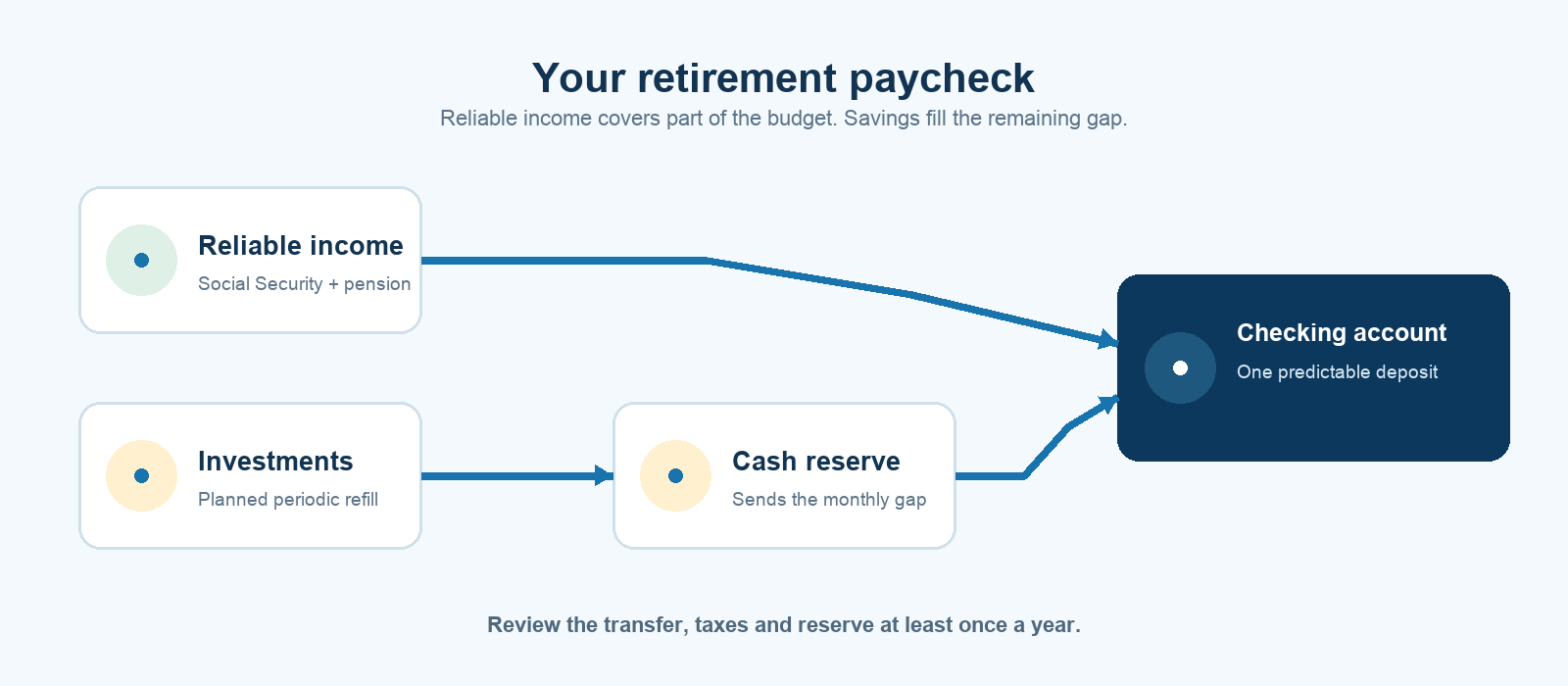
1. Reliable income
Social Security, pensions and other predictable payments go directly to checking.
2. Cash reserve
Near-term portfolio withdrawals wait in cash or another stable, accessible holding.
3. Monthly transfer
An automatic deposit from the reserve fills the gap in the bill-paying account.
4. Planned refill
Investments replenish the reserve during scheduled reviews instead of random withdrawals.
Think of the cash reserve as a small payroll department. The portfolio may move every day, but the amount arriving in checking can stay steady for ordinary spending.
How much cash should sit in the reserve?
There is no correct number for everyone. Some retirees keep only a few months of portfolio withdrawals. Others hold a year or more, especially when most spending depends on investments or when market swings make them anxious. The reserve should be based on the amount savings must provide, not the entire household budget.
If Maria and James choose a 12-month reserve, they would start with roughly $26,400—their $2,200 monthly gap multiplied by 12—plus any separate emergency fund. They would not need $78,000, which would be 12 months of their full $6,500 spending target, because Social Security and the pension already cover most of it.
More cash can make the paycheck easier to manage during a market decline, but cash also has an opportunity cost and can lose purchasing power to inflation. Choose a rule you can explain, then test it under a bad early market rather than assuming “more cash” is always safer.
Where should the monthly money come from?
A common mistake is to look for the account with the largest balance and withdraw from it first. The better question is how withdrawals from all accounts work together. A household may have cash, a taxable brokerage account, a traditional 401(k) or IRA, a Roth IRA and an HSA. Each has different tax treatment and rules.
| Source | How it may fit | Watch for |
|---|---|---|
| Bank or money-market reserve | Supplies predictable monthly transfers | Inflation, yield changes and holding too much idle cash |
| Taxable brokerage | Sales can refill cash; only gains are generally taxable | Capital gains, losses, cost basis and selling after a decline |
| Traditional 401(k) or IRA | Can provide scheduled withdrawals with withholding | Withdrawals are generally ordinary income; early-withdrawal and RMD rules |
| Roth IRA | Qualified withdrawals may provide tax-free flexibility | Qualification rules and giving up future tax-free growth |
| HSA | Tax-free reimbursements for qualified medical expenses | Receipts, eligible expenses and penalties for nonqualified use before 65 |
“Taxable first, traditional next, Roth last” is a useful classroom example, but it is not a universal rule. Taking some traditional IRA money earlier can sometimes reduce future required minimum distributions. Preserving taxable assets can sometimes help with flexibility or estate goals. Roth money may be useful in a high-expense year. The right sequence depends on tax brackets, Social Security, Medicare premiums, charitable plans, heirs and the investments held in each account.
Do dividends and interest have to cover the paycheck?
No. A retirement paycheck can come from dividends, interest, maturing bonds and planned sales of investments. This is called a total-return approach: the portfolio is built for the household’s overall goals, and cash is created from whatever source makes sense during the review.
Forcing the portfolio to produce every dollar through dividends or interest can push a retiree toward concentrated stocks, risky bonds or products chosen mainly for a high advertised yield. A distribution is not automatically a gain, and a high yield is not a guarantee of safety. Diversification, cost, taxes and total return still matter.
How to set up the transfers
- Choose one bill-paying checking account. Route Social Security, pensions and the savings transfer into it. Social Security lets beneficiaries manage direct-deposit information through a personal account and other approved methods.1
- Choose the cash-reserve account. This may be a bank savings account, brokerage cash position or money-market fund. Confirm insurance coverage, access rules, settlement time and yield.
- Set the gross withdrawal. If $2,200 must reach checking and taxes will be withheld, the gross distribution needs to be higher than $2,200.
- Select withholding. Do not simply accept a default percentage without comparing it with the household’s projected tax return.
- Schedule the transfer. Most IRA custodians and many workplace plans allow recurring electronic distributions. Ask about minimum amounts, fees and whether investments must be sold manually first.
- Keep a buffer in checking. A modest cushion prevents a holiday, transfer delay or surprise bill from causing an overdraft.
- Test one payment before relying on it. Confirm the deposit date, net amount, withholding and account routing.
Monthly, quarterly or annual withdrawals?
| Method | Why people use it | What requires attention |
|---|---|---|
| Monthly withdrawal from the investment account | Simple and paycheck-like | Can trigger frequent sales and may be limited by a workplace plan |
| Quarterly withdrawal | Fewer transactions with regular cash infusions | Checking balance must cover the months between payments |
| Annual withdrawal | One coordinated sale and tax decision | Creates a large cash-management job and one major timing decision |
| Hybrid system | Refill cash once or twice a year, then transfer monthly to checking | Requires maintaining both the reserve and the automatic transfer |
For many retirees, the hybrid is easiest to live with: the portfolio is reviewed periodically, while checking receives a predictable monthly amount. The schedule itself does not make an unsustainable withdrawal safe. The annual total matters much more.
Build taxes into the paycheck
Traditional IRA and 401(k) withdrawals are generally taxable income. Taxable account sales may create capital gains or losses. Qualified Roth withdrawals can be tax-free. Additional income can also change how much Social Security is taxable and may affect Medicare income-related surcharges later.
The IRS uses Form W-4P for certain periodic pension or annuity payments and Form W-4R for nonperiodic retirement-account payments. For many nonperiodic payments, the federal default is 10%, but the IRS warns that a default may not match the household’s actual tax situation.2 If withholding is insufficient, estimated tax payments may be necessary.3
A $2,200 need is not always a $2,200 withdrawal
If Maria and James want $2,200 deposited after withholding, they must request a larger gross distribution. At an illustrative 12% withholding rate, a gross withdrawal of $2,500 would send $300 to federal taxes and $2,200 to checking. State withholding or a different federal rate would change the result.
What changes when required distributions begin?
Required minimum distributions generally begin at age 73 under current rules, although age 75 applies to certain younger birth cohorts. Traditional IRAs and most workplace retirement plans are covered; Roth IRAs and designated Roth workplace accounts do not require lifetime RMDs for the original owner under current rules.4
An RMD is a minimum, not a separate pile of money. It can become part of the annual amount used to refill your paycheck reserve. If it exceeds what you need to spend, the after-tax remainder can be moved to a taxable savings or brokerage account. An RMD itself cannot be rolled into another retirement account.
What should happen during a bad market?
The danger is not simply that investments fall. The danger is being forced to sell a large amount after they fall while withdrawals continue. A cash reserve can buy time, but it does not remove sequence-of-returns risk.
Your written rule might say that during a serious decline you will use the reserve, pause large optional purchases, reduce travel temporarily, rebalance only according to the plan and avoid increasing withdrawals automatically. Essential bills should not depend on a decision made in panic. Use RetireNerd’s Retirement Withdrawal Strategies guide to compare approaches, then stress-test the complete plan in Compass.
Review the paycheck once a year
- Did spending rise or fall?
- Are large one-time expenses coming next year?
- Did Social Security, pensions or other income change?
- Is the cash reserve above or below its target?
- Which investments should be sold or rebalanced to refill it?
- Will the planned withdrawal create an avoidable tax or Medicare surprise?
- Have beneficiaries, bank instructions or account access changed?
- Does the withdrawal still work in a difficult market projection?
Do not increase the transfer merely because the market had a good year, and do not cut essential spending automatically because of one bad month. Compare the annual withdrawal with inflation, portfolio value, future income and remaining years. A raise should be a decision, not an unchecked automatic habit.
Your retirement paycheck checklist
- Estimate normal monthly spending.
- Add a monthly allowance for irregular expenses.
- Subtract Social Security, pensions and other dependable income.
- Test whether savings can reasonably support the remaining gap.
- Choose a near-term cash-reserve target.
- Decide which accounts will refill the reserve and when.
- Set federal and state withholding based on the whole tax picture.
- Schedule a monthly transfer to checking.
- Run a small test transfer.
- Write down the refill, bad-market and annual-review rules.
Find the amount your savings must provide
First, build a realistic monthly budget with the Retirement Spending Planner. Then use Compass to test the withdrawal with your investments, Social Security, taxes and difficult market sequences.
Frequently asked questions
Do I need to roll my 401(k) into an IRA to create a paycheck?
No. Some workplace plans allow recurring partial distributions. Others offer limited schedules or charge fees. Compare the plan’s actual distribution options before moving money. RetireNerd’s 401(k), rollover and Roth conversion guide explains the main rules.
Should my retirement paycheck be the same every month?
A steady amount makes ordinary budgeting easier. Keep large irregular costs separate so a roof repair or major trip does not permanently inflate the monthly transfer.
Should I keep two years of expenses in cash?
There is no universal requirement. Base the reserve on the spending gap that investments must cover, your other dependable income, the stability of your portfolio and the amount of volatility you can tolerate without abandoning the plan.
Can I live only on dividends and never sell shares?
Possibly, but making that a requirement can distort the portfolio. Selling shares according to a planned total-return strategy is a normal way to fund retirement. What matters is the total withdrawal, taxes, diversification and whether the plan remains sustainable.
How often should I refill the cash reserve?
Many people review it once or twice a year, often alongside rebalancing and tax planning. Others use a defined minimum balance. Pick a schedule that prevents constant market decisions while keeping enough cash for the next planned transfers.
Keep learning with RetireNerd
- How to Estimate Your Retirement Spending
- Retirement Spending Planner
- 401(k), Rollover and Roth Conversion Guide
- Retirement Withdrawal Strategies
- Retirement Taxes and Paperwork
- Compass Retirement Planner
Sources
- Social Security Administration. “Update direct deposit.”
- Internal Revenue Service. “Pensions and annuity withholding.”
- Internal Revenue Service. Publication 505, “Tax Withholding and Estimated Tax.”
- Internal Revenue Service. “Retirement plan and IRA required minimum distributions FAQs.”
Rules were reviewed September 14, 2026. Tax law, account services and plan rules can change. Examples are illustrative and do not predict investment returns. This article provides general education, not individualized financial, investment, tax or legal advice.