
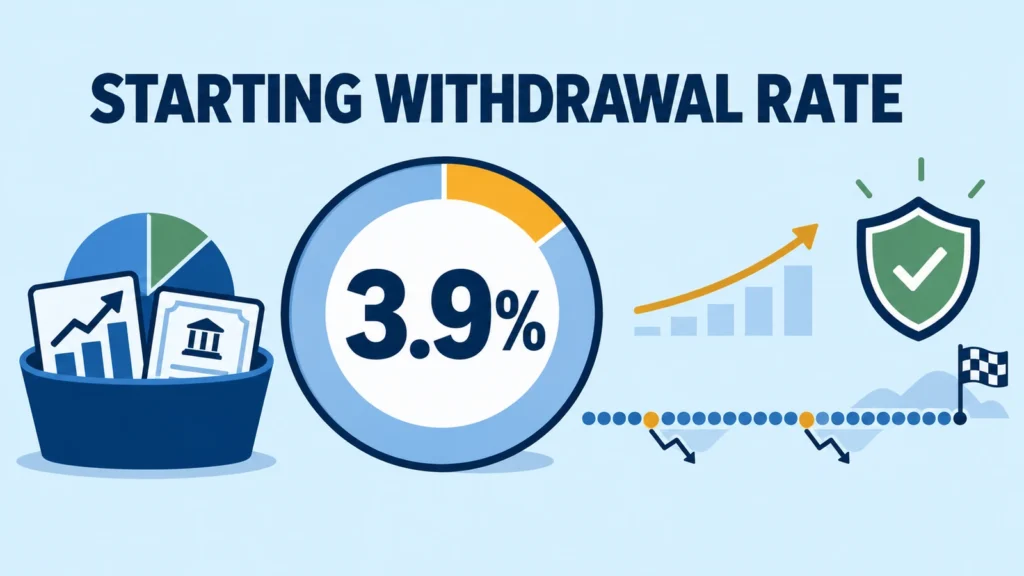
Morningstar’s latest retirement-income research estimates a 3.9% starting safe withdrawal rate for a new retiree seeking steady, inflation-adjusted portfolio spending over 30 years. That number is useful—but only when its assumptions are understood.
The research does not say that every retiree should withdraw 3.9% of every account each year. It does not guarantee success, and it does not include an individual retiree’s taxes, investment fees, Social Security, pension, healthcare costs or desired inheritance. It is a planning benchmark for a particular spending system and portfolio—not a personalized retirement paycheck.
The finding in plain English
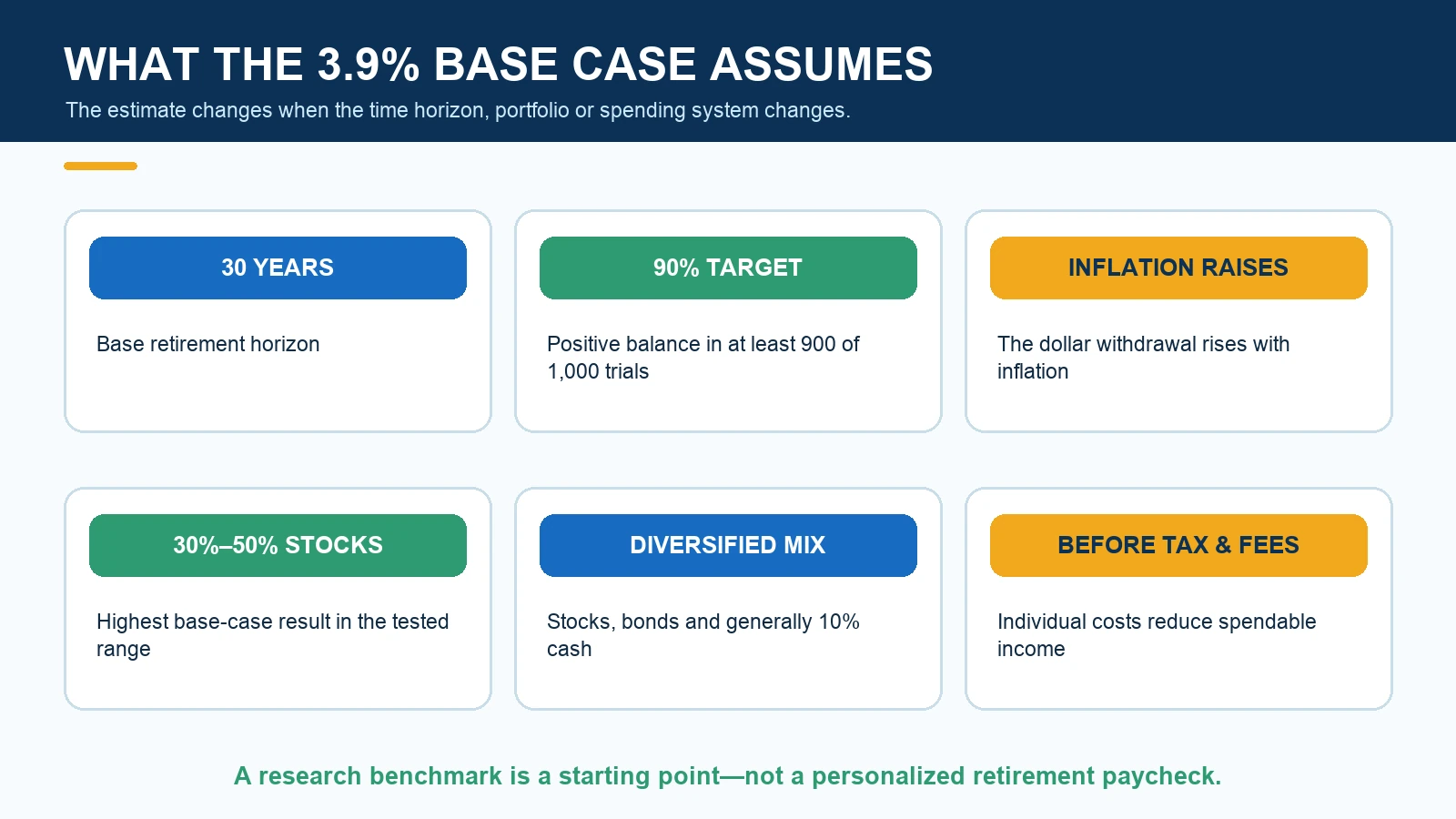
A retiree with a diversified portfolio and a 30-year planning horizon could begin by withdrawing 3.9% of the starting portfolio, then increase that dollar amount with inflation each year. In Morningstar’s simulations, portfolios with 30%–50% in equities supported that rate with a 90% probability of finishing the 30 years with money remaining.
“Safe” means successful in 900 of 1,000 modeled return sequences. It does not mean guaranteed.
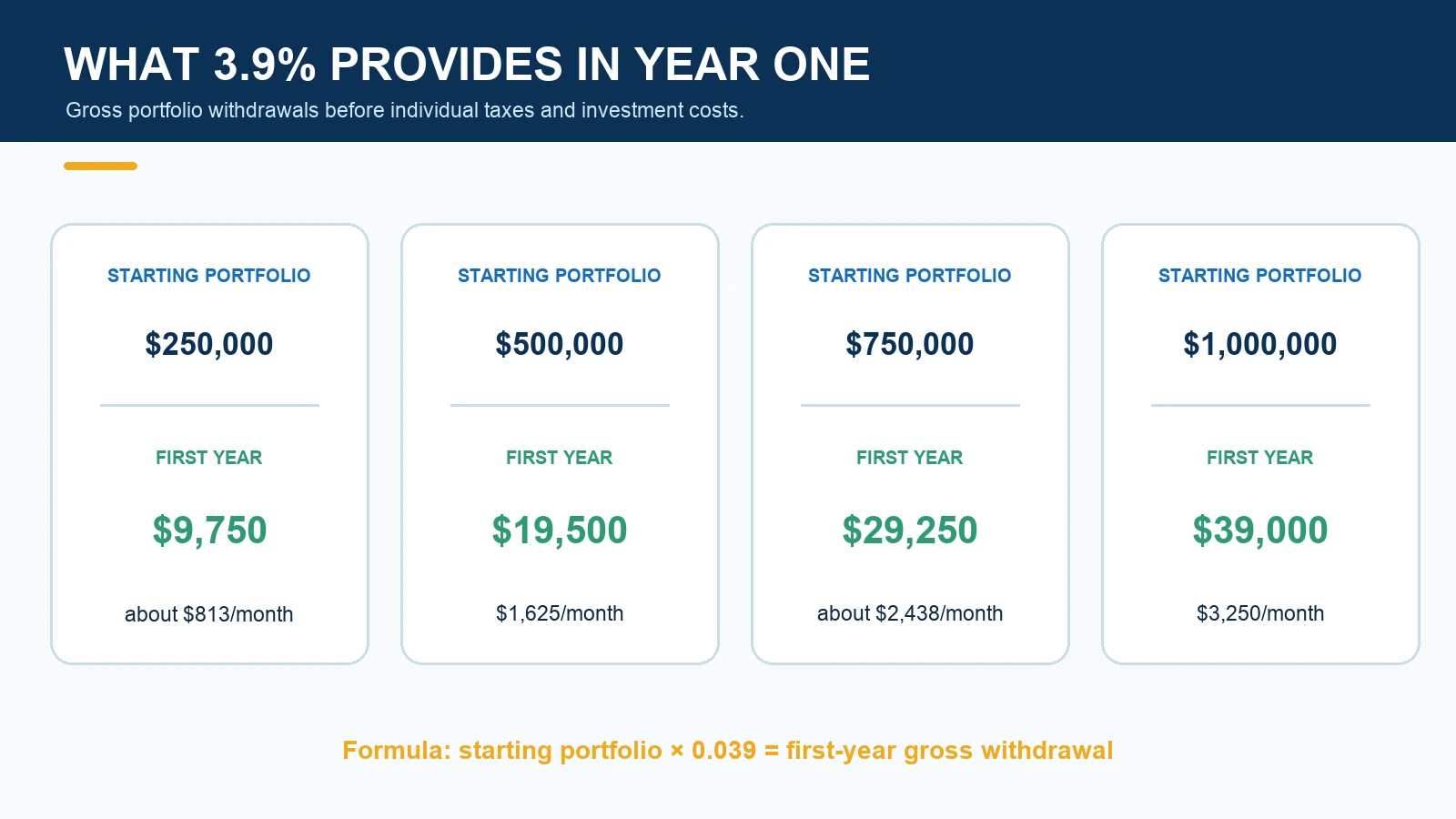
What 3.9% means in dollars
Multiply the invested portfolio at retirement by 0.039. That is the first-year gross portfolio withdrawal under the base-case approach.
| Starting portfolio | 3.9% first-year withdrawal | Monthly equivalent before taxes |
|---|---|---|
| $250,000 | $9,750 | About $813 |
| $500,000 | $19,500 | $1,625 |
| $750,000 | $29,250 | About $2,438 |
| $1,000,000 | $39,000 | $3,250 |
| $1,500,000 | $58,500 | $4,875 |
This is portfolio spending, not total retirement income. A retiree may also receive Social Security, a pension, annuity income, rent or part-time earnings. Start by estimating total spending, subtracting dependable income, and calculating what the portfolio must provide. RetireNerd’s guide to creating a retirement paycheck walks through that calculation.
The assumptions behind the number
A 30-year retirement
The base case assumes withdrawals for 30 years. Someone retiring at 55 may need the portfolio to last 35 or 40 years. Morningstar estimated 3.5% for a 35-year horizon and 3.3% for 40 years under the analyzed portfolio and success assumptions. A shorter horizon may support more, but health, longevity and a surviving spouse make it risky to assume retirement will be brief.
A 90% probability of success
Morningstar generated 1,000 hypothetical return patterns. A rate qualified when at least 900 finished the 30-year period with a positive balance. That leaves modeled failures. It also treats one dollar remaining as a technical success, even though a household might want a larger reserve for late-life care, a spouse, heirs or charity.
Fixed, inflation-adjusted spending
The base case takes the first-year dollar amount and raises it with inflation annually, regardless of whether the portfolio had a good or bad year. That produces a stable real paycheck, but it is intentionally inflexible. Actual households often spend less after a poor market year, postpone a vehicle purchase or allow discretionary spending to fall later in life.
A balanced portfolio
The highest 3.9% result appeared with portfolios holding 30%–50% in equities. The modeled portfolios were diversified and generally held 10% in cash. A concentrated stock portfolio, expensive fund lineup, speculative allocation or very conservative cash-heavy account should not borrow the same rate without analysis.
Forward-looking forecasts
Morningstar used forecasts for asset-class returns, volatility and inflation rather than relying only on the market’s historical record. Forecasts change as valuations, yields and methodology change. That is why the published base-case rate moved from 3.3% in the 2021 research to 3.8%, 4.0%, 3.7% and now 3.9% in later editions.
No individual taxes or investment fees
The base result does not subtract a retiree’s investment expenses or taxes. A $39,000 gross IRA distribution does not produce $39,000 of spendable cash after tax. Advisory fees, fund expenses and trading costs also reduce what the portfolio can support. Roth, pretax and taxable brokerage withdrawals can create different after-tax amounts. The guide to using a brokerage account alongside retirement accounts explains those differences.
How the first withdrawal changes in year two
The 3.9% is applied only at the beginning. It is not 3.9% of the new portfolio balance every year under the base case.
For example, a $1 million portfolio produces a $39,000 first-year withdrawal. If inflation were 2.5%, the second-year withdrawal would be approximately $39,975—even if the portfolio had fallen. The withdrawal is increased to preserve purchasing power. That stability is helpful for budgeting, but continuing raises during a serious decline can intensify sequence-of-returns risk.
Do not recalculate 3.9% from the balance every January
Taking a constant percentage of the current balance is a different variable-spending method. It greatly reduces the chance of completely exhausting the account, but income can fall sharply after market losses. The Morningstar base case targets a steadier inflation-adjusted dollar amount.
Why 3.9% is not simply a new “4% rule”
The traditional 4% rule grew from historical-return research. Morningstar’s work uses forward-looking market assumptions and updates them regularly. A difference of one-tenth of a percentage point is small: $1,000 in the first year for each $1 million invested. The larger lesson is not that 3.9% defeats 4.0%. It is that a sustainable withdrawal depends on the market assumptions, retirement length, asset allocation, spending method, costs and desired confidence.
False precision can distract from larger planning errors. Underestimating healthcare by $8,000, forgetting taxes, retiring several years earlier or carrying a costly portfolio matters far more than debating 3.9% versus 4.0% in isolation.
What “90% success” does not promise
- It does not promise that real markets will resemble the simulated returns.
- It does not guarantee the portfolio survives.
- It does not guarantee a large ending balance or inheritance.
- It does not include every tax, fee or household expense.
- It does not protect against fraud, concentration or poor implementation.
- It does not mean the retiree should ignore spending after a major market decline.
- It does not determine the correct Social Security claiming age.
Sequence risk remains the central danger
Two retirees can earn the same average return and experience different outcomes because the returns arrive in a different order. Losses during the first retirement years are especially damaging when withdrawals force the sale of depressed investments. Less capital remains to participate in the recovery.
Morningstar’s research found that early gains greatly improved outcomes, while early losses increased the risk of failure. Diversification and a meaningful fixed-income allocation helped the modeled retiree avoid depending entirely on volatile equities. A cash reserve can also reduce forced sales, but too much cash may reduce long-term growth. See how much cash to keep in retirement for the trade-offs.
Flexibility can support a higher starting withdrawal—but with a price
Morningstar tested flexible approaches that adjust withdrawals as the portfolio changes. Some supported starting rates as high as 5.7% in the research. That does not make 5.7% a universally safe replacement for 3.9%. The higher starting amount comes with greater year-to-year spending variation, possible cuts after losses and often lower ending balances.
A flexible strategy works better when essential expenses are covered by Social Security, a pension or another dependable income source. Then travel, gifts and other discretionary spending can absorb temporary reductions. A household whose portfolio pays the mortgage, food, insurance and medicine has less room for a large cut.
RetireNerd’s Guyton-Klinger guardrails guide explains one system for giving raises in strong conditions and making reductions when withdrawals become too large relative to the remaining portfolio.
Your spending pattern may not stay flat
The base case assumes constant inflation-adjusted spending. Many retirees spend more during active early years, less during quieter middle years and potentially more again if care expenses rise. Morningstar found that modeling actual spending patterns can support a higher initial rate than the fixed-real base case, but that does not mean every household will follow the average pattern.
Build the budget using actual plans rather than a smooth formula. Include housing, taxes, insurance, healthcare, vehicles, travel, family support and irregular replacements. Review retirement expenses people often forget before settling on the portfolio withdrawal.
A better way to use the 3.9% research
- Calculate the spending gap. Subtract Social Security, pension and other dependable income from realistic spending.
- Divide the first-year portfolio need by the invested portfolio. A $32,000 need from an $800,000 portfolio is a 4.0% initial withdrawal.
- Compare the horizon. Use more than 30 years for an early retirement or a household with longevity.
- Check the portfolio. Compare the actual stock, bond and cash allocation with the research assumptions.
- Subtract costs and estimate taxes. Convert the gross withdrawal into spendable cash.
- Separate essential and discretionary expenses. Identify what could be reduced after a poor market year.
- Test bad early returns. A plan that works only with smooth average returns is not ready.
- Choose a written adjustment rule. Decide when inflation raises pause, discretionary spending falls or the plan needs a larger revision.
- Review annually without chasing each new published rate. Update spending, balances and life changes while preserving a coherent strategy.
Should someone already retired switch to 3.9%?
Not automatically. Morningstar specifically cautions against moving an existing retiree’s withdrawal up and down each year to match the newest published starting rate. The annual rate is designed for a new retirement beginning under the report’s current assumptions.
An existing retiree should instead evaluate the current withdrawal in relation to the remaining portfolio, remaining horizon, recent returns, future income, tax situation and spending flexibility. A retiree ten years into a healthy plan is not in the same position as a person retiring today.
How taxes and account type change spendable income
The same $39,000 gross withdrawal can produce different spendable amounts:
- A traditional IRA withdrawal is generally included in ordinary taxable income.
- A qualified Roth withdrawal is generally federally tax-free.
- A taxable brokerage withdrawal may include both return of basis and taxable gains.
- Large taxable income can affect Social Security taxation, Medicare premiums and other income-based calculations.
A coordinated order may use brokerage assets, fill selected tax brackets with pretax withdrawals, complete partial Roth conversions and preserve some Roth money for later. There is no single account order that works for every year.
What could justify starting below 3.9%?
- A retirement horizon longer than 30 years
- High investment or advisory costs
- A concentrated or unusually volatile portfolio
- Little ability to reduce spending
- Large late-life healthcare or family-support goals
- A strong desire to leave an inheritance
- Uncertain Social Security, pension or employment assumptions
- A withdrawal that must cover taxes in addition to spending
What could allow more spending?
- A shorter planning horizon supported by careful longevity analysis
- Reliable Social Security, pension or annuity income covering essentials
- Meaningful ability to reduce discretionary spending after losses
- A willingness to use a formal guardrails system
- Part-time income during early retirement
- A smaller bequest goal
- Strong portfolio performance followed by a disciplined review
None of these automatically proves that a higher rate is safe. They are reasons to model a different spending system rather than simply multiplying by a larger percentage.
The useful takeaway
Morningstar’s 3.9% estimate is a strong starting benchmark for a specific 30-year, inflation-adjusted plan. Use it to test whether the portfolio and spending gap are in the same neighborhood. Then replace the generic assumptions with your retirement length, income floor, taxes, fees, allocation, irregular expenses and willingness to make changes. A withdrawal plan should be monitored—not placed on autopilot for 30 years.
Compare multiple market paths and spending adjustments with the RetireNerd Compass retirement planner, and review the broader retirement withdrawal strategies guide before choosing a rule.
Frequently asked questions
Is 3.9% guaranteed to last 30 years?
No. It succeeded in 90% of Morningstar’s modeled trials under the report’s assumptions. Real returns, inflation, costs, taxes and spending will differ.
Does the 3.9% include Social Security?
No. The base rate applies to portfolio withdrawals. Social Security, pensions and other income are added separately when building total retirement cash flow.
Do I withdraw 3.9% of the current balance every year?
Not under the fixed-real base case. It begins with 3.9% of the original portfolio and then adjusts the dollar amount for inflation. A constant-percentage strategy is different.
Is 3.9% better than the 4% rule?
It uses different return assumptions and is updated with current research. The one-tenth-point difference is less important than matching the horizon, portfolio, taxes, costs and spending method to the household.
Can I start at 5.7% if I am flexible?
Morningstar found that some flexible methods supported rates up to 5.7% in its analysis, but those strategies can require substantial spending changes and may leave lower ending balances. The figure is not a universal recommendation.
Primary source
- Morningstar: The State of Retirement Income—2025
- Morningstar: Retirement-income research and safe withdrawal rates
Reviewed September 2026 using Morningstar’s State of Retirement Income—2025 report, published December 3, 2025. RetireNerd is not affiliated with or endorsed by Morningstar. This article provides general educational information, not individualized investment, tax or financial-planning advice. Research assumptions, market forecasts and withdrawal estimates can change. No withdrawal rate guarantees that money will last.