

A retirement budget can look perfectly affordable until the roof leaks, the car needs replacing, a crown breaks, the insurance renewal jumps and the family plans a wedding across the country—all in the same year.
These are not exotic emergencies. They are ordinary parts of life that do not arrive as neat monthly bills. That is why they disappear from many retirement estimates. A budget lists groceries, utilities and premiums, then treats everything else as a surprise.
The expenses people most often leave out
- Home maintenance and major replacements
- The next vehicle—not just today’s payment
- Dental care, hearing aids and vision costs
- Helping adult children, parents or grandchildren
- Federal and state taxes
- Home, auto, health and long-term-care insurance increases
- Travel that happens irregularly
Why a “normal month” is the wrong starting point
Imagine looking at last month’s checking account. There was no roof replacement, new car, hearing aid or family emergency, so none appears in the budget. Repeat that process and the plan quietly assumes the house never ages, the car lasts forever and every family year is uneventful.
A better retirement estimate has two layers:
- Regular spending: housing, food, utilities, transportation, insurance premiums and other monthly bills.
- Irregular spending: predictable expenses with unpredictable dates.
The second layer is where otherwise sensible plans often break.
1. The house keeps sending bills after the mortgage ends
A paid-off home is not a free home. Roofs, heating and cooling systems, appliances, plumbing, paint, trees and driveways wear out. Property taxes, homeowners insurance, utilities and association fees can rise. Later, you may pay someone else for work you once did yourself: mowing, snow removal, gutter cleaning or minor repairs.
Walk through the house and list each expensive component, its approximate age and a reasonable replacement window. Divide the expected cost by the months remaining. The result is not a prediction of the exact repair date. It is permission to stop calling routine wear a financial emergency.
Relatable example: Ellen’s mortgage is gone, so she reduces her housing budget by $1,400 a month. Two years later, a failing air conditioner and exterior paint cost $14,000. The house was affordable; the budget was incomplete.
2. Your current car is not your final car
Many retirement plans include fuel, registration and repairs but no future vehicle purchase. Someone retiring at 62 may need transportation for another 25 or 30 years. Even a reliable car is unlikely to cover that entire period.
Choose a replacement amount and a rough interval. If you expect to spend $30,000 in ten years, saving $250 a month creates the purchase amount before interest. Include sales tax, registration and a possible insurance increase. If you may stop driving later, also estimate rideshare, delivery or transit costs rather than assuming transportation falls to zero.
3. Medicare does not cover every health expense
Original Medicare generally does not cover routine dental care, dentures, hearing aids or exams for fitting hearing aids. Some Medicare Advantage plans offer extra dental, hearing or vision benefits, but limits, networks and cost sharing vary. Coverage should be verified rather than assumed.
Budget for cleanings and ordinary dental work, then create a separate reserve for crowns, implants or dentures. Add hearing-aid replacement, batteries or charging equipment, glasses and other out-of-pocket costs based on your current needs and family history.
Relatable example: Martin budgets carefully for Medicare premiums and prescriptions. He does not include dental work because he thinks Medicare covers it. A cracked tooth creates a bill large enough to push travel onto a credit card.
4. Helping family can become a recurring expense
A grandchild’s tuition gap, an adult child between jobs, an aging parent’s care or a family wedding can turn “just this once” into repeated support. Generosity belongs in the plan if it matters to you.
Set a yearly family-assistance amount and decide what it can cover. A boundary such as “up to $2,000 a year from the family fund” is kinder to the retirement plan than deciding from scratch during every emotional request. Do not co-sign a loan or make a large gift until you have tested what happens if the money never returns.
5. Retirement does not end the tax bill
Wages may stop, but taxable pension payments, traditional IRA and 401(k) withdrawals, interest, dividends, capital gains and sometimes Social Security can remain. Property tax also continues, and selling investments or making a Roth conversion can create an uneven tax year.
Pension and annuity payments are generally subject to federal withholding. Social Security recipients may request voluntary withholding, while others may need estimated payments. The amount withheld is not necessarily the final tax owed.
Estimate taxes as a spending category. Review the estimate after a large distribution, home sale, Roth conversion, required minimum distribution or change in filing status.
6. Insurance premiums rarely stay still
Homeowners, auto, health, Medicare supplement and long-term-care premiums can change. Deductibles and uncovered amounts can rise too. A premium shown on today’s statement should not be repeated unchanged for a 30-year retirement projection.
Keep a cushion above current premiums and review coverage every year. A lower premium may come with a higher deductible, a narrower provider network or less protection. Compare the whole policy, not just the renewal price.
7. Travel does not happen in twelve equal pieces
A retirement budget might contain $300 a month for travel, but the actual year may contain no trips until a $5,000 cruise, reunion or international visit. Airfare, lodging, meals, pet care, travel insurance, passports and ground transportation arrive together.
Create separate amounts for optional trips and important family travel. That distinction matters. A vacation can be postponed after a bad market year; attending a funeral or helping a sick relative may not be optional.
Turn forgotten expenses into one monthly number
You do not need to know exactly when every expense will occur. Estimate the annual average and transfer that amount to a separate reserve each month.
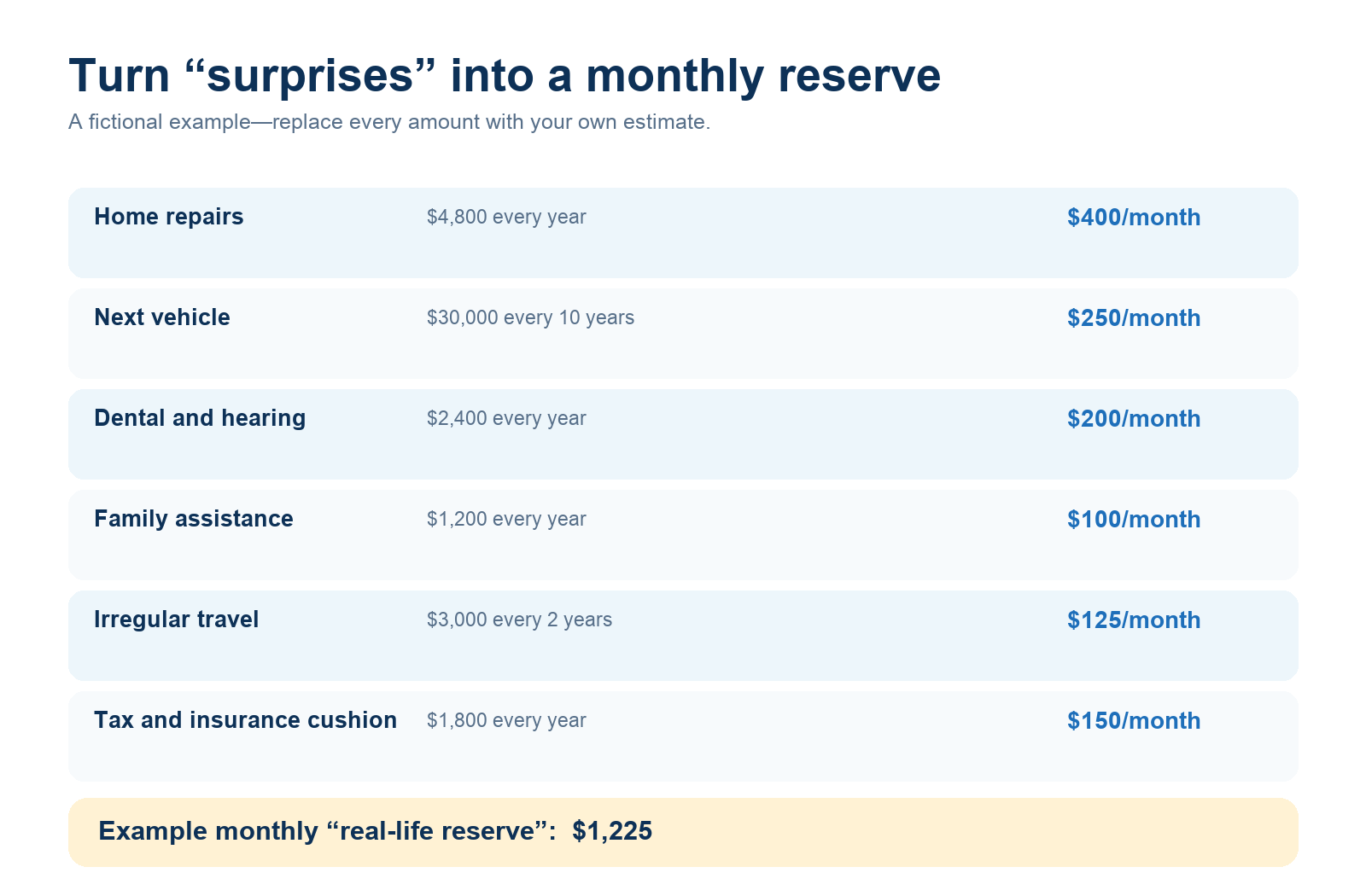
In the example, irregular expenses add $1,225 to the monthly retirement need. Someone who budgets only for regular bills could underestimate annual spending by $14,700.
Use three buckets instead of one giant emergency fund
- Monthly spending: ordinary bills paid from retirement income.
- Irregular-expense reserve: car replacement, repairs, dental work, insurance deductibles, family help and travel.
- True emergency reserve: urgent events that are difficult to predict or insure.
This keeps a new water heater from consuming money intended for a medical emergency. It also makes travel easier to enjoy because the trip is funded rather than borrowed from next month’s groceries.
A simple worksheet you can do today
| Expense | Expected amount | Years until needed | Monthly reserve |
|---|---|---|---|
| Home repairs | Your estimate | Ongoing | Annual estimate ÷ 12 |
| Vehicle replacement | Your estimate | Your timeline | Amount ÷ months |
| Dental, hearing and vision | Your estimate | Ongoing | Annual estimate ÷ 12 |
| Family assistance | Your limit | Ongoing | Annual limit ÷ 12 |
| Taxes and insurance cushion | Your estimate | Annual | Annual estimate ÷ 12 |
| Travel | Your plan | Your schedule | Total ÷ months |
Add the monthly reserves to your regular retirement spending. Then test the complete amount against Social Security, pensions and portfolio withdrawals. If the number feels too high, adjust priorities openly: keep a car longer, phase home projects, reduce optional travel or cap family support. Do not solve the problem by deleting the expense from the plan.
Questions to ask before calling your retirement budget finished
- What will need replacing in the house during the next ten years?
- How many vehicles might retirement require?
- What dental, hearing and vision coverage do we actually have?
- How much family help can we provide without borrowing?
- Are taxes included in the withdrawal amount?
- Which insurance premiums and deductibles could rise?
- What travel is optional, and what family travel matters most?
- Can the reserve handle two large expenses in one year?
The useful retirement budget is not the cheapest believable year. It is the ordinary year plus a fair share of the expenses that do not happen every month.
Continue with RetireNerd
- Build your Retirement Roadmap
- Add detailed expenses and test them in Compass
- Plan retirement withdrawals
- Check retirement savings benchmarks
Sources
- Medicare: What Original Medicare does not cover
- Medicare: Hearing-aid coverage
- IRS Publication 554: Tax Guide for Seniors
- IRS Publication 505: Tax Withholding and Estimated Tax
- AARP: Often-underestimated retirement expenses
This article provides general education, not individualized financial, tax, insurance or healthcare advice. Costs and coverage vary by household, location, plan and year. Verify benefits and obtain estimates for your own situation.