

When one spouse dies, the investment portfolio may look nearly unchanged on the next statement. The household, however, has changed profoundly. Two Social Security checks may become one. A pension may shrink or stop. Tax filing may eventually move from joint to single rates. Accounts need new ownership, beneficiaries and withdrawal instructions. The surviving spouse may also discover that the old investment mix was designed for two people with different income sources, ages and comfort with risk.
This is why the first portfolio question should not be, “What should I sell?” It should be, “What changed around the portfolio?” The answer usually involves cash flow, taxes, account rules, estate administration and personal capacity before it involves choosing funds.A useful first rule
Do not rebuild the portfolio during the first wave of grief unless money is needed immediately or an account faces a real deadline. Secure cash, identify every account and income source, then make one documented decision at a time.
The assets do not simply become one account
A couple may think of their savings as one household portfolio, but the law and the financial firms see separate forms of ownership. After a death, each asset follows its own title, beneficiary form, trust terms or probate process.
| Asset | What commonly happens | What to verify |
|---|---|---|
| Joint bank or brokerage account | The surviving owner may continue to own the account, depending on the title and state law | Exact registration, access, new tax reporting and updated beneficiary |
| IRA | A named spouse beneficiary may have several options, including treating the IRA as their own or retaining beneficiary status | Beneficiary form, ages, year-of-death RMD and future distribution rules |
| 401(k) or other workplace plan | The plan document controls available survivor and rollover choices | Spousal rights, payment form, fees, investment menu and deadlines |
| Individual taxable account | The account usually passes under its beneficiary designation, trust, will or state law | Date-of-death value, basis adjustment, probate or transfer process |
| Trust-owned assets | The trustee follows the trust’s instructions | Successor trustee, distribution terms and tax reporting |
| Pension or annuity | Payments may continue, decrease or stop under the elected survivor option | Contract or plan election, guarantee period and beneficiary claim |
Ownership rules vary. Confirm each account rather than assuming every asset follows the will.
Beneficiary designations often control retirement accounts and transfer-on-death registrations. A will does not usually override a valid beneficiary form. Before moving money, obtain the death certificate copies the institutions require and ask each custodian for its written survivor process.
The portfolio may stay the same while the plan gets weaker
A surviving spouse does not necessarily lose investment assets. Yet the same portfolio may need to support a larger share of the household budget because other income falls.
Social Security changes
Social Security does not normally continue both retirement checks. An eligible surviving spouse may receive a survivor benefit based on the deceased worker’s record, or continue their own benefit if it is higher, subject to the program’s rules. The exact amount depends on ages, claiming history and eligibility. Contact Social Security rather than relying on the last bank deposit.
This creates an important planning reality: expenses rarely fall by half when a household goes from two people to one, but Social Security income can fall substantially. Housing, property tax, insurance, utilities and vehicle costs may remain close to their former levels.
Pension and annuity income may change
A pension paid as a joint-and-survivor annuity generally continues at the elected survivor percentage. A single-life pension may stop. An annuity may have a joint life, period-certain, refund or death-benefit provision. Read the actual election or contract before adding income to the new plan.
Taxes can rise on less household income
The year of death is generally the last year in which an eligible surviving spouse can file a joint federal return with the deceased spouse. A person who meets specific dependent-child and household requirements may qualify for qualifying-surviving-spouse status for the following two years. Many retired survivors do not meet those requirements and file as single after the year of death.
Single tax brackets, the standard deduction and income-related thresholds are generally narrower than their joint counterparts. Consequently, the survivor can have less total income but pay a higher effective tax rate. More income may also fall into the range used to tax Social Security or determine Medicare income-related premiums.
A first-year survivor case study
Consider Ruth and David, both age 72. Their $1.4 million household portfolio includes $350,000 in a joint taxable account, $800,000 in traditional IRAs, $150,000 in Roth IRAs and $100,000 in cash. Before David’s death, the household receives $54,000 of Social Security and $24,000 from David’s pension. Their annual spending is $96,000, so the portfolio supplies about $18,000 before taxes.
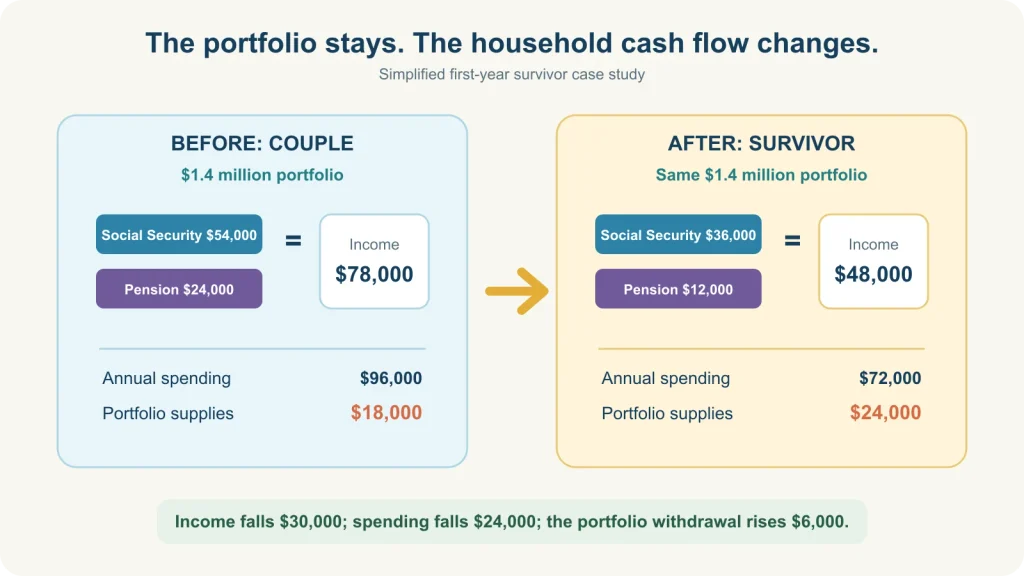
After David’s death, Ruth’s continuing Social Security is estimated at $36,000 and the pension’s 50% survivor option pays $12,000. She expects spending to fall to $72,000—not to $48,000—because the house, insurance and many fixed costs remain. Her planned portfolio withdrawal therefore rises from about $18,000 to $24,000 before taxes.
| Annual cash flow | Couple | Survivor |
|---|---|---|
| Social Security | $54,000 | $36,000 |
| Pension | $24,000 | $12,000 |
| Spending | $96,000 | $72,000 |
| Portfolio withdrawal before taxes | $18,000 | $24,000 |
Simplified illustration. Actual taxes, benefit rules and spending vary.
Ruth does not immediately sell stocks or combine every account. First, she confirms the survivor income, keeps one year of planned withdrawals in cash and requests written IRA options. Then she creates a tax projection using the filing status expected after the year of death. Only after those steps does she revisit the investment mix.
What happens to an inherited IRA?
A surviving spouse who is the sole beneficiary has choices that other IRA beneficiaries do not have. Under current federal rules, the spouse may often treat the IRA as their own, roll eligible amounts into their own IRA or keep the account under inherited-IRA rules. The best option is not automatic.
Treating the IRA as the survivor’s own
Combining the account with the survivor’s IRA can simplify management. Future required minimum distributions generally follow the survivor’s rules as owner. However, age matters. A survivor younger than 59½ may lose the inherited IRA’s potential penalty exception if the money is rolled into their own IRA and withdrawn early. Future RMD timing can also differ.
Keeping it as an inherited IRA
Beneficiary status can preserve different distribution timing or access rules. It also creates a separate account with its own title and beneficiary. IRS Publication 590-B contains detailed spouse rules, including special timing provisions and treatment of a year-of-death RMD.
If the deceased spouse had an RMD due for the year and did not complete it, determine who must take the remaining amount before moving the account. An RMD cannot be rolled over. Do not let a custodian’s routine paperwork decide this choice without reviewing the ages, cash needs and tax plan.
Cost basis can change after death
Taxable investments inherited from a decedent generally receive a basis tied to fair market value at death, subject to important exceptions and estate elections. For jointly owned property, only the portion included in the deceased spouse’s estate may receive an adjustment under the general rule. Community-property treatment can differ and may adjust both halves when the legal requirements are met.
This means the surviving spouse should not sell or transfer taxable holdings before the custodian records the date-of-death value and the tax adviser determines the correct basis. Save statements showing values on the date of death and any alternate valuation supplied by the estate.
Traditional IRAs do not receive the same basis adjustment for pretax money. Their tax character generally carries forward. If the deceased spouse made nondeductible IRA contributions, locate Form 8606 records so basis is not lost.
Should the investment allocation change?
Death alone does not prove the survivor needs a more conservative portfolio. The correct allocation depends on the new withdrawal rate, guaranteed income, time horizon, liquidity, estate goals and the survivor’s ability to manage volatility.
Review these questions:
- How much annual spending must the portfolio now provide?
- Which Social Security, pension and annuity payments continue?
- How much cash is needed for the estate, taxes, repairs or relocation?
- Can the survivor live through a major market decline without selling long-term investments?
- Was one spouse managing a strategy the survivor does not understand or want?
- Does the portfolio contain concentrated company stock, private investments or many overlapping funds?
- Will inherited-account distributions or the survivor’s RMDs change the tax plan?
Often, simplification matters more than reducing stock exposure. A survivor may keep a balanced risk target while consolidating duplicate accounts, replacing speculative holdings and creating a clearer cash reserve. RetireNerd’s stocks, bonds and cash guide can help separate allocation from account administration.
The widow’s or widower’s tax penalty
The informal phrase “widow’s penalty” describes the financial squeeze that can occur when one spouse dies: household income falls, but the survivor eventually uses single tax brackets and single income thresholds. The issue can affect ordinary income, capital gains, Roth conversions, Social Security taxation, net investment income tax and Medicare premiums.
If Medicare premiums were based on a prior joint return and household income fell after the death, the survivor may ask Social Security to reconsider the income-related monthly adjustment amount. Death of a spouse is one of the life-changing events listed for Form SSA-44. Approval depends on the evidence and estimated or actual modified adjusted gross income.
The year of death can also create a planning window because a joint return may still be available if the requirements are met. Yet grief is not a reason to force a large Roth conversion or gain realization. Model the current year and several future single-filer years before acting.
A practical order for the first year
First 30 days: protect access and liquidity
- Order certified death certificates and locate the will, trust and beneficiary records.
- Keep enough cash available for bills, funeral costs and urgent repairs.
- Notify Social Security, pension administrators and insurers through verified contact information.
- Do not close the primary checking account until deposits and automatic payments are mapped.
- Freeze or monitor credit and be skeptical of unsolicited financial contacts.
Months one through three: inventory and claim
- List every account, owner, beneficiary, balance and institution.
- Request written survivor options for each IRA, workplace plan, pension and annuity.
- Record date-of-death values for taxable property.
- Confirm Social Security and pension income rather than estimating from prior deposits.
- Check whether the deceased spouse had an incomplete RMD.
Months three through twelve: rebuild the plan
- Create a survivor spending plan based on actual fixed and flexible costs.
- Project federal and state taxes for the year of death and later single-filer years.
- Choose inherited-account elections with tax and legal advice when needed.
- Set a cash reserve and sustainable portfolio withdrawal.
- Review the household allocation, then rebalance across accounts deliberately.
- Update beneficiaries, powers of attorney, healthcare documents, will and trust.
The related Social Security after a spouse’s death checklist covers benefit and immediate administrative steps in greater detail. The tax-aware rebalancing guide explains how to adjust the investment mix without creating an avoidable tax problem.
What not to do immediately
- Do not liquidate everything. Selling first and asking about basis later can create preventable tax and reinvestment problems.
- Do not roll over an inherited retirement account automatically. A spouse has options, and the right choice depends on age and distribution needs.
- Do not assume the will controls every account. Titles, beneficiary forms and trust terms may govern.
- Do not make a permanent housing decision only to relieve immediate stress. Build a cash-flow comparison first.
- Do not keep an opaque portfolio out of loyalty. The surviving spouse must be able to understand, monitor and use it.
- Do not let a salesperson create urgency. Most investment replacements can wait until the survivor understands the existing holdings and surrender terms.
Frequently asked questions
Does a surviving spouse pay tax when inheriting a brokerage account?
Receiving inherited property is generally different from selling it. A later sale can create a gain or loss based on the property’s adjusted basis. Joint ownership, community-property rules and estate elections affect the calculation, so establish the basis before trading.
Can a spouse combine an inherited IRA with their own IRA?
Often, a surviving spouse beneficiary can treat the IRA as their own or complete an eligible rollover. Keeping it inherited may be preferable in some situations. Review age, RMD timing, early access and beneficiary goals first.
Should the survivor reduce stocks right away?
Not automatically. Recalculate spending, reliable income, withdrawal needs and emergency reserves. Change the allocation only when the new plan—not fear alone—supports the change.
Will Medicare premiums fall after a spouse dies?
They may if household income fell and an income-related surcharge applies. A spouse’s death is a qualifying life-changing event for requesting a new IRMAA determination through Social Security. The standard Part B and Part D premiums do not disappear.
How long should major investment decisions wait?
There is no universal waiting period. Meet true deadlines, protect cash and prevent obvious risk. Permanent allocation changes, new products and large taxable sales can usually wait until the survivor has reliable income, account and tax information.
The portfolio needs a new job description
After one spouse dies, the portfolio is no longer supporting the same tax return, income stream or decision-making partnership. The assets may survive intact, but their job changes. The best response is a careful transition: establish ownership, secure cash, confirm survivor income, preserve tax records and then rebuild the investment plan around one person’s life.Educational note
This article provides general education, not individualized legal, tax or investment advice. Estate, community-property, retirement-plan and beneficiary rules can depend on state law, account documents and family circumstances. Use qualified legal and tax help for elections, disclaimers, trusts, basis questions and inherited retirement accounts.
Sources
- IRS Publication 590-B: IRA distributions and spouse beneficiaries
- IRS Publication 559: Survivors, Executors and Administrators
- IRS Publication 501: Filing status after a spouse’s death
- Social Security Administration: Survivor benefits
- Social Security Administration: Request to lower IRMAA
- U.S. Department of Labor: Retirement plans and survivor annuities