

After a spouse dies, Social Security creates two separate jobs: close the deceased person’s payment record correctly, and determine whether the surviving spouse or other family members qualify for benefits. The first job is urgent. The second deserves a careful comparison before anyone chooses a starting date.
If you can do only three things today
- Confirm that the death has been reported to Social Security.
- Do not spend a Social Security deposit that may cover the month of death.
- Call SSA about survivor benefits and the one-time death payment; do not assume conversion or payment happens automatically.
The first days: stop the wrong payment without stopping the right questions
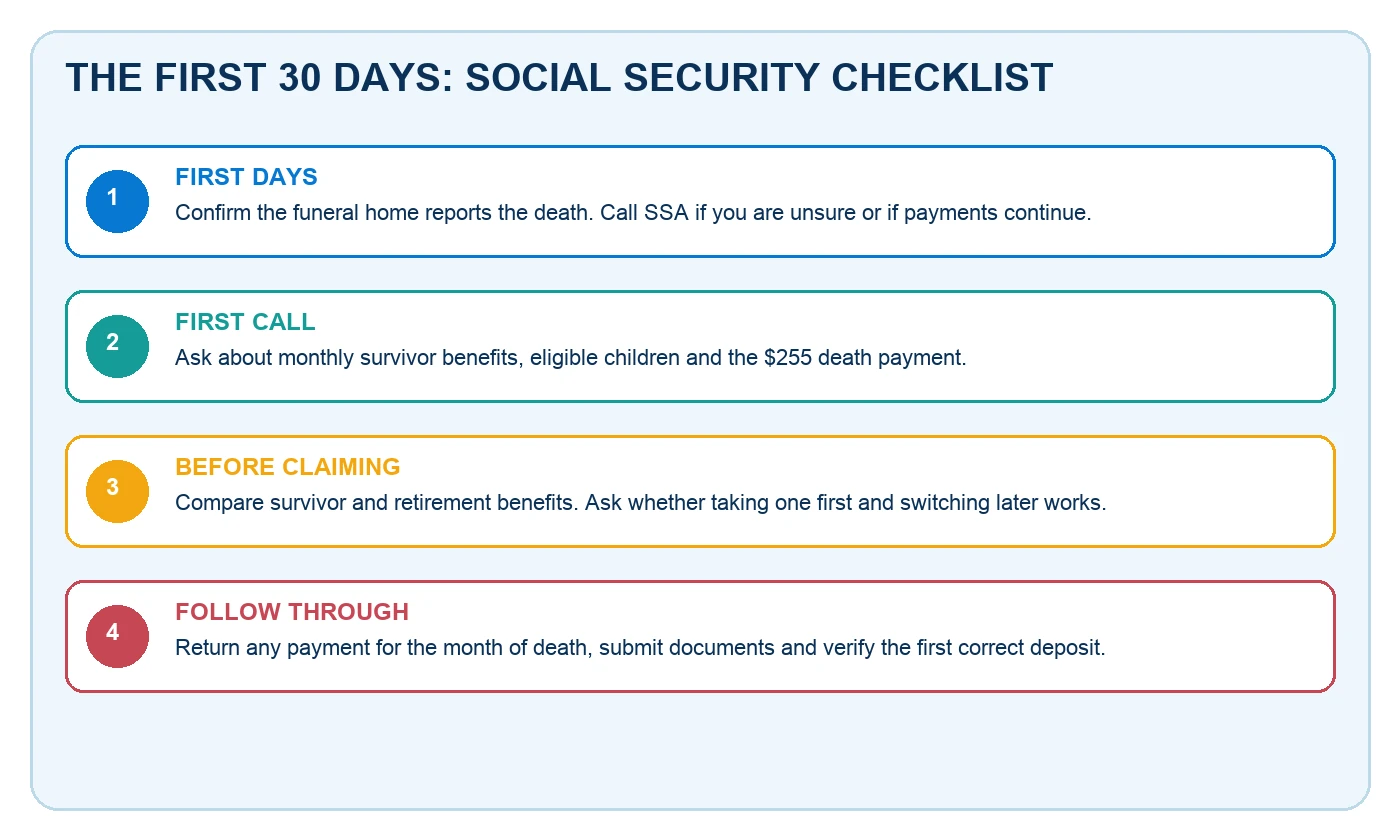
Funeral homes usually report a death to Social Security using information supplied by the family. Ask whether they will do it and confirm that they have the deceased person’s correct name and Social Security number. If the funeral home will not report it, or you are unsure whether the report was made, call Social Security at 1-800-772-1213.
A deceased beneficiary is not entitled to a Social Security payment for the month of death, even if death occurs on the last day of that month. Because Social Security retirement and survivor checks are generally paid one month behind, a deposit arriving after the death may represent the month of death and may have to be returned. Contact the bank and SSA before moving or spending it. Do not close the receiving account until you understand which deposits and withdrawals are still pending.
The first call: ask SSA to screen the whole family
Survivor benefits are not limited to a retirement-age spouse. Ask the representative to screen every potentially eligible person on the deceased worker’s record:
- A surviving spouse age 60 or older, or age 50–59 with a qualifying disability
- A surviving spouse of any age caring for the deceased worker’s child who is under 16 or has a qualifying disability
- An eligible former spouse, generally after a marriage lasting at least 10 years
- Unmarried children age 17 or younger, ages 18–19 while attending elementary or secondary school full time, and certain adult children whose disability began before age 22
- In some cases, dependent parents age 62 or older
Marriage-duration, remarriage, disability, custody and child-status exceptions can change the answer. Give SSA the actual facts rather than deciding that someone is ineligible based on a summary list.
Ask about the $255 lump-sum death payment
The one-time payment is separate from monthly survivor benefits. It may be payable to a qualifying surviving spouse or, when there is no eligible spouse, to certain eligible children. An application is generally required within two years of the worker’s death. Ask about it during the first call even if the spouse already receives benefits.
Build one application folder
SSA says not to delay filing simply because every document is not available. Call first, establish the filing date and ask exactly what the agency needs. A survivor application may require:
| Information or document | Why it matters |
|---|---|
| Proof of death or funeral-home report | Confirms the worker’s death |
| Both Social Security numbers and birth information | Locates the correct earnings and claimant records |
| Marriage certificate | Documents the surviving-spouse relationship |
| Final divorce decree | Supports a surviving divorced-spouse claim |
| Birth certificates and Social Security numbers for eligible children | Supports child or child-in-care benefits |
| Deceased worker’s latest W-2 or self-employment tax return | Helps complete the most recent earnings record |
| Survivor’s recent W-2 or self-employment information | Helps SSA apply the earnings test when relevant |
| Bank routing and account numbers | Sets up direct deposit |
SSA accepts photocopies of some wage, tax and medical records but generally must inspect originals or issuing-agency-certified copies of vital records. Do not mail irreplaceable originals unless SSA instructs you to do so and explains how they will be returned.
Before claiming: compare the survivor benefit with your own
A survivor does not normally receive two full Social Security checks added together. When eligible for a survivor benefit and a retirement benefit on their own work record, the person generally receives the better payment. But survivor rules preserve an important planning option: a person may sometimes claim one benefit first and switch to the other later.
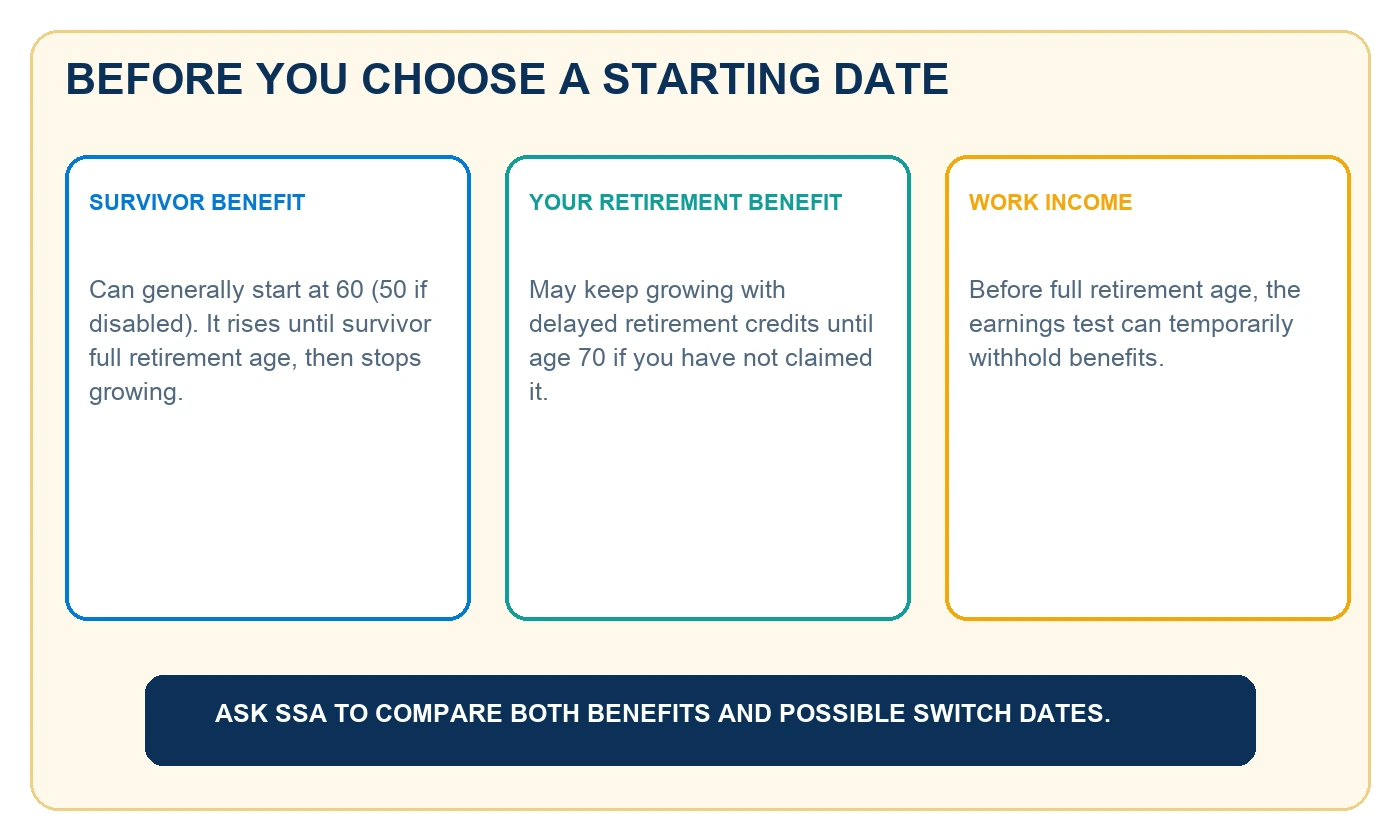
For a spouse or qualifying former spouse, survivor payments can generally begin as early as 60, or 50 with a qualifying disability. The age-60 amount can start at 71.5% of the relevant benefit and rises with later claiming until the survivor’s full retirement age. Waiting beyond survivor full retirement age does not increase the survivor payment.
Your own retirement benefit follows a different clock: delayed retirement credits can increase it until age 70. That can create strategies such as taking a reduced survivor benefit first and switching to a larger retirement benefit later, or taking retirement first and switching to a larger survivor benefit at survivor full retirement age. The right order depends on both estimates, age, work, health, immediate cash needs and other household income.
Questions to ask before filing
- What is my survivor amount if I start now, at 60, at 62 and at survivor full retirement age?
- What is my own retirement amount now and at 70?
- Can I claim one benefit first and switch later? On what exact month?
- Did my spouse’s early claiming or delayed retirement credits change the survivor amount?
- Will my current earnings cause benefits to be withheld?
- Are children or another family member eligible, and does the family maximum apply?
Check the factors that can change the amount
Your spouse’s claiming history
A deceased worker’s delayed retirement credits can increase a surviving spouse’s benefit. Early retirement can limit it. Do not estimate the survivor benefit simply by copying the last bank deposit; Medicare premiums, tax withholding, garnishments and other adjustments may have changed the net deposit.
Work before full retirement age
If the survivor works and is below full retirement age, the retirement earnings test can temporarily withhold some benefits. The annual limit changes, and a special monthly rule may matter in the first year. Use the gross benefit and current earnings estimate when comparing choices. See Should You Claim Social Security and Keep Working? for the mechanics.
Other eligible family members
Eligible children generally can receive up to 75% of the deceased parent’s basic benefit, but the family maximum may reduce payments when several people collect on one record. A surviving divorced spouse’s payment generally does not count toward the family maximum for the worker’s other family members.
Remarriage
Remarriage before age 60 can generally prevent entitlement on a prior deceased spouse’s record while that marriage continues. After 60, generally does not prevent survivor benefits. For disabled widow or widower benefits, age 50 can be relevant. Ask SSA before changing marital status when a survivor claim is part of the financial plan.
A cash-flow checklist for the surviving household
- List the income that stops: the deceased spouse’s Social Security, wages, pension payments and withdrawals that were personal to that spouse.
- List income that may replace it: survivor Social Security, survivor pension elections, life insurance, employer death benefits and inherited-account distributions.
- Protect liquidity: keep enough cash for housing, insurance, taxes and funeral or estate expenses while claims are pending.
- Update withholding: a new filing status and different income mix can change federal and state taxes.
- Review Medicare deductions: verify which premium will be withheld from the survivor’s Social Security payment and how existing coverage continues.
- Delay irreversible moves: do not rush to sell investments, surrender insurance, roll over accounts or claim a permanently reduced benefit solely to simplify paperwork.
Track the application until the first correct payment
| Date | Action | Person/reference | Next step and deadline |
|---|---|---|---|
| Death reported | |||
| SSA screening call | |||
| Application filed | |||
| Documents submitted | |||
| Decision received | |||
| First deposit checked |
Compare the award notice with the discussion you recorded: benefit type, starting month, gross amount, Medicare deduction, tax withholding and any retroactive payment. If SSA denies the claim or the amount appears wrong, follow the reconsideration or appeal instructions and deadline on the notice.
The financial plan after the claim
A survivor claim solves only one part of the household transition. Rebuild the retirement income plan around one life expectancy, one tax return, survivor pension terms, health coverage and inherited accounts. RetireNerd’s guide to how Social Security calculates benefits explains the earnings foundation, while the Social Security Benefit Estimator can help frame claiming-age comparisons after SSA provides the official estimates.
If the surviving spouse is still employed, also review beneficiaries, workplace retirement-plan contributions and emergency savings before making a major withdrawal. The loss of one Social Security check can change the sustainable withdrawal amount even when the investment balance remains the same.
Official resources
- SSA survivor benefits hub
- Who can get survivor benefits
- What survivor benefits may pay
- Information needed for a surviving-spouse application
- SSA publication: Survivors Benefits
Reviewed September 2026. Social Security eligibility, application procedures, earnings limits and payment rules can change. Contact SSA for an official benefit comparison before selecting a start date. This article provides general educational information and is not individualized legal, tax or financial advice.