

For an employee, Social Security reporting happens quietly inside payroll. A self-employed worker has to build that bridge: calculate business profit correctly, file the right schedules, pay self-employment tax and confirm that the earnings reached the Social Security record. Missing one link can reduce work credits or future retirement, disability and survivor benefits.
The operating rule
Revenue does not go directly onto your Social Security record. Covered net earnings generally flow through the federal tax return and Schedule SE. A profitable business can still produce a weak Social Security record if returns are missing, filed incorrectly or assigned to the wrong taxpayer identification information.
Follow the money from the business to your earnings record
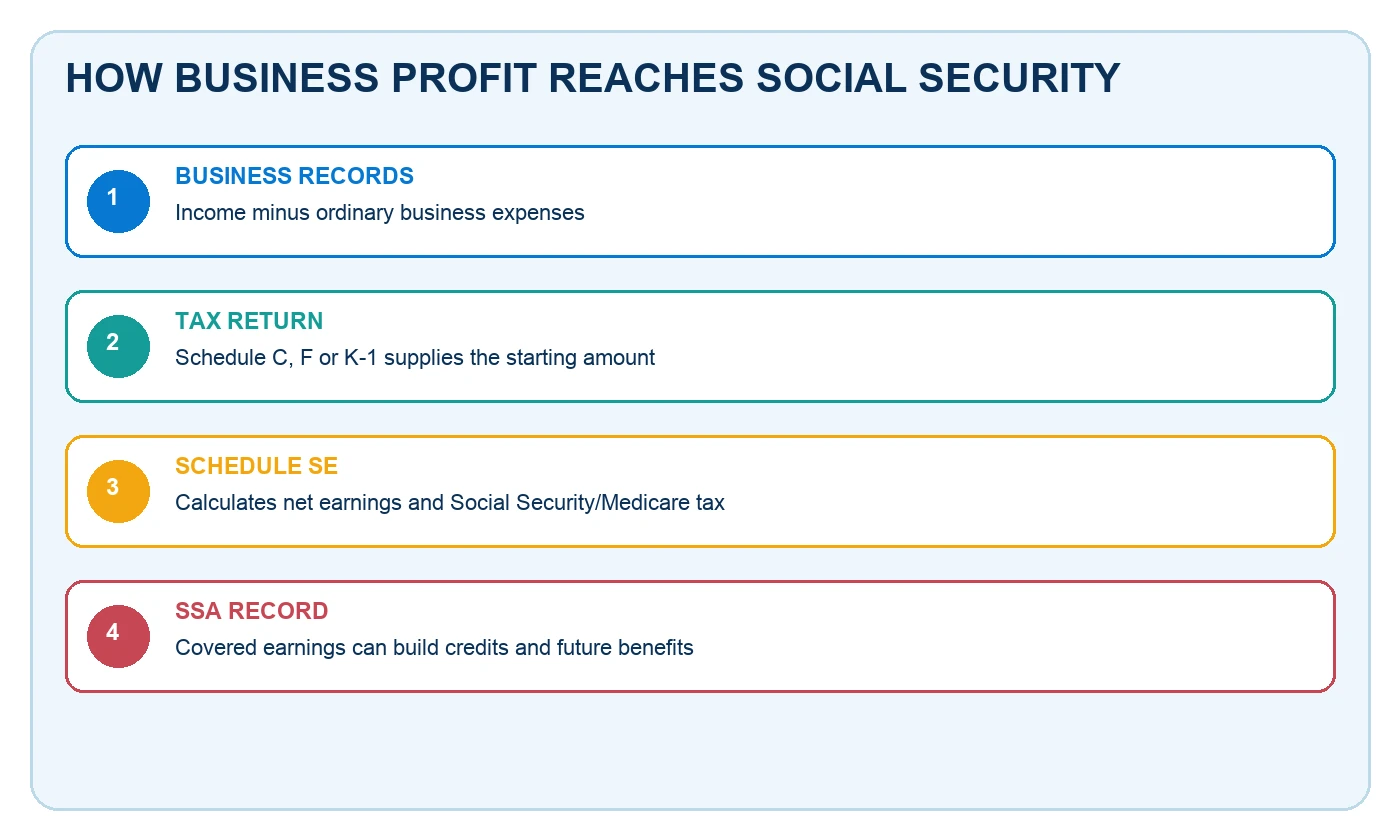
1. Calculate net business profit
Start with gross business income, then subtract allowable business deductions and depreciation. Sole proprietors and many single-member LLC owners generally calculate profit on Schedule C; farmers use Schedule F. Partners may receive self-employment information through Schedule K-1. This business profit is a starting point, not necessarily the exact amount posted by SSA.
2. Calculate net earnings on Schedule SE
Schedule SE generally multiplies self-employment profit by 92.35% before applying Social Security and Medicare tax. If net earnings from self-employment are $400 or more, the worker generally must file Schedule SE. Special rules apply to church employees, farmers, members of religious orders and certain other situations.
3. Pay Social Security and Medicare tax
The standard self-employment tax rate is 15.3%: 12.4% for Social Security and 2.9% for Medicare. The 12.4% portion applies only up to the annual Social Security wage base after accounting for covered wages from a job. Medicare tax has no comparable wage cap, and an additional 0.9% Medicare tax can apply above statutory income thresholds.
Self-employed workers can generally deduct the employer-equivalent half of self-employment tax when calculating adjusted gross income. That deduction reduces income tax; it does not erase the tax used to fund Social Security and Medicare.
4. Verify the SSA record
After the return is processed, check the full earnings history in a secure my Social Security account. Compare the Social Security self-employment amount with the filed return and Schedule SE rather than gross sales or bank deposits. RetireNerd’s earnings-record audit and correction guide explains what proof to keep and how to request a correction.
The 2026 numbers on one page
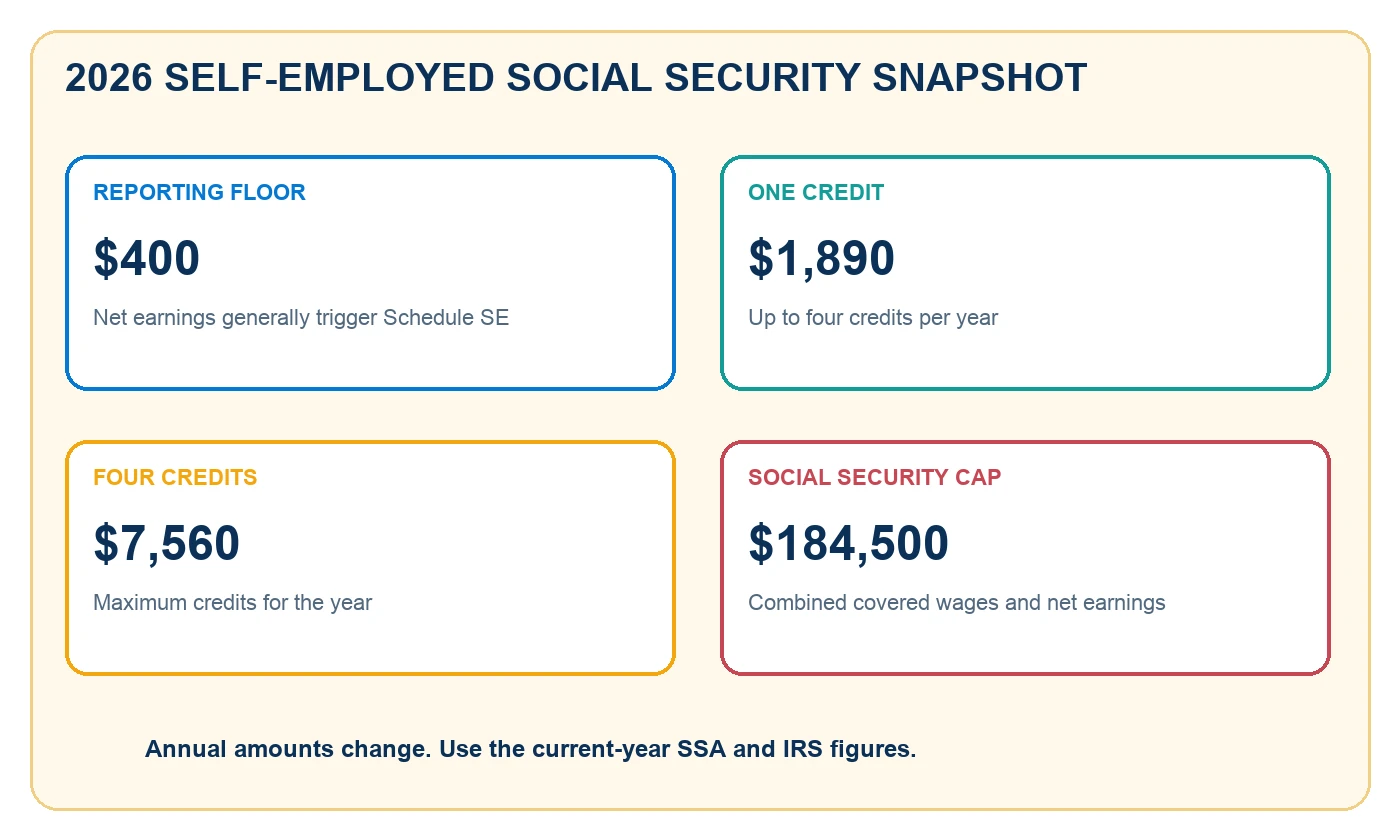
| 2026 figure | Amount | What it means |
|---|---|---|
| General Schedule SE threshold | $400 | Net earnings generally require self-employment-tax reporting |
| One Social Security credit | $1,890 | Covered annual earnings needed for one credit |
| Four-credit maximum | $7,560 | Enough covered earnings for all four credits available in one year |
| Social Security wage base | $184,500 | Maximum combined covered wages and net earnings subject to the Social Security portion |
| Social Security portion | 12.4% | Combined employee and employer rate paid through self-employment tax |
| Medicare portion | 2.9% | Applies without the Social Security wage cap; additional Medicare tax may also apply |
Credits determine whether a worker is insured for retirement, disability, Medicare and family survivor protection. In 2026, $1,890 of covered earnings produces one credit and $7,560 produces the annual maximum of four. A person generally needs 40 credits for retirement benefits, although disability and survivor protection can require fewer depending on age.
More credits above the eligibility requirement do not increase the payment. The benefit amount is based on covered earnings history—generally the highest 35 years after wage indexing for retirement. Low-profit years and zeros can reduce the average. See How Social Security Calculates Your Benefit for the AIME and PIA process.
Your business structure changes the reporting path
| Business arrangement | Typical Social Security reporting path | Watch for |
|---|---|---|
| Sole proprietor or disregarded single-member LLC | Schedule C profit generally flows to Schedule SE | Confusing revenue with covered net earnings |
| Partner or LLC member taxed as a partnership | Schedule K-1 may report self-employment earnings; guaranteed payments for services may count | General-versus-limited-partner rules and entity-specific treatment |
| S corporation owner who works in the business | Reasonable compensation is generally reported as W-2 wages subject to payroll tax | Using distributions to replace reasonable wages |
| C corporation owner-employee | W-2 wages generally create covered earnings | Corporate profits or dividends are not automatically Social Security wages |
| Worker plus side business | W-2 wages and Schedule SE earnings are coordinated | The combined Social Security wage base and duplicate estimates |
An LLC is a state-law structure, not one federal tax answer. Its Social Security treatment depends on whether it is disregarded, taxed as a partnership, S corporation or C corporation. Have a qualified tax professional review compensation and self-employment-tax treatment before changing an entity solely to reduce payroll taxes.
A worked example: profit is not the posted amount
Assume a sole proprietor has $80,000 of revenue and $30,000 of allowable business expenses. Schedule C profit is $50,000. A simplified Schedule SE starting calculation applies 92.35%, producing about $46,175 of net earnings subject to self-employment tax. The estimated 15.3% tax would be about $7,065 before considering other wages, Additional Medicare Tax or special adjustments.
Illustration only: $50,000 × 92.35% = $46,175; $46,175 × 15.3% ≈ $7,065. Actual Schedule SE calculations can change when the worker also has wages, reaches the wage base, owes Additional Medicare Tax or qualifies for special treatment.
Pay-as-you-go taxes need their own system
No employer is withholding tax from a sole proprietor’s client payment. Many self-employed people therefore make quarterly estimated payments covering both income tax and self-employment tax. In general, estimated payments may be required when at least $1,000 will remain due and withholding and refundable credits will not meet the applicable safe-harbor tests.
- Forecast revenue, deductible expenses and net profit at least quarterly.
- Use Form 1040-ES or current tax software to estimate income and self-employment tax.
- If income is uneven, ask whether the annualized-income installment method better matches the business cycle.
- Keep a separate tax reserve rather than treating every client payment as spendable cash.
- If a spouse or second job has wages, consider whether adjusted withholding can cover part of the household obligation.
Five records to keep every year
- Business ledger: invoices, income, expenses, mileage, assets and depreciation support.
- Filed return: Form 1040 plus Schedule C, F, K-1 and Schedule SE as applicable.
- Proof of timely filing: accepted electronic-filing confirmation, transcript or certified-mail evidence.
- Tax payments: estimated-payment confirmations and the final balance-due record.
- SSA comparison: a saved earnings history showing that the correct year posted.
Timely filing is especially important. The ordinary correction period for an earnings record generally ends three years, three months and 15 days after the year. Late-filed self-employment returns face stricter correction limits than ordinary wage evidence, so reconstructing the business years later may not restore the missing coverage.
When profit is low or negative
A genuine business loss generally does not create covered earnings or credits for that year. If net earnings are below $400, farm and nonfarm optional methods may allow some workers to report earnings for Social Security purposes, subject to eligibility limits and trade-offs. The optional method can increase self-employment tax and other tax calculations, so model the full return rather than using it automatically.
If you claim Social Security and keep the business
Self-employment tax can still apply at any age and even after Social Security or Medicare begins. Before full retirement age, net earnings can also trigger the retirement earnings test. Report material changes when actual profit will differ from the estimate SSA is using.
During a first retirement year, SSA’s special monthly rule can examine whether a self-employed person performed substantial services. Hours matter, but so do the skill and value of the work, management duties, business size and the change from pre-retirement activity. More than 45 hours in a month generally indicates substantial services; highly skilled work can be substantial at lower hours. Keep a contemporaneous calendar of hours, duties and who managed the business.
Read Should You Claim Social Security and Keep Working? before selecting a start date. The annual earnings test, monthly rule, benefit taxation and continued payroll taxes are separate calculations.
Year-end owner checklist
| Question | Complete |
|---|---|
| Are all business accounts reconciled and personal expenses separated? | □ |
| Are contractor forms, payroll returns and owner wages correct? | □ |
| Does the entity’s tax treatment match how income is being reported? | □ |
| Is Schedule SE included when required? | □ |
| Were estimated taxes and payroll deposits recorded? | □ |
| Was the return filed under the correct name and Social Security number? | □ |
| Did the prior year appear correctly in the SSA earnings record? | □ |
| Does the retirement estimate use a realistic future-profit assumption? | □ |
Official resources
- SSA: If You Are Self-Employed
- SSA: Social Security credits
- IRS: Schedule SE
- IRS: Self-employment tax
- IRS Publication 505: Estimated tax
- SSA: Reporting work while receiving retirement benefits
Reviewed September 2026. Annual credit amounts, wage bases, tax forms and reporting procedures change. Business entity and worker-classification questions can be fact-specific. Confirm current rules with SSA, the IRS and a qualified tax professional. This article is general educational information, not individualized tax, legal or financial advice.