
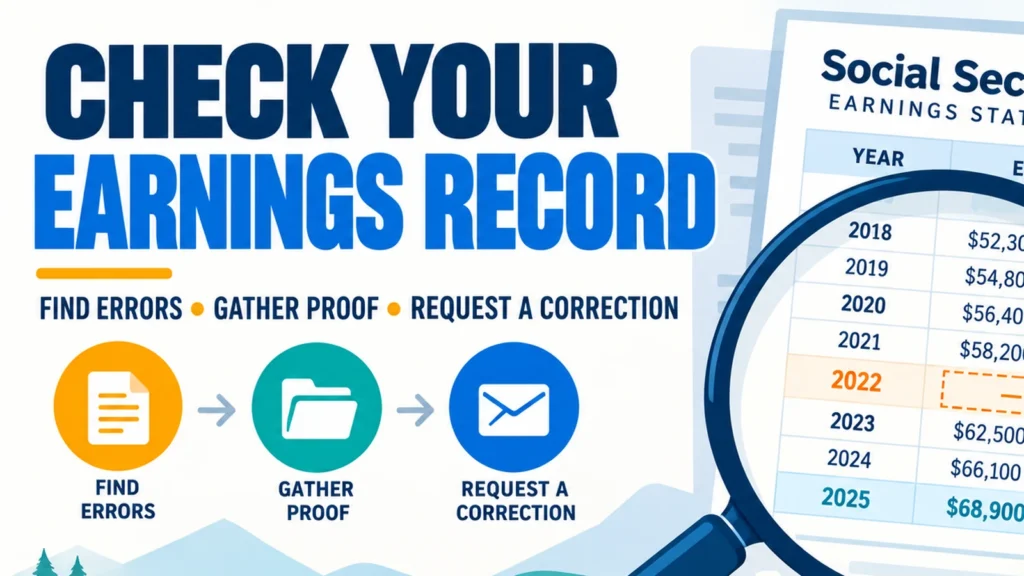
One missing earnings year can be easy to overlook because the number appears inside a long Social Security history. It can also reduce a future retirement, disability or survivor benefit if the missing amount would have been used in the calculation. The best protection is a short annual audit while tax and payroll records are still easy to find.
Maya checked her record at 61 and found a zero from a job she held eight years earlier. Her W-2 showed Social Security wages, but the employer’s report had not reached the correct record. She still had the W-2 and tax return, so she could identify the exact year, amount and employer instead of asking SSA to investigate a vague discrepancy.
The names are illustrative, but the lesson is practical: do not wait until the benefit application to examine four decades of earnings.
Run a three-pass audit
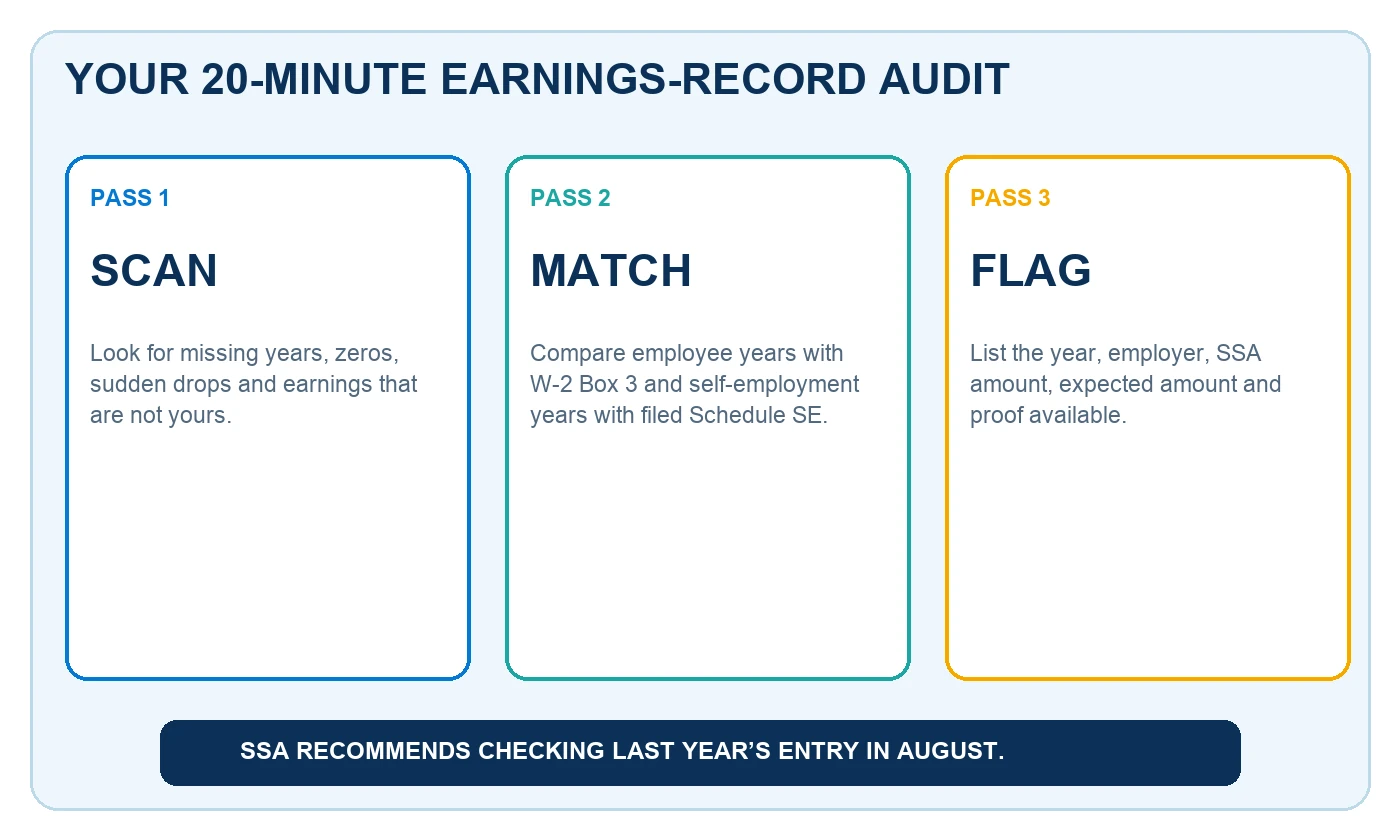
Pass 1: Scan for breaks in the pattern
Sign in to a secure my Social Security account, open the full earnings record and scan the years rather than reading only the estimated benefit.
- A zero during a year you worked
- A sharp drop that does not match a job change
- Only one employer’s wages when you had several jobs
- Self-employment income that is missing or unexpectedly low
- Earnings that exceed what you actually made or belong to someone else
- A name-change year, multiple-surname period or year an employer used an incorrect Social Security number
Last year’s wages may not appear immediately. SSA processes millions of reports and says the prior year may not post until late in the current year. Its public guidance recommends checking in August to see whether the previous year is correct.
Pass 2: Match the right numbers
Do not compare the SSA record casually with gross salary, bank deposits or W-2 Box 1. For an employee, start with W-2 Box 3, Social Security wages, plus Box 7 Social Security tips when applicable. Box 3 can differ from Box 1 because pretax benefits and other payroll items are treated differently. It can also stop at the annual Social Security taxable maximum.
Medicare wages in Box 5 may be higher because Medicare tax does not use the same wage cap. The SSA statement can display both Social Security and Medicare earnings, so compare the correct column.
For self-employment, compare the record with the Social Security earnings derived from a filed Schedule SE—not gross business revenue and not simply Schedule C sales. Keep Form 1040, Schedule SE, Schedule C or F and proof that the return was filed on time.
Pass 3: Create a discrepancy worksheet
| Year | Employer or business | SSA amount | Expected amount | Evidence | Action |
|---|---|---|---|---|---|
| ______ | ________________ | $________ | $________ | W-2 / return / other | Wait / ask employer / correct |
| ______ | ________________ | $________ | $________ | W-2 / return / other | Wait / ask employer / correct |
| ______ | ________________ | $________ | $________ | W-2 / return / other | Wait / ask employer / correct |
Decide whether the difference is an error
| What you see | Possible explanation | Next check |
|---|---|---|
| The newest year is blank | Employer or IRS report may still be processing | Recheck later in the year; ask the employer whether the W-2 was filed |
| SSA amount is below total salary | Only Social Security-covered wages count, and the annual cap applies | Compare with W-2 Box 3, not Box 1 or gross pay |
| Medicare earnings exceed Social Security earnings | Different wage-base rules | Compare W-2 Boxes 3 and 5 |
| Self-employment amount is lower than revenue | Schedule SE uses net earnings and a statutory adjustment | Review filed Form 1040 and Schedule SE |
| A complete older year is missing | Reporting, name or Social Security-number mismatch | Gather W-2, tax return and employer details |
| Earnings are not yours | Wrong-person posting or identity misuse | Request removal from SSA and address identity theft separately |
Gather proof before contacting SSA
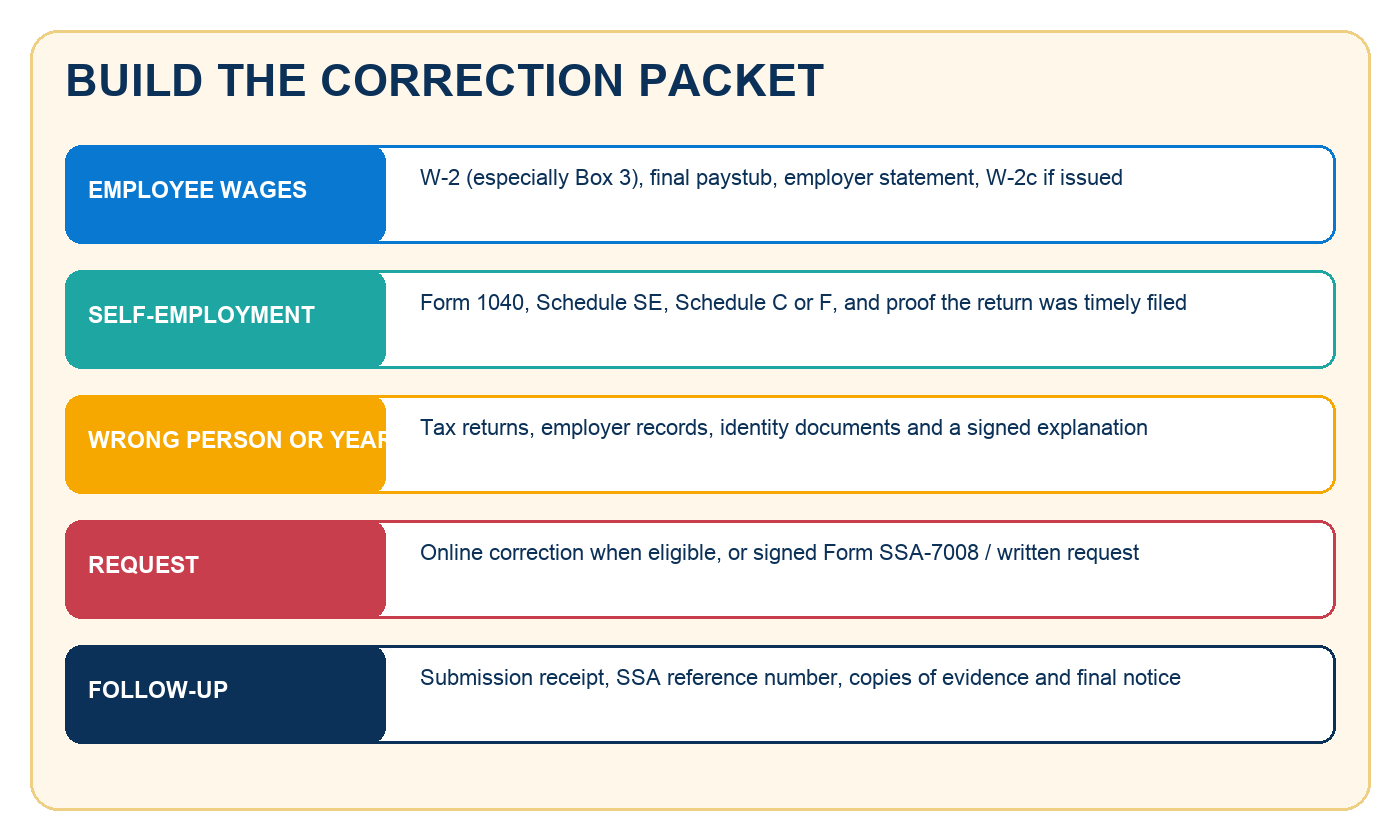
SSA identifies these as especially useful evidence:
- Employee wages: a W-2 for the year, an original signed statement from the employer or payroll recordkeeper, final paystubs and any corrected W-2c.
- Self-employment: Form 1040, Schedule SE, Schedule C or F and evidence that the return was timely filed, such as an IRS transcript, IRS date stamp, accepted electronic-filing record or payment evidence.
- Name or number mismatch: documents showing names used, employer identity, correct Social Security number and the work period.
- Earnings that are not yours: filed tax returns and a clear written statement identifying the years and amounts disputed.
Keep originals unless SSA specifically needs to inspect them. Submit copies through an approved method, retain a complete copy of the packet and remove unneeded financial information from documents when permitted.
Request the correction
Some people can request an earnings correction online. In the my Social Security account, open Review your full earnings record now under Eligibility and Earnings and look for Request a correction online. Online correction is not available for every person or every type of discrepancy.
If the online option is unavailable or the issue is complex, contact SSA and make an appointment. SSA may ask for Form SSA-7008, Request for Correction of Earnings Record. A valid written request should identify the incorrect record, specify the years or periods questioned, be signed and include or describe the available evidence.
The ordinary time limit matters
The general correction period ends three years, three months and 15 days after the end of the calendar year in which wages were paid, or after the end of the taxable year for self-employment income. File a written request before the deadline even if every supporting document is not yet available.
What if the year is already too old?
Do not assume an older error is impossible to fix. Federal rules permit corrections after the ordinary limit in specified situations, including certain tax-return records, a timely written correction request or benefit application, an error apparent on SSA’s records, fraud, earnings posted to the wrong person or period, and some missing or understated wage reports.
The rules for late-filed self-employment returns are especially strict. A return filed after the time limit generally cannot be used to increase self-employment income on the record, although it may sometimes reduce or remove an entry. Ask SSA which exception applies and provide the timely-filing evidence.
Use a correction cover sheet
| Name used during the work year | ________________________________________ |
|---|---|
| Current name and last four digits of SSN | ________________________________________ |
| Year being corrected | ________________________________________ |
| Employer/business and address | ________________________________________ |
| Amount shown by SSA | $_______________________________________ |
| Amount requested | $_______________________________________ |
| Reason the record is wrong | ________________________________________ |
| Documents enclosed | ________________________________________ |
| Ordinary deadline | ________________________________________ |
| Requested outcome | Correct year ______ to $________________ |
Track the case until the record changes
- Save the online confirmation, certified-mail receipt or office-stamped copy.
- Record the SSA reference number, employee name, date and promised next step.
- Respond promptly if SSA asks for more evidence or permission to contact the employer.
- Read the written determination. If the correction is denied, follow the reconsideration or appeal instructions and deadline on the notice.
- After approval, reopen the earnings record and confirm the correct year and amount actually posted.
- Download a new benefit estimate. If benefits are already being paid, verify whether SSA recalculated the payment and any retroactive amount.
If earnings belong to someone else
Use the online correction option when available or schedule an SSA office appointment. SSA may verify identity, ask for filed tax returns, request Form SSA-7008 and require a signed declaration that the earnings are not yours.
SSA can correct its earnings record, but it does not investigate identity theft for the entire financial system. If identity misuse is possible, report it through IdentityTheft.gov, review credit reports and secure relevant tax and financial accounts.
Why the correction can change more than retirement
The earnings record supports retirement, disability and survivor benefits. A correction can affect whether a worker has enough credits, the amount used in a disability calculation and what eligible family members may receive. RetireNerd’s guide to how Social Security calculates your benefit explains how the highest 35 years feed the AIME and PIA formula.
After the record is accurate, use the Social Security Benefit Estimator to compare claiming ages, and review claiming while continuing to work if employment will overlap with benefits.
Keep this annual record-audit file
- Current SSA earnings history
- W-2s and corrected W-2c forms
- Forms 1040, Schedule SE and Schedule C or F for self-employment years
- IRS account and wage-and-income transcripts when needed
- Name-change and employer records
- Copies of correction requests and proof of delivery
- SSA notices and the verified corrected record
Official resources used for this audit
- SSA: Review your earnings record
- SSA: How to Correct Your Social Security Earnings Record
- Form SSA-7008: Request for Correction of Earnings Record
- SSA Handbook: Correction time limit
- Federal rules: Corrections after the time limit
- SSA: How employer wages reach the record
Reviewed September 2026. SSA’s online correction tools, forms and procedures can change. Use only an official SSA account or office, protect the full Social Security number and follow the instructions and appeal deadline on any SSA notice. This article is general educational information, not individualized legal, tax or financial advice.