

You can claim Social Security retirement benefits and keep working. The better question is whether claiming now improves your household plan after accounting for the permanent claiming-age adjustment, temporary earnings-test withholding, taxes, health insurance and the value of a larger later benefit.
The short answer
Claiming while working can make sense when cash flow is needed, health or longevity expectations favor earlier payments, or the earnings test will not withhold much. Delaying can be more valuable when work already covers expenses, the worker expects a long retirement, or a larger survivor benefit matters.
Once you reach full retirement age, wages no longer reduce benefits under the retirement earnings test. Before then, benefits may be withheld when earned income exceeds the annual limit.
Start with your full retirement age
Full retirement age, or FRA, is the age at which the retirement earnings test stops and the unreduced retirement benefit becomes available. It depends on birth year and reaches 67 for people born in 1960 or later.
FRA is not the same as Medicare eligibility at 65, and it is not the age when delayed credits stop. A person can claim retirement benefits as early as 62, but the monthly benefit is permanently reduced for claiming before FRA. Waiting after FRA earns delayed retirement credits through age 70. For people born in 1943 or later, those credits equal 8% per year, or two-thirds of 1% per month.
The 2026 earnings test
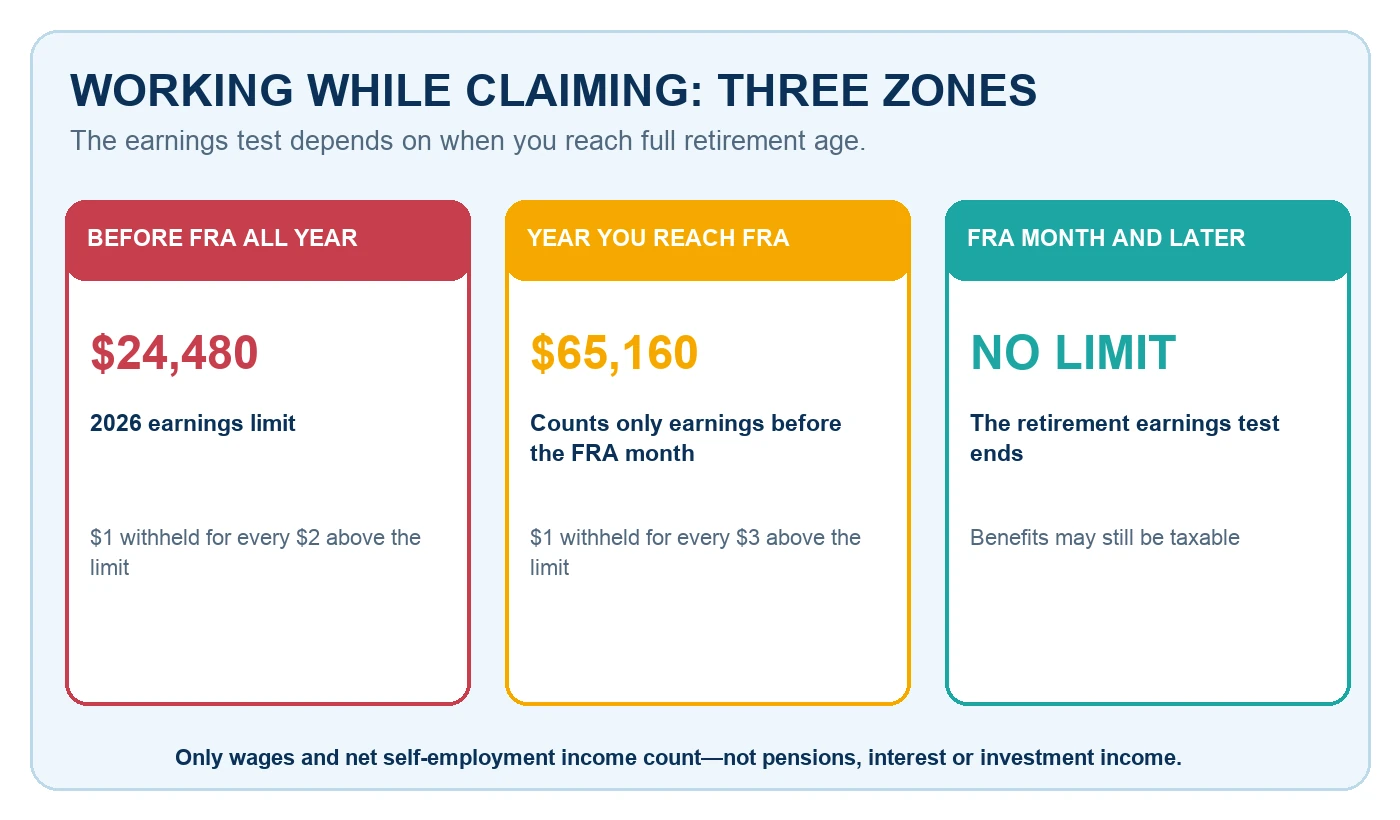
The retirement earnings test applies only before full retirement age. The limits generally change every year.
| Situation in 2026 | Earnings limit | How benefits are withheld |
|---|---|---|
| Under FRA for the entire year | $24,480 | $1 for every $2 of earnings above the limit |
| Reach FRA during 2026 | $65,160 for earnings before the FRA month | $1 for every $3 above the limit; only pre-FRA-month earnings count |
| Beginning with the FRA month | No limit | No earnings-test withholding |
What counts as earnings?
Social Security counts wages from a job and net earnings from self-employment. Bonuses, commissions and vacation pay count. Pensions, annuities, interest, dividends, capital gains, veterans benefits and other government or military retirement benefits do not count toward the retirement earnings test.
The rules are different for work outside the United States. Self-employment also requires special attention to when services were performed and whether someone has actually retired from the business.
A simple withholding example
Assume a worker is below FRA for all of 2026, earns $45,000 and has already claimed retirement benefits. Earnings exceed the $24,480 limit by $20,520. At $1 withheld for every $2 above the limit, Social Security would withhold $10,260 of benefits.
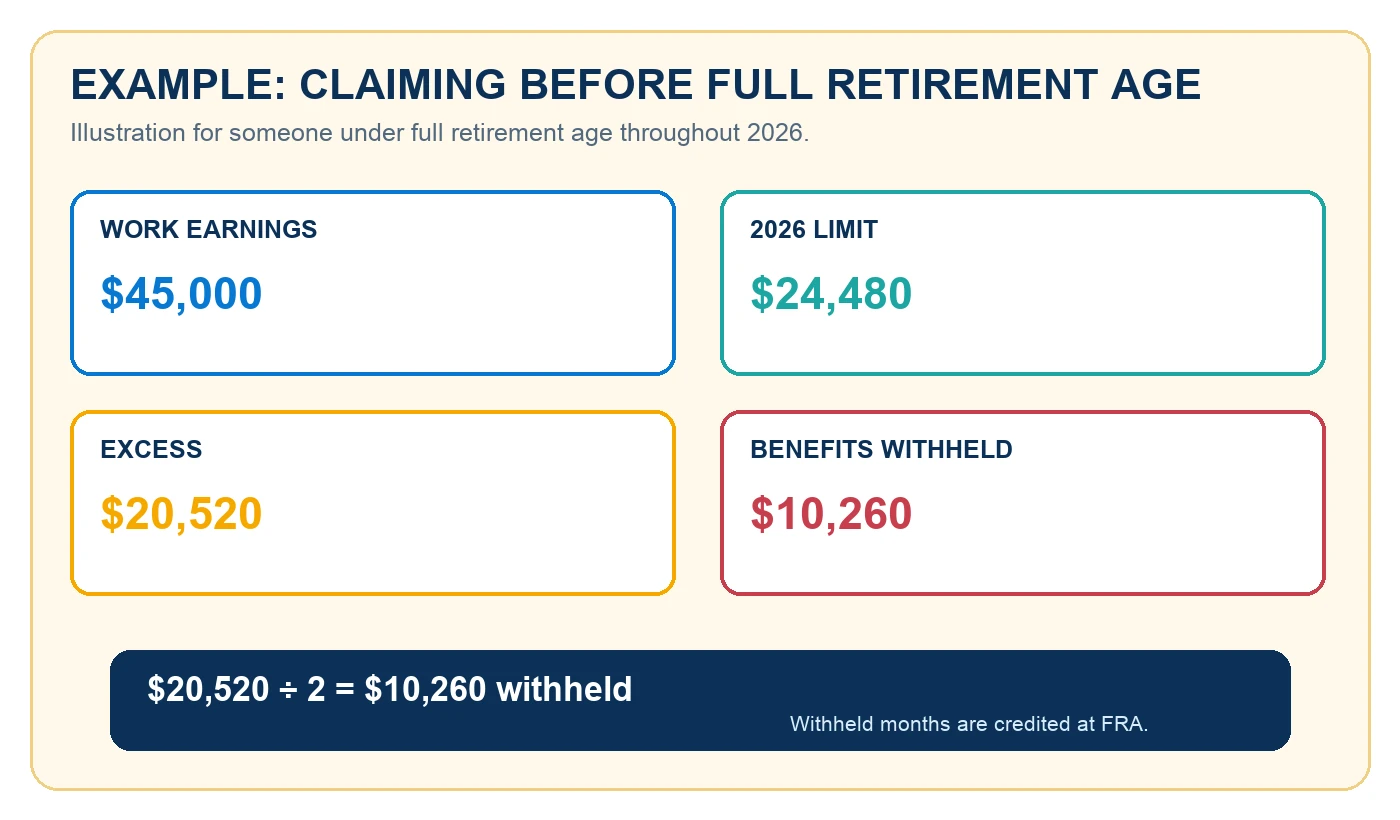
This is an illustration, not a benefit estimate. Actual withholding depends on the monthly benefit, timing and earnings reported to SSA.
Withheld benefits are not simply lost
At full retirement age, SSA recalculates the monthly benefit to credit months in which a full benefit was withheld because of earnings. That adjustment reduces the effect of the original early-claiming reduction.
This does not mean the earnings test is an interest-bearing savings account or that every household ends up economically indifferent. The claimant gives up access to money during the withholding period, the later adjustment follows a formula, taxes and household benefits can differ, and partial withholding can be handled differently. Plan around the actual payment schedule.
Claiming early still permanently reduces the starting benefit
The age-based reduction and earnings test are separate. Claiming before FRA produces a lower scheduled monthly benefit because payments begin earlier. The earnings test may then temporarily withhold some or all of those already-reduced checks while work continues.
Someone born in 1960 or later who claims at 62 can receive about 70% of the primary insurance amount before considering earnings-test withholding. Waiting to FRA provides 100%. Waiting beyond FRA increases the benefit through delayed credits until 70. Use the exact month-by-month SSA estimate instead of treating 62, 67 and 70 as the only choices.
Working can increase your future benefit
SSA calculates retirement benefits using the highest 35 years of wage-indexed earnings. It reviews the record each year. If new earnings replace a zero or a lower year among the highest 35, the monthly benefit can rise. SSA sends a notice when additional earnings produce an increase.
Before relying on the estimate, use RetireNerd’s guide to checking and correcting your Social Security earnings record. The companion explanation of how Social Security calculates your benefit shows how a new high-earning year can replace a lower year.
You continue paying Social Security and Medicare payroll taxes on covered wages even while receiving benefits. Payroll taxes do not disappear merely because retirement benefits started.
Income taxes are a different test
The retirement earnings test asks whether benefits should be withheld before FRA. Federal income-tax rules ask how much of the benefits is taxable. Wages can affect both, but the formulas are different.
For federal taxes, “combined income” generally includes adjusted gross income, tax-exempt interest and one-half of Social Security benefits. The base amount is $25,000 for a single filer or qualifying surviving spouse and $32,000 for a married couple filing jointly. Above higher thresholds—$34,000 single and $44,000 married filing jointly—up to 85% of benefits can be included in taxable income. That does not mean an 85% tax rate; it means up to 85% of the benefit may be taxable at the household’s applicable rates.
State taxation varies. Working can also affect Affordable Care Act premium assistance before Medicare, income-related Medicare premiums later, retirement-plan contribution options and the tax cost of Roth conversions. Review the entire tax return, not Social Security in isolation.
The special monthly rule for the first year
The annual earnings test can look unfair when someone retires late in the year after earning a full salary. A special monthly rule may allow a benefit for any whole month SSA considers the person retired, even if total annual earnings exceed the annual limit. For someone under FRA throughout 2026, SSA’s monthly amount is $2,040. Self-employment activity and the year FRA is reached have additional rules.
Do not assume this exception applies automatically. Tell SSA when work stops or earnings change and confirm which months qualify.
Reasons claiming while working may make sense
- The worker is at or past FRA, so the earnings test no longer applies.
- The household needs cash flow now and understands the permanent claiming adjustment.
- Earnings stay below the applicable limit.
- Health or longevity expectations make earlier payments more valuable.
- The worker is single and survivor-benefit considerations do not apply.
- The benefit helps avoid high-interest debt or an undesirable portfolio withdrawal.
- The person is already 70, when delayed retirement credits stop.
Reasons delaying may be stronger
- Work income already covers spending.
- The person is below FRA and expects much of the benefit to be withheld.
- The worker expects a long retirement and values larger inflation-adjusted lifetime income.
- The worker is the higher earner in a married couple and wants to strengthen a potential survivor benefit.
- Claiming would increase taxable income or interfere with another planned tax move.
- The household has other bridge assets that can support delay without harming emergency reserves.
Couples should evaluate the survivor benefit
For a married couple, the higher earner’s claiming decision can affect the amount the surviving spouse may later receive. Delayed retirement credits earned by the higher earner can increase the survivor benefit; an early claim can leave a smaller base. The household should compare cash flow while both spouses are alive with income after the first death.
The practical survivor steps are covered separately in Social Security After the Death of a Spouse: A Financial Checklist.
Spousal and survivor rules differ, and restricted-application strategies are unavailable to most people born after January 1, 1954. Do not assume one spouse can freely claim only a spousal benefit while delaying their own.
Do not forget Medicare at 65
Social Security claiming age and Medicare enrollment age are separate. A person delaying Social Security may still need to enroll in Medicare at 65 unless qualifying current-employment coverage supports a delay. A person already receiving Social Security is generally enrolled automatically in Original Medicare around 65.
Before delaying Part B, verify whether the employer plan is based on current employment, how many employees the employer has, who pays first and whether an HSA contribution must stop. See RetireNerd’s guide to when to sign up for Medicare.
A decision checklist
- Find your exact FRA by birth date.
- Download your current Social Security statement and estimates for several claiming months.
- Estimate wages or net self-employment income for this year and next year.
- Calculate possible earnings-test withholding.
- Compare spendable cash flow after federal and state taxes.
- Check whether new earnings could replace a low year in the 35-year record.
- Model the higher earner’s potential survivor benefit.
- Coordinate Medicare, employer coverage and HSA contributions.
- Compare claiming with using cash or taxable investments as a bridge.
- Stress-test longevity, job loss, disability and the first spouse’s death.
Use the RetireNerd Social Security Benefit Estimator to compare ages, then place the result inside the household’s broader retirement income and budget plan.
If earnings change after you claim
Report the change promptly when you are below FRA and actual earnings will differ from the estimate SSA is using. Otherwise, SSA may withhold too much now or later seek repayment for an overpayment. Keep pay records and note bonuses, commissions, vacation pay and self-employment income.
Frequently asked questions
Can I work full time and collect Social Security?
Yes. Before FRA, benefits may be withheld when earned income exceeds the annual limit. Beginning with the FRA month, the earnings test no longer limits benefits.
Are benefits withheld by the earnings test lost forever?
No. At FRA, SSA recalculates the benefit to credit months in which the full benefit was withheld because of work. The cash was unavailable during those months, so households still need to plan around the timing.
Do investment withdrawals count toward the earnings limit?
No. The earnings test counts wages and net self-employment income, not pensions, annuities, interest, dividends or capital gains. Those amounts can still affect income taxes and other planning.
Does working after 70 increase Social Security?
Delayed retirement credits stop at 70, but additional earnings can still increase the benefit if they replace a lower year in the highest 35 years.
Should I claim at FRA if I am still working?
There is no earnings-test penalty at FRA, but delaying can still earn credits through 70. Compare current cash needs, taxes, longevity and survivor protection before claiming.
Official resources
- SSA: Working while receiving retirement benefits
- SSA: Annual retirement earnings-test limits
- SSA: Working, applying for benefits, or both
- SSA: Delayed retirement credits
- SSA: How Work Affects Your Benefits
- IRS Publication 915: Taxation of Social Security benefits
Reviewed September 2026. Earnings-test limits and tax rules can change annually. Confirm your full retirement age, benefit estimate, earnings forecast and current rules with SSA and a qualified tax professional before filing. This article is general educational information, not individualized financial, tax or legal advice.