
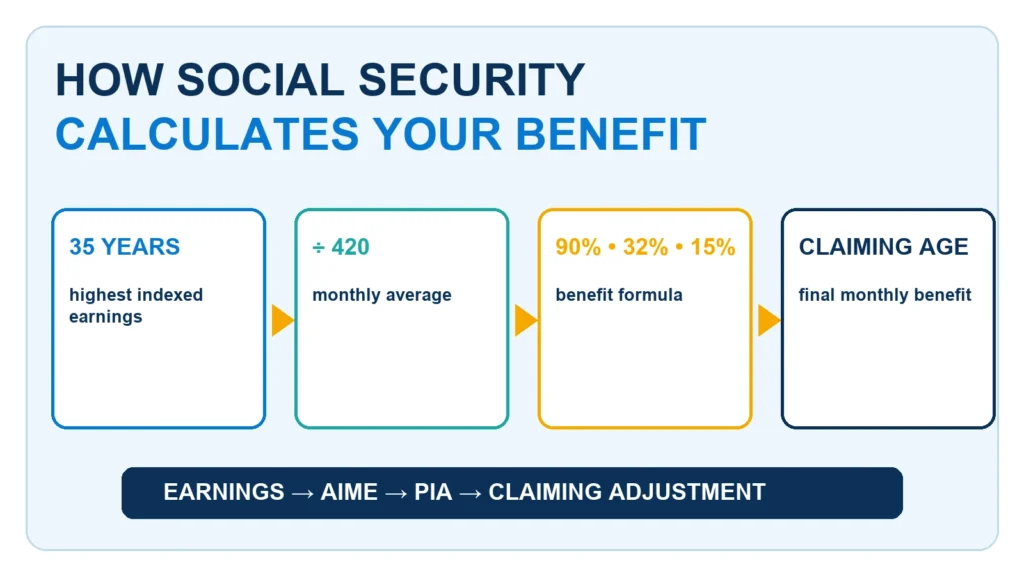
Social Security does not base a retirement check on your last salary, your final five years or the total amount of payroll tax you personally paid. It builds the benefit from your highest 35 years of covered earnings, adjusts earlier years for wage growth, converts the result to a monthly average and applies a progressive formula.
The formula in one sentence
SSA turns your 35 highest years of wage-indexed Social Security earnings into average indexed monthly earnings (AIME), applies three replacement-rate percentages to calculate your primary insurance amount (PIA), adds applicable COLAs and then adjusts the payment for the age you claim.
Watch: checking the calculation
The video below walks through checking a Social Security benefit calculation. Use it with your own official earnings record rather than entering private information into an unfamiliar website.
Social Security benefit estimator
Step 1: Start with covered earnings
SSA begins with earnings on your Social Security record. For an employee, these are generally wages subject to Social Security payroll tax. For a self-employed worker, they are covered net earnings reported for Social Security purposes.
Investment income, pension payments, IRA withdrawals and wages from jobs that were not covered by Social Security do not become part of the retirement-benefit calculation. Earnings above the annual Social Security taxable maximum also do not count. In 2026, the maximum covered amount is $184,500.
Before estimating anything, sign in to a personal my Social Security account and compare every year with W-2s, tax returns and self-employment records. An omitted year or incorrect amount can affect the estimate, especially if it belongs among the highest 35.
Step 2: Index earlier earnings for wage growth
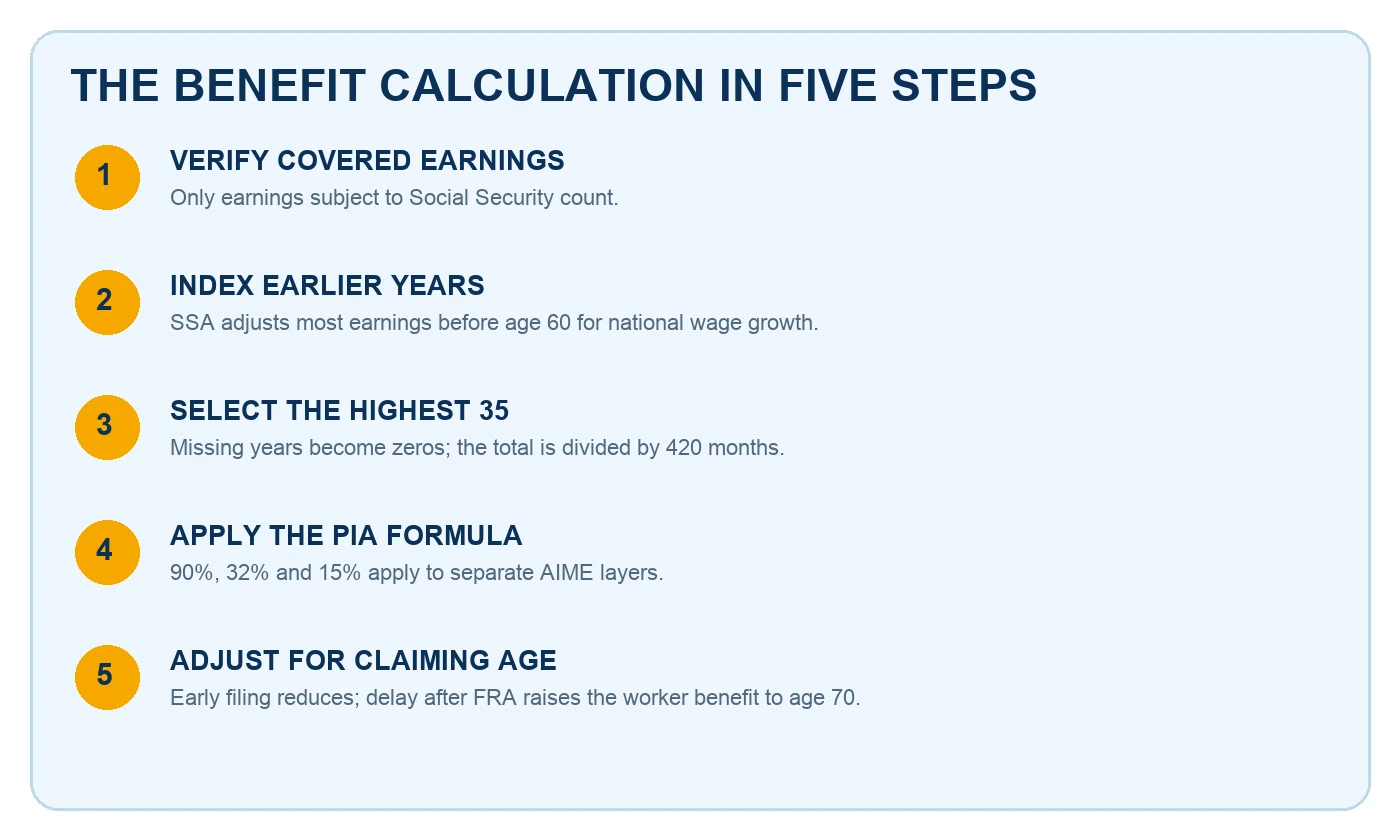
A dollar earned decades ago is not treated like a dollar earned today. SSA generally indexes earnings before the year a worker turns 60 using changes in the national average wage index. Earnings at age 60 and later enter the calculation at their actual nominal amounts.
The indexing year is tied to the year the worker first becomes eligible for retirement benefits—normally the year they reach 62. SSA uses the national average wage level from two years earlier. For someone turning 62 in 2026, earlier earnings are indexed to the 2024 national average wage index.
Wage indexing is different from a cost-of-living adjustment. Indexing helps compare earnings across a career. COLAs adjust benefits after eligibility to reflect inflation.
Step 3: Select the highest 35 years
SSA selects the 35 highest years of indexed covered earnings. It adds them and divides by 420—the number of months in 35 years. The result, rounded down to the next lower whole dollar, is the average indexed monthly earnings, or AIME.
Fewer than 35 years creates zeros
If you have only 30 years of covered earnings, the calculation includes five zero years. Working longer may replace zeros or low years. A 36th year does not automatically increase the benefit; it must be higher than one of the 35 years already used.
Step 4: Convert AIME into the primary insurance amount
The PIA is the basic monthly amount payable at full retirement age before certain rounding and other adjustments. SSA applies a weighted formula to three layers of AIME. The percentages—90%, 32% and 15%—make Social Security replace a larger share of career earnings for lower-wage workers.
The dollar boundaries between the layers are called bend points. They are set for the year the worker turns 62, not the year benefits begin, and generally remain attached to that worker’s calculation.
For a worker first eligible at 62 in 2026, the formula is:
- 90% of the first $1,286 of AIME, plus
- 32% of AIME from $1,286 through $7,749, plus
- 15% of AIME above $7,749.
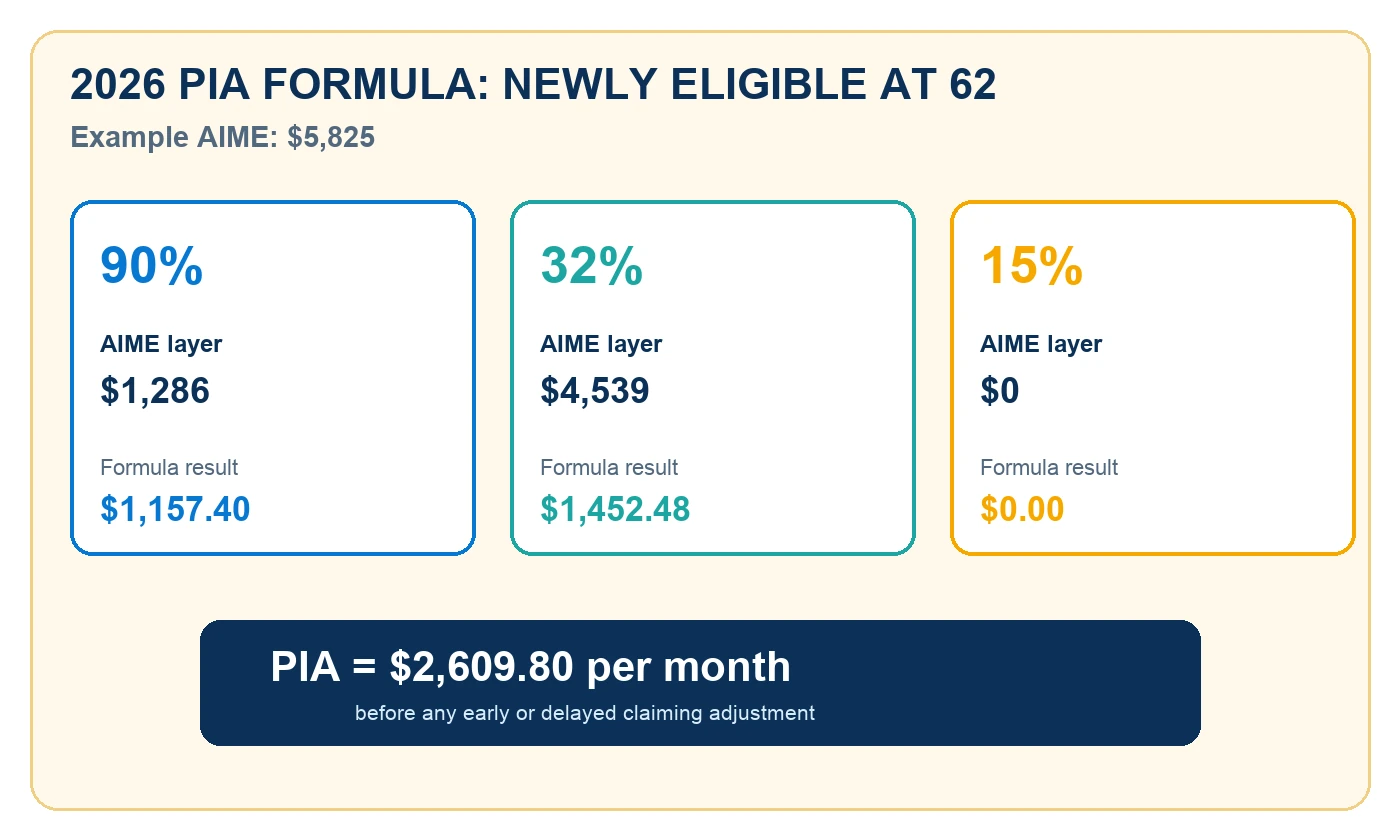
These bend points apply to workers first eligible in 2026. Someone who turned 62 in a different year uses that year’s bend points, followed by applicable COLAs. Do not substitute the latest bend points into every person’s record.
Step 5: Apply COLAs and claiming age
After the initial PIA is established, applicable cost-of-living adjustments are incorporated. Then the monthly retirement benefit changes according to when the worker claims:
- Before full retirement age: the worker benefit is permanently reduced for the number of early months.
- At full retirement age: the worker generally receives the PIA.
- After full retirement age: delayed retirement credits increase the worker benefit for each month of delay through age 70.
For people born in 1960 or later, FRA is 67. Claiming at 62 generally produces 70% of the PIA. For people born in 1943 or later, delay after FRA earns credits at an annual rate of 8% through 70. The exact adjustment is monthly.
Claiming age does not change the underlying earnings record. It changes the amount paid from that record. See Social Security at 62, 67 or 70 for the household trade-offs.
Why your SSA estimate can change
- Future earnings assumptions: personalized estimates may assume continued earnings. Stopping work early can lower the final result.
- A new high year: later earnings can replace a lower year among the highest 35.
- Corrections: missing or incorrect earnings may be fixed.
- Annual COLAs: benefit amounts can rise after eligibility.
- Claiming month: each month early or delayed changes the adjustment.
- Earnings-test withholding: claiming while working before FRA can temporarily withhold checks, though SSA later credits fully withheld months at FRA.
- Family benefits: spouse, child and survivor amounts use additional rules and may be affected by a family maximum.
- Medicare premiums: the amount deposited may be lower than the gross benefit when Part B, Part D or other deductions are withheld.
RetireNerd’s guide to claiming Social Security while working explains the earnings test separately. The Social Security Benefit Estimator can compare broad claiming scenarios, but the official SSA record should remain the primary source for personal earnings and estimates.
What your benefit is not based on
| Common assumption | What actually happens |
|---|---|
| My last salary determines the check | SSA generally uses the highest 35 years of indexed covered earnings |
| Only my final five or ten years matter | Any covered year can be included if it belongs among the highest 35 |
| Social Security returns my personal contributions | Benefits follow a statutory insurance formula, not an individual investment account |
| Every dollar I earn increases my benefit | Only covered earnings up to the annual taxable maximum count |
| Working a 36th year always helps | It helps only when it replaces a lower indexed year |
| The number in my bank account is my calculated benefit | The deposit may reflect Medicare premiums, tax withholding or other deductions |
How to check your own calculation
- Create or sign in to a secure my Social Security account.
- Download the earnings record and benefit estimates.
- Compare each earnings year with W-2s, Schedule SE and tax records.
- Identify whether you have 35 covered years and which years are likely to be replaced.
- Check the assumption for future annual earnings.
- Confirm the bend-point year—the year you reach 62.
- Compare claiming months at 62, FRA and 70, plus intermediate ages.
- Separate the gross benefit from Medicare premiums and tax withholding.
- Coordinate worker, spouse and survivor benefits as a household.
- Save the statement and repeat the review annually.
Frequently asked questions
Does Social Security use my last 35 years?
No. It generally uses the highest 35 years of indexed covered earnings, wherever those years fall in the work history.
What happens if I worked fewer than 35 years?
Zero-earnings years fill the missing slots. Additional covered work can replace a zero and may increase the benefit.
Are all 35 years adjusted for inflation?
SSA uses national wage indexing for most earnings before age 60. Earnings at age 60 and later generally enter at their nominal value. Later COLAs are a separate adjustment.
Do the 2026 bend points apply to everyone claiming in 2026?
No. They apply to workers first eligible for retirement benefits in 2026, generally people reaching 62 that year. Other workers use the bend points from their own eligibility year.
Why is my deposit smaller than the SSA benefit amount?
The deposit may be reduced by Medicare premiums, voluntary federal tax withholding, recovery of an overpayment or other deductions. Compare the gross benefit and each deduction on the notice.
Official resources
- SSA: How benefit amounts are calculated
- SSA: 2026 retirement benefit calculation examples
- SSA: Primary insurance amount formula and bend points
- SSA: Earnings indexing factors
- SSA: Get a personalized benefit estimate
- SSA benefit calculators
Reviewed September 2026. The annual taxable maximum, bend points, wage indexes and COLAs change. Personal estimates also depend on the accuracy of the earnings record and future-work assumptions. Verify your record and current figures directly with SSA. This article is general educational information, not individualized financial, tax or legal advice.