

The right amount of retirement cash is enough to keep an emergency, a planned purchase or a falling market from forcing a bad decision—without leaving so much idle that inflation quietly weakens the plan.
That amount is not automatically six months, two years or 10% of the portfolio. A retiree with a pension covering every essential bill needs a different reserve from someone whose investments pay most of the mortgage, groceries and healthcare. Start with what the cash must do.
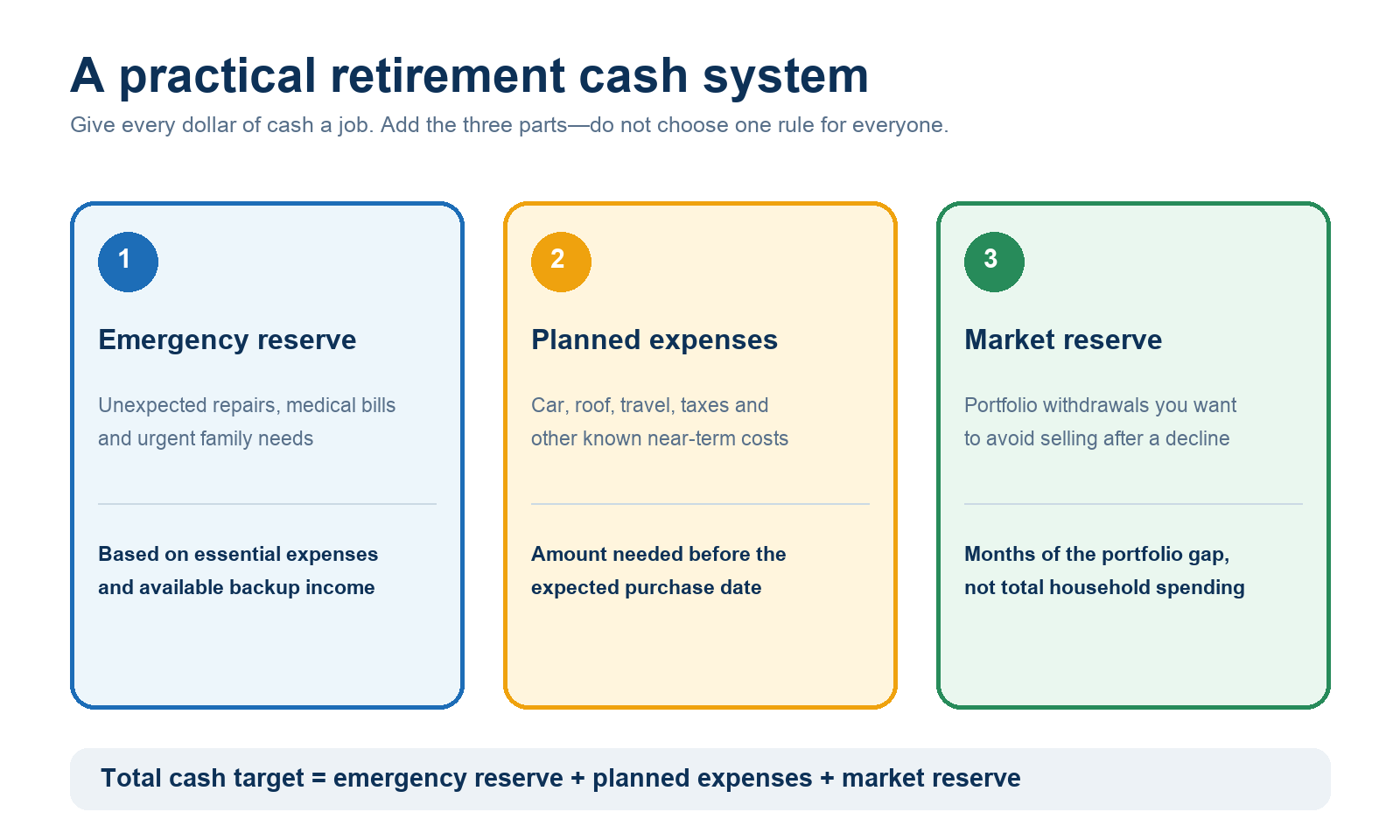
The answer in one minute
- Emergency reserve: money for expenses you cannot predict.
- Planned-expense reserve: money for a car, roof, taxes, travel or another known cost coming soon.
- Market reserve: money that can cover portfolio withdrawals during a decline.
Add those three numbers. Then subtract cash already assigned to this month’s bills. The result is a starting target to test—not a universal command.
Cash job 1: Handle real emergencies
An emergency reserve covers urgent, unplanned costs: a broken furnace, major car repair, medical bill, insurance deductible or sudden family need. It keeps you from carrying expensive credit-card debt or selling investments at an inconvenient time.
Three to six months of essential expenses is a common starting point, but the Consumer Financial Protection Bureau correctly notes that the right amount depends on the household. In retirement, ask:
- How stable are Social Security, pension and annuity payments?
- How large are home, auto and health-insurance deductibles?
- Could a second vehicle or aging home create a large repair?
- How quickly could investments be sold and transferred?
- Do you support anyone else?
A homeowner with an older roof and no pension may favor a larger emergency reserve. A renter whose reliable income covers essential bills may need less.
Cash job 2: Pay for expenses you already know are coming
A planned cost is not an emergency simply because it arrives once a year. Property taxes, insurance premiums, vacations, a replacement vehicle, dental work and home projects belong in the plan.
List what you expect during the next one to three years, with a date and amount. Keep money needed soon out of investments that could fall sharply before the bill arrives. A $25,000 car purchase planned for next summer has a different job from money intended for age 90.
| Expected expense | Timing | Amount to reserve now |
|---|---|---|
| Property tax and insurance | Within 12 months | Unfunded amount |
| Vehicle replacement | 18 months | Purchase price minus ongoing savings |
| Roof or HVAC | 1–3 years | Expected cost with a cushion |
| Major trip or family event | Known date | Travel total minus deposits already paid |
Cash job 3: Avoid selling after a market decline
A market reserve gives investments time to recover by funding withdrawals when stocks are down. It does not prevent losses, and there is no guarantee a decline will end before the reserve runs out. Its value is behavioral and practical: it creates choices.
Base this reserve on the portfolio spending gap, not total household spending.
Example: A household spends $6,000 a month. Social Security and a pension provide $4,000. Investments must supply $2,000. A 12-month market reserve is $24,000; a 24-month reserve is $48,000. Holding $72,000–$144,000 based on total spending would count reliable income twice.
Someone with a stock-heavy portfolio, little flexibility and anxiety about selling may value a larger reserve. Someone with high reliable income, flexible travel spending and a balanced portfolio may use less. The reserve must fit the investment allocation; cash held outside the portfolio still counts as part of the household’s conservative assets.
A relatable complete example
Rosa spends $5,500 a month, of which $4,000 is essential. Social Security and her pension provide $3,700. Her investments normally supply $1,800 a month.
- Emergency reserve: four months of essential spending, or $16,000. Her reliable income continues during most emergencies, but she owns an older home.
- Planned expenses: $22,000 for property taxes, dental work and a vehicle purchase during the next two years.
- Market reserve: 18 months of her $1,800 portfolio gap, or $32,400.
Her starting cash target is $70,400. It is not “13 months of spending.” It is three specific amounts with three different jobs. Once she buys the car, the planned-expense portion falls unless she begins saving for the next purchase.
Where retirement cash can be kept
| Place | Useful for | What to check |
|---|---|---|
| Checking account | This month’s bills | Fees, fraud controls and interest |
| High-yield savings or bank money-market deposit account | Emergency and near-term reserves | FDIC coverage, transfer limits and variable rate |
| Certificate of deposit | Money needed on a known schedule | Maturity date and early-withdrawal penalty |
| Treasury bills | Staggered near-term expenses | Maturity, reinvestment, access and account mechanics |
| Government or Treasury money-market mutual fund | Brokerage liquidity | Expense ratio, yield, settlement and lack of FDIC insurance |
| 401(k) or IRA stable-value/cash option | Retirement-account withdrawals | Plan restrictions, fees, crediting rate and tax treatment |
Bank checking, savings, money-market deposit accounts and CDs may qualify for FDIC insurance. The standard limit is $250,000 per depositor, per insured bank, per ownership category. Branches of the same bank do not create separate coverage.
A money-market mutual fund is different from a bank money-market deposit account. The fund is a security and is not FDIC insured; although it seeks stability, it can lose money. SIPC may protect missing securities and certain cash if a member brokerage fails, but it does not protect investment value or market losses.
Treasury bills are available in terms ranging from four to 52 weeks on regular auction schedules. They are not FDIC-insured bank deposits; they are obligations of the U.S. government. Match maturities to the dates you expect to spend the money rather than locking every dollar for the highest advertised yield.
The cost of keeping too much cash
Cash feels safe because the account balance does not bounce around like stocks. But it carries other risks.
- Inflation risk: prices can rise faster than the after-tax interest earned.
- Opportunity cost: long-term money misses potential investment growth.
- Reinvestment risk: savings, CD and Treasury rates can fall when holdings mature.
- Tax drag: interest in a taxable account is generally taxable in the year earned.
- False security: a large cash pile can hide an investment allocation that no longer supports decades of spending.
For illustration, $100,000 earning 2% for ten years becomes about $121,900. At a hypothetical 6%, it becomes about $179,100—a difference of roughly $57,200 before taxes. The 6% result is not guaranteed and could include substantial declines. The point is that stability has a cost when money will not be needed for many years.
Do you need one or two years of cash?
Sometimes. A one- or two-year market reserve can help a household avoid selling after a decline. It should not be repeated as a rule without defining what “one year” includes.
- Use the portfolio gap after Social Security, pensions and other reliable income.
- Separate known purchases so they do not consume the market reserve.
- Count cash held inside retirement accounts and conservative investments across the whole household.
- Decide how the reserve will be refilled—after market gains, from dividends and interest, or through periodic rebalancing.
A reserve without a refill rule slowly becomes an empty checking account.
When more cash may be reasonable
- You are within a few years of retirement and have large known expenses.
- Your portfolio supplies most essential spending.
- You own an older home or have high deductibles.
- You would sell investments in panic during a decline.
- Your income is irregular or a pension has limited survivor protection.
When less cash may be reasonable
- Social Security and pensions cover nearly all essential spending.
- Major planned costs are already funded separately.
- You have flexible discretionary spending that can fall during bad markets.
- Your portfolio already contains bonds or other conservative assets intended for withdrawals.
- Excess cash will not be needed for many years.
Calculate your retirement cash target
- Add several months of essential expenses for emergencies.
- Adjust for reliable income that would continue during an emergency.
- Add known expenses due during the next one to three years.
- Calculate monthly spending minus reliable monthly income.
- Multiply that portfolio gap by the number of market-reserve months you choose.
- Subtract cash already assigned to current bills.
- Check deposit-insurance limits, access rules, maturity dates and fees.
- Review the target annually and after major purchases.
Cash is not the opposite of investing. It is the part of the plan assigned to near-term certainty. Keep enough to protect the plan, then give long-term money the opportunity to do long-term work.
Continue with RetireNerd
- Retirement Withdrawal Strategies
- Model cash and withdrawals in Compass
- Build your Retirement Roadmap
- The Retirement Expenses People Most Often Forget
Sources
- Consumer Financial Protection Bureau: Emergency funds
- FDIC: Deposit insurance FAQs
- Investor.gov: Money-market funds
- TreasuryDirect: Treasury-bill FAQs
- SIPC: What SIPC protects
- Investor.gov: CD risks and early-withdrawal penalties
This article provides general education, not individualized financial, investment or tax advice. Examples are hypothetical. Interest rates, inflation, investment returns, insurance coverage and account rules change. Verify current terms before choosing an account or investment.