
If your income was high two years ago, Medicare may charge you more today. Here is how the surcharge, called IRMAA, works, what it costs in 2026, and how to get it lowered when your income has dropped.
Ron and Carla retired in early 2025. Late that year, a letter from Social Security said their Medicare premiums for 2026 would go up. Each of them would pay $284.10 a month for Part B, not the standard $202.90, plus an extra $14.50 for drug coverage.
Their income had just dropped. So why the higher bill? Because Medicare was looking at 2024, Ron’s last full year of work, when his salary and a large year-end bonus pushed their income to $240,000.
That extra charge has a name: IRMAA, the income-related monthly adjustment amount. Ron and Carla could get it removed with one form. Many people never ask.
Key takeaways
- IRMAA is an extra charge on Medicare Part B and Part D for people whose income was above $109,000, or $218,000 for couples filing jointly.
- Medicare uses your tax return from two years earlier, so 2026 premiums are based on 2024 income.
- Going even $1 over a threshold triggers the full surcharge for that tier, for each spouse.
- If your income dropped because you stopped working or another life-changing event happened, Form SSA-44 can lower the charge.
What IRMAA is
Most people pay the standard Part B premium, $202.90 a month in 2026. People with higher incomes pay the standard premium plus an income-related monthly adjustment amount. The same kind of surcharge is added to Part D drug coverage, whether you have a standalone drug plan or a Medicare Advantage plan with drug coverage.
Social Security decides who pays it, using information from the IRS. If you get Social Security, the extra amount comes out of your monthly check.
The 2026 income brackets
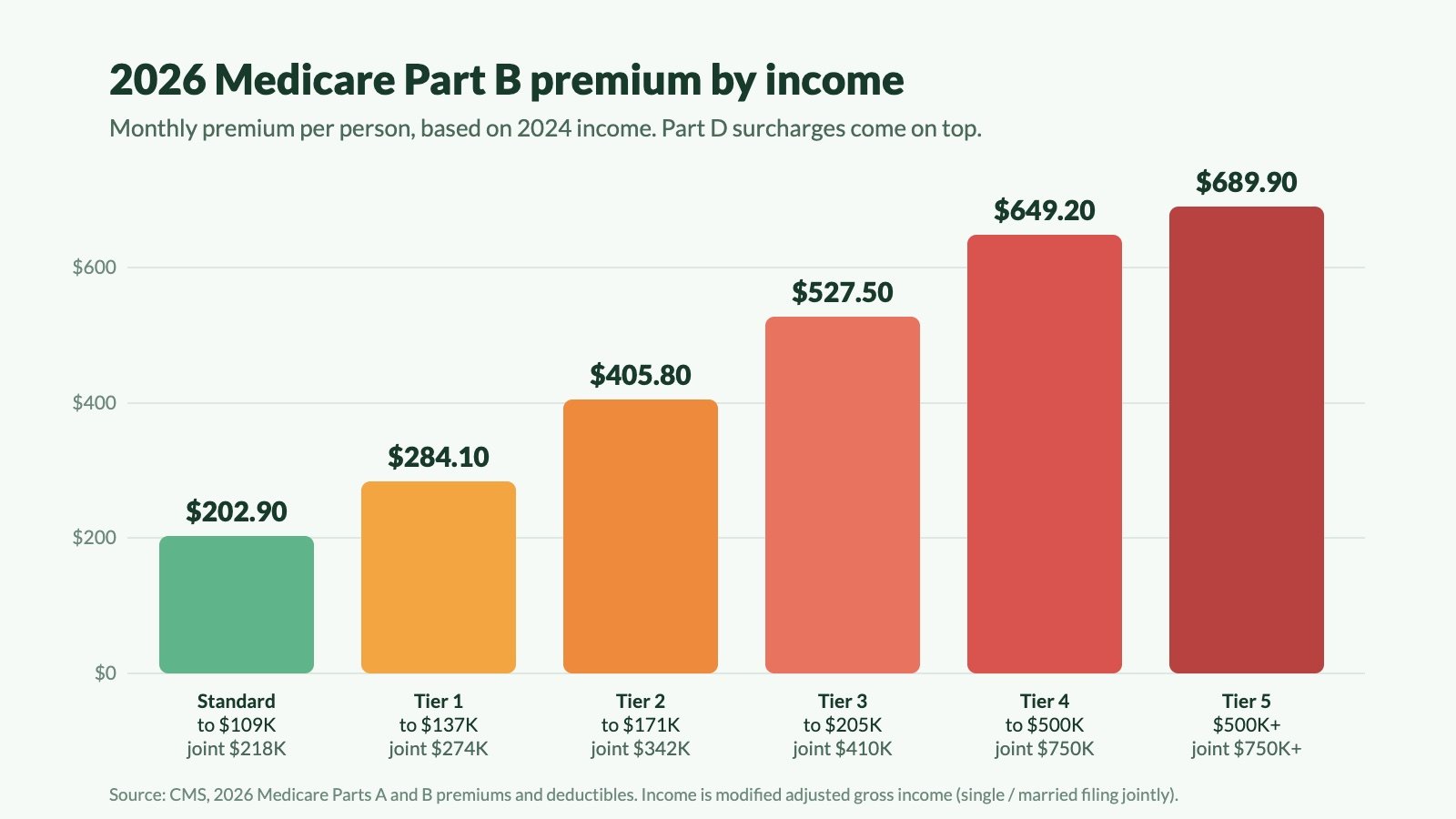
These amounts are per person, per month. A married couple where both have Medicare pays them twice.
| 2024 income, single | 2024 income, married filing jointly | Part B monthly premium | Part D surcharge |
|---|---|---|---|
| $109,000 or less | $218,000 or less | $202.90 | $0 |
| $109,001 to $137,000 | $218,001 to $274,000 | $284.10 | $14.50 |
| $137,001 to $171,000 | $274,001 to $342,000 | $405.80 | $37.50 |
| $171,001 to $205,000 | $342,001 to $410,000 | $527.50 | $60.40 |
| $205,001 to $499,999 | $410,001 to $749,999 | $649.20 | $83.30 |
| $500,000 or more | $750,000 or more | $689.90 | $91.00 |
Married people who file separately and lived with their spouse during the year have only three brackets, and the surcharge starts at $109,000 and jumps straight to the second-highest Part B premium.
Which income counts
Medicare uses your modified adjusted gross income, or MAGI. For IRMAA, that is your adjusted gross income from your tax return plus any tax-exempt interest, such as interest from municipal bonds.
It includes wages, pension income, traditional IRA and 401(k) withdrawals, required minimum distributions, Roth conversions, capital gains, interest, dividends and the taxable part of your Social Security. It does not include tax-free Roth withdrawals or a qualified charitable distribution made straight from an IRA to a charity.
And it is two years old. Your 2026 premiums depend on your 2024 return, and your 2027 premiums will depend on your 2025 return.
The $1 cliff
IRMAA doesn’t phase in. If your income is one dollar over a threshold, you pay that tier’s full surcharge for the whole year.
For a married couple at $218,001, that is $81.20 more for Part B and $14.50 more for Part D, each, every month. Over a year, the couple pays $2,296.80 more than a couple at $218,000. One extra dollar of income can cost more than two thousand dollars.
That is why one large, one-time item can sting: selling a house or a rental property for a big gain, a large IRA withdrawal, or a Roth conversion done all in one year.
How to get it lowered: Form SSA-44
If your income has gone down because of a life-changing event, you can ask Social Security to use a more recent year, or your estimate for this year. The qualifying events are:
- Stopping work or working fewer hours
- Marriage, divorce or the death of a spouse
- Loss of income-producing property, for example after a disaster
- Loss or reduction of some pensions
- An employer settlement payment
You can fill out Form SSA-44 online after signing in at ssa.gov, mail or fax it to a Social Security office, or call 800-772-1213. Include proof, such as a letter from your employer showing your last day of work. If you filed an amended tax return that lowers your income, call Social Security instead.
Ron filed Form SSA-44 for work stoppage with an estimate of $95,000 for 2025. Social Security agreed, and both of their premiums went back to the standard amount.
Big investment gains or a one-time IRA withdrawal don’t count as life-changing events. If one of those pushed you over, you will usually pay the surcharge for that one year only, and it drops off when your income does.
Planning around the brackets
Because Medicare looks back two years, the planning starts at about age 63. A few ideas people use:
- Know your number. Look up where your income sits compared with the next threshold before making a large withdrawal or sale.
- Spread out Roth conversions. Converting smaller amounts over several years can keep each year under a bracket. Our guide to the Roth conversion window before RMDs shows how.
- Give from your IRA. From age 70½, a qualified charitable distribution is left out of your income, and once required withdrawals start it counts toward them.
- Time big sales. If you can, split a large gain across two tax years.
Keep it in proportion. Paying IRMAA for a year is often better than skipping a smart move, such as a Roth conversion that saves much more tax later. Our guide to how taxes affect your retirement withdrawals puts the pieces together.
Frequently asked questions
Does IRMAA apply to both spouses?
Yes. Each spouse on Medicare pays the surcharge based on the couple’s joint income. A spouse not yet on Medicare pays nothing until they enroll.
Is IRMAA permanent?
No. Social Security looks at your income again every year. If your income falls below the threshold, the surcharge goes away two years later, or sooner with Form SSA-44 after a life-changing event.
Can I appeal if I think the income is wrong?
Yes. If the IRS information is incorrect, or you filed an amended return, contact Social Security and ask for a new decision. Your IRMAA letter explains your appeal rights and deadlines.
Do the brackets change every year?
Yes. The thresholds and amounts are updated each fall for the next year. Our retirement numbers page lists the current figures.
Your next step
Find your tax return from two years ago and look at your adjusted gross income plus any tax-exempt interest. If it is near or over $109,000, or $218,000 as a couple, check where you stand before your next big withdrawal. And if you just retired and got an IRMAA letter, file Form SSA-44.
Ron and Carla now check their income every December. They keep Roth conversions just under the next bracket, and they haven’t paid the surcharge since.
Related reading: how much Medicare costs and Medicare for married couples.
Educational note: This article is general education, not individualized tax or Medicare advice. Figures are the 2026 amounts from CMS and Social Security and change each year. Ron and Carla are an illustrative example. A tax professional or financial planner can help you plan income around the brackets.