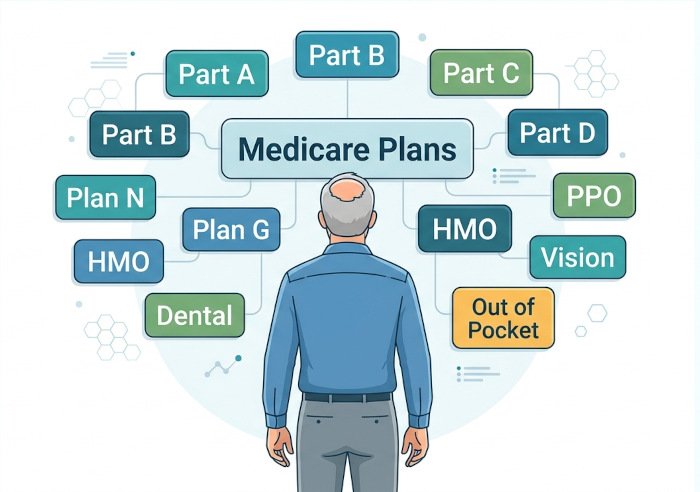
If you just retired, or you are about to, one task on your list probably feels more confusing than it should: choosing a Medicare plan. The letters alone, Part A, Part B, Part C, Part D, Medigap, can feel like an alphabet you never signed up to learn. This guide explains how to choose a Medicare plan in plain language, walks through what each path actually costs, compares real examples of plans, and lays out the exact timing and steps for enrolling, so you can make this choice with confidence instead of guesswork.
Key takeaways
- Original Medicare is Parts A and B; most people add a Part D drug plan and often a Medigap policy.
- Medicare Advantage bundles coverage through a private plan, usually with drug coverage, a provider network and a yearly out-of-pocket cap.
- Original Medicare alone has no yearly out-of-pocket limit, which is why many people pair it with Medigap.
- Compare the premium plus what a bad health year could cost, not the monthly premium alone.
The Building Blocks: What the Letters Actually Mean
Before comparing anything, it helps to know what each piece of Medicare actually covers. There is no test here, just four ideas worth holding onto.
Part A is hospital insurance. It covers inpatient hospital stays, care in a skilled nursing facility, hospice, and some home health care. Most people do not pay a monthly premium for Part A, because it was already paid for through payroll taxes during their working years.
Part B is medical insurance. It covers doctor visits, outpatient care, preventive screenings, and durable medical equipment like wheelchairs or walkers. Nearly everyone pays a monthly premium for Part B, and this premium is often deducted directly from a Social Security check.
Parts A and B together are known as Original Medicare. It is run directly by the federal government and accepted by almost any doctor or hospital in the country.
Part C, better known as Medicare Advantage, is a different way of receiving your benefits. Instead of the government paying your medical bills directly, a private insurance company is paid to manage your care, usually through a local network of doctors, and that company typically bundles in extra benefits like dental, vision, and drug coverage.
Part D is prescription drug coverage, sold by private insurers. It is a separate add on for anyone who chooses Original Medicare, since Original Medicare does not cover prescription drugs on its own. Most Medicare Advantage plans already include drug coverage built in.
Medigap, also called Medicare Supplement Insurance, is a private policy that helps pay the costs Original Medicare leaves behind, things like deductibles and coinsurance. It only works alongside Original Medicare. You cannot pair a Medigap policy with a Medicare Advantage plan.
The Big Fork in the Road: Original Medicare or Medicare Advantage
Nearly every decision about Medicare eventually comes back to one central choice: do you want Original Medicare, usually paired with a separate Part D plan and often a Medigap policy, or do you want a Medicare Advantage plan that bundles everything together under one private insurer. Neither path is universally better. They trade off differently on cost, flexibility, and predictability.
Original Medicare (Parts A and B)
The biggest advantage of Original Medicare is freedom. You can see almost any doctor or specialist in the country without a referral, and your coverage travels with you if you spend part of the year in a different state. The tradeoff is that Original Medicare, by itself, has no annual limit on how much you could pay out of pocket in a bad health year. That is exactly why most people who choose this path also add a Medigap policy, which caps that exposure by covering the leftover costs.
Medicare Advantage (Part C)
Medicare Advantage plans are appealing because many carry a very low or even zero dollar monthly premium, and they typically bundle in drug coverage plus extras like dental, vision, and hearing that Original Medicare does not cover at all. The tradeoff is a more limited network of doctors, often a requirement to get a referral before seeing a specialist, and by law, every Medicare Advantage plan does cap your yearly out of pocket costs, though that cap can still run into the thousands of dollars.
What These Paths Actually Cost
Numbers make this easier to picture than percentages and rules. Here is what three common paths cost in monthly premiums for 2026, using national average figures.
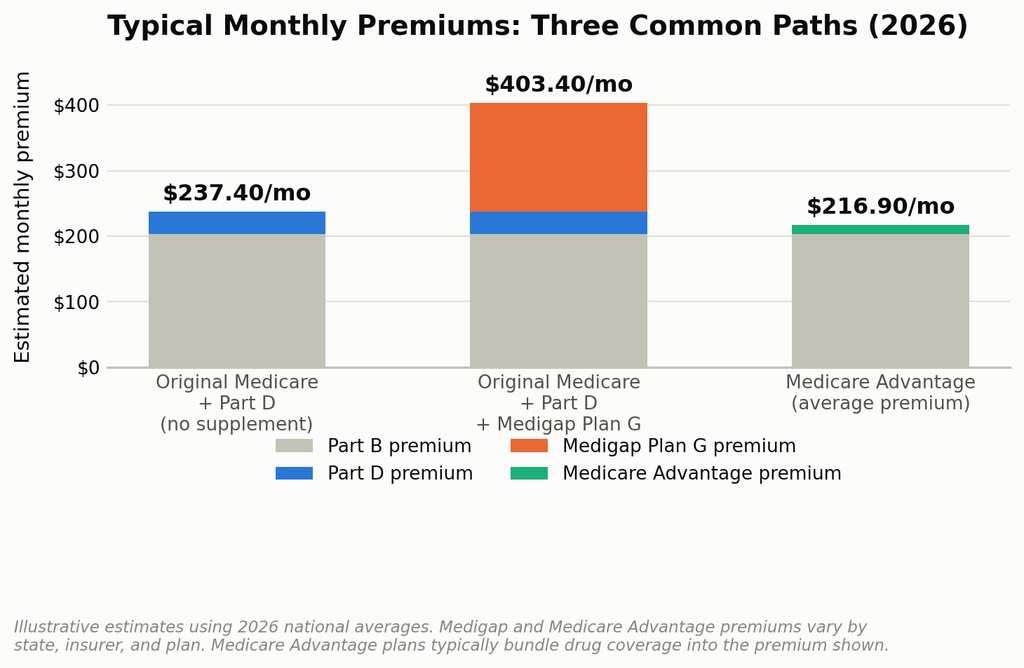
Illustrative 2026 estimates. Actual premiums vary by state, insurer, income, and plan choice.
A person who picks Original Medicare with just a Part D drug plan and no supplement pays a relatively low premium, around $237 a month, but takes on the risk of large, unpredictable bills if a serious illness or injury happens. Adding a Medigap Plan G brings the monthly cost up to roughly $403, but in exchange, nearly all of the unpredictable costs disappear, since Medigap absorbs most of what Original Medicare does not cover. A Medicare Advantage plan, on the other hand, often lands close to $217 a month on average, including drug coverage, because so many of these plans charge a very low or zero premium. The real comparison is not just the monthly premium, it is premium plus the risk of what a bad year could cost you.
If You Choose Original Medicare: Do You Need a Medigap Policy
If Original Medicare appeals to you because of the freedom to see any doctor, the next question is whether to add a Medigap policy, and if so, which one. Medigap plans are standardized and labeled by letter, so a Plan G from one insurer covers exactly the same benefits as a Plan G from another insurer, though the price can still differ between companies.
Plan G is one of the most popular choices. It covers nearly every gap Original Medicare leaves behind except the annual Part B deductible, which is $283 in 2026. Premiums for Plan G commonly fall somewhere in the neighborhood of $150 to $200 a month for a new 65 year old, though your actual quote will depend on your state and health history at the time you apply.
Plan N typically costs noticeably less than Plan G, often in the range of $110 to $140 a month, but it comes with small copays, sometimes up to $20 for an office visit or $50 for an emergency room visit, and it does not cover a charge called an excess charge, which happens if a doctor does not accept Medicare’s approved payment amount in full.
Plan F used to be the most complete option, covering the Part B deductible as well, but it is no longer available to anyone who became eligible for Medicare on or after January 1, 2020. If you already have Plan F from before that date, you can keep it.
If You Choose Medicare Advantage: What to Look For
Medicare Advantage plans are not one size fits all, and the details matter more than the premium alone.
HMO plans generally require you to choose a primary care doctor and get a referral before seeing a specialist, and they typically do not cover out of network care except in an emergency. They tend to have the lowest premiums.
PPO plans give you more freedom to see specialists without a referral and offer some out of network coverage, usually at a higher cost to you, in exchange for a somewhat higher premium.
Extra benefits are one of the biggest draws. The large majority of Medicare Advantage plans now include dental, vision, and hearing coverage that Original Medicare does not offer at all, and many include a fitness benefit or an allowance for over the counter health items.
The out of pocket maximum is worth checking closely before you enroll. By law, every Medicare Advantage plan must cap what you pay out of pocket each year for covered services, with a legal ceiling around $9,250 for in network care in 2026, but individual plans can and do set their own limit anywhere below that.
Do Not Forget: Prescription Drug Coverage
Even if you are not taking any medications right now, it is worth thinking about Part D drug coverage the moment you become eligible for Medicare, not later once you actually need it. If you go 63 days or longer without what is called creditable drug coverage, meaning coverage at least as good as Medicare’s, you can be charged a late enrollment penalty of about 1% of the national average premium for every month you went without it. That penalty is added to your monthly premium and generally stays for as long as you have Part D coverage, so it is one of the easiest mistakes to avoid simply by enrolling on time.
Timing Matters: When You Can Enroll or Change Plans
Medicare has specific windows for enrolling and switching, and missing one can mean waiting months for the next chance, or paying a permanent penalty.
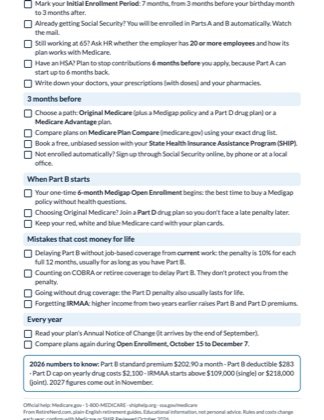
1. Your Initial Enrollment Period is a seven month window built around your 65th birthday: it starts three months before your birthday month, includes your birthday month, and runs three months after. This is when most people make their very first Medicare decisions.
2. If you delay signing up for Part B because you still have solid coverage through a job, either your own or a spouse’s, you generally qualify for a Special Enrollment Period that lasts as long as that coverage continues, plus eight months after it ends, without facing a late penalty.
3. If you delay Part B without qualifying employer coverage, the standard premium can permanently increase by about 10% for every full 12 month period you went without it, added to your bill for as long as you have Part B.
4. Once you are enrolled, the Annual Enrollment Period runs every year from October 15 through December 7. This is your yearly chance to switch Part D plans or move between Original Medicare and Medicare Advantage. Watch for scam calls during this season. Medicare will never call to sell you a plan or ask for your Medicare number. Our guide to avoiding retirement scams shows how to check a call before you share anything.
5. A shorter Medicare Advantage Open Enrollment Period runs January 1 through March 31 each year, letting anyone already in a Medicare Advantage plan switch to a different one, or drop it and return to Original Medicare, one time.
6. If you want a Medigap policy, timing matters even more here. You get a six month window starting the month you turn 65 and are enrolled in Part B, during which an insurer must sell you any Medigap policy it offers, regardless of your health. Miss that window, and insurers in most states are allowed to ask health questions, charge you more, or deny you coverage entirely.
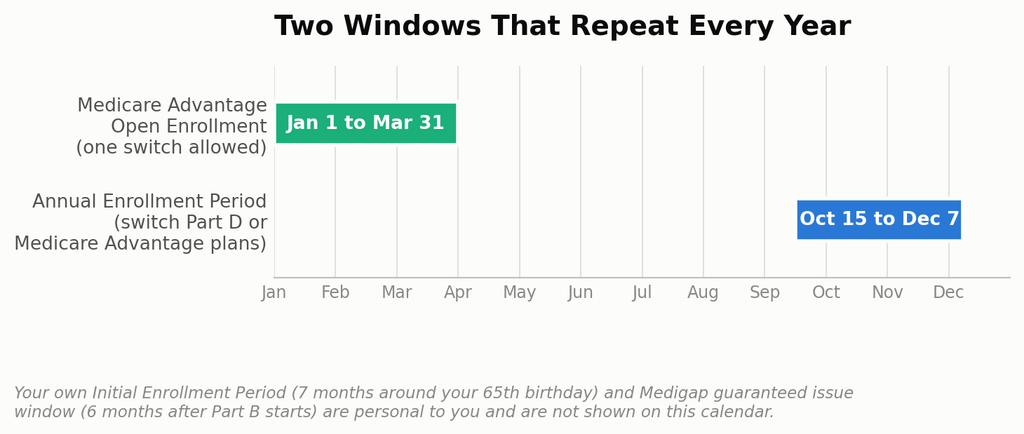
The Annual Enrollment Period and Medicare Advantage Open Enrollment Period repeat every calendar year.
Steps to Actually Enroll
1. Mark your Initial Enrollment Period on a calendar as soon as you know your 65th birthday month, so you do not miss the seven month window.
2. Decide on your starting path: Original Medicare, possibly with a Medigap policy and a Part D plan, or a Medicare Advantage plan. It helps to write down which matters more to you, lower monthly cost and bundled extras, or maximum flexibility in choosing doctors.
3. Use the Medicare Plan Finder tool at medicare.gov to compare specific Medicare Advantage or Part D plans available in your zip code, including their premiums, networks, and covered drugs.
4. If you want free, unbiased help, contact your local State Health Insurance Assistance Program, often called SHIP. These counselors do not sell insurance and can walk through your specific situation at no cost.
5. Enroll through ssa.gov, medicare.gov, or by calling 1-800-MEDICARE. Social Security actually handles Medicare enrollment, which surprises a lot of new retirees.
6. Put the Annual Enrollment Period, October 15 through December 7, on your calendar every single year. Plans change their costs, covered drugs, and networks annually, so the plan that fit you perfectly last year may not be the best fit this year.
There is no single right answer here, only the answer that fits your health, your budget, and how much you value flexibility versus predictability. The good news is that this decision is rarely permanent. Medicare gives you regular, built in chances to reassess and change course, so the goal on day one is simply to make a reasonable, informed choice, not a perfect one.
Educational Content Only.
This article is educational and general in nature. It is not personalized insurance, medical, or legal advice, and premiums, plan availability, and program rules change over time and vary by state and individual circumstances. A licensed insurance agent or a free State Health Insurance Assistance Program counselor can help you apply these ideas to your own specific situation.