
A study of more than 400,000 people found a real link between sunlight and lower blood sugar, strongest in the darkest months of the year.
If your daily routine already includes a morning walk, time in the garden, or a few unhurried minutes on the porch with your coffee, a newly published study gives you one more reason to keep doing it. Researchers analyzed health records from more than 400,000 people and found that periods of greater sunlight exposure lined up with lower blood sugar readings, an effect that showed up most clearly in winter, when daylight is hardest to come by.
Key takeaways
- A study of more than 400,000 people linked more sunlight with lower blood sugar, most clearly in winter.
- The biggest gains came from going from very little sunlight to a modest amount, so hours of sun are not needed.
- People who habitually sought more sun had about 14% to 23% lower risk of type 2 diabetes, though the researchers do not recommend sunbeds.
- Everyday outdoor time like walking or gardening counts, but protect your skin, which grows more sun-sensitive with age.
What the Study Actually Found
The research team, led by scientists at the University of Edinburgh and Sweden’s Karolinska Institute, used satellite based sunlight data alongside health records from the UK Biobank, one of the largest long running health studies in the world. They compared sunlight levels in the days before a blood test to the blood sugar result itself, across 429,368 participants.
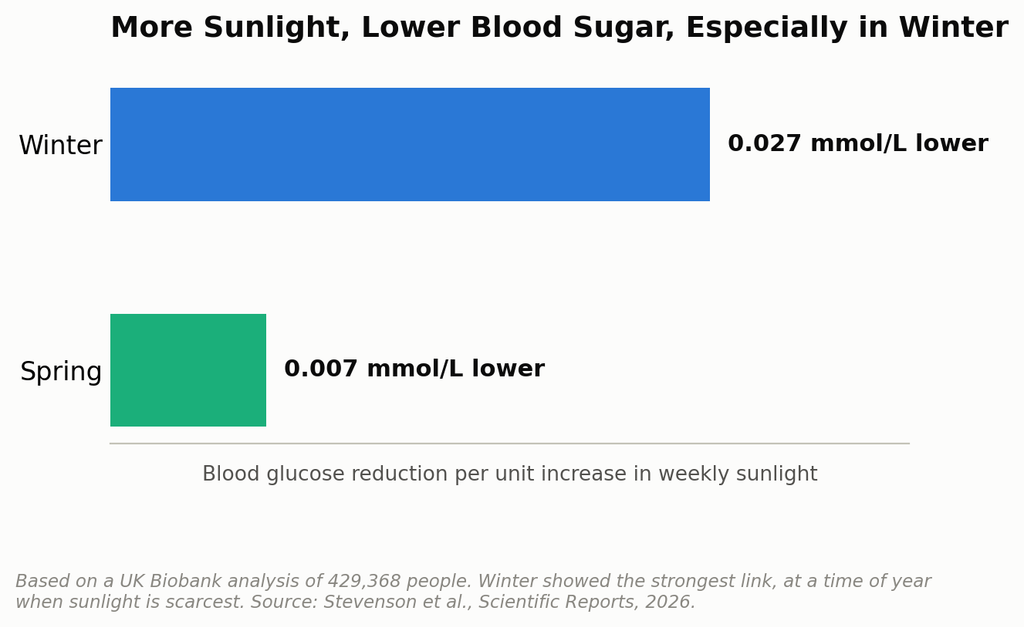
Winter showed the strongest relationship between sunlight and lower blood glucose.
In winter, a small increase in the week’s average sunlight lined up with meaningfully lower blood sugar. The effect was smaller, though still present, in spring. The pattern was not a straight line either. The biggest improvements showed up when people went from very little sunlight to a modest amount, then leveled off from there, meaning you likely do not need hours of full sun to see a benefit.
The Long Term Picture
The researchers also looked at habits over a lifetime, tracking whether people reported using a sunlamp or solarium occasionally or frequently, as a general marker of how much someone tends to seek out sunlight. Following 408,531 people over an average of decades, they recorded 16,971 new diagnoses of type 2 diabetes.
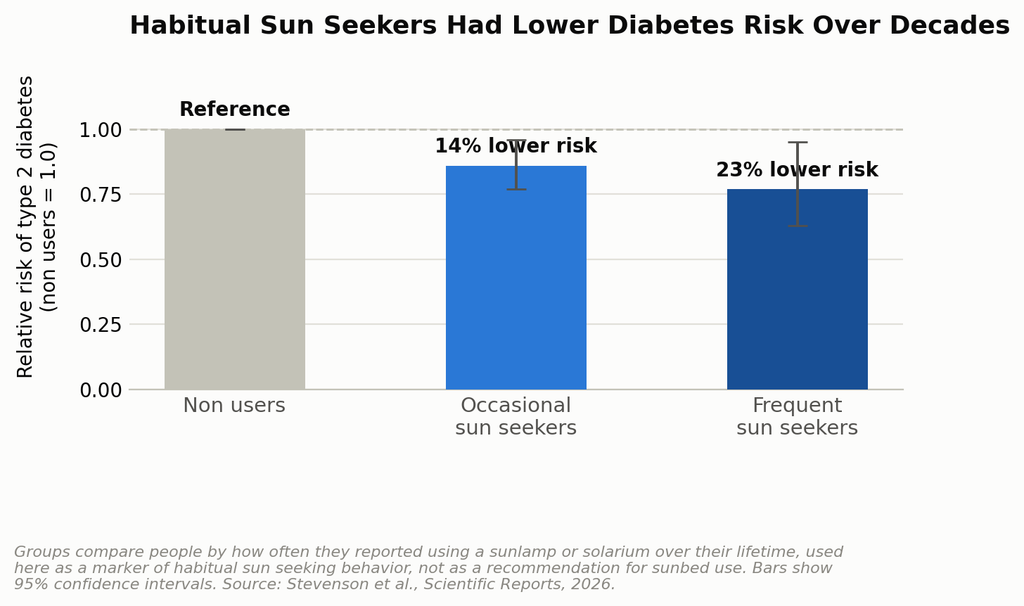
People with more habitual sun exposure had a meaningfully lower rate of type 2 diabetes over time.
Compared to people who rarely sought out sunlight, occasional sun seekers had about 14% lower diabetes risk, and frequent sun seekers had about 23% lower risk. To be clear, the researchers are not recommending sunbeds or tanning as a health strategy. They used this history simply as one available way to estimate lifelong sun seeking behavior, and they were careful to note that sunbed use itself carries well established skin cancer risks, including melanoma.
Why Sunlight Might Matter
Scientists do not yet have a full explanation, but they point to a few likely pieces. One is nitric oxide, a compound released from the skin after sun exposure that widens blood vessels and may improve how the body uses insulin. Interestingly, the winter effect held up even though winter sunlight in the UK is usually too weak to trigger much vitamin D production, suggesting something beyond vitamin D may be at play. Researchers also mentioned that certain light wavelengths may influence energy production inside cells, though this remains an active area of study.
What This Means if You Are Retired
Your daily outdoor time already counts. A walk around the block, time spent gardening, or sitting outside while reading the paper are exactly the kinds of everyday, modest sun exposure this study points to. You do not need to sunbathe for hours, and the research suggests you would not gain much more benefit even if you tried.
Be sensible about how you get it. Skin gets thinner and more sensitive to sun damage with age, and skin cancer risk rises the longer you have lived. A short daily walk in the morning or late afternoon sun, a wide brimmed hat, and sunscreen on your face and hands for anything beyond a brief outing is a reasonable way to get outside without unnecessary risk.
This does not replace your diabetes care. If you manage type 2 diabetes or prediabetes, sunlight is not a substitute for medication, diet, or your doctor’s guidance. Think of it as one more small habit that may work alongside the plan you already have, not a reason to change it on your own.
Ask your doctor if you take medications that affect sun sensitivity. Some common prescriptions increase sensitivity to sunlight. If you are unsure whether yours does, it is worth a quick check with your doctor or pharmacist before spending more time outdoors.
A Few Honest Caveats
This is an observational study, which means it can show a strong pattern without proving that sunlight alone causes lower blood sugar. People who spend more time outdoors may also be more active or have other healthy habits that the study could not fully separate out. The sunlight measurements were based on regional satellite estimates rather than exactly how much sun each person personally received, and the long term diabetes analysis focused on White European participants, so the results may not apply equally to everyone. The study’s own authors say the next step is clinical research to identify what a safe, effective amount of sunlight actually looks like.
None of that erases the finding. It simply means this is an encouraging early clue, not a prescription. For now, the best takeaway may be the simplest one: the walk you already enjoy, the garden you already tend, and the porch you already sit on may be doing a little more for you than you realized.
This article is educational and general in nature, based on a single published study. It is not medical advice, and it does not replace guidance from your doctor, especially regarding diabetes management, medication, or sun exposure and skin cancer risk. Always speak with a healthcare provider before making changes based on new research.
Source: Stevenson, A.C., Weller, R.B., Lindqvist, P., and Dibben, C. “Sunlight exposure is associated with lower blood glucose levels and type 2 diabetes.” Scientific Reports, 2026. https://www.nature.com/articles/s41598-026-66100-4