If you start your morning with a game of solitaire or end the day with a word puzzle on your phone, you have plenty of company. Here is what the research says games can and can’t do for your brain after 50, and how to make the most of the time you spend playing.
Dorothy is 71. Every morning she plays two games of solitaire with her coffee, and most evenings she does a word puzzle before bed. After her husband died, those games filled the quiet hours. Now her daughter keeps sending her articles about “brain training” and asking whether her games are keeping her sharp.
It’s a fair question, and the honest answer has two parts. Games can do real good for your mood and your day. On their own, though, they are not a proven shield against memory loss.
Key takeaways
- About half of adults 50 and older play video games, most often word, puzzle, card and tile games on a phone.
- Most older players say games help them relax, ease stress, cope with hard times and keep their minds sharp.
- There is little proof that games alone prevent memory loss. The strongest evidence is for one kind of speed training tested in a large study.
- Games work best as one part of a brain-healthy routine that also includes exercise, sleep, time with people and learning new things.
Who is playing, and why
A new AARP survey of more than 1,000 gamers over 50, published in October 2026, found that about half of adults 50 and older play video games. That’s an estimated 60 million people playing every month, up from about 52 million in 2023.
Most of them play on a smartphone, usually for 15 minutes to an hour at a time. Word, puzzle, card and tile games are the favorites. And the reasons people give are about how they feel as much as how they think:
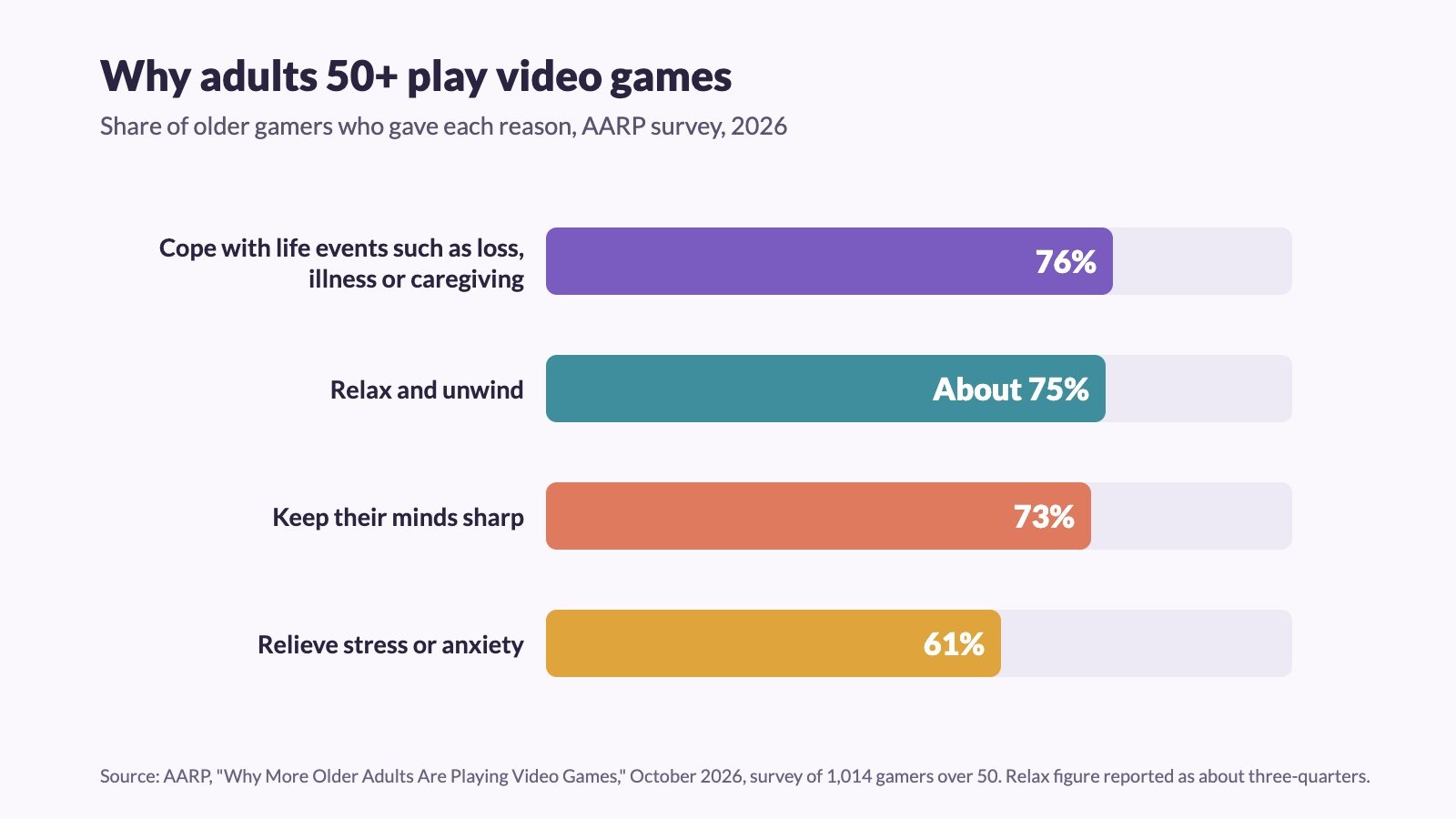
Players also told AARP what bothers them: ads, pressure to buy add-ons to keep going, games that are too complicated, and design that seems to forget older players exist.
What games can do for you
- Lift your mood and ease stress. A few relaxing minutes can reset a tense day.
- Help you through hard times. Three in four older players said games help them cope with loss, illness, caregiving or a big life change.
- Give your day a rhythm. A morning puzzle or an evening card game can anchor a routine after work ends.
- Keep you connected. A bingo game with friends or a word game with a grandchild turns playing into time together.
- Keep you practiced at the game itself. You will get better at solitaire by playing solitaire. Whether that carries over to the rest of life is the open question.
What the science says about memory
This is where the claims and the evidence part ways.
The best-known study is ACTIVE, which followed 2,802 healthy older adults for ten years. People were assigned to memory training, reasoning training, a computer-based speed-of-processing exercise, or no training. Those who did the speed training had about a 29% lower risk of developing dementia over the decade. The memory and reasoning groups did not show that benefit.
That result is encouraging, but it was one specific exercise, done in sessions with booster training, and it hasn’t been shown for everyday games. The National Institute on Aging cautions that there isn’t enough evidence that commercial brain-training apps have the same effect.
Others have been blunter. In 2016, the maker of the Lumosity app paid $2 million to settle Federal Trade Commission charges that it advertised benefits for memory and aging it couldn’t prove. And AARP’s own Global Council on Brain Health concluded that the evidence for long-term brain benefits from “brain games” is weak, while broader mentally engaging activities look more promising.
So play because you enjoy it. Be wary of any game or app that promises to prevent memory loss.
What does protect your brain
A 2024 report from the Lancet Commission on dementia estimated that close to half of dementia cases might be prevented or delayed by addressing 14 risk factors over a lifetime. Several are within reach in your 50s, 60s and beyond:
- Move your body. Regular physical activity is one of the most consistent recommendations.
- Manage blood pressure and cholesterol. What’s good for your heart is good for your brain.
- Treat hearing and vision loss. Hearing aids and eye care help keep you engaged with the world.
- Stay connected. Social isolation is a risk factor; friends, family, clubs and volunteering all count.
- Keep learning. New skills, classes, languages and hobbies challenge the brain in fresh ways.
- Limit alcohol and sleep well. Heavy drinking is one of the 14 risk factors, and good sleep helps you think clearly day to day.
How to make game time count
- Mix it up. Rotate between words, cards, numbers and patterns rather than playing one game for hours.
- Raise the challenge. When a game feels easy, try a harder level or something new.
- Play with someone. Invite a friend to a bingo game or race a grandchild to finish a puzzle.
- Move between rounds. Take a short walk or stretch between games.
- Choose games that respect you. Skip apps that push you to pay to keep playing or promise medical benefits.
- Notice how you feel. If you play to avoid people or feel worse after hours on a screen, that’s worth paying attention to.
Free games on RetireNerd
RetireNerd’s Brain Breaks are free to play in your web browser, with no sign-up and nothing to buy. They are built for phones and large, readable text.
| Game | What you’ll do |
|---|---|
| Word Cascade | Connect letters to build words and clear the board |
| Solitaire | Classic Klondike with large cards, hints and undo |
| Bingo | 75-ball bingo on your own or in a live room with family and friends |
| Golden Getaway | Match colorful travel treasures across a 24-level trail |
| Memory Match | Turn over tiles and remember where the pairs are |
| Pattern Quest | Solve five changing visual puzzles |
| Number Sequence | Find the rule behind five number patterns |
| Four in a Row | Plan ahead to connect four before the computer does |
See them all on the Brain Breaks page.
Frequently asked questions
Do brain games prevent dementia?
There’s no good evidence that everyday games prevent dementia. One specific speed-training exercise was linked to lower risk in a large study, but that hasn’t been shown for commercial games or apps.
Is it bad to play for hours a day?
Not if you enjoy it and it doesn’t crowd out sleep, movement and time with people. If games become a way to avoid everything else, try setting a time limit.
Are games good for someone with memory problems?
Many people with memory changes enjoy simple, familiar games, and they can be a pleasant activity to share. They are not a treatment, so talk with a doctor about any memory concerns.
Which game is best for my brain?
The one you enjoy enough to keep playing, especially if it challenges you and you play it with others. Variety matters more than any single game.
Your next step
This week, try one game you have never played, invite someone to play with you, and add a 10-minute walk to your game time. That combination of something new, someone else and some movement does more than any single game can.
Dorothy still plays her morning solitaire. She also joined her neighbor’s weekly bingo night, and the two of them now walk to the library afterward. Her daughter stopped sending articles.
Related reading: when health forces an early retirement and long-term care costs.
Educational note: This article is general education, not medical advice. Games are not tests or treatments for memory loss or dementia. If you or someone you love notices changes in memory or thinking, talk with a doctor. Dorothy is an illustrative example.
Sources
- AARP: Why more older adults are playing video games (October 2026)
- National Institute on Aging: Cognitive health and older adults
- Penn State: Digital training program reduces risk of dementia among older adults (ACTIVE study, 2017)
- Federal Trade Commission: Lumosity to pay $2 million to settle deceptive advertising charges (2016)
- AARP Global Council on Brain Health: Cognitively stimulating activities
- UCL: Nearly half of dementia cases could be prevented or delayed by tackling 14 risk factors (2024 Lancet Commission)