

Most people will need help with daily care at some point, and Medicare pays for very little of it. Here is what long-term care costs, what Medicare and Medicaid cover, and the ways families pay.
Carol was 79 when she fell and broke her hip. After three days in the hospital, she moved to a rehab center, and Medicare covered it, with a daily copay after the first 20 days. Her daughter, Anne, felt relieved.
Five weeks later, the rehab center called. Carol was stable but had stopped improving, so Medicare would stop paying. She still couldn’t bathe or dress on her own. Coming home meant hiring an aide, and at about $35 an hour, a few hours a day added up to more than Carol’s Social Security check.
Anne had just learned what most families learn in a crisis: Medicare pays for getting better, not for help with daily living. That help, called long-term care, is one of the biggest costs in retirement, and most of it is paid out of pocket or by Medicaid.
Key takeaways
- Someone turning 65 today has almost a 70% chance of needing some long-term care, and about one in five will need it for more than five years.
- In 2025 a home health aide cost a median $35 an hour, and a semi-private nursing home room cost about $115,000 a year.
- Medicare covers short skilled care after a hospital stay, but not ongoing help with bathing, dressing or eating.
- Medicaid pays for long-term care only after most savings are spent, and it reviews gifts made in the five years before you apply.
What long-term care means
Long-term care is help with everyday tasks when an illness, an injury, frailty or memory loss makes them hard to do alone. Planners call the core tasks “activities of daily living”: bathing, dressing, eating, using the toilet, moving from a bed to a chair, and continence.
Most of this help is custodial care, not medical care. It can happen at home, in adult day programs, in assisted living, or in a nursing home. That distinction matters, because it decides who pays.
How likely you are to need it
According to the federal Administration for Community Living, someone turning 65 today has almost a 70% chance of needing some type of long-term care. Women need it for about 3.7 years on average, and men for about 2.2 years.
The range is wide. About one-third of 65-year-olds may never need it, while about 20% will need it for more than five years. Most care happens at home, often from family, before any move to a facility.
What long-term care costs
These are national medians from the CareScout 2025 Cost of Care Survey, released in March 2026. Prices in your area can be much higher or lower.
| Type of care | Median price | Per year |
|---|---|---|
| Adult day health care | $95 a day | $24,700 (5 days a week) |
| Home health aide | $35 an hour | $80,080 (44 hours a week) |
| Assisted living (one bedroom) | $6,200 a month | $74,400 |
| Nursing home (semi-private room) | $315 a day | $114,975 |
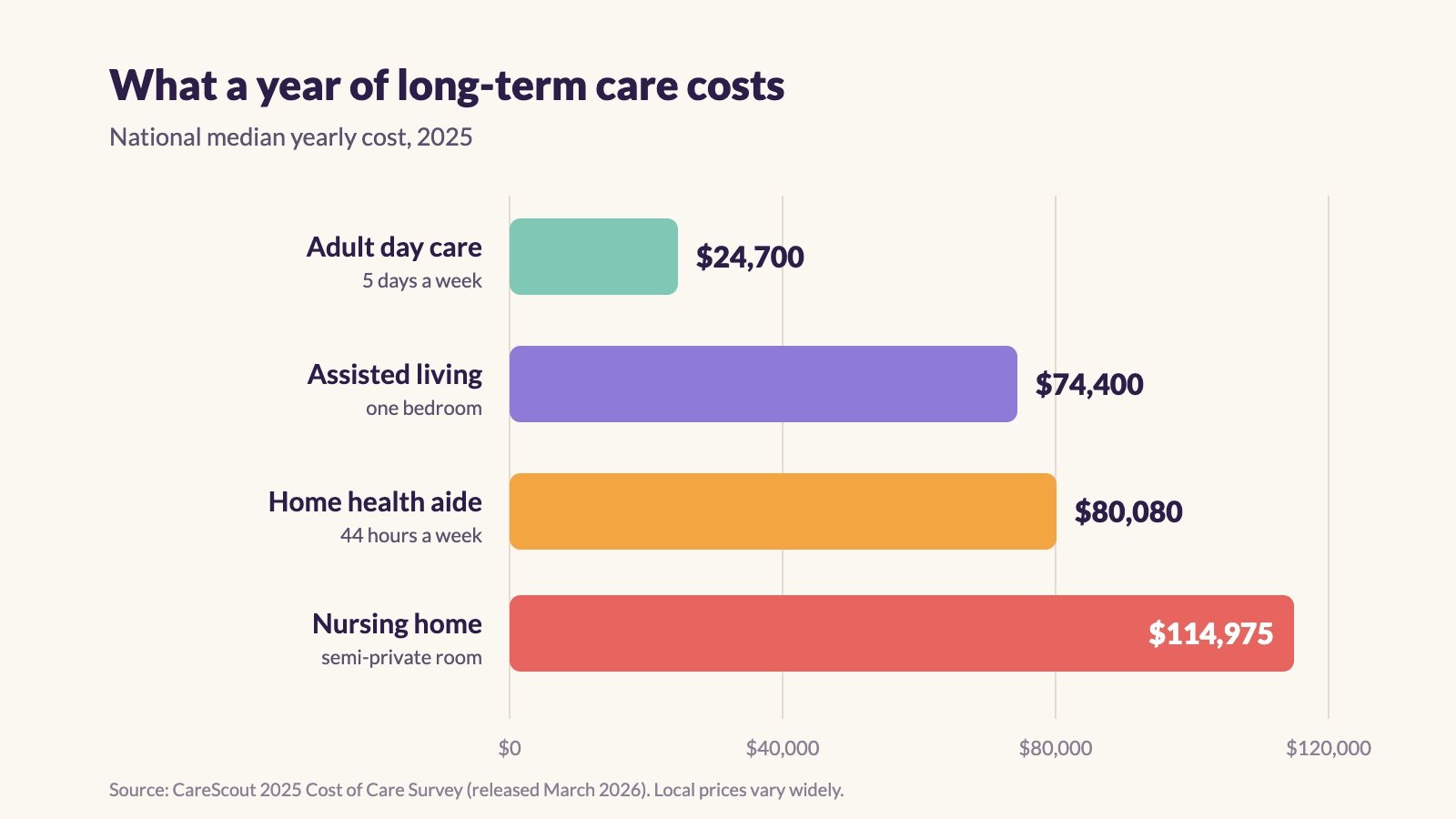
Home care looks cheaper by the hour, but the bill grows with the hours. Someone who needs help around the clock at home can easily pay more than a nursing home.
What Medicare covers, and what it doesn’t
Medicare pays for care that helps you recover. It does not pay for custodial care when that is the only care you need.
- Skilled nursing facility care: covered after a hospital stay of at least three days as an admitted inpatient, for up to 100 days, and only while you need daily skilled care. In 2026, days 1 to 20 cost $0 and days 21 to 100 cost $217 a day. After day 100, you pay everything.
- Home health care: part-time skilled nursing or therapy at home if you are homebound. Aide help is covered only alongside that skilled care.
- Hospice: comfort care for a terminal illness, at home or in a facility. See how hospice works with Medicare.
- Not covered: ongoing help with bathing, dressing and eating, and the room and board in assisted living.
That is what happened to Carol. Her rehab stopped being “skilled” once she stopped improving, even though she still needed help every day. Some Medicare Advantage plans offer small extra benefits, such as a few hours of in-home help, but none pays for long-term care in a big way.
How Medicaid pays for long-term care
Medicaid is the largest public payer of long-term care in the country. It covers nursing homes, and every state also pays for some care at home or in the community. But Medicaid is for people with limited income and savings, and the rules are strict.
- Spend-down: in many states, a single person can keep only a few thousand dollars in countable savings. Your home, one car and personal belongings usually don’t count, within limits.
- The five-year look-back: Medicaid reviews gifts and below-value sales from the 60 months before you apply. Giving money or the house to your children during that window can delay coverage for months or years.
- Protection for a spouse: when one spouse needs nursing home care, the spouse at home can keep part of the couple’s savings (up to $162,660 in 2026, depending on the state) and some of the income.
- Estate recovery: after a Medicaid recipient 55 or older dies, the state must seek repayment for long-term care from the estate, which can include the home. It can’t recover while a surviving spouse is alive, or if there is a child under 21 or a child who is blind or disabled.
- Waiting lists: help at home often comes through state programs called waivers, and many have waiting lists.
Medicaid planning is legal, but the rules differ a lot from state to state. An elder law attorney can explain yours.
The main ways families pay
| Option | How it works | Watch for |
|---|---|---|
| Your own savings and income | Set aside part of your portfolio, or plan to use home equity, for care. | A long stay can drain savings meant for a spouse. |
| Traditional long-term care insurance | Pays a daily or monthly amount for care once you need help with two daily activities or have severe memory loss, such as from dementia. | Premiums can rise later, and if you never need care, you get nothing back. |
| Hybrid life or annuity policy | Life insurance or an annuity with a long-term care benefit. If you don’t use the care benefit, the policy still leaves money to your heirs. | Usually needs a large single payment or set yearly payments, and offers less care coverage per dollar. |
| Medicaid | Pays once income and savings fall below your state’s limits. | Limits your choice of facilities and requires spending down. |
| Veterans benefits | Some veterans and surviving spouses qualify for VA care or a monthly pension add-on for help at home. | Has service, income and asset rules. |
Insurance prices vary a lot. In one 2026 example from the American Association for Long-Term Care Insurance, a couple, both 60, got quotes from about $4,591 to $7,173 a year for the same coverage, depending on the insurer. Health matters too: the older you are when you apply, the higher the price and the greater the chance of being turned down.
Two tax points. Part of a qualified long-term care insurance premium can count as a deductible medical expense, up to a yearly limit that rises with age. And you can use health savings account (HSA) money to pay those premiums, up to the same limit. Many states also offer “partnership” policies, which let you keep more savings if you later need Medicaid.
Make a plan while you are healthy
- Talk about wishes. Where would you want care: at home, near family, or in a community? Who could help, and for how long?
- Price care where you live. Look up local costs for an aide, assisted living and a nursing home, then compare them with your income and savings.
- Choose your approach. Self-fund, insure, or blend the two. If you are considering insurance, get quotes in your 50s or early 60s, before health issues make it harder.
- Sign your documents. A power of attorney and a health care directive let someone you trust act if you can’t. Our estate planning basics guide explains both.
Frequently asked questions
Does Medicare pay for assisted living?
No. Medicare may cover doctor visits and medical services you receive while living there, but not the rent, meals or personal care. Some state Medicaid programs help pay for the care part.
Can I give my house to my children so Medicaid will pay?
Gifts made within five years of applying can delay Medicaid coverage, and the gift can create tax problems for your children. A few transfers are allowed, such as to a spouse, so talk to an elder law attorney before moving any property.
When should I think about long-term care insurance?
Many people look at it in their 50s or early 60s, when prices are lower and health is usually better. It tends to fit people with enough savings to protect but not enough to pay for years of care comfortably.
What if I can’t afford insurance?
You still have choices. Plan to use home equity, keep a care fund within your savings, learn your state’s Medicaid rules early, and line up family help. Local Area Agencies on Aging can point you to programs near you.
Your next step
This week, look up what an aide and a nursing home cost in your area, and write those two numbers next to your monthly income. That one page tells you how big your gap would be and whether to explore insurance, a care fund, or both.
Anne did this for her own retirement after her mother’s fall. Carol now has an aide four mornings a week, paid partly from her savings, and Anne has a plan for herself.
Related reading: a family plan for aging in place, how caring for an aging parent can affect your retirement, and what Medicare does not cover.
Educational note: This article is general education, not financial, legal, tax or insurance advice. Costs are national medians from the CareScout 2025 survey, and Medicare figures are for 2026. Medicaid eligibility, look-back rules, spousal protections and estate recovery vary by state. Carol and Anne are an illustrative example. An elder law attorney, a licensed insurance professional or a financial planner can help you build a plan for your situation.
Sources
- Administration for Community Living: How much care will you need?
- Administration for Community Living: Medicaid and long-term care
- Medicare.gov: Skilled nursing facility care
- CMS: 2026 Medicare Parts A and B premiums and deductibles
- HHS: 2026 SSI and spousal impoverishment standards
- Social Security POMS SI 01730.046: Transfer of assets for Medicaid purposes
- CareScout: 2025 Cost of Care Survey results
- American Association for Long-Term Care Insurance: 2026 price study
