

A few signed pages decide who can pay your bills, who speaks to your doctors, and who receives what you leave behind. Here are the estate planning basics: the four documents you need and the mistakes that undo them.
Linda was 66 when her husband, Tom, had a stroke. He survived, but for months he couldn’t talk or sign his name.
The bills kept coming. Tom’s IRA, his pension deposits and the car were in his name alone. Linda was his wife of 40 years, yet the bank and the IRA company couldn’t let her act for him. Tom had never signed a power of attorney.
Linda had to ask a court to appoint her as Tom’s conservator. It took months, it cost thousands in legal fees, and she now files reports with the court. One form, signed while Tom was healthy, would have avoided all of it.
Estate planning sounds like something for the wealthy. It isn’t. It is a short set of documents that protect you while you are alive and make life easier for your family when you are gone. Only about one in three American adults has a will, according to a 2024 Caring.com survey, and fewer have the other three documents.
Key takeaways
- Most people need four things: a will, a financial power of attorney, a health care directive and up-to-date beneficiary forms.
- Beneficiary forms on retirement accounts and life insurance override your will, so an old form can send money to the wrong person.
- Without a power of attorney, even a spouse may need a court order to manage your accounts if you can’t.
- In 2026, federal estate tax applies only to estates over $15 million per person, though 12 states and Washington, D.C. have their own estate tax.
The four documents most people need
| Document | What it does | Without it |
|---|---|---|
| Will | Says who gets property in your name alone and who settles your estate. Can name a guardian for minor children. | State law decides who inherits, and a court picks the person in charge. |
| Durable financial power of attorney | Lets someone you choose pay bills, file taxes and manage accounts if you can’t. | Family may need a court to appoint a guardian or conservator. |
| Health care directive | Names a health care agent (also called a proxy) and records the treatment you want or don’t want. | State law decides who speaks for you, and family may disagree. |
| Beneficiary designations | Name who receives each IRA, 401(k), life insurance policy and payable-on-death account. | The money may go through probate, or to someone you no longer intended. |
A few terms, in plain English. Probate is the court process that checks a will, pays final bills and hands out what’s left. Durable means the power of attorney keeps working after you lose the ability to decide, which is exactly when your family needs it. A health care directive usually combines a living will (your treatment wishes) and a health care power of attorney (the person who decides).
Your will doesn’t control most of your money
This surprises a lot of people. For many retirees, the biggest assets pass outside the will:
- Retirement accounts and life insurance go to whoever is named on the beneficiary form.
- Joint accounts and a jointly owned home usually pass straight to the surviving owner.
- Bank and brokerage accounts with a payable-on-death or transfer-on-death name go to that person.
- Anything in a living trust follows the trust’s instructions.
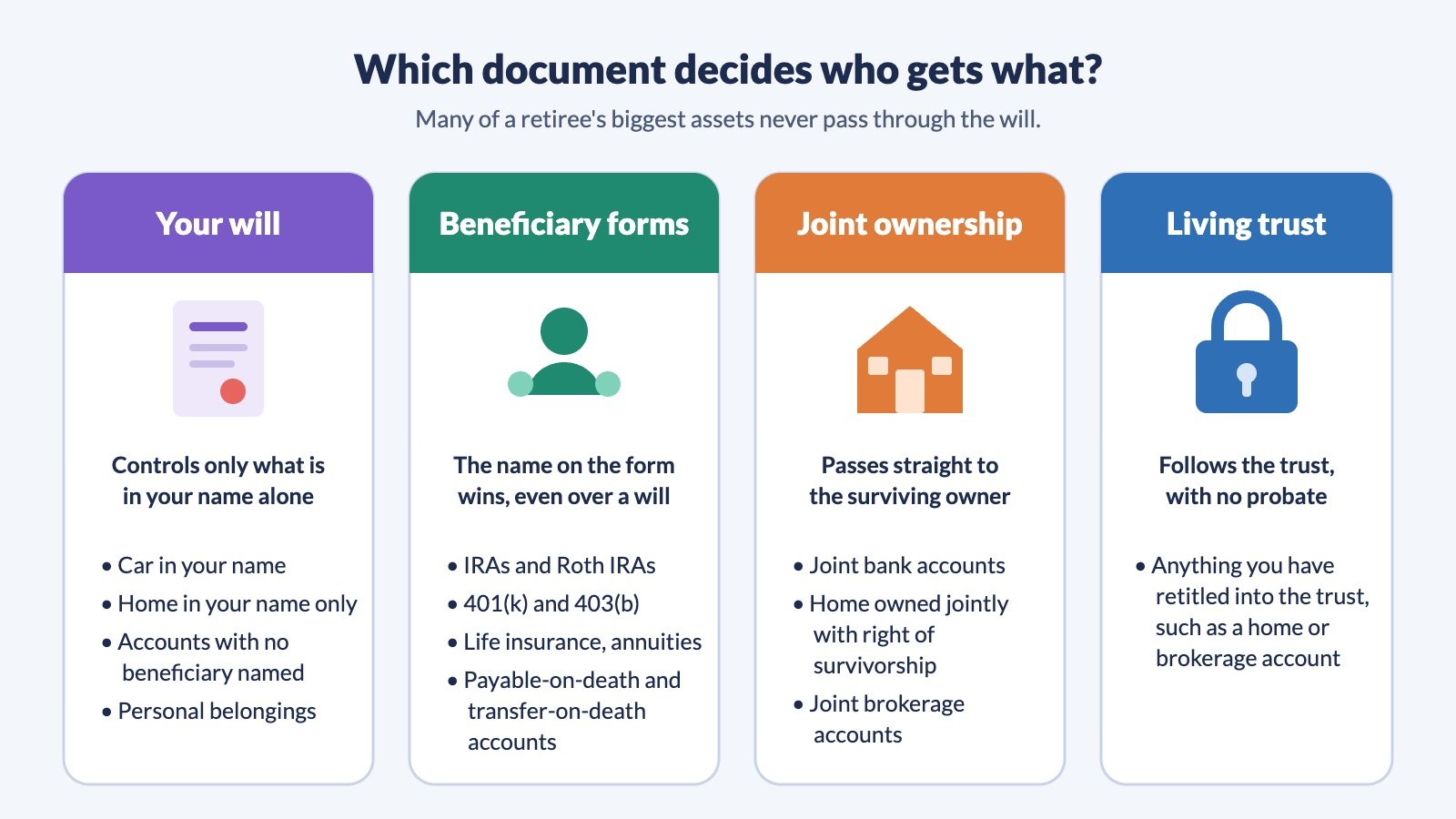
The danger is an old form. In a 2009 case, the U.S. Supreme Court ruled that a man’s retirement plan had to pay his ex-wife, because her name was still on his beneficiary form. She had given up her claim in their divorce decree, but the plan followed its form. His estate, run by his daughter, lost.
Two more rules worth knowing. If you are married, federal law generally makes your spouse the beneficiary of your 401(k), and naming anyone else takes your spouse’s signed, witnessed consent. And many forms ask for a contingent beneficiary, the backup if your first choice dies before you. Fill that line in too.
Do you need a living trust?
A revocable living trust holds your property while you are alive and passes it on without probate when you die. You stay in control and can change it at any time. It costs more to set up than a will, and it only works for property you actually retitle into the trust.
A trust is often worth a conversation with an estate attorney if you:
- Own real estate in more than one state, which can mean probate in each state
- Have a blended family and want to provide for a spouse while protecting your children’s share
- Want to leave money to a minor, a family member with a disability, or someone who shouldn’t get it all at once
- Live in a state where probate is slow or expensive, or simply value privacy, since probate records are public
If none of those fit, a will plus good beneficiary forms often does the job. Many states also allow a transfer-on-death deed, which passes a home to a named person without probate.
Will your heirs owe estate tax?
Almost certainly not at the federal level. In 2026, the federal estate tax applies only to estates worth more than $15 million per person. A married couple can usually shelter twice that.
State taxes are a different story. Twelve states and Washington, D.C. charge their own estate tax, some starting near $1 million. Five states (Kentucky, Maryland, Nebraska, New Jersey and Pennsylvania) charge an inheritance tax that the heirs pay, usually with lower rates or none for spouses and children. If you live in one of these states, ask a local attorney how it applies to you.
Gifts during life are simpler than most people think. In 2026 you can give up to $19,000 to any one person without filing a gift tax return.
Your one-afternoon checklist
- Log in and check every beneficiary form. IRAs, 401(k)s, 403(b)s, pensions, life insurance, annuities, and bank accounts. Add contingent beneficiaries.
- Choose your people. Pick a financial agent, a health care agent and an executor, plus a backup for each. Then ask them, so nobody is surprised.
- Get the health care forms. Most states offer advance directive forms for free, and you don’t need a lawyer to complete them. Give copies to your agent and your doctor.
- Sign a durable financial power of attorney. Many states have a standard form. Ask your bank and brokerage whether they want their own form as well.
- Make or update your will. Follow your state’s signing rules exactly, usually with witnesses, or the will may not count.
- Write a one-page “where things are” list. Accounts, policies, the safe deposit box, how to reach your advisor, and how to get into your phone and computer. Tell your executor where to find it.
Review everything every three to five years, and right away after a marriage, divorce, death, move to another state or new diagnosis. The National Institute on Aging suggests reviewing health care directives once a year.
Frequently asked questions
Do I need a lawyer?
Not always. Free state forms work for many health care directives and powers of attorney, and a simple will can be enough for a simple estate. A lawyer is worth it for a blended family, a business, property in several states, a family member with special needs, or a large estate in a state with estate tax.
What happens if I die without a will?
Your state’s inheritance law decides who gets anything in your name alone, usually a spouse and children first. A court appoints someone to handle the estate. Accounts with beneficiaries still pass to the people named.
Can my spouse use my accounts if I’m too sick to decide?
Usually only joint accounts. Accounts in your name alone, including every IRA and 401(k), need a power of attorney or a court order. That is why both spouses should sign one.
Does divorce remove my ex from my beneficiary forms?
Don’t count on it. Some state laws cancel an ex-spouse’s designation automatically, but workplace plans like 401(k)s follow the form on file. Change the forms yourself after a divorce.
Your next step
Start with the step that takes 20 minutes: log in to each retirement account and insurance policy and read the beneficiary names out loud. If any name surprises you, fix it today.
Linda did that after Tom recovered enough to sign. They both have powers of attorney now, and Tom’s IRA form finally names a backup: their son.
Related reading: how to organize an aging parent’s financial documents, what happens to your portfolio when one spouse dies, the 10-year rule for inherited IRAs, and what long-term care costs and who pays.
Educational note: This article is general education, not legal, tax or financial advice. Estate law, document requirements and state taxes vary by state and change over time. Linda and Tom are an illustrative example. An estate planning attorney in your state can tell you which documents fit your family and help you sign them correctly.
Sources
- IRS: What’s new, estate and gift tax
- U.S. Department of Labor: FAQs about retirement plans and ERISA
- National Institute on Aging: Advance directives for health care
- National Institute on Aging: Getting your affairs in order checklist
- Consumer Financial Protection Bureau: Help for agents under a power of attorney
- Kennedy v. Plan Administrator for DuPont Savings and Investment Plan, 555 U.S. 285 (2009)
- Caring.com: 2024 Wills and Estate Planning Study
