
For many retirees, the house is the biggest thing they own. Here is how to compare selling and moving somewhere smaller with taking a reverse mortgage and staying put, including the costs and the rules that surprise people.
Carol is 70 and Jim is 72. Their house is paid off and worth about $450,000. Their Social Security and savings cover the basics, but every year there is a new roof, a bigger tax bill or a repair they hadn’t planned for.
Their daughter says sell and move closer to her. A TV ad says they can stay in the home they love and get cash from it. Both ideas use the same thing, their home equity, in very different ways.
Key takeaways
- Downsizing turns home equity into cash and can lower your monthly costs, but selling and moving usually cost several percent of the price.
- A reverse mortgage lets homeowners 62 and older borrow against the home with no monthly loan payment, while the balance grows over time.
- With a reverse mortgage you must keep living in the home and keep paying property taxes, insurance and repairs.
- Neither choice is right for everyone. A free session with a HUD-approved housing counselor is required before a reverse mortgage and helpful either way.
Three ways to use your home in retirement
| Option | What happens | Best fit when |
|---|---|---|
| Downsize | Sell the house, buy or rent something smaller, keep the difference | You are open to moving and want lower upkeep and costs |
| Reverse mortgage | Borrow against the home and keep living there with no monthly loan payment | You plan to stay many years and can keep up taxes, insurance and repairs |
| Stay as you are | Keep the house and the equity for later or for heirs | Your income covers the costs and you want to keep options open |
Downsizing: what you really keep
Selling a $450,000 house doesn’t put $450,000 in your pocket. Agent fees, closing costs, repairs before the sale and moving often add up to somewhere between 6% and 10% of the price.
Here is what downsizing could look like for Carol and Jim:
| Step | Amount |
|---|---|
| Sale price | $450,000 |
| Selling costs at about 8% | −$36,000 |
| Smaller condo near their daughter | −$280,000 |
| Moving costs | −$5,000 |
| Cash freed up | About $129,000 |
They would also pay less for property tax, insurance and upkeep, though condo fees can eat into that. Our guide to whether to move after retirement walks through those monthly costs.
Taxes on the sale are often smaller than people fear. If you owned and lived in the home for at least two of the last five years, you can usually exclude up to $250,000 of profit from tax, or $500,000 for a married couple filing jointly.
Reverse mortgage: how it works
Most reverse mortgages are Home Equity Conversion Mortgages, or HECMs, insured by the Federal Housing Administration (FHA). You must be 62 or older, live in the home as your main residence and have a lot of equity in it.
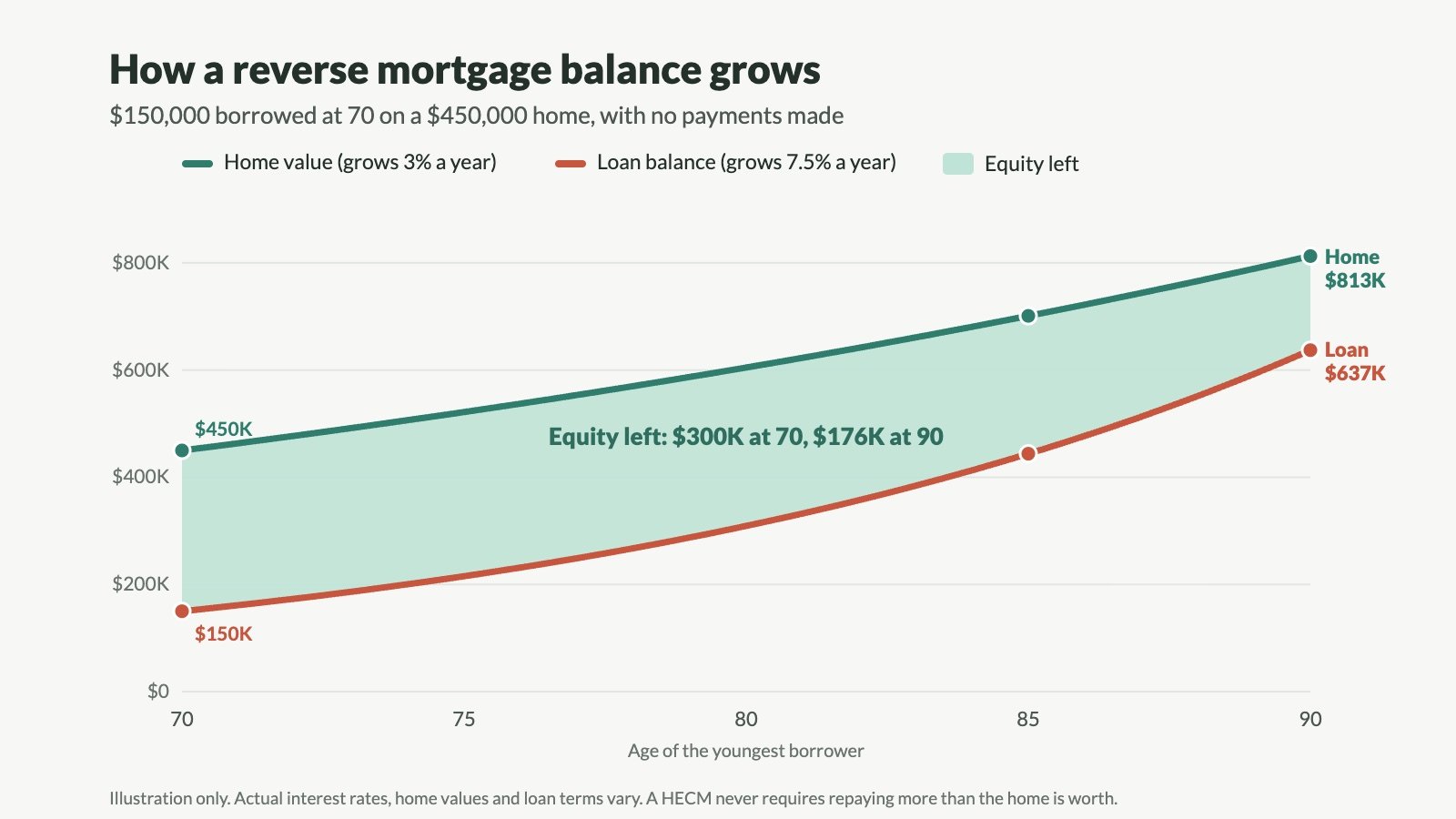
You borrow against the house but make no monthly loan payments. Instead, interest and fees are added to the balance every month, so what you owe grows over time. The loan is repaid when the last borrower dies, sells or moves out, usually by selling the home.
You can take the money in several ways:
- A line of credit you draw on when needed. The unused part of a HECM line of credit grows over time.
- Monthly payments for as long as you live in the home, or for a set number of years.
- A lump sum at closing.
- A mix of these.
How much you can borrow depends on the age of the youngest borrower, interest rates and the home’s value, up to a 2026 limit of $1,249,125. It is always well below the full value of the home, and older borrowers can get more.
What a reverse mortgage costs
The upfront costs are higher than a regular mortgage. For Carol and Jim’s $450,000 home:
| Cost | Amount |
|---|---|
| FHA mortgage insurance, 2% of the home’s value | $9,000 |
| Lender’s origination fee (capped at $6,000) | Up to $6,000 |
| Appraisal, title and other closing costs | Usually a few thousand more |
| Ongoing FHA insurance | 0.5% a year on the balance |
The bigger cost is time. Because interest compounds, a balance of $150,000 growing at about 7.5% a year roughly doubles in 10 years.
The protections, and the rules that catch people
A HECM is a non-recourse loan. You or your heirs will never owe more than the home is worth when it is sold. If the balance is higher, the FHA insurance you paid covers the difference.
But you can still lose the home if you don’t keep your end of the deal:
- Keep paying property taxes and homeowners insurance. Falling behind can lead to foreclosure.
- Keep the home in good repair.
- Keep living there. Moving out, including more than 12 months in a row in a nursing home or assisted living, can make the loan due.
Two more situations need care. If your spouse is younger than 62 and not on the loan, newer HECMs may let them stay in the home after you die, but they can’t draw more money. And when the loan comes due, heirs who want to keep the house must pay the full balance. If they sell, they never have to pay more than 95% of the home’s appraised value.
Before any HECM, you must meet with a HUD-approved housing counselor who is independent of the lender. Be wary of anyone who pushes a reverse mortgage to pay for home repairs or an investment. Our page on avoiding scams covers the warning signs.
Questions to answer before you choose
- Do we expect to stay in this home for at least the next 10 years?
- Can we keep paying property taxes, insurance and repairs as we age?
- Does the house still work for us if walking or stairs get harder?
- Do we want to leave the house, or its value, to our children?
- Would we rather live near family, or keep our neighbors and routines?
- Is our spouse younger than 62, and how would they be protected?
If you might need care later, our guide to long-term care costs explains why the home is often part of that plan.
Frequently asked questions
Is reverse mortgage money taxable?
No. The money is a loan, not income, so it isn’t taxed and doesn’t affect Social Security or Medicare. It can affect Medicaid or Supplemental Security Income (SSI) if you keep it in the bank past the month you receive it.
Can I use a reverse mortgage to buy a smaller home?
Yes. A HECM for Purchase lets people 62 and older buy a new main home with a large down payment and a reverse mortgage for the rest, with no monthly loan payment afterward.
Can I cancel a reverse mortgage after I sign?
Most reverse mortgages give you three business days after closing to cancel for any reason. Tell the lender in writing, ideally by certified mail.
Is downsizing always cheaper?
Not always. A newer home or a different area can bring higher property taxes, insurance or association fees. Compare the full monthly cost of each home, not just the price.
Your next step
Write down what you would get from each option: the cash from selling after costs, your new monthly costs, and what a reverse mortgage would offer at your age. Then book a free session with a HUD-approved housing counselor, even if you lean toward selling. They can walk through both choices with your own numbers.
Carol and Jim met with a counselor and decided to downsize. The condo is ten minutes from their daughter, the $129,000 went into savings, and they no longer worry about the roof.
Related reading: how to create a retirement paycheck and estate planning basics.
Educational note: This article is general education, not individualized financial, tax or legal advice. The figures are illustrations; home prices, selling costs, interest rates and reverse mortgage terms vary. Carol and Jim are an illustrative example. A HUD-approved housing counselor, a fee-only financial planner or an elder law attorney can help with your own situation.
Sources
- CFPB: What is a reverse mortgage?
- CFPB: With a reverse mortgage loan, can my heirs keep or sell my home after I die?
- CFPB: What happens if I have a reverse mortgage and have to move out?
- CFPB: Can anyone take out a reverse mortgage loan?
- HUD: FHA announces 2026 loan limits (HECM maximum claim amount)
- HUD: Mortgagee Letter 2017-12, HECM mortgage insurance premiums
- IRS: Topic no. 701, sale of your home
