

The $20,000 Purchase That Could Cost Your Retirement $174,000
A $20,000 withdrawal from your 401(k) can feel like a solution today. If that money could otherwise remain invested for 32 years and earn a hypothetical 7% a year, it could grow to about $174,000. The purchase costs $20,000. The retirement opportunity cost may be many times larger.
Workers tap retirement accounts for cars, down payments, remodeling, vacations and everyday bills. Some withdrawals answer a real emergency. Others happen because the account looks like available cash—especially after a job change. The tax bill is visible. The decades of lost compounding are much easier to miss.
The numbers in one minute
- 6% of participants initiated a hardship withdrawal in 2025, according to Vanguard’s How America Saves 2026 report.
- 28% of participants eligible for a distribution after leaving an employer took cash in 2025. Most assets were preserved because cash-outs were concentrated among smaller accounts.
- A pre-tax withdrawal generally creates ordinary taxable income. Before age 59½, it may also trigger a 10% additional federal tax unless an exception applies.
- A hardship distribution generally cannot be repaid or rolled over.
- The first-home exception to the 10% additional tax applies to IRAs, not to 401(k) plans.
Why raiding a 401(k) causes more damage than people expect
The obvious cost is the money removed. Three less-obvious costs can be larger.
1. Taxes and a possible penalty reduce what you can spend
Traditional 401(k) contributions usually went into the account before federal income tax. When you take a taxable distribution, it generally becomes ordinary income. If you are under 59½, a 10% additional federal tax may apply unless the distribution qualifies for an exception. State income tax may also apply.
Suppose a 45-year-old withdraws $20,000 and falls in the 22% federal marginal bracket. If the 10% additional tax applies, the federal cost could be about $6,400, leaving $13,600 before any state tax. This is an illustration; withholding and the final tax owed are not the same thing, and a withdrawal can affect credits, deductions and other income-based costs.
2. The money loses years of compounding
Compounding means future returns can earn returns of their own. Removing money early interrupts that process. At a hypothetical 7% annual return, $20,000 left invested for 32 years grows to about $174,000. At a hypothetical 4% return after inflation, the purchasing-power equivalent is about $70,000 in today’s dollars. Neither result is guaranteed, but both expose the scale of the decision.
3. You may miss contributions and employer matching money
A withdrawal sometimes leads a worker to reduce future contributions while rebuilding cash. A 401(k) loan can also compete with new contributions. If that causes you to miss an employer match, the cost grows again. Check your plan’s match formula, vesting schedule and loan rules before acting.
The $20,000 purchase that could cost $174,000
Imagine someone age 35 uses $20,000 from a 401(k) for a car, renovation or vacation. If the money remained invested until age 67 and earned 7% annually, it would be about $174,000. At an illustrative 4% first-year withdrawal, that balance could represent nearly $7,000 of gross retirement spending in the first year. A retirement-income plan would still need to account for market risk, inflation, taxes and longevity.
The right comparison is therefore not “Do I want the purchase more than $20,000?” It is “Do I want it more than the taxes, possible penalty, lost future balance and lower retirement income?”
Can you use a 401(k) for a house down payment?
A plan may permit a hardship distribution for costs directly related to buying a principal residence. That does not mean the distribution is tax-free, and it does not automatically remove the 10% additional tax. The federal first-time-homebuyer exception—up to a $10,000 lifetime limit—applies to IRAs, not distributions from qualified plans such as a 401(k).
A down payment can build home equity, so it is different from a vacation. But it can also leave a new homeowner with less retirement money and too little cash for repairs, closing costs and emergencies. Compare the complete housing payment and cash reserves after closing, not just whether the withdrawal makes the down payment possible.
What about home renovations, cars and vacations?
| Use | What is easy to miss | A better first question |
|---|---|---|
| Car | A depreciating asset replaces an account built for decades of growth | Can a less expensive vehicle or shorter savings period solve the need? |
| Ordinary remodel | A kitchen or cosmetic update generally is not the same as casualty repair for hardship purposes | Can the work be phased and paid from a renovation fund? |
| Vacation | The experience ends while taxes and lost growth remain | Can you postpone, shorten or save monthly before booking? |
| House down payment | A permitted hardship reason does not necessarily waive tax or penalty | Will you still have emergency cash and an affordable total payment? |
| Emergency bills | The math may be costly, but protecting health, housing or safety can take priority | What grants, payment plans, insurance benefits or lower-cost credit exist first? |
The job-change cash-out trap
Changing jobs turns a retirement account into a decision point. In Vanguard’s 2025 data, seven in ten separating participants preserved their savings by leaving the money in the former plan or rolling it to an IRA or a new employer plan. Yet 28% took cash. Because small accounts are cashed out much more often, 94% of the dollars available for distribution were still preserved.
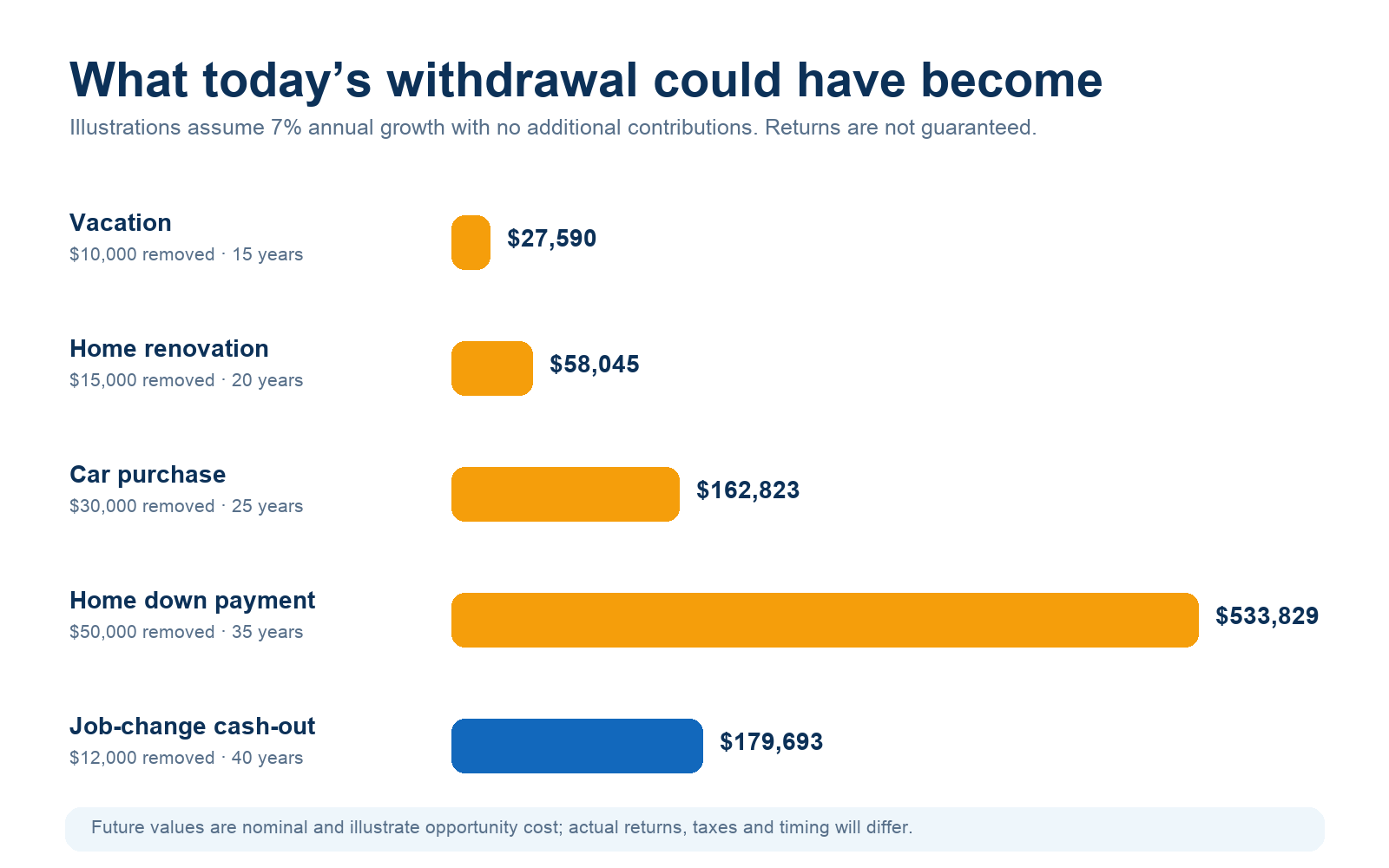
A $12,000 balance can look small beside moving costs or a period between paychecks. Left invested for 40 years at a hypothetical 7%, it could become about $180,000. Small-account cash-outs can be large retirement decisions.
- Leave it in the former plan if the plan permits it and its investments, fees and services remain competitive.
- Use a direct rollover to a new employer plan or IRA so the money moves from custodian to custodian.
- Avoid having the check paid to you unless you understand mandatory withholding, the 60-day rollover deadline and the amount you may need to replace from other cash.
- Do not assume an IRA is automatically better. Compare investment costs, advice fees, creditor protections, withdrawal rules and convenience.
Hardship withdrawal, 401(k) loan or ordinary distribution?
| Method | Main appeal | Main risk |
|---|---|---|
| Hardship withdrawal | No repayment schedule | Taxable, possibly subject to additional tax, permanently leaves the account and generally cannot be repaid |
| 401(k) loan | Repayments return to your account | Investment growth is interrupted; missed payments or job separation can create a taxable loan offset/distribution |
| Cash-out after job change | Immediate access to the balance | Taxes, possible additional tax and decades of lost compounding |
| Direct rollover | Preserves tax-deferred status | New account may have higher costs or weaker protections; compare first |
If a plan permits loans, federal rules generally cap borrowing at the lesser of $50,000 or 50% of the vested balance, subject to detailed exceptions and plan limits. Repayment is generally required within five years unless the loan is used to buy a principal residence. A loan is not free money: the balance is out of the market, repayments affect cash flow, and leaving the job can complicate repayment.
How many people actually pay the 10% penalty?
There is no clean, current national figure that answers that exact question. Plans and surveys can count withdrawals, but the 10% additional tax depends on age, account type and whether an IRS exception applies. It is calculated on a tax return, sometimes using Form 5329.
An IRS oversight audit found that 2.83 million taxpayers in tax year 2021 potentially had early retirement distributions without self-reporting the additional tax or an exception. That is a compliance finding—not proof that all owed a penalty, and not a count of people who properly paid it. The useful lesson is that early-distribution rules are easy to misunderstand. Confirm the treatment before withdrawing, rather than after the tax form arrives.
A decision test before touching retirement money
- Name the need. Is this health, safety, housing stability or optional consumption?
- Calculate spendable cash. Estimate income tax, possible 10% additional tax and state tax.
- Calculate opportunity cost. Use several reasonable return assumptions and the years until retirement.
- Check the plan document. Availability, proof requirements, loan terms and distribution choices vary.
- Protect the employer match. If cash flow is tight, try to preserve enough contribution to receive the full match.
- Compare alternatives. Emergency savings, a payment plan, insurance, a smaller purchase, delaying the project or temporarily reducing contributions above the match may cause less permanent harm.
- Plan the rebuild. If withdrawal is unavoidable, set a date and amount for restoring contributions.
When taking money can still be reasonable
Retirement math should not shame someone facing eviction, urgent medical treatment, domestic safety needs or another serious crisis. Money exists to support life. Sometimes a retirement withdrawal is the least damaging available choice.
The standard should be higher for discretionary spending. A car upgrade, vacation or cosmetic remodel should usually survive a full-cost comparison that includes taxes and lost growth. If the purchase works only by pretending the future cost is zero, it is probably too expensive.
How to keep the next expense out of your 401(k)
- Build a starter emergency reserve, then expand it toward several months of essential expenses.
- Create separate monthly savings buckets for vehicles, travel and home repairs.
- At a job change, decide where the 401(k) will go before the final paycheck.
- Keep beneficiary and contact information current so account administration does not become another obstacle.
- Review your retirement projection after any withdrawal and increase contributions when cash flow improves.
Vanguard found that workers with at least $2,000 in emergency savings were substantially less likely to use 401(k) loans, hardship withdrawals or cash out after leaving a job. The analysis shows an association, not proof that the emergency fund alone caused the difference, but the practical connection is clear: accessible cash gives retirement money a better chance to remain retirement money.
Continue with RetireNerd
- 401(k) for Beginners
- 401(k), RMD, Rollover and Roth Conversion Guide
- Retirement Savings Benchmarks
- Test the long-term effect in Compass
- Retirement Withdrawal Strategies
Sources
- Vanguard: How America Saves 2026
- Vanguard: Mitigating 401(k) leakage with emergency savings
- IRS: Hardships, early withdrawals and loans
- IRS: 401(k) hardship distributions—consider the consequences
- IRS: Exceptions to tax on early distributions
- IRS: Considering a loan from your 401(k) plan?
- Treasury Inspector General: Early retirement distribution compliance audit
This article provides general education, not individualized financial, investment, tax or legal advice. Tax treatment depends on the account, plan, age and facts. Illustrations assume steady returns; actual investment returns vary and may be negative. Review your plan documents and consult a qualified tax or financial professional when appropriate.