

A three-fund portfolio can own thousands of companies and bonds without asking you to predict the next winning stock, sector or country. The entire strategy fits into one sentence: own the broad U.S. stock market, the broad international stock market and a broad bond market—and keep them in percentages you can live with.
That sounds almost too simple. It is simple, but it is not automatic. You still have to choose how much risk to take, identify the right funds in your account, rebalance occasionally and stay invested when markets are uncomfortable. This guide explains the structure, its benefits and limitations, three sample allocations and how to build one inside a 401(k).
The three-fund portfolio in one minute
- Fund 1: Broad U.S. stocks for ownership across the American stock market.
- Fund 2: Broad international stocks for companies outside the United States.
- Fund 3: Broad investment-grade bonds to reduce volatility and provide a different source of return.
- You choose the percentages.
- You direct new contributions or rebalance periodically to restore those targets.
- The goal is broad diversification, low cost and a plan simple enough to follow.
What is a three-fund portfolio?
A three-fund portfolio is a minimalist investment strategy. The usual building blocks are a total U.S. stock-market index fund, a total international stock-market index fund and a total U.S. bond-market index fund. “Three” describes the asset classes more than a sacred fund count. A total-world stock fund plus a bond fund can express a similar idea with two funds; an incomplete 401(k) menu might require four funds to recreate the three broad exposures.
Each fund is a basket. A broad U.S. stock fund can hold large, midsize and small domestic companies. A broad international fund can hold developed and emerging-market companies. A broad bond fund commonly holds government, corporate and mortgage-backed debt. Mutual funds and ETFs can both fill these roles, although workplace plans usually offer mutual funds or collective investment trusts rather than exchange-traded funds.
The strategy does not promise safety or superior returns. Stocks can fall sharply, international markets can lag for long stretches, and bond funds can lose value when rates rise or credit conditions deteriorate. Diversification spreads risk; it does not remove it.
Why would someone choose three funds over a larger portfolio?
The appeal is not that three is a magical number. The appeal is that each fund has a clear job and together they cover a large part of the investable public market. You are less likely to build a collection of overlapping funds, chase last year’s winner or forget why you bought something.
- Broad diversification: one portfolio reaches across company sizes, industries and countries, plus many bond issuers.
- Easy maintenance: three target percentages are easier to monitor and rebalance than a dozen.
- Potentially low cost: broad index funds often have low expense ratios, although you must check the actual plan choices.
- Clear risk control: the bond percentage makes the major risk decision visible.
- Less temptation: a written allocation can reduce performance chasing and constant trading.
- Portability: the same asset-class plan can often be recreated with different fund brands in a new 401(k) or IRA.
Investor.gov explains that diversification means spreading money both among and within asset classes, while rebalancing restores a portfolio after markets move it away from its target. Those two ideas are the operating system of a three-fund portfolio.
Three example allocations
These examples show how the same three ingredients can create very different risk levels. They are illustrations, not recommendations for a particular age. Your time horizon, job security, pension, Social Security, emergency reserves, withdrawal needs and reaction to losses all matter.
Example 1: growth-oriented—90% stocks, 10% bonds
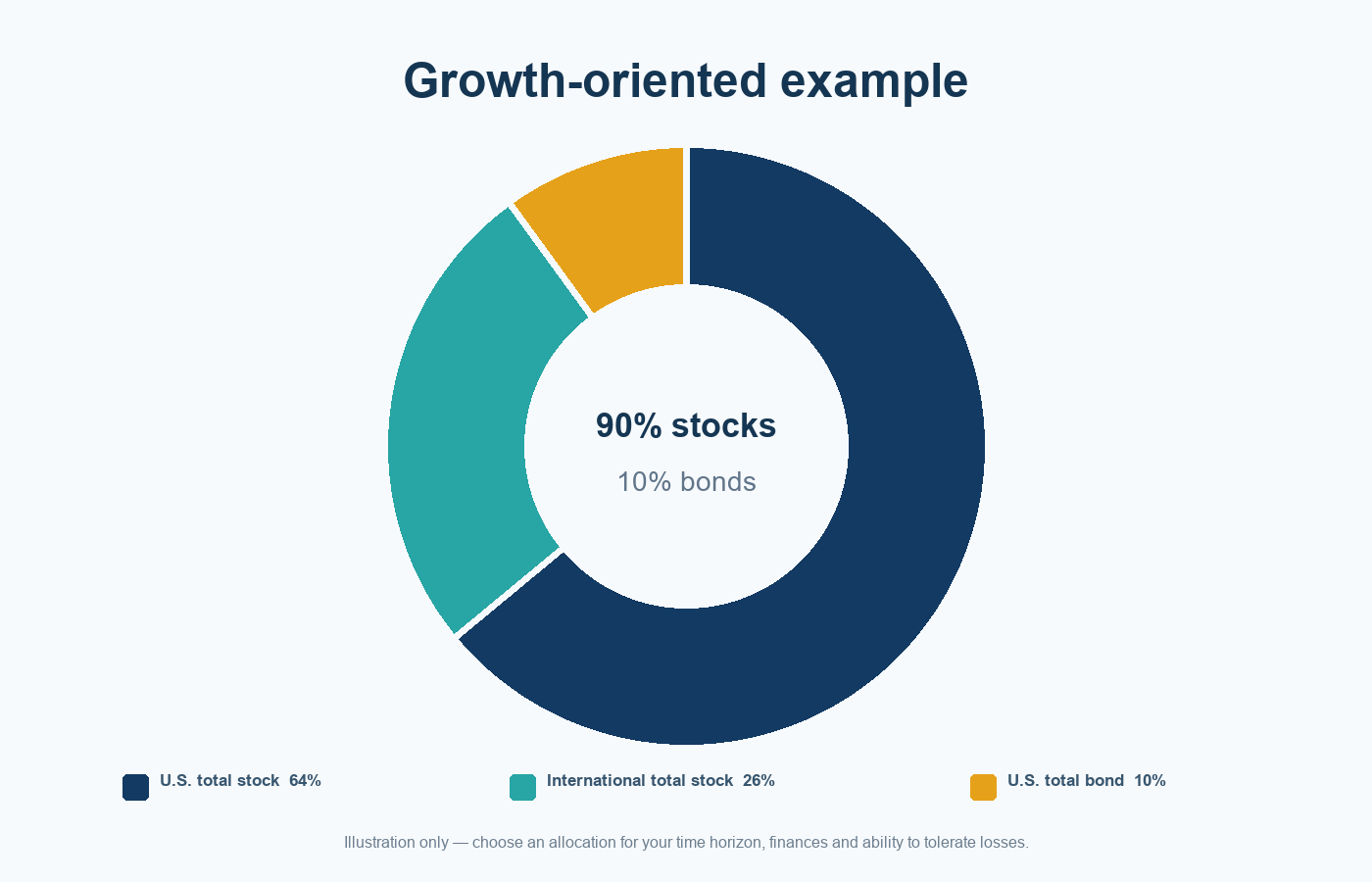
This could fit an investor with a long horizon, stable finances and the willingness to remain invested through a severe stock-market decline. The small bond position will not prevent large losses.
Example 2: balanced—70% stocks, 30% bonds
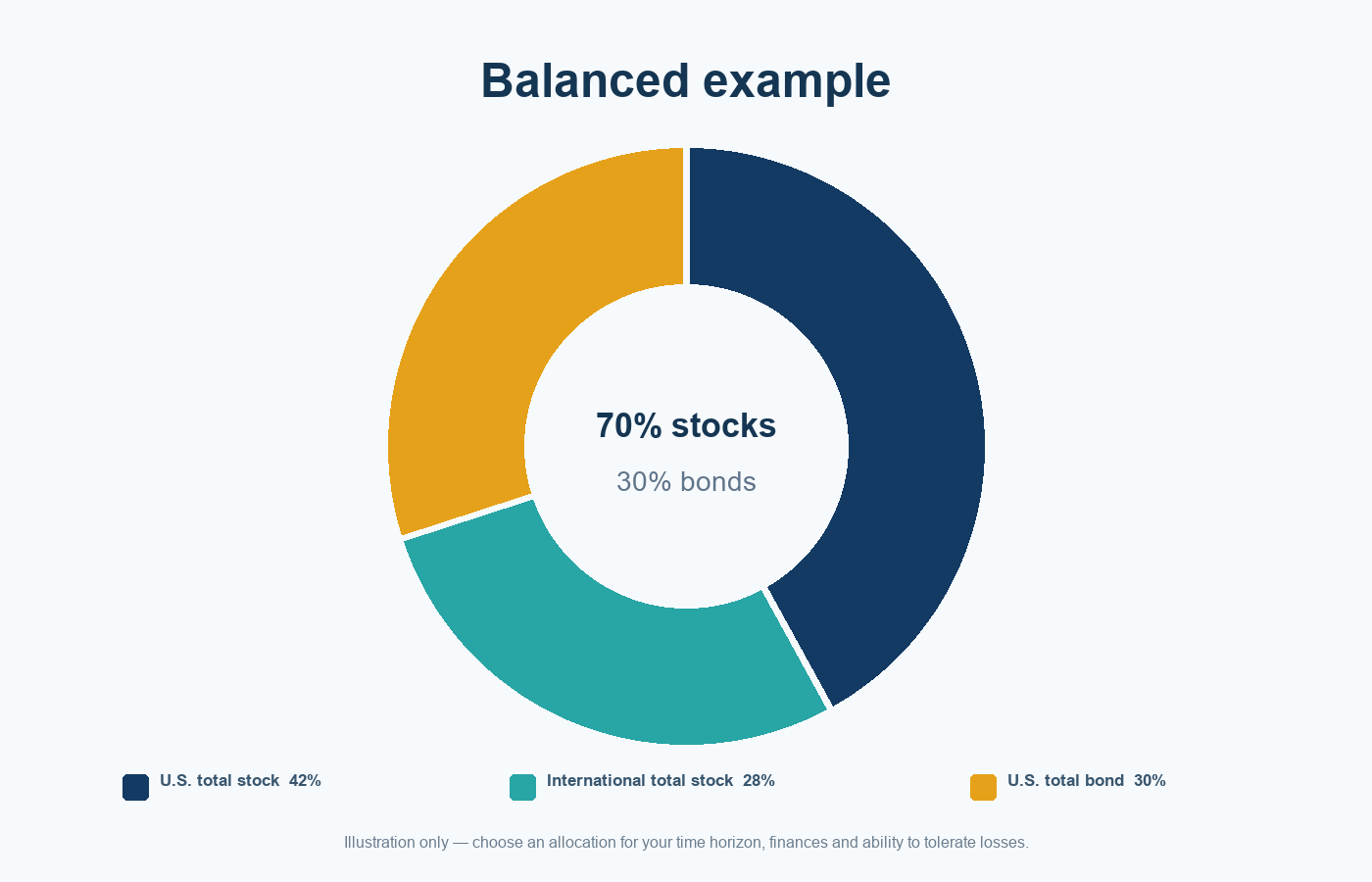
This mix still depends heavily on stocks for growth but gives bonds a larger stabilizing role. “Balanced” does not mean low risk: a 70% stock portfolio can still suffer a substantial temporary decline.
Example 3: more conservative—50% stocks, 50% bonds
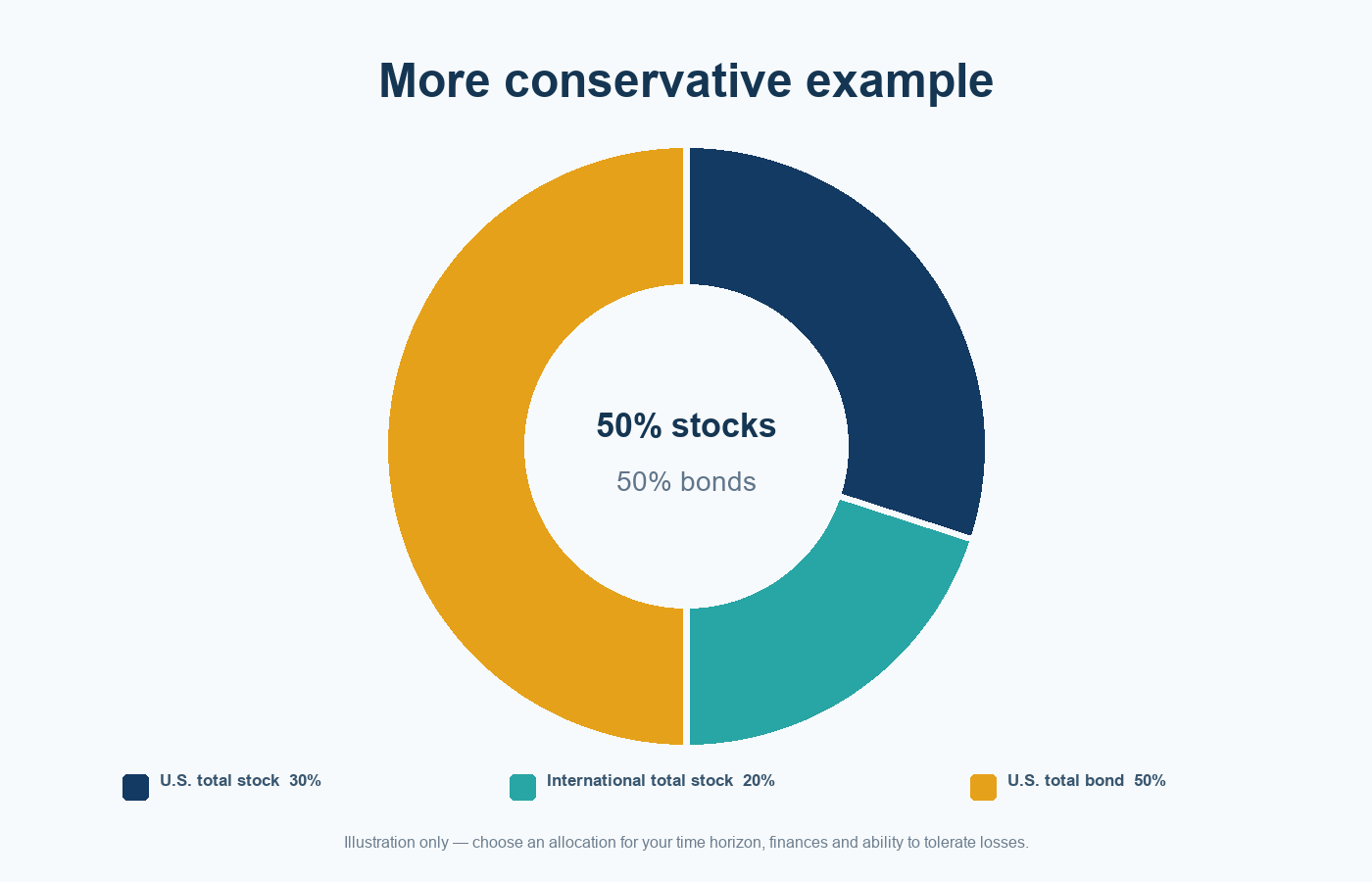
An investor who will soon withdraw money or who cannot tolerate a stock-heavy decline might consider more bonds. The tradeoff is less stock exposure and therefore potentially less long-term growth. A conservative allocation that causes someone to save too little can create a different risk.
How do you choose the percentages?
Make two decisions in order. First choose the split between stocks and bonds. Then divide the stock portion between the United States and international markets.
Decision 1: stocks versus bonds
- Time horizon: when will you need to begin spending this money?
- Capacity for loss: could a decline force you to sell, delay retirement or cut essential spending?
- Tolerance for loss: would you stay with the plan after seeing the balance fall sharply?
- Other resources: pensions, reliable income and cash reserves can change the job the portfolio must do.
Do not use age alone. Two people of the same age can have different withdrawal schedules, guaranteed income and comfort with risk.
Decision 2: U.S. versus international stocks
There is no universally correct percentage. A global market-weight approach will change as markets change. Some U.S. investors deliberately keep a home-country tilt. Vanguard research has found that international allocations in the neighborhood of 30% to 40% of equities captured most of the historical diversification benefit in its analysis. Treat that as research context, not a command.
Is the three-fund portfolio good for beginners?
It can be. The holdings are understandable, fees are easy to compare, and the investor has only three target percentages to maintain. It also teaches the central concepts of asset allocation, diversification and rebalancing without demanding individual-stock research.
But a target-date fund may be easier for a true hands-off beginner. A target-date fund bundles diversified investments, rebalances automatically and generally becomes more conservative as its date approaches. With three funds, you are the person responsible for the allocation and rebalancing. If you will not do that—or if market headlines will make you change course—a reasonably priced target-date fund with a suitable glide path may be the better simple choice.
Important: A target-date fund is usually meant to work as the entire portfolio. Combining one with a separate three-fund portfolio can create duplication and an allocation you did not intend.
Who is a three-fund portfolio right for?
It may suit someone who wants broad market exposure, accepts market returns rather than trying to beat them, prefers low maintenance and can follow a written allocation through both booms and declines. It is especially useful for an investor who wants more control than a target-date fund provides without managing many specialized funds.
It may be a poor fit for someone who wants professional allocation changes handled automatically, needs a highly customized income or tax strategy, cannot identify suitable broad funds, wants guaranteed principal, or is likely to trade in response to news. Investors with concentrated employer stock, large taxable accounts, pensions, near-term withdrawals or complex tax considerations may need to evaluate the three funds as part of the whole household rather than one account in isolation.
The disadvantages and tradeoffs
| Benefit | Tradeoff |
|---|---|
| Broad market coverage | You receive the weak companies and markets along with the strong ones |
| Simple structure | You still must select an allocation and rebalance it |
| International diversification | Currency, political and market risks can produce long periods of underperformance |
| Bond diversification | Bond funds can lose money and may trail inflation |
| Index discipline | The fund generally follows its index through declines and may have tracking error |
| Potentially low fees | Not every index fund is inexpensive; plan-level fees may also apply |
| Fewer decisions | No dedicated tilts to small value, real estate, inflation-protected bonds or other preferences |
How to build a three-fund portfolio
- Write down the goal and timeline. State when withdrawals could begin and what the money is meant to support.
- Choose the stock/bond target. Use your ability and willingness to withstand losses, not recent performance.
- Choose the U.S./international stock split. Apply it only to the stock portion. If stocks are 70% and international is 40% of stocks, the total portfolio becomes 42% U.S. stock, 28% international stock and 30% bonds.
- Find broad, low-cost candidates. Read each fund’s objective, index, holdings, expense ratio and risk disclosures. “Index” in the name does not guarantee low cost or broad coverage.
- Check for overlap. A total U.S. fund already contains large, mid- and small-company stocks. Adding an S&P 500 or technology fund changes the allocation rather than merely adding diversification.
- Invest using the target percentages. Direct new contributions to the selected funds.
- Create a rebalancing rule. Review at a calm, predetermined interval such as annually, or when an asset class moves beyond a threshold you set in advance.
- Review after life changes. Retirement, a pension decision, a major withdrawal or a changed time horizon may justify a new target.
How to use a three-fund portfolio in your 401(k)
Your plan may not use the words “total market.” Open the investment menu and the participant fee disclosure, then look for these roles:
| Role | Possible 401(k) label | What to verify |
|---|---|---|
| Broad U.S. stocks | Total stock market, broad market or U.S. equity index | Does it include large, mid and small companies? |
| International stocks | Total international, global ex-U.S. or international index | Does it include developed and emerging markets? |
| Broad bonds | Total bond, U.S. aggregate bond or core bond index | Credit quality, duration and whether it is truly broad |
If the only low-cost U.S. option is an S&P 500 index, it can serve as a large-company approximation, but it is not the total U.S. market. An extended-market fund may fill the mid- and small-company gap, turning the implementation into four funds. That is still consistent with the three-asset-class idea.
If one asset class is missing or unreasonably expensive, look across the household. You might hold the available U.S. stock and bond funds in the 401(k) and place the international allocation in an IRA, provided the combined percentages still match the plan. Do not judge each account as if it were a separate portfolio.
Compare expense ratios and plan fees. The Department of Labor notes that 401(k) costs may include investment management, administration and individual service fees. Passive funds often cost less, but “passive” is not enough—read the actual disclosure. Also confirm the employer match and vesting rules before changing contributions.
A practical 401(k) example
Suppose a worker chooses the 70/30 example. Their plan offers a U.S. total-market index, an international index covering developed and emerging markets, and a U.S. aggregate bond index. They direct 42% of contributions to U.S. stock, 28% to international stock and 30% to bonds.
A year later, stocks have risen and the account is 47% U.S. stock, 30% international stock and 23% bonds. The worker could direct new contributions toward bonds until the mix moves closer to target, or exchange funds inside the 401(k). Rebalancing inside a tax-advantaged retirement account generally does not create the capital-gains tax issue that a sale in a taxable brokerage account can create, though plan trading restrictions can still apply.
Five mistakes that defeat the strategy
- Choosing percentages from someone’s age-based rule without considering your own finances.
- Holding a target-date fund plus three separate funds without calculating the combined exposure.
- Selecting the international or bond fund only because it had the best recent return.
- Using three narrow funds—such as technology, emerging markets and high-yield bonds—and calling the result diversified.
- Abandoning the allocation during a market decline. A plan you cannot follow is not a practical plan.
The decision in plain English
A three-fund portfolio is compelling because it separates investing into a few decisions you can understand: how much stock risk to take, how globally to diversify that stock exposure, and how much to place in bonds. It favors market coverage, cost awareness and consistency over prediction.
For a beginner willing to choose an allocation and review it occasionally, it can be an excellent framework. For someone who wants allocation and rebalancing handled automatically, a well-chosen target-date fund may be simpler. The right answer is the one that fits your complete plan and that you can continue using when markets stop being comfortable.
Continue with RetireNerd
- 401(k) for Beginners: The Simple Guide Your Employer Forgot to Give You
- 401(k), RMD, Rollover and Roth Conversion Guide
- Retirement Savings Benchmarks
- Test the portfolio in Compass
- Retirement Withdrawal Strategies
Sources
- Investor.gov: Asset Allocation and Diversification
- Investor.gov: Index Funds
- Investor.gov: Bond Funds and Income Funds
- U.S. Department of Labor: A Look at 401(k) Plan Fees
- Investor.gov: Target Date Funds
- Vanguard research: Approach to Target-Date Funds
This article provides general education, not individualized investment, tax or legal advice. Example allocations are hypothetical and do not predict performance. Investments can lose value, including stock and bond funds. Review your plan documents and consider a qualified fiduciary professional for advice based on your circumstances.