

Your last paycheck does not turn your 401(k) into a pumpkin. The account remains invested, keeps its tax treatment and stays yours. Retirement simply gives you a decision: keep the account in the old plan, move it, or begin taking money from it.
That sounds simple until a packet arrives from the plan administrator and a financial company offers to “help” with a rollover. A retiree can easily mistake moving the account for a required step, turn a tax-free transfer into a taxable distribution, or roll away a valuable early-withdrawal option without realizing it.
This guide explains the choices in plain English. It covers how to compare your old 401(k) with an IRA, complete a direct rollover, choose investments after the move and turn retirement savings into a practical stream of money for bills.
The answer in one minute
- You usually do not have to move a 401(k) immediately after retiring.
- Your four basic choices are to leave it in the plan, roll it to an IRA, roll it to another employer plan that accepts it, or withdraw the money.
- A direct rollover is normally the cleanest way to move the account without current tax or mandatory withholding.
- A traditional 401(k) generally rolls to a traditional or rollover IRA; designated Roth 401(k) money generally rolls to a Roth IRA.
- A rollover changes the account holding the investments. It does not require a completely different investment strategy.
- Before rolling over, check the Rule of 55, employer stock, loans, fees, investment options, withdrawal flexibility and creditor protections.
- For regular bills, many retirees use a cash reserve plus automatic monthly transfers rather than selling investments every month.
What actually happens on your retirement date?
Normally, nothing dramatic happens to a vested 401(k) balance when employment ends. Contributions from your paycheck stop. Any unvested employer contributions may be forfeited under the plan’s vesting schedule. Your vested money remains in the account and continues to rise or fall with the investments you hold.
The plan’s rules determine what services remain available. Some plans allow former employees to keep the same funds, rebalance and take flexible installments. Others limit withdrawal frequency or charge distribution fees. Your first call should therefore be to the plan administrator—not a salesperson asking you to transfer the account.
Ask for the Summary Plan Description, current fee disclosure, distribution forms and a complete statement separating pre-tax, Roth and after-tax money. Confirm beneficiaries and ask whether any employer contributions remain unvested.
Your four choices
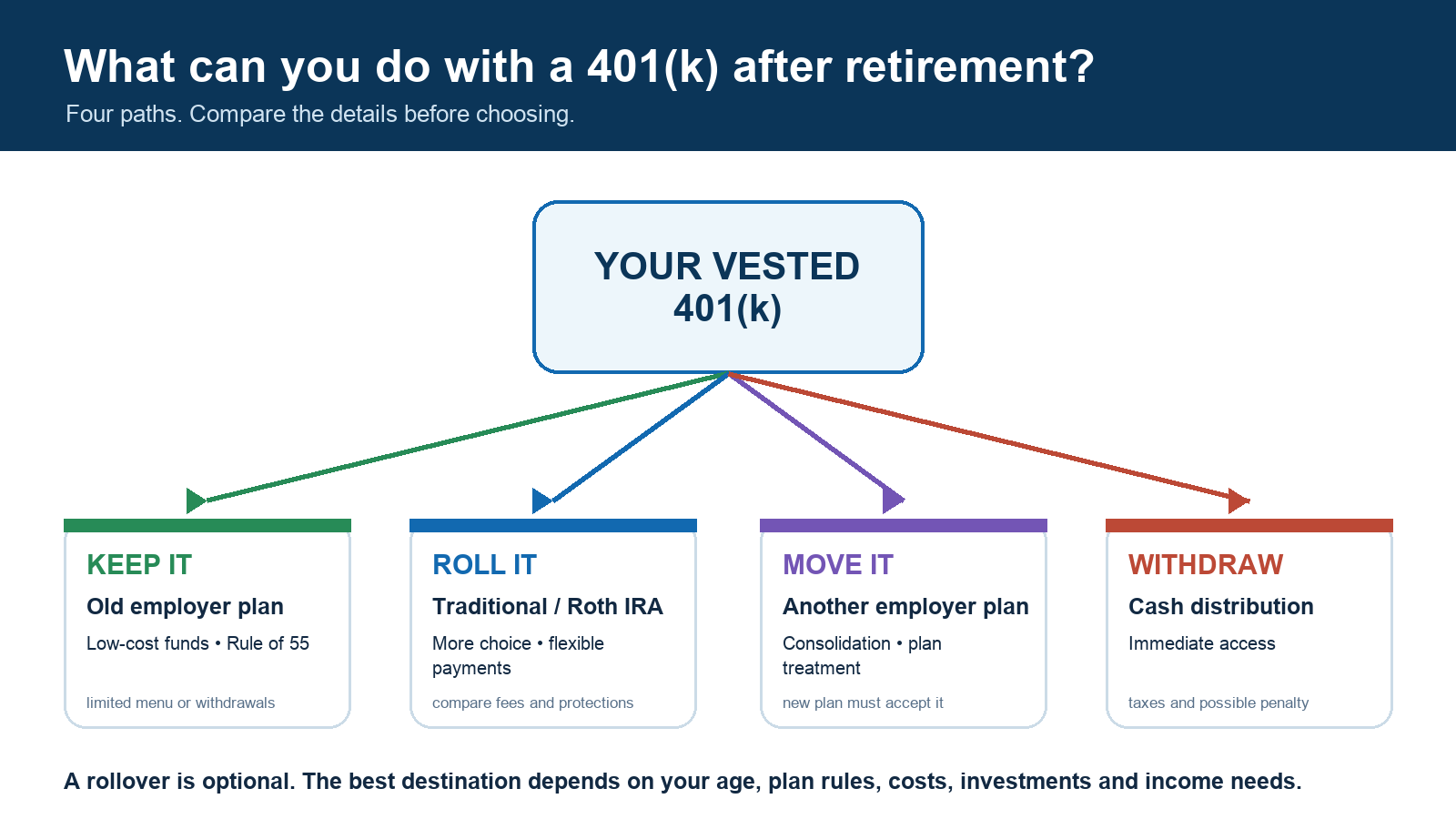
| Choice | Why it may help | What can go wrong |
|---|---|---|
| Leave it in the old 401(k) | Institutional funds, potentially low costs, ERISA protections, Rule of 55 access and no immediate transfer work | Limited menu, restricted withdrawals, multiple accounts and less personal service |
| Direct rollover to an IRA | Wider investment choice, easier consolidation, flexible withdrawals and potential access to advice | Higher fees or sales conflicts, loss of plan-specific benefits, no Rule of 55 and possible tax-strategy complications |
| Move to another employer plan | Consolidation while retaining plan treatment; possible delayed RMDs if still working and the plan permits | The new plan need not accept rollovers and may have worse investments or fees |
| Withdraw cash | Immediate access to spendable money | Potentially large income-tax bill, possible 10% additional tax and loss of future tax-deferred growth |
The IRS recognizes all four paths for eligible workplace accounts.1 The correct comparison is not “401(k) versus IRA” in the abstract. It is your specific 401(k) versus the specific IRA, investments and service arrangement being offered.
When leaving the money in the 401(k) can be smart
A good large-employer plan can be difficult to beat. It may offer inexpensive institutional funds unavailable to individual investors, a carefully selected target-date series, stable-value investments or low-cost advice. Federal rules also require participant-directed plans to disclose plan and investment fees, including expense ratios and certain transaction charges.2
Keeping the plan deserves special consideration in these situations:
- You retired between 55 and 59½. If you separated from this employer during or after the calendar year in which you turned 55, distributions from that employer’s qualified plan may avoid the usual 10% additional tax. That exception generally does not follow money rolled into an IRA.3
- The plan has unusually good investments. Compare total plan cost and fund expense ratios, not advertising claims.
- You value ERISA creditor protection. Employer plans and IRAs can receive different protection under federal and state law. This matters most to people with meaningful lawsuit or bankruptcy exposure.
- You hold a useful stable-value fund. Similar products may be unavailable in a retail IRA.
- You want simplicity. Doing nothing for a few months while you organize retirement is a valid choice if the plan permits it.
The weaknesses are practical. Some former-employer plans offer only lump sums or inflexible installments. You may have to manage several accounts, and the fund menu may be narrow or expensive. Ask specifically whether you can take partial withdrawals, schedule automatic payments, choose tax withholding and change investments after retiring.
When an IRA rollover may be better
An IRA usually provides far more investment choices and control over withdrawals. It can combine several old plans into one account, simplify beneficiary administration and make it easier to coordinate investments across the household.
A rollover becomes more compelling when the old plan has high administrative costs, weak funds, poor service or distribution rules that do not support the retirement paycheck you want. It can also make Roth conversions and qualified charitable distributions easier to manage. Those strategies have separate tax rules and should not be treated as automatic reasons to roll over.
An IRA can also be worse. “More choice” may mean high-cost funds, annuities, trading temptation or an ongoing advisory fee on the entire balance. A 1% annual fee equals $10,000 a year on a $1 million account before underlying fund expenses. Advice can be valuable, but its price and service should be explicit.
Seven checks to make before any rollover
- Rule of 55: Will you need penalty-free access before 59½ from the plan you just left?
- Employer stock: A net unrealized appreciation strategy can sometimes give appreciated employer shares special tax treatment. Rolling those shares into an IRA can permanently remove that option. Get qualified tax advice before moving employer stock.4
- Outstanding loan: Separation can trigger a plan-loan offset. The deadline and tax treatment differ from an ordinary rollover; do not ignore the plan notice.
- After-tax and Roth sources: Confirm how every source will be routed. Pre-tax money and Roth money normally need different receiving accounts.
- Fees: Compare plan administration, fund expense ratios, IRA account charges, trading costs and any advisory or annuity fees in dollars and percentages.
- Creditor protection: Compare the law that applies in your state and situation.
- Backdoor Roth planning: A new pre-tax rollover IRA can affect the pro-rata tax calculation for later nondeductible IRA conversions. Ask a tax professional if this strategy is relevant.
How to roll a 401(k) into an IRA safely
The safest routine method is a direct rollover. The money travels from the 401(k) trustee to the receiving IRA custodian. A check may still pass through your hands, but it should be payable to the receiving institution for the benefit of you—not payable to you personally.
- Choose the receiving company and account type. Open a rollover or traditional IRA for pre-tax money and a Roth IRA for designated Roth money.
- Ask the new custodian for its exact registration and rollover instructions. Account titles and check language matter.
- Call the old plan administrator. Request a direct rollover and confirm whether separate checks will be issued for pre-tax and Roth sources.
- Record every detail. Save confirmation numbers, statements, check copies and tracking information.
- Confirm receipt and tax coding. You will generally receive Form 1099-R from the old plan. The new custodian reports receipt on Form 5498. A nontaxable rollover can still be reportable on your return.
- Invest the money. A rollover often arrives as cash. Unless you deliberately want cash, do not assume opening the IRA automatically invests it.
- Review beneficiaries and automation. Beneficiary instructions do not necessarily carry over from the 401(k).
If an eligible retirement-plan distribution is paid directly to you, the plan generally must withhold 20%. You normally have 60 days to complete a rollover, and you would need to replace the withheld amount from other money to roll over the full balance.5 That is why “make the check payable to me and I’ll deposit it” is needlessly risky for most rollovers.
Do not confuse a rollover with a Roth conversion
Moving pre-tax 401(k) money to a traditional or rollover IRA is generally tax-deferred. Moving that pre-tax money to a Roth IRA is generally a taxable conversion. The word “rollover” on a form does not make the tax bill disappear. Confirm the destination account before authorizing the transfer.
Companies that commonly offer rollover IRAs
Large custodians commonly used for rollover IRAs include Fidelity, Vanguard, Charles Schwab and Merrill Edge. This is a list of examples, not a ranking or endorsement. Fidelity advertises no account fee or minimum for its self-directed rollover IRA; Vanguard states that it charges no fee to open an IRA or complete a rollover; and Schwab advertises no opening or maintenance fee for its rollover IRA. Investment, advisory, transaction, closure and specialty-service costs can still apply and change over time.678
| What to compare | Questions to ask |
|---|---|
| Total cost | What will I pay for the IRA, the investments, advice, trades, transfers and closing the account? |
| Investment menu | Can I build a low-cost diversified portfolio without proprietary or load-bearing products? |
| Cash management | Can I schedule monthly ACH payments, choose withholding and hold a useful cash or money-market reserve? |
| Service | Can I reach a person? Are branches important to me? Who handles a missing rollover check? |
| Advice | Is it optional? Is the fee flat, hourly, subscription-based or a percentage of assets? |
| Safeguards | What login protection, trusted-contact support and fraud controls are available? |
Do not choose solely because your old 401(k) already uses that company. The employer plan and a retail IRA at the same brand can have different investments, prices and services.
What should you invest in after the rollover?
The rollover itself is not an investment strategy. You can preserve the same broad allocation, simplify it, or change it—but the change should come from your retirement plan, not from the fact that the account moved.
Many 401(k) funds cannot transfer in kind because they are plan-only share classes or collective investment trusts. The plan may sell them and send cash. You can then buy different funds that provide similar market exposure. An S&P 500 index fund does not need the same ticker to perform the same portfolio role; what matters is the index, cost, tracking, tax treatment and how it fits with everything else you own.
Three practical approaches are common:
- A target-date or retirement-income fund: one diversified fund that manages stocks, bonds and rebalancing. Compare its glide path and expense ratio.
- A simple three-fund portfolio: broad U.S. stocks, international stocks and investment-grade bonds. Read RetireNerd’s three-fund portfolio guide.
- A coordinated household allocation: hold each asset where it works best across the 401(k), IRA, Roth IRA and taxable account rather than making every account look identical.
A retiree’s portfolio still needs growth. Moving everything to cash on retirement day can exchange market volatility for inflation and longevity risk. At the other extreme, keeping near-term bill money entirely in stocks can force sales after a decline. The Retirement Withdrawal Strategies guide explains sequence-of-returns risk and cash buckets.
How to turn the account into money for bills
A practical retirement paycheck usually has two layers. Investments replenish a cash reserve periodically; the cash reserve sends a predictable monthly transfer to checking. Social Security and pensions can flow into the same checking account.
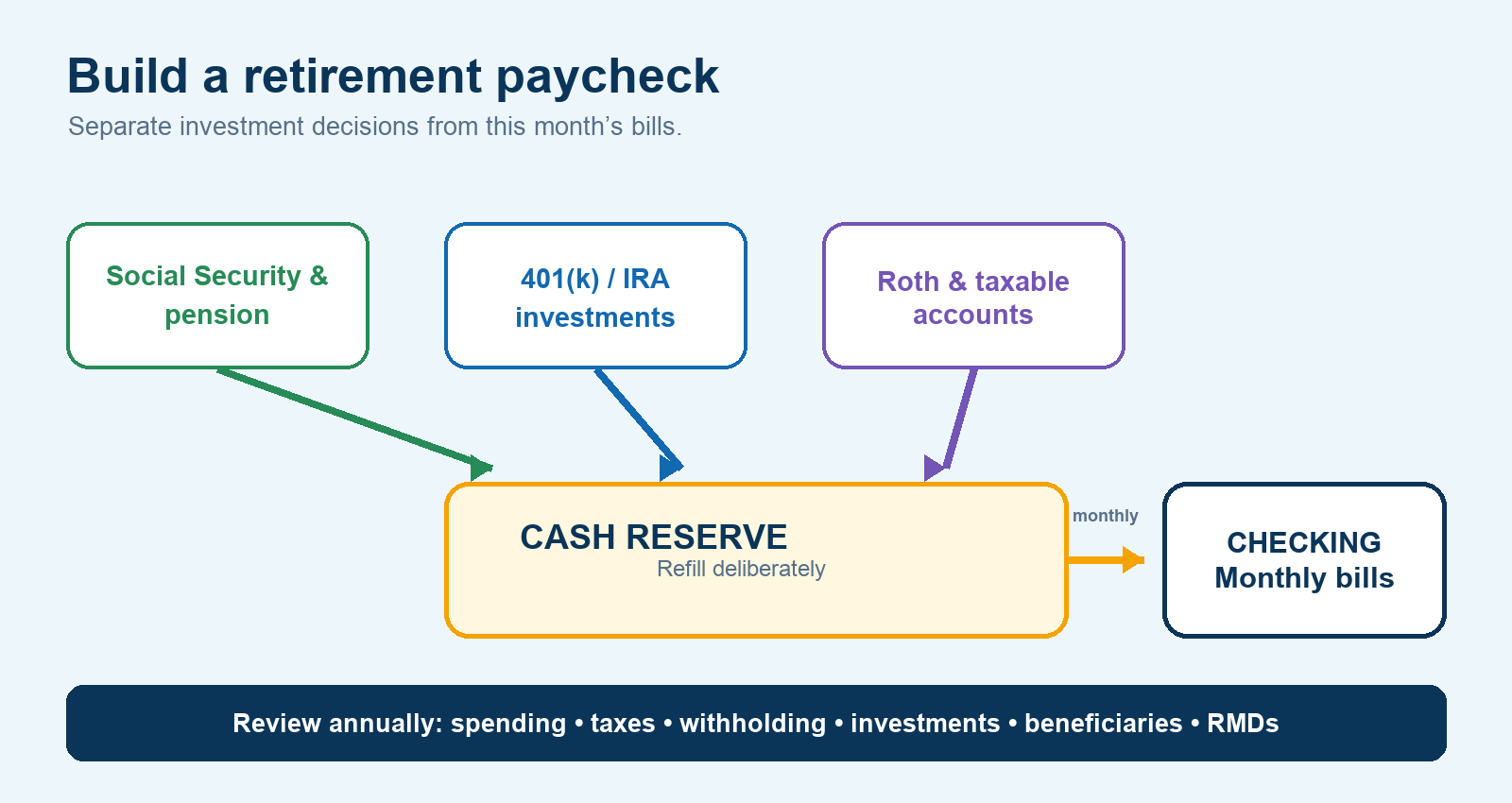
- Estimate annual spending and subtract Social Security, pensions and other dependable income.
- Keep an appropriate amount for near-term withdrawals in cash or short-term reserves.
- Set an automatic monthly transfer from the IRA or plan—or from the linked cash account—to checking.
- Select federal and state withholding based on the whole tax picture, not just the withdrawal.
- Refill the reserve on a schedule and rebalance investments at the same time.
- Review spending, taxes and portfolio results at least annually.
Example: A household spends $6,000 per month and receives $4,300 from Social Security and pensions. The portfolio must initially supply about $1,700 per month, plus taxes and irregular costs. Instead of selling a stock fund on the first of every month, the household might maintain a cash reserve, transfer $1,700 monthly to checking and refill the reserve once or twice a year according to its written plan.
Monthly or yearly withdrawals: which is better?
Neither schedule is automatically more tax-efficient. Federal income tax is generally based on your taxable income for the full year. Timing can still matter when a withdrawal crosses a tax bracket, changes how much Social Security is taxable, affects Medicare IRMAA two years later, changes an ACA subsidy or interacts with investment gains.
| Schedule | Advantages | Limitations |
|---|---|---|
| Monthly | Feels like a paycheck; aligns with bills; reduces temptation to overspend a lump sum | May require frequent sales; withholding and cash levels need monitoring |
| Quarterly | Balances routine cash flow with fewer portfolio transactions | Requires budgeting between payments |
| Annual | Allows one coordinated tax and rebalancing decision | A poorly timed large sale can be uncomfortable; the cash must be managed all year |
| Hybrid | Periodic reserve refill plus monthly checking transfer combines planning with convenience | Requires setting up and maintaining two linked steps |
For many households, the hybrid method is easiest to live with. The best frequency is the one that funds bills reliably while keeping investment sales, withholding and rebalancing deliberate.
Do not forget taxes and RMDs
Traditional 401(k) and traditional IRA withdrawals are generally included in ordinary income. Roth treatment depends on whether the distribution is qualified. The IRS uses Form W-4P for certain periodic pension or annuity payments and Form W-4R for nonperiodic payments and eligible rollover distributions.9 The custodian’s default withholding may be very different from your actual tax rate.
Required minimum distributions generally begin at 73 under current rules, with a later age of 75 applying to younger cohorts under SECURE 2.0. A current employer plan may permit a still-working participant to delay RMDs from that plan, while traditional IRAs generally do not have the same still-working delay. Roth 401(k) accounts and Roth IRAs no longer require lifetime RMDs for the owner, although beneficiary rules apply.10
An RMD cannot be rolled over. It can be taken monthly, quarterly or annually as long as the full required amount is withdrawn by the applicable deadline. Taking the first RMD late in the following year can create two taxable RMDs in one calendar year, so model the tax effect before delaying it.
Is paying for advice helpful?
It can be, especially when the decision includes employer stock, after-tax contributions, a pension election, early retirement, large Roth conversions, charitable giving, multiple beneficiaries or a portfolio that must support most household spending. The value should come from analysis and implementation—not merely filling out a rollover form.
You can pay in several ways: an hourly or project fee, a recurring flat fee, a subscription, commissions, or a percentage of assets under management. A percentage looks small but grows with the account. On $1 million, 0.50% is $5,000 a year and 1.00% is $10,000 a year, before investment expenses.
Ask the professional—in writing:
- Are you acting as a fiduciary for this rollover recommendation?
- Why is moving the money better than leaving it in my specific plan?
- What will I pay during the first year and every year afterward, in dollars?
- Do you receive commissions, referral payments or more compensation for any recommended product?
- What services are included: tax planning, withdrawal strategy, Social Security, estate coordination and ongoing rebalancing?
- Can I buy the same investment without the advisory program?
- What happens if I later end the relationship?
The Department of Labor says a professional making a fiduciary rollover recommendation should consider alternatives—including leaving assets in the employer plan—and provide written reasons the rollover is in the investor’s best interest.11 Check the professional’s Form CRS and disciplinary history through Investor.gov and FINRA BrokerCheck.
Things to avoid
- Do not cash out the account just to “get control.” A direct rollover can provide control without turning the balance into current taxable income.
- Do not let a salesperson create urgency. There is generally no IRS deadline for deciding on a direct rollover; the old plan’s rules may impose practical limits.
- Do not sign a blank distribution form or accept a check payable to you without understanding withholding.
- Do not roll away Rule of 55 access before age 59½.
- Do not move appreciated employer stock before evaluating NUA treatment.
- Do not assume “no account fee” means no cost. Fund expenses, advisory fees, annuity charges and transfer fees can remain.
- Do not buy an investment you cannot explain. Understand liquidity restrictions, surrender charges, guarantees, insurer risk and compensation.
- Do not leave rollover cash uninvested by accident.
- Do not forget beneficiaries. Retirement account beneficiary designations can override instructions elsewhere in an estate plan.
- Do not withdraw based only on this year’s market return. Spending, taxes, longevity and the order of returns belong in one plan.
A decision checklist before your final workday
- Download the latest statement and fee disclosure.
- List pre-tax, Roth, after-tax and employer-stock balances separately.
- Confirm the vesting status, loan balance and distribution options.
- Calculate the first two years of spending not covered by reliable income.
- If younger than 59½, verify whether the Rule of 55 matters.
- Compare the old plan with at least one specific IRA in writing.
- Choose investments and a cash-reserve policy before the rollover arrives.
- Use a direct rollover if moving the account.
- Set beneficiaries, withholding and recurring transfers.
- Run the complete plan under both normal and difficult early-market conditions.
Test the decision before moving the money
A rollover changes where the account lives. Your retirement outcome still depends on spending, taxes, Social Security, investments and difficult market years. Use Compass to model the complete plan, then compare the result with keeping the 401(k).

Frequently asked questions
Do I have to move my 401(k) when I retire?
Usually no. A plan may let you keep a sufficiently large vested balance after retirement. Read the plan documents because minimum balances and distribution rules vary.
Can I roll over only part of the account?
Some plans permit partial rollovers or distributions; others do not. A partial approach can preserve a useful plan feature while moving the rest, but source rules and plan limitations matter.
Can I keep the same investments?
Sometimes, but many plan investments cannot be held in a retail IRA. You can often buy a different low-cost fund that supplies similar market exposure. Compare purpose and cost rather than ticker symbols alone.
Does a rollover count against the IRA contribution limit?
No. An eligible rollover is separate from the annual IRA contribution limit.
Can I roll a traditional 401(k) directly into a Roth IRA?
It may be permitted, but the untaxed amount is generally included in income as a Roth conversion. Estimate the federal, state, Medicare and other effects before doing it.
Should I take my whole annual withdrawal in January?
There is no universal best month. A large early withdrawal provides cash certainty but removes money from tax-deferred investing sooner and can create unfortunate market timing. A cash reserve with scheduled transfers often provides a smoother compromise.
Keep learning with RetireNerd
- 401(k), Rollover and Roth Conversion Guide
- 401(k) for Beginners
- How to Build a Three-Fund Portfolio
- Retirement Withdrawal Strategies
- Retirement Taxes and Paperwork
- Compass Retirement Planner
Sources
- U.S. Securities and Exchange Commission, Investor.gov. “Switching Jobs.”
- U.S. Department of Labor. “A Look at 401(k) Plan Fees.”
- Internal Revenue Service. “Significant Ages for Retirement Plan Participants.”
- Internal Revenue Service. Publication 575, “Pension and Annuity Income,” net unrealized appreciation section.
- Internal Revenue Service. “Rollovers of Retirement Plan and IRA Distributions.”
- Fidelity Investments. “Rollover IRA.”
- Vanguard. “401(k) Rollover to an IRA.”
- Charles Schwab. “Rollover IRA.”
- Internal Revenue Service. “Pensions and Annuity Withholding.”
- Internal Revenue Service. “Retirement Plan and IRA Required Minimum Distributions FAQs.”
- U.S. Department of Labor. “Choosing the Right Person to Give You Investment Advice.”
Rules and services were reviewed September 12, 2026. Tax law, plan terms, provider services and fees can change. Examples are illustrative and do not predict investment returns. This article provides general education, not individualized financial, investment, tax or legal advice. Consider consulting a qualified tax professional or fiduciary adviser before moving a large account or acting on employer stock, after-tax contributions or early-withdrawal rules.