

There is no universally best age to claim Social Security. Age 62 buys earlier income. Age 67 avoids the permanent early-filing reduction for people born in 1960 or later. Age 70 produces the largest monthly retirement benefit. The right answer depends on what the benefit must do for your household.
Meet Denise, Marcus and Elena, and David and Linh. They are fictional, but their decisions reflect questions real households face: Can work continue? How much savings would a delay consume? What does health suggest about longevity? Which spouse’s check could become the survivor’s income?
The basic comparison
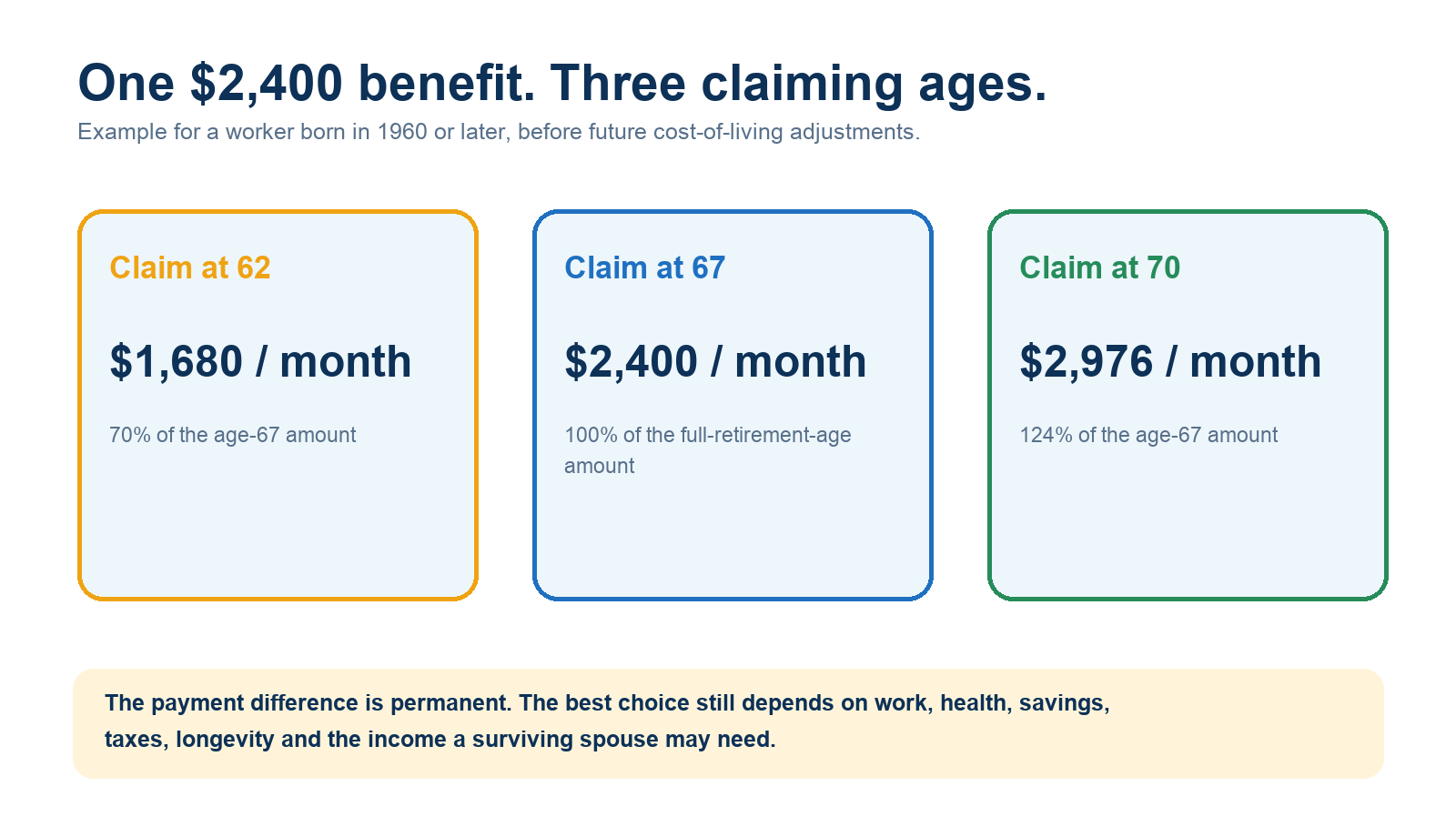
For a worker born in 1960 or later with a $2,400 monthly benefit at full retirement age:
- At 62: about $1,680 a month, or 70% of the full benefit.
- At 67: $2,400 a month, or 100%.
- At 70: about $2,976 a month, or 124%.
These are simplified illustrations before future cost-of-living adjustments. Social Security calculates benefits by month, so 62, 67 and 70 are useful landmarks rather than the only choices.
Story 1: Denise claims at 62 because the bridge is too expensive
Denise is 62, single and leaving a physically demanding maintenance job. Arthritis makes full-time work harder each year. Her full-retirement-age estimate is $1,900 a month, so claiming at 62 would provide about $1,330. She has $185,000 in retirement savings, modest housing costs and no pension.
Waiting until 67 would raise her benefit to $1,900, but she would need to finance five years from work or savings. A $2,000 monthly portfolio withdrawal for 60 months would consume $120,000 before considering investment gains, losses, taxes or inflation. That could leave too little invested for repairs and late-life expenses.
Denise claims at 62 and takes a small, flexible job. Her choice accepts a permanently smaller check in exchange for protecting more of her liquid savings and leaving work that is worsening her health.
Why 62 can make sense in this story
- Her health makes continued full-time work uncertain.
- She does not have a spouse whose future survivor benefit depends on her claiming record.
- Her savings cannot comfortably fund a five- or eight-year delay.
- The benefit covers essential spending now.
Denise must still watch the retirement earnings test. In 2026, someone under full retirement age for the entire year can earn up to $24,480 before Social Security begins withholding $1 of benefits for every $2 above the limit. Withholding under the earnings test is not necessarily permanently lost: at full retirement age, Social Security recalculates the benefit to credit months withheld. Pension income and investment withdrawals do not count as earnings for this test; wages and net self-employment income generally do.
Story 2: Marcus and Elena claim at 67 because the plan is already balanced
Marcus and Elena are both 67. Marcus has a $2,400 full-retirement-age benefit and Elena has $1,650 on her own record. They have $720,000 invested, a paid-off mortgage and enough cash for two years of planned portfolio withdrawals. Both are ready to stop working.
They could delay to 70, but doing so would require larger portfolio withdrawals during the first three years. Their retirement analysis shows that either choice is workable. They value stable cash flow now, want to limit early portfolio withdrawals, and have similar benefit amounts, so delaying one benefit does not transform the survivor picture as much as it would for a couple with one very high earner.
They claim at 67. This is not a neutral default; it is a deliberate exchange. They give up delayed credits after 67 and receive three additional years of payments. Because they have reached full retirement age, employment earnings no longer cause benefits to be withheld under the retirement earnings test.
Why 67 can make sense in this story
- Both receive their unreduced full-retirement-age amounts.
- Their work income ends at 67.
- Claiming limits the amount they must draw from investments early in retirement.
- Their benefits are close enough that the higher-earner survivor strategy is less decisive.
Story 3: David delays to 70 to protect Linh
David is 67 and earns more. His full-retirement-age benefit is $3,400. Linh’s benefit on her own work record is $1,400. David enjoys consulting, plans to work part-time until 70 and has longevity in his family. Their savings can cover the gap without disrupting the investment plan.
Linh claims her own benefit at 67. David delays his. At 70, his approximate benefit is $4,216 before future cost-of-living adjustments—124% of $3,400. If David dies first, Linh does not keep both checks. She may step up to a survivor amount based on David’s record, including his delayed retirement credits, subject to survivor-benefit rules and the age when she claims it.
That makes David’s delay more than a bet on his own lifespan. It purchases a larger inflation-adjusted monthly benefit while either spouse is alive and can strengthen the income floor for the eventual survivor, when one Social Security check disappears but many household expenses remain.
Why 70 can make sense in this story
- The higher earner can keep working comfortably.
- The household has enough savings to delay without dangerous portfolio withdrawals.
- Long life is plausible for one or both spouses.
- Delayed credits on the higher earner’s record can raise a future survivor benefit.
What the three stories reveal
| Question | Leans earlier | Leans later |
|---|---|---|
| Can you keep working? | Work is unavailable, harmful or unreliable | Work is sustainable and pays the bills |
| Can savings bridge the delay? | Delay would drain the portfolio | Cash and investments can fund the gap |
| What does health suggest? | Shortened longevity appears likely | Long life appears plausible |
| Are you married? | Benefits are similar or survivor protection is limited | Higher earner’s delay materially raises survivor income |
| Do you need income now? | Essential expenses require it | Other income covers current spending |
| How do you react to market risk? | Claiming reduces withdrawals after a decline | Portfolio can support a delay through volatility |
Health matters—but it is not a stopwatch
A serious diagnosis and family longevity can inform the decision, but no calculator knows an individual lifespan. Married couples should consider both lives. Even if the higher earner expects a shorter life, delaying may still help a longer-lived lower-earning spouse through the survivor benefit.
If health prevents substantial work before retirement age, investigate Social Security Disability Insurance rather than assuming an early retirement claim is the only route. Disability eligibility uses different rules and requires a qualifying condition and work history.
The break-even age is useful—and incomplete
Using the $2,400 example and ignoring cost-of-living adjustments, taxes, investment returns and the time value of money, cumulative benefits from claiming at 67 overtake claiming at 62 at roughly age 78 years and 8 months. Claiming at 70 overtakes 67 around age 82 years and 6 months, and overtakes 62 around age 80 years and 4 months.
Those ages do not declare a winner. Money received earlier can be spent or invested. Money used to bridge a delay may come from a portfolio during a bad market. Taxes can differ. A surviving spouse can inherit the effect of the higher earner’s decision. Break-even math is one lens, not the plan.
Five rules people often miss
- Claiming and retiring are separate decisions. You can stop work without claiming, or claim while continuing to work.
- Full retirement age is not Medicare age. Medicare generally begins at 65. Delaying Social Security does not mean you should automatically delay Medicare enrollment.
- There is no bonus for waiting beyond 70. Delayed retirement credits stop then.
- A spouse’s benefit and a survivor benefit are different. A spouse’s maximum generally depends on up to half the worker’s full-retirement-age amount; delayed credits can increase the surviving spouse’s benefit.
- The earnings test is not a tax. It can temporarily withhold benefits before full retirement age; Social Security later adjusts the benefit for months withheld.
A better way to choose your claiming age
- Download estimates for 62, full retirement age and 70 from each spouse’s my Social Security account.
- Correct any errors in the earnings records.
- Build a monthly spending plan from retirement until the later claim date.
- Identify exactly where bridge income would come from: wages, cash, taxable investments, retirement accounts or a pension.
- Model a poor market in the first years of retirement.
- Compare the income available to the surviving spouse under each strategy.
- Review health, work capacity, family longevity and insurance needs.
- Coordinate Medicare enrollment at 65.
- Choose the month, not just the age, and verify the first-payment timing.
The decision in one sentence
Claim at 62, 67 or 70 only after deciding which risk your household is best equipped to carry: a smaller lifetime check, larger withdrawals while waiting, continued work, or less income for a surviving spouse.
Continue with RetireNerd
- Build your age-based Retirement Roadmap
- Compare claiming ages in Compass
- Plan retirement withdrawals
- Check retirement savings benchmarks
Sources
- Social Security Administration: When should I start retirement benefits?
- SSA: Effect of early or delayed retirement
- SSA: Receiving benefits while working
- SSA: 2026 retirement earnings test limits
- SSA regulations: Delayed retirement credits and survivor benefits
- SSA: Retirement Benefits
- Medicare: Enrolling in Part A and Part B
The households and dollar amounts are fictional illustrations. This article provides general education, not individualized financial, tax or legal advice. Social Security rules and personal circumstances can change. Verify estimates and eligibility with the Social Security Administration before claiming.