
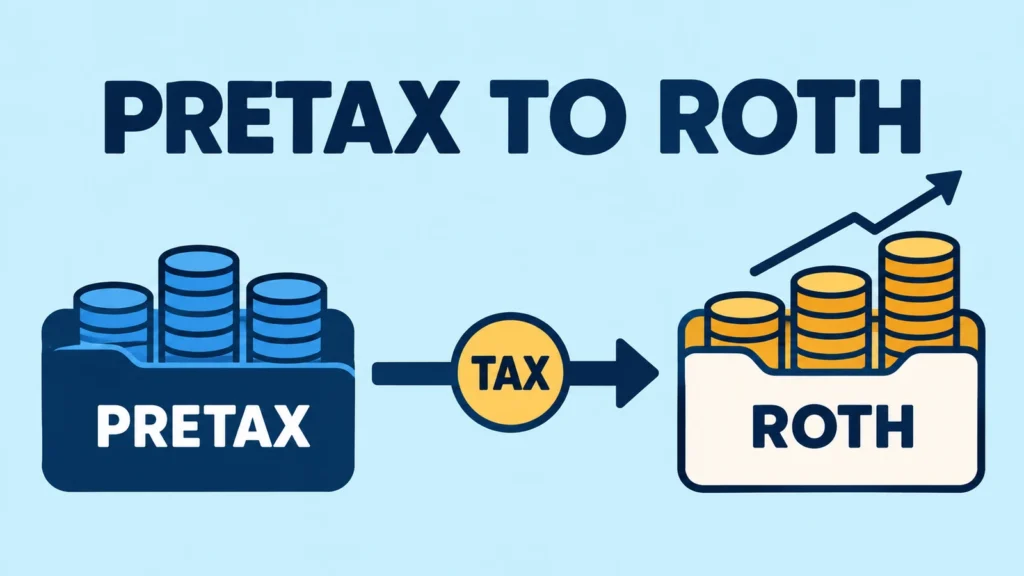
A Roth conversion moves retirement money from a pretax account into a Roth account. You generally pay income tax on the previously untaxed amount in the conversion year. In return, the converted money can grow in the Roth, and qualified Roth withdrawals can be federally tax-free.
A conversion can be useful in a year when your taxable income is temporarily low, when you want fewer required taxable withdrawals later, or when nearly all your retirement savings is pretax. But it is not automatically a tax saver. A large conversion can push income into higher tax brackets and affect Medicare premiums, Marketplace health-insurance savings and other income-based tax rules.
The conversion in one sentence
Pretax retirement account → Roth account → taxable income now → potential tax-free qualified withdrawals later.
The best question is not “Should everyone convert?” It is “Would paying tax on this amount this year likely improve my long-term plan?”
What accounts can be converted?
| Source account | Common Roth destination | What to confirm |
|---|---|---|
| Traditional IRA | Roth IRA | Any nondeductible basis and the year-end value of all traditional, SEP and SIMPLE IRAs |
| SEP IRA | Roth IRA | How the conversion interacts with all other IRAs and current SEP contributions |
| SIMPLE IRA | Roth IRA | Whether the account has passed its special initial participation period |
| 401(k), 403(b) or governmental 457(b) | Roth IRA or the plan’s designated Roth account | Whether the money is eligible for distribution and whether the plan permits an in-plan Roth rollover |
| After-tax workplace-plan money | Often Roth IRA or designated Roth account | Exact source balances and whether pretax earnings will be sent separately |
| Inherited retirement account | Special rules apply | Do not assume it can be converted; verify beneficiary-specific rules first |
A Roth 401(k) contribution and a Roth conversion are different. A contribution directs new pay into a Roth workplace account. A conversion moves money that is already in a pretax account and generally creates current taxable income. If you are still choosing where new contributions should go, read Roth or Traditional 401(k)?
Why someone might want to convert
- Use a temporarily low-income year. Retirement before Social Security, a career break, a business loss or reduced work can create room in lower tax brackets.
- Reduce future pretax balances. Smaller pretax balances may mean smaller required minimum distributions later.
- Create tax flexibility. Holding taxable, pretax and Roth money gives you more control over which account funds a large future expense.
- Prepare for a surviving spouse’s tax return. A widow or widower may eventually file as a single taxpayer while managing much of the same retirement income.
- Plan for heirs. Roth money may be more tax-efficient for some beneficiaries, although inherited-account distribution rules still apply.
- Respond to expected higher future rates. Paying a known tax today may be reasonable if you expect the converted dollars to face a higher marginal rate later.
These are reasons to analyze a conversion, not proof that one is beneficial. If your current tax rate is high and future withdrawals are likely to face a lower rate, keeping the money pretax may be better. Your state tax situation matters too.
What to do before contacting the custodian
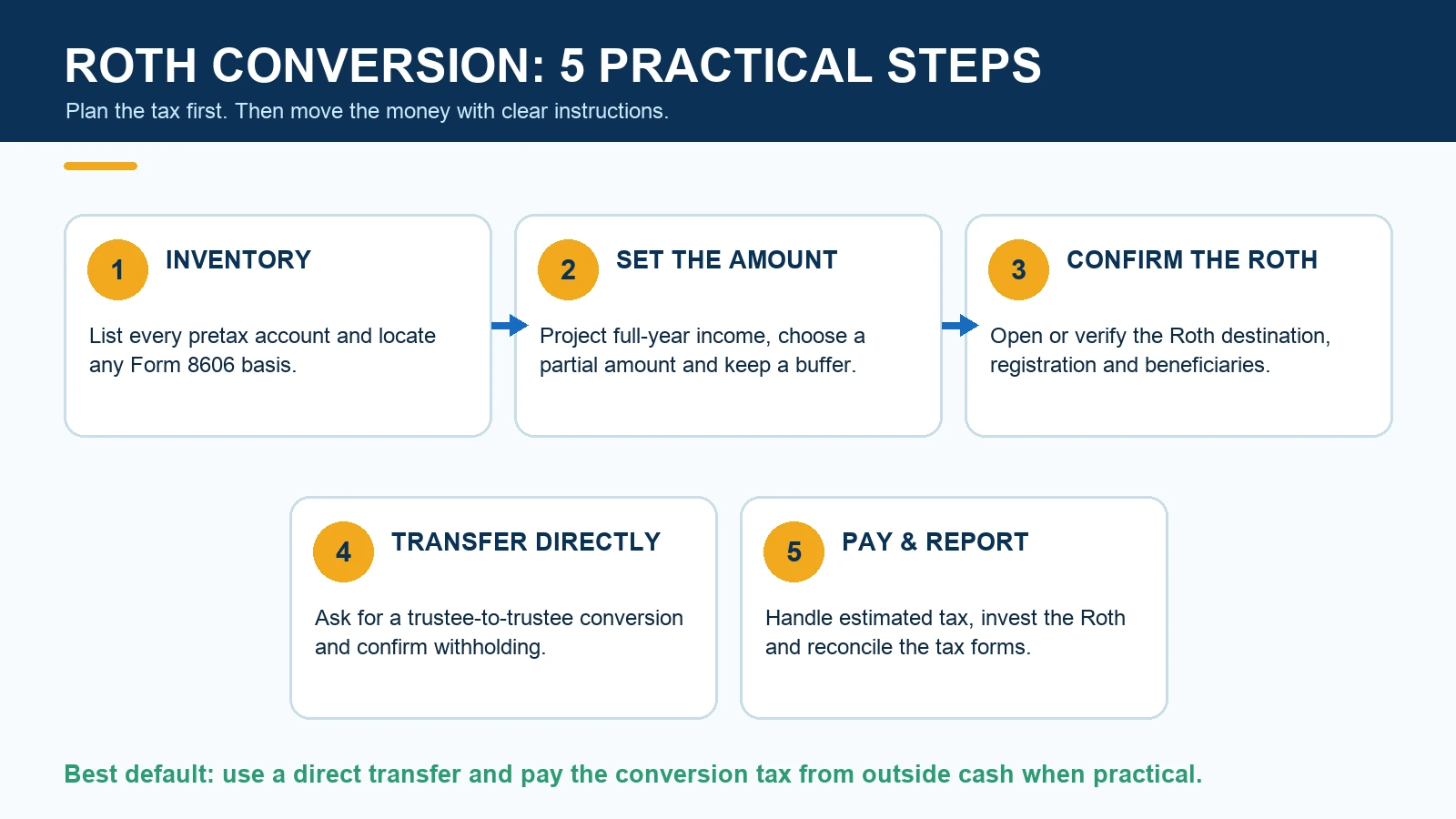
1. Make an account inventory
List every traditional IRA, rollover IRA, SEP IRA, SIMPLE IRA and former or current workplace plan. Record the balance, account owner, custodian, tax type and whether any part has already been taxed. Include old accounts you may have left behind after changing jobs; this old 401(k) guide explains the main choices.
2. Find your basis records
If you ever made nondeductible traditional IRA contributions, locate prior Forms 8606. That after-tax basis is important. For IRA tax calculations, the IRS generally looks across all of your traditional, SEP and SIMPLE IRAs rather than letting you convert only the after-tax dollars from one chosen IRA. This is commonly called the pro-rata rule.
3. Estimate full-year income
Start with expected wages, pension income, taxable Social Security, interest, dividends, capital gains, business income and planned retirement withdrawals. Add deductions and credits. Then estimate how different conversion amounts change federal and state tax. Use marginal tax brackets—the rate on the next dollars—not only your average tax rate.
4. Choose a target amount and leave a buffer
Many conversions are partial. Suppose your projected taxable income before conversion is $72,000 and your planning ceiling is $100,000. The simple difference is $28,000, but a prudent conversion amount may be lower after allowing for year-end dividends, capital gains and other surprises. This example illustrates a process, not a recommended tax bracket or amount.
5. Decide how the tax will be paid
Paying the tax from cash outside the retirement account usually leaves the full conversion working in the Roth. Withholding tax from the distribution sends less money to the Roth. If you are under age 59½, the amount withheld may also be treated as an early distribution and could face an additional tax unless an exception applies. A conversion may require an estimated-tax payment or an adjustment to payroll withholding.
The paperwork to gather
- Latest statements for every retirement account involved
- Prior Forms 8606 showing nondeductible IRA basis
- The workplace plan’s summary plan description and rollover or distribution notice, if applicable
- Roth IRA application, if the receiving account has not been opened
- Conversion, rollover or distribution form from the sending custodian
- Receiving custodian’s exact account title, account number and transfer instructions
- Beneficiary designation for the new Roth account
- A written tax projection showing the proposed amount
- Records of estimated-tax payments or extra withholding
After year-end, expect Form 1099-R from the distributing institution and Form 5498 from the Roth IRA custodian. An IRA conversion is generally reported on Form 8606 with the federal return. Keep the confirmation, statements and forms together. Form 5498 may arrive after the tax-filing deadline, so use the custodian’s confirmation and tax documents rather than waiting to begin the return.
Questions to ask both custodians
- Is this account and this money eligible for a Roth conversion now?
- Can you complete a direct trustee-to-trustee transfer so I never receive the money?
- If a check is required, exactly how should the payee and account number appear?
- What are your processing cutoff dates? How early should I submit this for completion by December 31?
- Can the investments move in kind, or must they be sold to cash first?
- Will any fees, surrender charges or account-closing fees apply?
- Does the account contain after-tax contributions or basis? How is each source tracked?
- What federal and state withholding will occur by default, and can I elect zero withholding?
- How will the transaction be coded on Form 1099-R?
- If I am subject to an RMD, has the entire required amount been distributed before the conversion?
- For a workplace plan, is an in-plan Roth conversion available, and what withdrawal restrictions remain afterward?
- When will the converted assets be invested in the Roth, and do I need to place trades?
- What confirmation number and final statement will I receive?
Use the direct-transfer route when possible
A direct transfer reduces the risk of missing a 60-day rollover deadline, depositing the wrong amount or triggering avoidable withholding. If a check must come to you, it can still be a direct rollover when it is payable to the receiving custodian for your benefit. Do not deposit or cash it.
The step-by-step conversion process
- Finish the tax projection. Select the maximum amount you are comfortable converting and a smaller working amount with a safety margin.
- Open or confirm the Roth destination. Verify registration, beneficiaries and transfer instructions.
- Separate any RMD. A required minimum distribution cannot be converted. Take the full required amount first.
- Request the direct conversion. Give the sending and receiving institutions matching instructions.
- Choose in-kind or cash movement. If assets are sold, know how long the proceeds could be out of the market.
- Save the confirmation. Check that the amount, date, account and tax withholding match your instructions.
- Invest the Roth balance. A transfer that arrives as cash may remain uninvested until you act.
- Pay enough tax during the year. Review estimated payments or withholding with a tax professional.
- Reconcile the tax forms. Match Form 1099-R, Form 5498 and your conversion records, and complete Form 8606 when required.
What to be careful with
The conversion cannot simply be undone
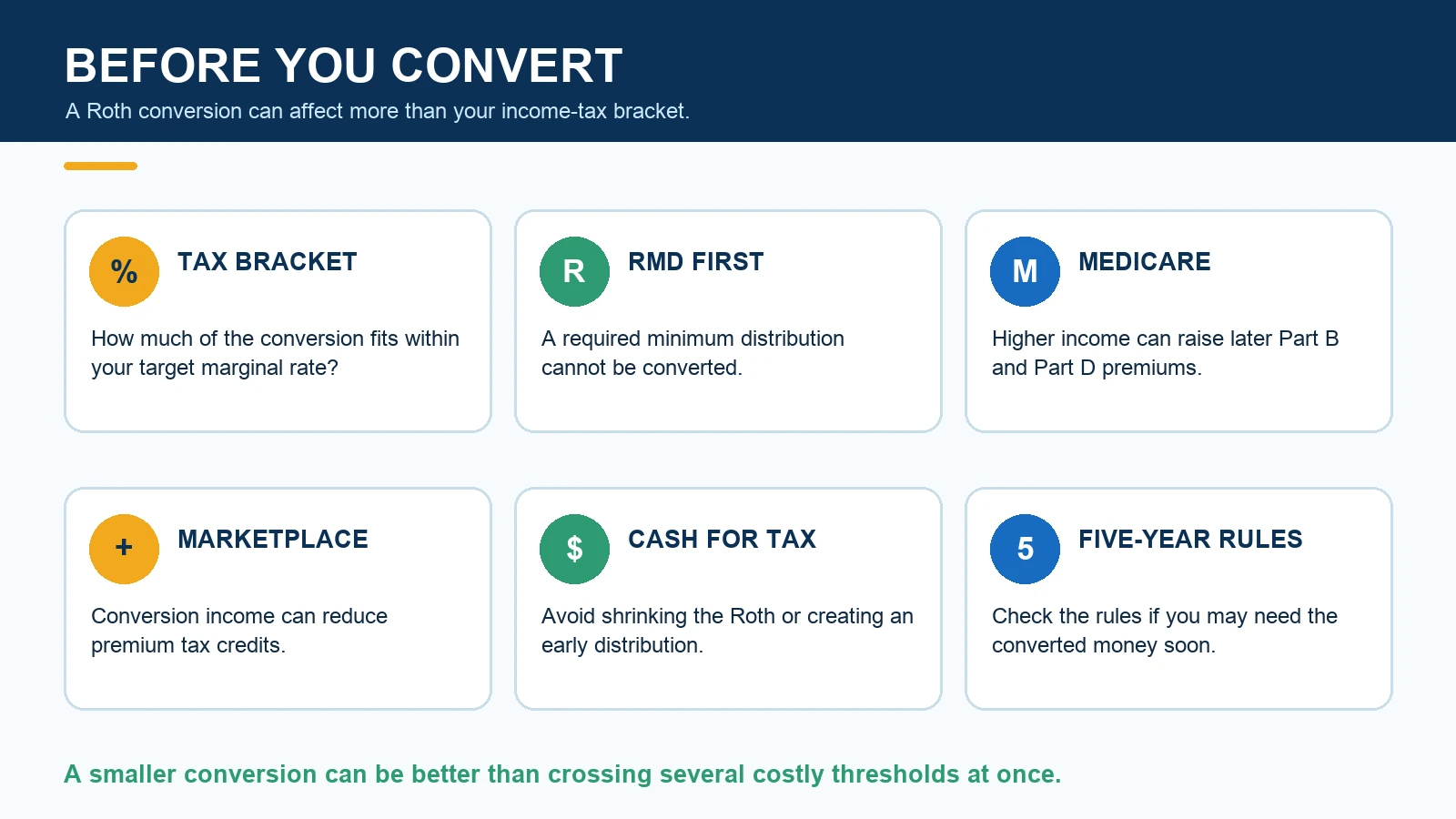
Roth conversions completed under current law cannot be recharacterized back to a traditional IRA. A market decline after the conversion does not let you reverse the transaction. This makes the amount and timing decision especially important.
RMD money cannot be converted
If an RMD is due for the year, distribute it before converting additional money. Trying to move the RMD into a Roth can create corrective work and potential penalties.
A larger conversion can cause secondary costs
Conversion income can increase the taxable portion of Social Security, reduce or eliminate some deductions or credits, expose more investment income to the net investment income tax and raise state income tax. It may also move long-term capital gains into a higher rate band even though the conversion itself is ordinary income.
If you use Marketplace health insurance, premium savings are based on expected annual household income. Report a material income change to the Marketplace. If you are on Medicare or approaching it, a conversion can increase income-related Part B and Part D premiums in a later year because Medicare generally uses an earlier tax return. Review how Medicare income-related premiums work, while confirming the current year’s thresholds directly with Medicare.
There are two Roth five-year concepts
One five-year rule helps determine whether Roth IRA earnings can be withdrawn as part of a qualified distribution. Separately, each taxable conversion can have its own five-year period for the early-distribution additional tax if converted principal is withdrawn before age 59½. Roth IRA ordering rules add another layer. Anyone who may need the money soon should get account-specific guidance before converting.
The December 31 deadline is real
A conversion must be completed by the end of the calendar year to count for that tax year. It does not use the following April’s IRA-contribution deadline. Custodians often impose earlier operational deadlines, so avoid waiting until the final days of December.
Check where the assets land
Many transfers arrive in a settlement fund. Confirm the desired investments after the money reaches the Roth. You can use the RetireNerd Compass planning tool to explore how account balances and withdrawals fit into a larger retirement plan, while remembering that its projections do not calculate your tax return.
When a conversion may be a poor fit
- You would need to use most of the converted money to pay the tax.
- The conversion would fall in an unusually high-income year.
- You expect a clearly lower marginal tax rate when the money is withdrawn.
- The added income would cause a large loss of health-insurance assistance or another important benefit.
- You may need the converted money soon and could run into five-year or early-distribution rules.
- You plan to give substantial IRA assets to charity; pretax money can sometimes be a more tax-efficient charitable asset.
- You have not resolved missing basis records, an RMD or inherited-account restrictions.
One large conversion or several smaller ones?
Smaller annual conversions can make tax costs easier to manage and allow the plan to adjust as income, markets and tax law change. A larger conversion may still make sense in an unusually low-income year or before a known income increase. Model both the immediate tax and the later withdrawal plan. The goal is not to eliminate every future pretax dollar; it is to improve lifetime after-tax flexibility.
A conversion should connect to a withdrawal strategy rather than stand alone. See retirement withdrawal strategies for the broader sequence of taxable, pretax and Roth accounts.
A practical final checklist
- Inventory every account and locate Form 8606 basis records.
- Project full-year federal and state income.
- Test a partial conversion and leave a buffer.
- Screen Medicare, Marketplace and other income-based effects.
- Take any required minimum distribution first.
- Open and verify the Roth destination.
- Request a direct transfer and confirm withholding instructions.
- Pay the tax from outside cash when practical.
- Invest the transferred assets.
- Save Forms 1099-R, 5498, 8606 and all confirmations.
Frequently asked questions
Do I have to convert the entire account?
No. Partial conversions are common and can help manage tax brackets and other income-based effects.
Is there an income limit for doing a Roth conversion?
There is no general income ceiling that prohibits a Roth IRA conversion. Income still matters because it determines the tax cost and related consequences.
Can I convert stock without selling it?
Some custodians allow an in-kind conversion of eligible investments. The fair market value transferred is used in the tax reporting. Ask both institutions whether the particular assets can move in kind.
Can I change my mind after the conversion?
A completed Roth conversion generally cannot be recharacterized or reversed. Verify the amount before authorizing it.
Should taxes be withheld from the conversion?
Many people prefer zero withholding and pay the tax from outside funds so the entire requested amount reaches the Roth. The right approach depends on cash flow, age, penalties and estimated-tax requirements.
Official resources
- IRS: IRA FAQs and Roth conversions
- IRS: Instructions for Form 8606
- IRS Publication 590-A: Contributions to IRAs
- IRS Publication 590-B: Distributions from IRAs
- IRS: Required minimum distributions
- IRS: Rollovers of after-tax plan contributions
- HealthCare.gov: Income used for Marketplace savings
Reviewed September 2026. This article provides general educational information, not individualized tax, investment or legal advice. Roth conversions are generally irreversible and can affect taxes, healthcare costs and other benefits. Verify current rules and consider working with a qualified tax professional before acting.