

An income annuity exchanges a lump sum for a stream of payments—often for life. In the right retirement plan, that trade can turn part of an uncertain portfolio into a dependable income floor. However, it also gives up liquidity, flexibility and some inheritance potential.
The useful question is not whether annuities are universally good or bad. Instead, ask whether a specific contract solves a specific income problem better than the alternatives.
The short answer
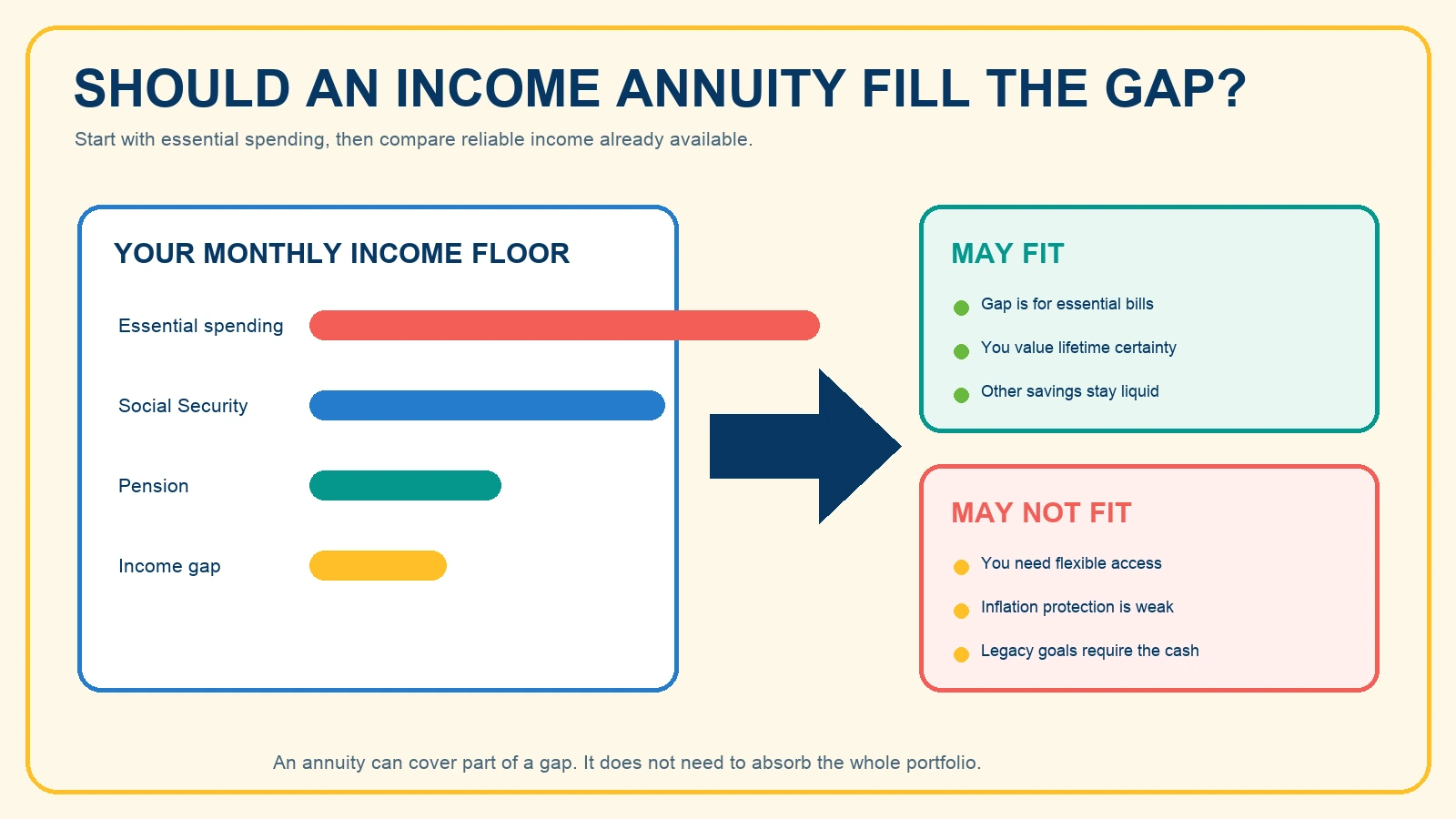
An income annuity may be useful when Social Security and pensions do not cover essential spending, you value predictable lifetime income and you can keep enough savings outside the contract. By contrast, it may be a poor fit when you need ready access to the money, face unstable expenses, prioritize leaving the principal to heirs or have not yet compared Social Security delay and other income strategies.
What is an income annuity?
An annuity is a contract with an insurance company. You pay a premium; in return, the insurer promises payments under the contract’s terms. An income annuity emphasizes the payout phase rather than investment accumulation.
Two common versions are:
- Single-premium immediate annuity (SPIA): You generally make one payment and begin receiving income within a year.
- Deferred income annuity (DIA): You buy future income now, but payments start years later. A longevity annuity beginning at an advanced age is one form.
These contracts differ from a deferred variable or indexed annuity sold mainly for accumulation. Moreover, an income rider attached to another annuity is not identical to irrevocably annuitizing a simple income contract. Therefore, compare the actual contract rather than relying on the word “annuity.”
How the trade works
Suppose you transfer $150,000 to an insurer. In exchange, the insurer quotes a monthly payment based on your age, interest rates, the start date and the payout option. A life-only payment usually pays more each month than a joint-life or refund option because the insurer has fewer potential payments to make.
Importantly, the quoted payment is not the same as investment yield. Part of each payment may represent a return of your own principal. In addition, people who die earlier help fund payments to those who live longer through insurance risk pooling.
The main payout choices
| Option | What it does | Main trade-off |
|---|---|---|
| Single life | Pays while one person is alive | Higher starting income, but payments can end at the first death |
| Joint and survivor | Continues while either covered person is alive | Protects two lives, but starts with a lower payment |
| Life with period certain | Pays for life, with a minimum period such as 10 years | Protects against very early death, but reduces monthly income |
| Cash or installment refund | Returns an unrecovered amount to beneficiaries under the contract | Supports legacy protection, but lowers the payment |
| Inflation-adjusted income | Payments rise by a stated percentage or formula | Starts lower and may still not match actual inflation |
Because payout elections can be difficult or impossible to reverse, compare them with your spouse or partner present. Also, obtain each quote in writing with the same premium and start date.
Why retirees consider income annuities
1. Lifetime income protects against outliving the money
A life annuity continues even if you live far beyond average life expectancy, subject to the insurer’s claims-paying ability. Consequently, it transfers some longevity risk from the household to the insurance company.
2. Predictability can simplify retirement spending
Regular income can cover housing, food, insurance or utilities without requiring a monthly withdrawal decision. As a result, some retirees find it easier to spend appropriately rather than underspending from fear.
3. Payments do not depend on this month’s market return
Once the contract is paying a fixed amount, a market decline does not directly reduce that promised payment. Therefore, the remaining portfolio may face less pressure to fund essential bills during a downturn.
4. Risk pooling can support more lifetime spending
A portfolio must remain available in case you live a long time. An insurer, however, pools many policyholders. That mortality pooling can produce lifetime payments that an individual bond ladder cannot duplicate on its own.
The disadvantages deserve equal weight
1. You may lose access to the principal
After annuitization, you generally cannot ask for the original premium back. Thus, money needed for home repairs, long-term care, family emergencies or a move should usually remain liquid.
2. Fixed payments lose purchasing power
A level $2,000 monthly payment buys less after years of inflation. Although an inflation feature can help, it commonly begins with a lower payment and may use a fixed increase that differs from actual inflation.
3. Early death can produce a disappointing result
With a life-only contract, payments may stop after an early death. Period-certain, joint-life and refund features address this risk; nevertheless, every added protection generally reduces the starting income.
4. The promise depends on the insurer
An annuity is not a bank deposit and is not insured by the FDIC. Instead, guarantees depend on the issuing insurer’s financial strength and claims-paying ability. State guaranty associations may provide limited protection under state law, but limits and eligibility vary. Therefore, do not treat guaranty coverage as a reason to ignore insurer quality or concentration.
5. Complexity can hide a poor comparison
Simple income annuities can be fairly direct. By contrast, contracts with indexes, caps, participation rates, market-value adjustments, bonuses or multiple riders require more analysis. In addition, commissions and compensation can influence recommendations even when charges are not shown as a separate line item.
Who may be a good fit?
- A retiree with an essential-income gap. Social Security and pensions cover part, but not all, of reliable monthly needs.
- Someone worried about longevity. Long life would place substantial pressure on the portfolio.
- A household that values simplicity. Predictable deposits matter more than keeping every dollar invested and accessible.
- A retiree with adequate liquid reserves. Emergency savings and flexible investments remain outside the annuity.
- Someone with limited pension income. An annuity can create a pension-like layer for part of the plan.
- A conservative spender who is afraid to use savings. Lifetime income may create permission to spend, provided the rest of the plan is sound.
When should you probably not consider one yet?
- You do not have an emergency reserve. First, preserve accessible cash for unpredictable costs.
- Your near-term spending is unstable. A move, major repair, family support or medical expense may require liquidity.
- Your health materially shortens expected longevity. In that case, a life-only contract may offer poor value, although household and survivor needs still matter.
- Leaving assets to heirs is a top priority. A refund feature can help, but it reduces income and may still be less flexible than retaining investments.
- You carry expensive debt. Paying high-interest debt may improve cash flow more directly.
- You have not evaluated Social Security timing. Delaying Social Security can provide a larger inflation-adjusted lifetime benefit and survivor protection, so compare it before buying private income.
- The sales presentation is rushed or unclear. Do not purchase a long-term contract you cannot explain in plain language.
- The proposed annuity would consume too much of the portfolio. Concentrating retirement assets in one illiquid contract can create a new risk while solving another.
How much might belong in an annuity?
Start with spending rather than a percentage of the portfolio. For example, assume essential spending is $5,800 per month and reliable Social Security plus pension income is $4,700. The gap is $1,100.
Next, request quotes for enough income to cover all or part of that gap. Meanwhile, keep money outside the annuity for emergencies, discretionary spending, inflation, healthcare and legacy goals. This “gap first” method avoids treating annuitization as an all-or-nothing decision.
Do not compare quotes by payment alone
A higher payment may reflect a single-life election, no refund, weaker inflation protection, a later start date or a different insurer. Therefore, every quote should use the same premium, age, start date and survivor terms.
Taxes depend on where the purchase money came from
Pretax retirement money
If an annuity is purchased inside a traditional IRA or other pretax retirement account, payments are generally taxable as ordinary income unless the account includes after-tax basis. Furthermore, placing an annuity inside an IRA does not create extra tax deferral; the IRA already provides it.
After-tax money
For a nonqualified income annuity bought with after-tax money, each payment can include a tax-free return of the investment and a taxable portion under the applicable IRS method. After the investment in the contract has been recovered, later payments may become fully taxable. Because tax treatment can be technical, review the insurer’s illustration and Form 1099-R treatment with a tax professional.
QLACs
A qualified longevity annuity contract, or QLAC, is a deferred income annuity that meets federal requirements and is purchased with eligible retirement-account money. It can delay income until a later age and receives special required-minimum-distribution treatment. However, the money generally becomes inaccessible, and death before payments begin may produce no benefit unless the contract includes survivor or refund protection.
Questions to ask before signing
- Is this a SPIA, DIA, QLAC or a different product with an income rider?
- Exactly when do payments start, and can that date change?
- Is the payment fixed, variable or inflation-adjusted?
- Does income last for one life, two lives or a fixed period?
- What happens if I die before or soon after payments begin?
- Can I access any principal after income starts?
- Which features lower the quoted monthly payment?
- What fees, commissions or compensation apply?
- What is the insurer’s current financial-strength rating from multiple rating agencies?
- What state guaranty-association protection may apply, and what are its limits?
- How will payments be taxed based on the funding account?
- What is the free-look period, and how do I cancel during it?
- Can I see quotes from several insurers using identical assumptions?
- How does this compare with delaying Social Security, a bond ladder or systematic portfolio withdrawals?
Alternatives and complements
An income annuity does not have to replace an investment portfolio. Instead, it can sit beside several other tools:
- Social Security delay: may increase inflation-adjusted lifetime and survivor income.
- Bond or Treasury ladder: creates scheduled cash flows while generally preserving more access and estate value.
- Systematic withdrawals: retain flexibility and growth potential, although payments are not guaranteed for life.
- Cash reserve: protects near-term spending without selling investments during a decline.
- Part-time work: can reduce early retirement withdrawals while preserving flexibility.
Often, a layered plan works better than a single product. For instance, Social Security and an annuity might cover core bills, while cash and investments fund inflation, travel, healthcare and bequests.
A practical way to decide
- Separate essential and flexible spending.
- Add reliable income already available. Include Social Security and pensions.
- Measure the essential-income gap.
- Set aside liquidity first. Include emergencies and major known expenses.
- Compare Social Security timing.
- Request matched quotes from multiple insurers.
- Stress-test inflation and early death.
- Review taxes, insurer strength and state protections.
- Use only the amount needed to solve the identified gap.
- Read the contract during the free-look period.
Ultimately, an income annuity is most useful as a targeted insurance decision. It may turn part of a portfolio into a lifetime paycheck; nevertheless, the value comes from the guarantee, not from keeping every future option open.
Related RetireNerd guides
- How to Create a Retirement Paycheck
- Which Accounts Should You Withdraw From First in Retirement?
- What Morningstar’s 3.9% Starting Safe Withdrawal Rate Means
- What Is a Brokerage Account?
- How to Convert Pretax Retirement Accounts to Roth
Official sources
- Investor.gov: Annuities
- Investor.gov: Variable annuities
- Investor.gov: Qualified longevity annuity contracts
- IRS Publication 939: General Rule for Pensions and Annuities
- IRS Publication 575: Pension and Annuity Income
- IRS Topic 410: Pensions and Annuities
This article provides general educational information, not a recommendation to buy or sell an insurance or investment product. Contract terms, insurer strength, state protections, taxes and suitability vary. Review the complete contract and consider advice from an independent fiduciary and qualified tax professional.