
Under the inherited IRA 10-year rule, most people who inherit an IRA now have 10 years to empty it, and many must take money out every year along the way. Here is how the rules work and how to keep more of the money.
Mark was 58 when his mother, Ruth, died in March 2025. She left him her traditional IRA, worth about $400,000.
Mark planned to leave the money alone, the way his mother had for years. Then his IRA company explained the rules. Mark had a deadline, and he had to take some money out every single year.
If you inherit an IRA from a parent, a friend, or anyone other than a spouse, the same rules probably apply to you. The good news is that they leave room to plan. Here is how they work, and how Mark can save about $23,000 in federal tax just by timing his withdrawals.
Key takeaways
- Most heirs other than a spouse must empty an inherited IRA by December 31 of the 10th year after the owner's death.
- If the owner had already started RMDs, you must also take a yearly minimum in years 1 through 9.
- Spouses, minor children, disabled or chronically ill heirs and heirs close in age to the owner can still stretch withdrawals.
- Spreading withdrawals into your lowest-income years can cut the tax, while one large final withdrawal usually costs the most.
The old stretch is gone for most heirs
Before 2020, a child who inherited an IRA could spread withdrawals over their whole life. The SECURE Act ended that for most heirs.
Now, if the owner died in 2020 or later, the account must be empty by December 31 of the 10th year after the death. Ruth died in 2025, so Mark’s deadline is December 31, 2035.
Who still gets more time
A short list of heirs, called eligible designated beneficiaries, can still stretch withdrawals over their own lifetime:
- A surviving spouse
- The owner’s minor child, until age 21. After that, the 10-year clock starts.
- Someone who is disabled or chronically ill
- Anyone no more than 10 years younger than the owner, such as a brother or sister close in age
Everyone else, including adult children and grandchildren, follows the 10-year rule.
Do you have to take money out every year?
That depends on whether the owner had started taking their own required minimum distributions, or RMDs.
- If the owner died before their RMDs began, you can withdraw whenever you like, as long as the account is empty by the end of year 10.
- If the owner had already started RMDs, you must also take a minimum each year in years 1 through 9.
Ruth was 84 and had taken RMDs for years, so Mark owes a yearly minimum starting in 2026.
To figure it, he looks up his age in the IRS Single Life Expectancy Table once. In 2026 he is 59, and his number is 28.0. After that, he subtracts 1 each year. So his first minimum is $400,000 divided by 28.0, or $14,286. Next year, he divides by 27.0.
The IRS waived penalties for missed yearly withdrawals from 2021 through 2024 while it finished these rules. Starting in 2025, the 25% penalty for a missed RMD applies. For how RMDs work for your own accounts, see Required Minimum Distributions, Explained.
Two mistakes to avoid in the first months
Don’t move the money into your own IRA. Unless you are the spouse, the money must go into an inherited IRA titled in the owner’s name for your benefit. Ask for a direct transfer. If the money lands in your bank account, all of it may be taxable at once, and you can’t put it back.
Check the year-of-death RMD. If your parent hadn’t taken their RMD for the year they died, you have to take it. Call the IRA company early and ask.
Timing your withdrawals to cut the tax
Every dollar Mark takes from a traditional inherited IRA counts as taxable income. So when he withdraws matters as much as how much.
Mark and his wife both work until he retires at 62, in 2029. Here are three ways he could handle the $400,000:
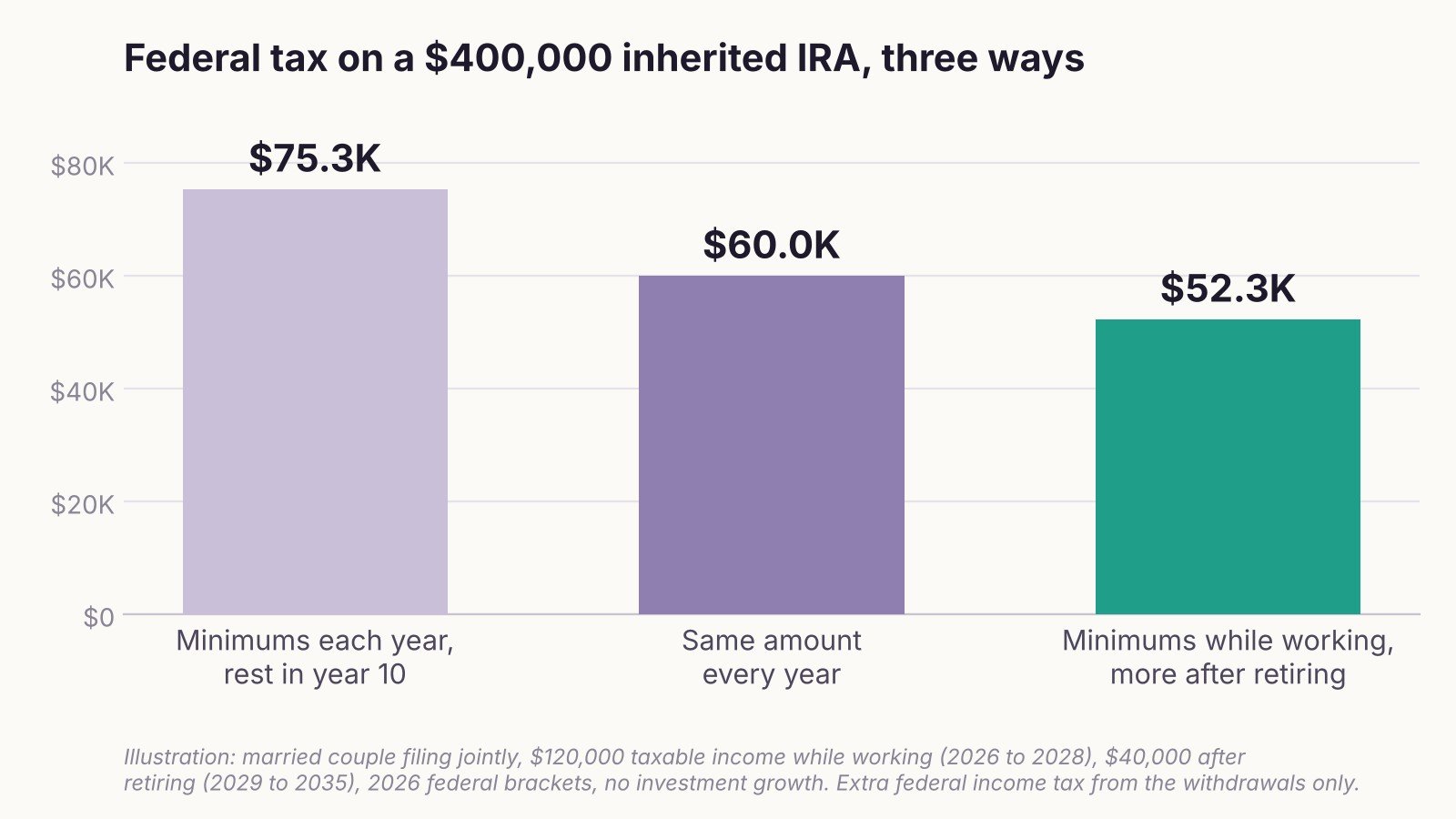
Taking only the minimums and leaving the rest for 2035 is the most expensive choice. That one big final withdrawal pushes most of the money into the 22% and 24% tax brackets.
Taking the same $40,000 every year is better. The best plan for Mark is to take just the minimum while he is still working, then take larger amounts after he retires, when his income is lower. That keeps every withdrawal from 2029 on in the 12% bracket and saves about $23,000 compared with waiting.
Your numbers will differ, but the idea is the same: spread the withdrawals out and lean on your lowest income years. Our guide How Taxes Affect Your Retirement Withdrawals explains how tax brackets work.
If you inherited a Roth IRA
The 10-year deadline still applies, but there are no yearly minimums. Withdrawals are usually tax free if the Roth was open for at least five years. Many heirs let it keep growing and empty it near the end of year 10.
If your spouse left you the IRA
Spouses have the most choices. You can roll the account into your own IRA and treat it as yours, which often makes sense if you are 59½ or older. If you are younger and need the money, keeping it as an inherited IRA lets you withdraw without the 10% early withdrawal penalty. You can still roll it into your own IRA later.
If you are the one leaving an IRA
Two moves help your heirs. Keep your beneficiary forms up to date, because they override your will (see Estate Planning Basics). And consider Roth conversions in lower income years, so your children inherit tax free money instead of a tax bill. The Roth Conversion Window Before RMDs walks through how.
Frequently asked questions
Do I pay the 10% early withdrawal penalty if I’m under 59½?
No. Withdrawals from an inherited IRA never carry the 10% early withdrawal penalty, whatever your age. You still owe income tax on withdrawals from a traditional IRA.
Is the inheritance itself taxed as income?
No. You owe income tax only on what you take out of a traditional inherited IRA, in the year you take it.
My siblings and I inherited one IRA. What should we do?
Ask the IRA company to split it into separate inherited IRAs, ideally by December 31 of the year after the death. Each of you then controls your own withdrawals and taxes. The 10-year deadline stays the same for everyone.
Your next step
If you have inherited an IRA, write down three things today: the year the owner died, whether they had started RMDs, and your deadline, which is the year of death plus 10. Then sketch your withdrawals year by year, aiming to take more in your lowest income years.
That is what Mark did. He takes the minimum for now, and he already has a plan for 2029, the year his paycheck stops and his IRA withdrawals get cheaper.
Educational note: This article is general education, not individualized tax, legal, or financial advice. Inherited IRA rules depend on the date of death, the owner’s age, the type of account, and your relationship to the owner. The example uses 2026 federal tax brackets, ignores investment growth and state taxes, and is for illustration only. A tax professional or financial advisor can help you build a plan for your own situation.
