Through Medicare drug price negotiation, Medicare now sets lower prices for some of its most expensive drugs. Here is which drugs cost less, when the new prices start, and why the price Medicare pays is not always the price you pay at the pharmacy.
Linda and Frank are neighbors, both 68, both on Medicare drug plans. Linda uses Trelegy Ellipta for COPD. Frank takes Tradjenta for type 2 diabetes. In January 2027, Medicare’s price for both drugs drops by more than 70%.
Linda’s plan charges her 25% of the drug’s price after her deductible, so her share falls from about $160 a month to about $44. Frank’s plan charges a flat $47 copay for Tradjenta, so his bill stays exactly the same. Same program, same month, very different results.
The difference comes down to how each plan sets your share. That’s what this guide will help you check before open enrollment ends on December 7.
Key takeaways
- Medicare drug price negotiation sets lower Medicare prices for some costly brand-name drugs, and 15 more drugs get new prices on January 1, 2027.
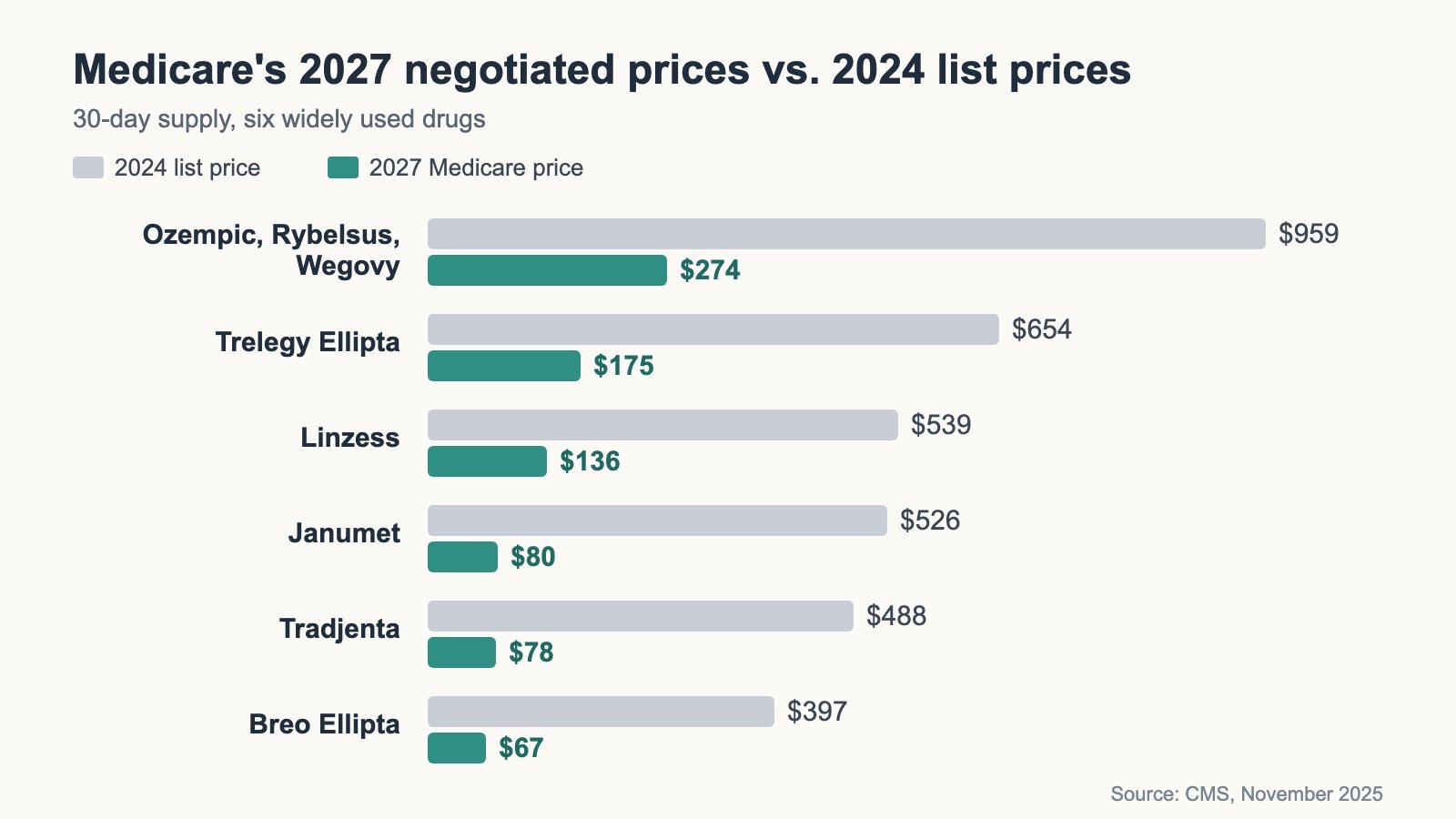
- The 2027 list includes Ozempic, Rybelsus and Wegovy, whose Medicare price falls to $274 a month from a $959 list price.
- The negotiated price is what Medicare pays, not your copay; people who pay coinsurance or are in their deductible usually save the most.
- Read your plan’s Annual Notice of Change and compare plans by December 7 to see what you will actually pay in 2027.
What Medicare drug price negotiation is
The Inflation Reduction Act of 2022 gave Medicare the power to negotiate prices directly with drug companies for the first time. Each year, the Centers for Medicare & Medicaid Services (CMS) picks brand-name drugs that cost Medicare the most and have no generic or biosimilar competition, then negotiates a lower price for them.
The law calls the result a “maximum fair price.” It’s the price Medicare drug plans use for that drug for people with Medicare. After the first year, the price is adjusted only for inflation unless Medicare renegotiates it.
| Round | Drugs | New prices start |
|---|---|---|
| First | 10 Part D drugs, including Eliquis, Jardiance, Xarelto and Januvia | January 1, 2026 |
| Second | 15 Part D drugs, including Ozempic, Wegovy and Trelegy Ellipta | January 1, 2027 |
| Third | 15 drugs, the first round to include Part B drugs given in a doctor’s office | January 1, 2028 |
The new prices apply only to people with Medicare. If you have employer coverage or pay cash, nothing changes.
What’s new for 2027: the 15 drugs
In 2024, about 5.3 million of the 53 million people with Medicare drug coverage used at least one of these 15 drugs. CMS estimates the new prices will save people with Medicare about $685 million in out-of-pocket costs once they take effect in 2027.
| Drug | Commonly used for | 2024 list price | 2027 Medicare price | Cut |
|---|---|---|---|---|
| Ozempic, Rybelsus, Wegovy | Type 2 diabetes; heart disease risk with obesity | $959 | $274 | 71% |
| Trelegy Ellipta | Asthma, COPD | $654 | $175 | 73% |
| Xtandi | Prostate cancer | $13,480 | $7,004 | 48% |
| Pomalyst | Multiple myeloma, Kaposi sarcoma | $21,744 | $8,650 | 60% |
| Ofev | Idiopathic pulmonary fibrosis | $12,622 | $6,350 | 50% |
| Ibrance | Breast cancer | $15,741 | $7,871 | 50% |
| Linzess | Chronic constipation, IBS with constipation | $539 | $136 | 75% |
| Calquence | Chronic lymphocytic leukemia, mantle cell lymphoma | $14,228 | $8,600 | 40% |
| Austedo, Austedo XR | Huntington’s chorea, tardive dyskinesia | $6,623 | $4,093 | 38% |
| Breo Ellipta | Asthma, COPD | $397 | $67 | 83% |
| Xifaxan | Hepatic encephalopathy, IBS with diarrhea | $2,696 | $1,000 | 63% |
| Vraylar | Bipolar disorder, depression, schizophrenia | $1,376 | $770 | 44% |
| Tradjenta | Type 2 diabetes | $488 | $78 | 84% |
| Janumet, Janumet XR | Type 2 diabetes | $526 | $80 | 85% |
| Otezla, Otezla XR | Psoriasis, psoriatic arthritis, Behçet’s disease | $4,722 | $1,650 | 65% |
Why your copay may not drop
A lower Medicare price helps you only when your share is tied to the price. How your plan charges you for a drug decides that:
- Coinsurance. You pay a percentage, such as 25%. When the price drops, your share drops with it. This is where most of the savings land.
- Deductible. Until you meet your plan’s deductible (up to $700 in 2027), you pay the plan’s full price for the drug. A lower price means a smaller bill in those early months.
- Flat copay. You pay a set amount, such as $47. The lower price doesn’t change it unless your plan lowers the copay or moves the drug to a cheaper tier.
- Extra Help. If you get Extra Help, your copays are already low and fixed, so you may see little change.
Two other rules still apply. Your plan’s formulary, its list of covered drugs, sorts drugs into tiers that set your cost. And in 2027, once you spend $2,400 out of pocket on covered drugs, you pay nothing more for the rest of the year. Someone who already hits that cap may not save much on a drug they take all year.
One protection is new. Every Medicare drug plan, including Medicare Advantage plans with drug coverage, must include the negotiated drugs on its formulary. Plans still choose the tier, and they can require prior authorization.
Ozempic, Wegovy and the $50 weight-loss program
The Ozempic family is the biggest item on the 2027 list. In 2024, about 2.3 million people with Medicare used it, and Part D spending on it totaled $15.2 billion.
Two other developments affect these drugs:
- A separate $245 price. Novo Nordisk, which makes all three drugs, also agreed to a $245 Medicare price for semaglutide, the drug in Ozempic, Rybelsus and Wegovy, in a separate deal with the White House. How the $245 and $274 prices fit together had not been fully settled when this guide was written.
- The Medicare GLP-1 Bridge. By law, Medicare drug plans don’t cover drugs used only for weight loss. A temporary program running from July 1, 2026, through December 31, 2027, lets eligible people get Wegovy, Zepbound KwikPen or Foundayo for weight management for a $50 monthly copay.
To qualify for the Bridge, you need a Medicare drug plan, your prescriber must get prior authorization, and you must meet body mass index (BMI) and health criteria. The $50 doesn’t count toward your deductible or your $2,400 yearly cap, and Extra Help can’t be used to lower it.
What to do before December 7
Open enrollment runs from October 15 through December 7. Any change you make starts January 1, the same day the new prices begin.
- Check the list. See whether you take any of the 15 drugs in the table above.
- Read your Annual Notice of Change. Your plan mailed it by September 30. Look for your drugs, their 2027 tiers, the deductible and the premium.
- Find how you pay. Note whether each drug has a copay or coinsurance, and whether the deductible applies to it.
- Run a comparison. Enter your exact drugs and doses in the Medicare Plan Finder at Medicare.gov. It estimates your total yearly cost in each plan using 2027 prices.
- Get free help. Your State Health Insurance Assistance Program (SHIP) offers free, unbiased plan reviews. If money is tight, check whether you qualify for Extra Help.
Our step-by-step guide to comparing Medicare Part D plans walks through the Plan Finder screen by screen.
What’s coming in 2028
The third round adds 15 more drugs, and for the first time it includes Part B drugs given in a doctor’s office or clinic. The list includes Trulicity, Biktarvy, Orencia, Cosentyx, Erleada, Kisqali, Entyvio, Verzenio, Botox, Lenvima, Xolair, Rexulti, Xeljanz, Anoro Ellipta and Cimzia. Tradjenta, from the 2027 list, is being renegotiated.
CMS must publish those prices by November 30, 2026, and they take effect January 1, 2028. We’ll add them here when they’re released.
Frequently asked questions
Do I need to sign up to get the negotiated price?
No. If you have a Medicare drug plan, your plan uses the negotiated price automatically when you fill the prescription. Your share depends on your plan’s copay or coinsurance for that drug.
Will my drug plan premium go down?
Not necessarily. Each plan sets its own premium every year. Check the premium in your Annual Notice of Change and compare it with other plans.
Does this help if I have Medicare Advantage?
Yes, if your Medicare Advantage plan includes drug coverage. Those plans must cover the negotiated drugs too, and the same copay and coinsurance rules decide what you pay.
Can my plan stop covering a negotiated drug?
No. Medicare drug plans must include every drug with a negotiated price on their formulary. A plan can still place it on a higher tier or require prior authorization, so check the details each year.
Your next step
Before December 7, open your Annual Notice of Change, circle every drug you take, and run your list through the Medicare Plan Finder. Ten minutes now can show whether a lower price reaches your pharmacy bill or stays with your plan.
Linda kept her plan, because the lower price flows straight to her. Frank found a plan that puts Tradjenta on a lower tier with a $12 copay, a better deal than his current $47. He switched before December 7.
Related reading: retirement numbers for 2027, Medicare Savings Programs and Extra Help and IRMAA, the Medicare income surcharge.
Educational note: This article is general education, not personal advice about your health coverage. Plan costs, tiers and rules vary, and the 2027 prices come from CMS’s November 2025 announcement. Check your own plan documents, Medicare.gov or your State Health Insurance Assistance Program before changing coverage, and talk with your doctor or pharmacist about your medications. Linda and Frank are illustrative examples; their costs are rounded and based on list prices.
Sources
- CMS: Selected drugs and negotiated prices
- CMS: Negotiated prices for initial price applicability year 2027 (November 2025)
- CMS: Selected drugs for initial price applicability year 2028 (January 2026)
- National Council on Aging: The Medicare GLP-1 Bridge program
- Medicare.gov: Medicare Plan Finder
- State Health Insurance Assistance Programs (SHIP)