Your state can take a bigger bite of your retirement income than you expect, or none at all. Here is which states tax Social Security, pensions and IRA withdrawals in 2026, and what to check before you move.
Ray and Denise live in Minnesota. When they retire next year, they plan to move two hours south to Iowa, near their daughter. They assumed the move would change their winters, not their taxes.
It changes both. Minnesota taxes their pensions and IRA withdrawals and can tax part of their Social Security at their income. Iowa taxes none of those for people 55 and older. Same income, same couple, a very different state tax bill.
Key takeaways
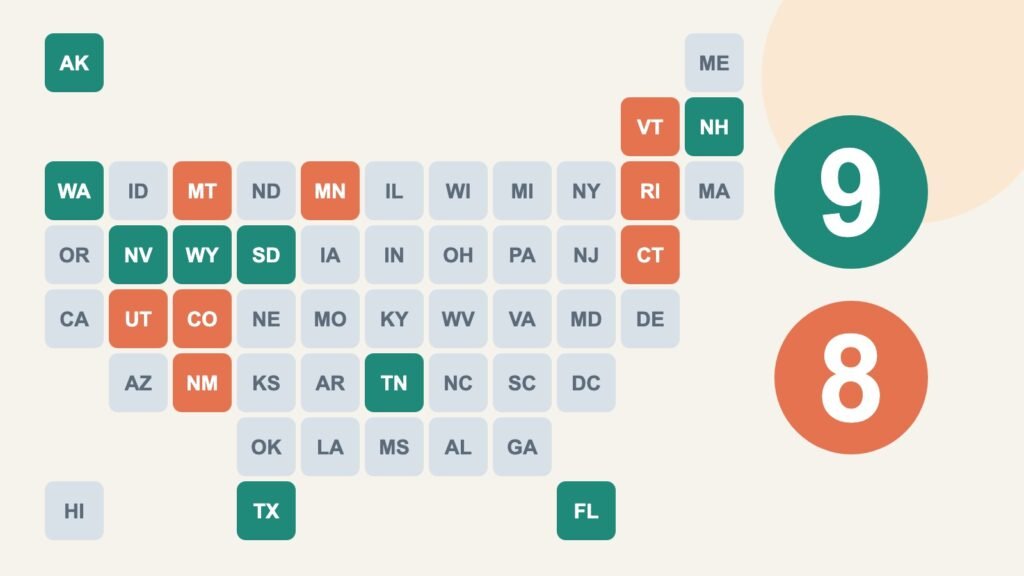
- Nine states have no tax on wages or retirement income: Alaska, Florida, Nevada, New Hampshire, South Dakota, Tennessee, Texas, Washington and Wyoming.
- In 2026, only eight states tax Social Security benefits, and most of them exempt retirees with low or moderate incomes.
- Illinois, Iowa (at 55+), Mississippi and Pennsylvania exempt nearly all pension and IRA income, while many other states exclude part of it.
- Once you move, federal law generally stops your old state from taxing your pension or IRA withdrawals.
What states tax differently
Federal tax rules are the same everywhere. State rules are not. Three kinds of retirement income get very different treatment:
- Social Security. Most states leave it alone. Eight still tax part of it in 2026.
- Pensions and IRA or 401(k) withdrawals. This is where states differ most. Some exempt them completely, many exclude a set amount, and others tax them like wages.
- Investment income. Interest, dividends and capital gains are taxed by every state that has an income tax.
A state’s income tax is only part of the picture. Property taxes, sales taxes and, in some states, estate or inheritance taxes can matter as much.
The nine states with no income tax on retirement income
Alaska, Florida, Nevada, New Hampshire, South Dakota, Tennessee, Texas, Washington and Wyoming do not tax wages, Social Security, pensions or IRA withdrawals. Two notes:
- New Hampshire used to tax interest and dividends. That tax ended after 2024.
- Washington taxes large long-term capital gains on things like stocks above a high yearly threshold. Retirement accounts and your home are not part of that tax.
No income tax does not always mean low taxes. Some of these states make up for it with high property or sales taxes, so compare the full cost of living. Our list of the best states to retire weighs cost, health care and quality of life.
The eight states that tax Social Security in 2026
West Virginia finished phasing out its tax on Social Security in 2026, which leaves eight states. Each one exempts some or most retirees:
| State | How it works in 2026 |
|---|---|
| Colorado | Fully deductible at 65+. Younger retirees can deduct it under income limits or within the state’s retirement subtraction. |
| Connecticut | Exempt if your income is under $75,000 (single) or $100,000 (married filing jointly). Above that, at least 75% is exempt. |
| Minnesota | Exempt below income limits ($86,410 single, $110,780 married filing jointly), then the exemption phases down. |
| Montana | Taxed much like the federal rules, with a senior subtraction at 65+. |
| New Mexico | Exempt if your income is $100,000 or less (single) or $150,000 or less (married filing jointly). |
| Rhode Island | Exempt at full retirement age if your income is below the state’s yearly limit. |
| Utah | Taxed, but a credit cancels the tax for moderate incomes. |
| Vermont | Exempt below the state’s income limits, partly exempt a little above them. |
In practice, most middle-income retirees in these states pay little or no state tax on their Social Security. How much of it is taxable federally is a separate question, covered in how Social Security benefits are taxed.
States that go easy on pensions and IRA withdrawals
Four states exempt nearly all pension and IRA income for retirees: Illinois, Iowa (at 55 and older), Mississippi and Pennsylvania (once you retire).
Several others exclude a large amount. Georgia excludes up to $65,000 per person at 65, Kentucky $31,110, Wisconsin up to $24,000 per person at 67, and New York $20,000 at 59 1/2. Michigan completed its phase-in in 2026, so most retirees can deduct pension and IRA income up to a yearly limit. Connecticut and New Jersey exempt most of it for people under their income limits.
Watch the fine print. Some states exempt only government or employer pensions and tax IRA withdrawals, including Hawaii, Kansas, Massachusetts and Maryland. Most states also exempt military retirement pay fully or in large part.
State-by-state table
This table shows how each state treats Social Security and pension and IRA income in 2026; the nine states with no income tax are marked as such. “Excluded” amounts are per person unless noted, and most come with age or income conditions. Use it to narrow your choices, then check the details with the state’s tax department.
| State | How it taxes retirement income in 2026 |
|---|---|
| Alabama | Social Security: exempt Pensions and IRAs: traditional pensions exempt; IRA and 401(k) withdrawals taxed above $6,000 at 65+ |
| Alaska | No income tax |
| Arizona | Social Security: exempt Pensions and IRAs: taxed; small exclusion for government pensions |
| Arkansas | Social Security: exempt Pensions and IRAs: first $6,000 excluded |
| California | Social Security: exempt Pensions and IRAs: taxed |
| Colorado | Social Security: taxed, with exemptions Pensions and IRAs: up to $20,000 (ages 55 to 64) or $24,000 (65+) excluded |
| Connecticut | Social Security: taxed, with exemptions Pensions and IRAs: pensions and IRA withdrawals exempt below income limits |
| Delaware | Social Security: exempt Pensions and IRAs: up to $12,500 excluded at 60+ |
| District of Columbia | Social Security: exempt Pensions and IRAs: taxed |
| Florida | No income tax |
| Georgia | Social Security: exempt Pensions and IRAs: up to $35,000 (62 to 64) or $65,000 (65+) excluded per person |
| Hawaii | Social Security: exempt Pensions and IRAs: employer pensions exempt; IRA and 401(k) withdrawals taxed |
| Idaho | Social Security: exempt Pensions and IRAs: taxed; deduction for some government pensions |
| Illinois | Social Security: exempt Pensions and IRAs: exempt |
| Indiana | Social Security: exempt Pensions and IRAs: taxed; small deduction for federal civil service pensions |
| Iowa | Social Security: exempt Pensions and IRAs: exempt at 55+ |
| Kansas | Social Security: exempt Pensions and IRAs: private pensions and IRAs taxed; most public pensions exempt |
| Kentucky | Social Security: exempt Pensions and IRAs: up to $31,110 excluded |
| Louisiana | Social Security: exempt Pensions and IRAs: about $12,000 excluded at 65+; government pensions exempt |
| Maine | Social Security: exempt Pensions and IRAs: partial deduction, reduced by Social Security and limited by income |
| Maryland | Social Security: exempt Pensions and IRAs: partial exclusion at 65+ for employer plans (not IRAs), reduced by Social Security |
| Massachusetts | Social Security: exempt Pensions and IRAs: private pensions and IRAs taxed; government pensions exempt |
| Michigan | Social Security: exempt Pensions and IRAs: deductible up to a yearly limit; 2026 is the first year the phase-in is complete |
| Minnesota | Social Security: taxed, with exemptions Pensions and IRAs: taxed |
| Mississippi | Social Security: exempt Pensions and IRAs: exempt |
| Missouri | Social Security: exempt Pensions and IRAs: public pensions largely deductible; small, income-limited deduction for private pensions and IRAs |
| Montana | Social Security: taxed, with exemptions Pensions and IRAs: taxed; senior subtraction at 65+ |
| Nebraska | Social Security: exempt Pensions and IRAs: taxed |
| Nevada | No income tax |
| New Hampshire | No income tax |
| New Jersey | Social Security: exempt Pensions and IRAs: large exclusion at 62+ if total income is $150,000 or less |
| New Mexico | Social Security: taxed above income limits Pensions and IRAs: taxed; small 65+ exemption for low incomes |
| New York | Social Security: exempt Pensions and IRAs: $20,000 excluded at 59 1/2+; government pensions exempt |
| North Carolina | Social Security: exempt Pensions and IRAs: taxed, except some government pensions vested before August 1989 |
| North Dakota | Social Security: exempt Pensions and IRAs: taxed |
| Ohio | Social Security: exempt Pensions and IRAs: taxed; small income-limited credits |
| Oklahoma | Social Security: exempt Pensions and IRAs: first $10,000 excluded |
| Oregon | Social Security: exempt Pensions and IRAs: taxed |
| Pennsylvania | Social Security: exempt Pensions and IRAs: exempt once you retire |
| Rhode Island | Social Security: taxed, with exemptions Pensions and IRAs: up to $50,000 of pensions excluded at full retirement age, below income limits (IRAs not included) |
| South Carolina | Social Security: exempt Pensions and IRAs: up to $10,000 deducted at 65+, plus a separate 65+ deduction |
| South Dakota | No income tax |
| Tennessee | No income tax |
| Texas | No income tax |
| Utah | Social Security: taxed, with a credit Pensions and IRAs: taxed |
| Vermont | Social Security: taxed, with exemptions Pensions and IRAs: taxed; small exclusion for some public pensions |
| Virginia | Social Security: exempt Pensions and IRAs: taxed; age deduction at 65+, limited by income |
| Washington | No income tax: capital gains tax on large gains |
| West Virginia | Social Security: exempt (from 2026) Pensions and IRAs: taxed; $8,000 excluded at 65+ |
| Wisconsin | Social Security: exempt Pensions and IRAs: up to $24,000 per person excluded at 67+ |
| Wyoming | No income tax |
If you plan to move in retirement
Where you live on paper decides which state taxes you. A few rules help:
- Your old state usually cannot follow your pension. A 1996 federal law bars states from taxing pension, 401(k) and IRA payments made to people who no longer live there. Wages and some deferred pay for work still done in the state are different.
- Make the move official. Change your driver’s license, voter registration, car registration and mailing address, and spend most of the year in the new state. States with high taxes sometimes audit people who claim to have left.
- Expect two part-year returns in the year you move, one for each state.
- Time big income for after the move. If you are moving to a lower-tax state, a Roth conversion or a large IRA withdrawal may cost less once you live there. See the Roth conversion window between retirement and RMDs.
- Count the home sale. Selling your old home is mostly tax-free federally for many people, but the state may tax any gain above the federal exclusion. See the $250,000 and $500,000 home sale exclusion.
A quick way to compare two states
- List your expected yearly income by type: Social Security, pensions, IRA and 401(k) withdrawals, and investment income.
- For each state, mark which of those it taxes and any exclusion you would qualify for at your age.
- Add property tax on the home you would buy and a rough sales tax estimate.
- Check whether the state has an estate or inheritance tax. See estate planning basics.
- Plug the results into the Retirement Income and Budget Calculator to see the difference in spendable income.
Frequently asked questions
Which states do not tax Social Security?
In 2026, every state except Colorado, Connecticut, Minnesota, Montana, New Mexico, Rhode Island, Utah and Vermont. Most of those eight exempt Social Security for retirees with low or moderate incomes.
Does my state tax my 401(k) withdrawals?
If your state has an income tax, it usually treats 401(k) and traditional IRA withdrawals like pension income. Some states exempt all of it, many exclude a set amount, and others tax it in full. Roth withdrawals that are tax-free federally are generally tax-free for states too.
Can my old state tax my pension after I move?
Generally no. Federal law bars a state from taxing pension and retirement account payments to people who are no longer residents.
Is military retirement pay taxed?
Most states exempt military retirement pay fully or in large part. A handful, such as California and the District of Columbia, still tax most or all of it.
Do these rules change often?
Yes. Several states cut rates or added retirement exclusions in 2025 and 2026. We review this guide every fall.
Educational note: This article is general education, not tax advice. State tax laws change often, many exclusions depend on age, income and the type of pension, and this summary leaves out details such as local income taxes. Ray and Denise are an illustrative example. Check your state’s department of revenue or ask a CPA or enrolled agent who prepares returns in your state before making a move or a large withdrawal.
Sources
- Tax Foundation: State tax changes taking effect January 1, 2026
- Kiplinger: States that tax Social Security benefits in 2026
- 4 U.S. Code section 114: Limitation on state income taxation of certain pension income
- Minnesota Department of Revenue: Inflation-adjusted amounts for 2026
- Connecticut Office of Legislative Research: Taxation of retirement income
- Wisconsin Department of Revenue: Publication 106, Wisconsin tax information for retirees
- Michigan Office of Retirement Services: Public Act 4 of 2023 FAQ
- West Virginia Tax Division: Social Security phase-out
- Iowa Department of Revenue: Retirement income exclusion