

A spouse, or even an ex-spouse, can collect Social Security spousal benefits based on a partner’s work record. Here is how much you can get, when to claim, and what changed for public workers in 2025.
Diane spent years at home raising three kids, then worked part time. Her own Social Security benefit at full retirement age is $1,000 a month. Her husband, Rick, worked full time for 40 years. His benefit at full retirement age is $2,800.
Diane assumed $1,000 was all she would get. It isn’t. As Rick’s wife, she can collect up to half of his full benefit, or $1,400 a month. That is $400 more a month, or nearly $5,000 a year, that she would never have claimed if she hadn’t asked.
Spousal benefits are one of the most overlooked parts of Social Security. Here is how they work for married couples and for divorced spouses.
Key takeaways
- A spouse can get up to half of the worker’s benefit at full retirement age, and Social Security pays the higher of that or the spouse’s own benefit.
- Claiming at 62 can cut the spousal benefit by up to 35%, and waiting past full retirement age does not raise it.
- An ex-spouse married at least 10 years can claim on the former partner’s record without reducing that person’s benefit.
- Since 2025, a government pension no longer reduces spousal benefits, so former teachers and public workers should check whether they now qualify.
How the spousal benefit works
A spousal benefit lets you collect up to 50% of your spouse’s benefit at their full retirement age, the age when Social Security pays 100% of what you’ve earned. For anyone born in 1960 or later, that age is 67.
You don’t get your own benefit plus half of your spouse’s. Social Security pays your own benefit first, then adds a top-up if half of your spouse’s amount is higher. For Diane, that is her own $1,000 plus a $400 top-up, for $1,400 in total.
To qualify, you generally need to:
- Have been married for at least one year
- Be at least 62, or be caring for your spouse’s child who is under 16 or has a disability
- Have a spouse who has already filed for their own benefit
That last rule surprises couples. If Rick waits until 70 to claim, Diane can’t get her $400 top-up until he files. She can still start her own benefit earlier.
Your age when you claim matters
You can claim a spousal benefit as early as 62, but it shrinks. For people born in 1960 or later, a spousal benefit taken at 62 is cut by 35%, while your own retirement benefit is cut by 30%.
And when you file, Social Security looks at both benefits at once. You can’t take your own benefit early and switch to the spousal one later at full value. This is called deemed filing, and it applies to everyone born on or after January 2, 1954.
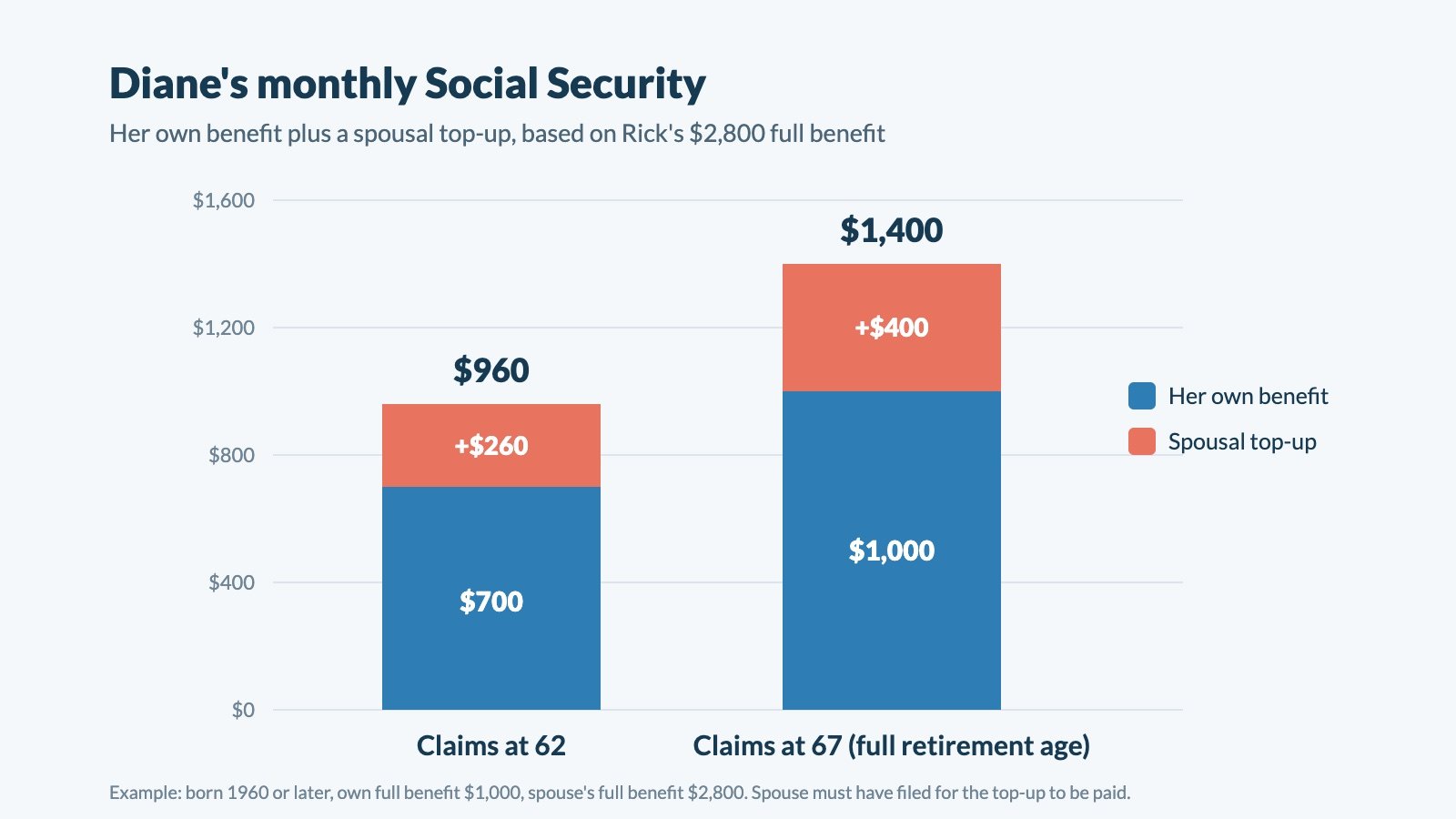
Waiting past full retirement age raises your own benefit, but not the spousal top-up. So the higher earner usually has more to gain from delaying than the lower earner does.
Here is a detail that matters later. Diane’s spousal amount is based on Rick’s full benefit, even if he claims early. But if Rick dies first, Diane’s survivor benefit is based on what Rick was actually receiving. When the higher earner waits to claim, the surviving spouse is better protected. Our survivor checklist explains that part.
Benefits for divorced spouses
Divorce doesn’t erase the work record you shared. You may be able to collect on an ex-spouse’s record if:
- Your marriage lasted at least 10 years
- You are unmarried now
- You and your ex are both at least 62
- Your own benefit is smaller than half of your ex’s full benefit
You don’t need your ex to have filed, as long as you’ve been divorced for at least two years. Your claim doesn’t lower your ex’s benefit or their new spouse’s benefit, and payments to ex-spouses don’t count toward the family maximum. Several ex-spouses can each claim on the same record.
If you remarry, you generally lose benefits on your ex’s record, unless the new marriage also ends. Survivor rules are kinder: a divorced widow or widower who remarries after 60 can still collect.
Good news for teachers and public workers
For decades, a rule called the Government Pension Offset cut spousal and survivor benefits for people with a pension from work that didn’t pay into Social Security, such as many teachers, police officers and some federal and state employees. Often it wiped the spousal benefit out completely.
The Social Security Fairness Act, signed in January 2025, ended that rule and the related Windfall Elimination Provision for benefits payable after December 2023. By July 2025, Social Security had sent more than 3.1 million back payments totaling $17 billion.
If you never applied for spousal benefits because you were told your pension would cancel them, apply now. Back payments for a new application are limited, so waiting can cost you money.
If you still work
Before full retirement age, earnings above a yearly limit reduce benefits. In 2026, Social Security holds back $1 for every $2 you earn above $24,480. The money isn’t lost: your benefit is recalculated upward at full retirement age. The worker’s earnings can also reduce what the spouse receives on that record, so couples who both still work should check before claiming early.
Frequently asked questions
Does my spousal benefit lower my spouse’s check?
No. Your spouse receives their full benefit. The spousal benefit is paid on top of the record, not taken out of it.
Will my ex find out if I claim on their record?
Social Security doesn’t tell your ex, and your claim doesn’t change their payments. You will need your ex’s Social Security number or other details, such as their date of birth, so Social Security can find the record.
Can I get Medicare through my spouse?
Yes. If you didn’t work long enough to get premium-free Part A on your own, you may qualify at 65 through a spouse’s or ex-spouse’s work record. See Medicare for married couples.
What if I’m the higher earner?
Your claiming age shapes your spouse’s future. Delaying raises your own check and, if you die first, the survivor benefit your spouse keeps for life.
Your next step
Both spouses should sign in to my Social Security at ssa.gov and write down their benefit at full retirement age. Then try our spousal benefit calculator to see how claiming ages change your household income. If you’re divorced after a long marriage, call Social Security and ask what you could get on your ex’s record.
Diane did. She and Rick now plan for her to claim at 67 and for Rick to wait until 70, which gives them more income now and gives Diane a bigger check if she outlives him.
Related reading: claiming at 62, 67 or 70 and how Social Security calculates your benefit.
Educational note: This article is general education, not individualized financial or legal advice. Spousal and divorced-spouse rules have exceptions, and figures use 2026 Social Security rules and a full retirement age of 67. Diane and Rick are an illustrative example. Social Security (800-772-1213) or a financial planner can help you compare claiming options for your household.
Sources
- Social Security: Who can get family benefits
- Social Security: What you could get from family benefits
- Social Security: Retirement age and benefit reduction
- Social Security: Benefits on a former spouse’s record
- Social Security: Social Security Fairness Act (WEP and GPO) update
- Social Security blog: Social Security Fairness Act milestone (July 2025)
- Social Security: 2026 cost-of-living adjustment fact sheet
