


Medicare at 65 — What Do I Need to Do?
Medicare can feel complicated, but you do not need to learn everything at once. Start with when you need to enroll, whether you can delay, and what each part actually does.
Start with the Medicare timeline
For most people, the important Medicare decisions happen before, around, and after age 65.
Get Ready
Know your enrollment window and whether employer coverage lets you delay.
Enroll or Confirm You Can Delay
Your Initial Enrollment Period lasts seven months around your 65th birthday.
Review Your Coverage
Understand annual enrollment windows and when you can make changes.
What are you trying to figure out?
Jump straight to the Medicare question that matters most to you.
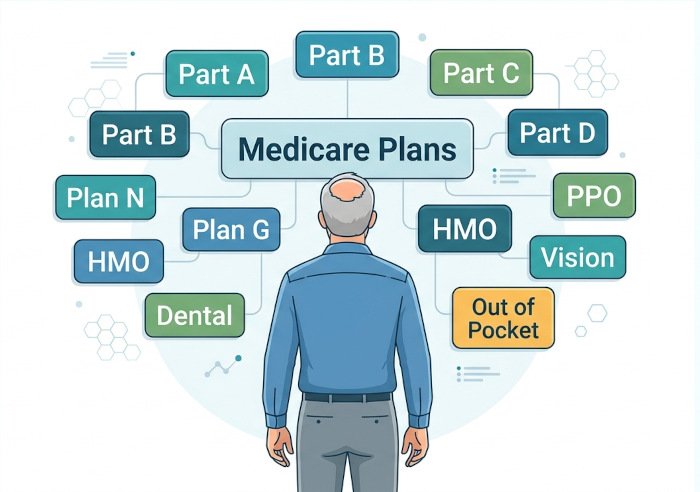
Your 6 Medicare decisions
| Part | Covers | 2026 cost snapshot |
|---|---|---|
| Part A — Hospital | Inpatient hospital stays, skilled nursing, hospice, some home health | Usually premium-free if you (or a spouse) paid Medicare taxes for 10+ years; $1,736 deductible per benefit period |
| Part B — Medical | Doctor visits, outpatient care, preventive services, durable medical equipment | $202.90/month standard premium (income-adjusted), $283 annual deductible, then typically 20% coinsurance |
| Part C — Medicare Advantage | A private-plan alternative that bundles Parts A + B (usually D too), often with extra benefits like dental/vision/hearing | Premiums vary by plan; uses a network, unlike Original Medicare |
| Part D — Prescription drugs | Outpatient prescription drugs, via a standalone plan or bundled into Medicare Advantage | Premiums vary by plan (income-adjusted) |
There's also Medigap (Medicare Supplement) — optional private insurance that only works alongside Original Medicare (A+B), designed to cover the ~20% coinsurance Part B leaves you owing. It's cheapest and easiest to get within 6 months of starting Part B, when insurers must sell it to you regardless of health (guaranteed issue) — after that window, they can medically underwrite you in most states.
Your Initial Enrollment Period (IEP) is a 7-month window centered on your 65th birthday: the 3 months before, your birthday month, and the 3 months after.
- Enroll in the first 3 months and coverage starts the month you turn 65.
- Enroll during your birthday month or the 3 months after and coverage starts the month after you sign up — so waiting inside your own IEP can still cost you a coverage gap.
This is the single most common Medicare mistake. The answer depends entirely on your employer's size.
| Your situation | What to do |
|---|---|
| Employer has 20 or more employees, you're actively working, and covered by that group plan | You can delay Part B (and Part A, if you'd owe a premium) without penalty. The employer plan pays first; Medicare would be secondary if you had it. |
| Employer has fewer than 20 employees | Medicare becomes primary at 65 regardless of work status — you generally need to enroll in both A and B at 65 to avoid coverage gaps, since the small-employer plan will assume Medicare is paying first. |
| You're on COBRA or retiree coverage (not active employment) | Neither counts as creditable coverage for delaying Part B. Enroll in Medicare at 65 on schedule. |
When qualifying employer coverage ends, an 8-month Special Enrollment Period (SEP) opens, starting the month after employment or the coverage ends, whichever is first. Enroll within that window and you avoid the late penalty.
| Part | Penalty | Duration |
|---|---|---|
| Part B | +10% of the standard premium for each full 12-month period you were eligible but not enrolled (and lacked creditable coverage) | For as long as you have Part B — potentially for life |
| Part D | +1% of the national base premium for each month without creditable drug coverage | For as long as you have Part D — potentially for life |
| Part A (if you owe a premium) | +10% for twice the number of years you delayed | Limited duration (not for life) |
"Creditable coverage" means health or drug coverage that's at least as good as Medicare's — active employer coverage from a large employer qualifies; COBRA and most retiree plans do not count for Part B purposes (though retiree drug coverage often does count for Part D).
If your income is above certain thresholds, you pay more for Part B and Part D — this surcharge is called IRMAA (Income-Related Monthly Adjustment Amount). It's based on your Modified Adjusted Gross Income from your tax return two years prior — your 2026 premium is based on your 2024 return.
2026 IRMAA brackets (Part B, monthly)
| Single filer MAGI | Married filing jointly MAGI | Monthly Part B |
|---|---|---|
| $109,000 or less | $218,000 or less | $202.90 (standard) |
| Up to $137,000 | Up to $274,000 | ~$284 |
| Up to $171,000 | Up to $342,000 | ~$406 |
| Up to $205,000 | Up to $410,000 | ~$528 |
| Under $500,000 | Under $750,000 | ~$649 |
| $500,000+ | $750,000+ | ~$690 |
Part D carries a comparable surcharge on top of your plan's own premium, using the same income brackets.
| Window | Dates | What you can do |
|---|---|---|
| Annual Enrollment Period (AEP) | Oct 15 – Dec 7 | Switch Medicare Advantage or Part D plans for the following year |
| Medicare Advantage Open Enrollment | Jan 1 – Mar 31 | If already in a Medicare Advantage plan, switch to a different one or back to Original Medicare (once) |
| General Enrollment Period (GEP) | Jan 1 – Mar 31 | Enroll in Part B if you missed your IEP and don't qualify for a Special Enrollment Period — coverage starts the month after you enroll, but late penalties likely apply |