

What if your retirement paycheck could respond to the market without changing every month? Guyton-Klinger guardrails create a spending lane: enjoy a raise when the portfolio grows far ahead, accept a planned cut when it falls too far behind, and otherwise keep moving.
That flexibility is the attraction—and the price. Guardrails may support more initial spending than a rigid inflation-adjusted method in some analyses, but only because the retiree agrees in advance to spend less when the plan becomes strained. A high starting withdrawal is not made safe by giving it a clever name.
Guardrails in one minute
- Choose a first-year withdrawal amount.
- Divide that withdrawal by the current portfolio balance each year.
- If the percentage rises above the upper guardrail, reduce spending.
- If the percentage falls below the lower guardrail, increase spending.
- If it stays between the rails, follow the normal scheduled withdrawal.
What are Guyton-Klinger guardrails?
Financial planner Jonathan Guyton introduced retirement-income decision rules in 2004. Guyton and William Klinger expanded and tested them in a 2006 Journal of Financial Planning paper. The approach is dynamic: withdrawals respond to the relationship between current spending and the portfolio that remains.
The original research contained more than two guardrail triggers. It also included rules governing inflation increases and which investments supplied withdrawals. Many modern calculators use “Guyton-Klinger guardrails” to describe the central spending rules: an upper capital-preservation rail and a lower prosperity rail. Compass lets you model that core idea through three settings:
- Initial withdrawal rate: the percentage withdrawn in the first year.
- Guardrail band: how far the current withdrawal rate may move from the starting rate before action occurs.
- Spending adjustment: the size of the raise or cut after a rail is crossed.
A simple $1 million example
Assume someone retires with $1 million and chooses:
- 5% initial withdrawal rate
- 20% guardrail band
- 10% spending adjustment
The first withdrawal is $50,000. A 20% band around the 5% starting rate creates:
- Upper rail: 6%—20% higher than 5%.
- Lower rail: 4%—20% lower than 5%.
The words “upper” and “lower” describe the withdrawal rate, not the portfolio value. A falling portfolio pushes the withdrawal rate upward. A growing portfolio pushes it downward.
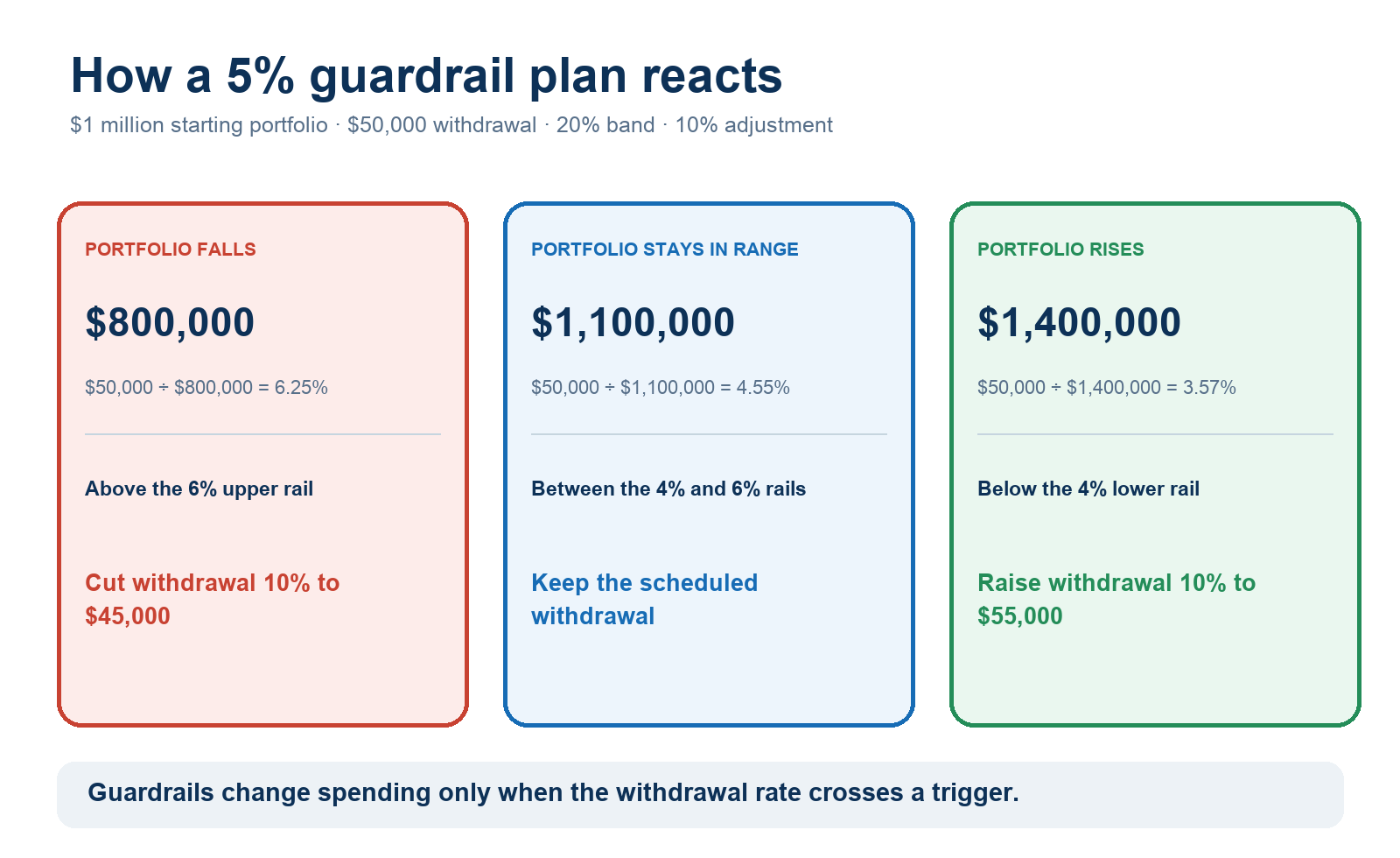
If the portfolio falls to $800,000
The scheduled $50,000 withdrawal equals 6.25% of the portfolio. That is above the 6% upper rail, so the capital-preservation rule reduces the withdrawal by 10%, from $50,000 to $45,000.
If the portfolio is $1.1 million
The $50,000 withdrawal equals about 4.55%. That remains between 4% and 6%, so neither guardrail triggers.
If the portfolio rises to $1.4 million
The $50,000 withdrawal equals about 3.57%. That is below the 4% lower rail, so the prosperity rule raises the withdrawal by 10%, from $50,000 to $55,000.
The calculation is usually repeated at a set annual review. The raise or cut applies to the withdrawal amount—not to the portfolio balance—and the next review begins from the adjusted spending level under the method being modeled.
What happens with inflation?
A plain fixed-real withdrawal normally increases the prior dollar amount with inflation every year. The original Guyton framework added an inflation rule: after a negative portfolio year, the retiree could skip the inflation increase, subject to conditions in the published method. That is a real spending cut even though the dollar withdrawal does not fall.
Calculator implementations vary. Some reproduce the original inflation and portfolio-management rules; others focus on the upper and lower spending rails. When using Compass, treat the displayed assumptions and results as the definition of the scenario you tested. Do not assume every online tool with the same label performs every original rule identically.
How guardrails differ from other withdrawal methods
| Method | How the paycheck changes | Main strength | Main tradeoff |
|---|---|---|---|
| Fixed inflation-adjusted income | Starts with a dollar amount and generally raises it with inflation | Predictable lifestyle target | Does not automatically respond to portfolio stress |
| Constant percentage | Withdraws the same percentage of the current portfolio | Automatically reduces depletion risk | Income can swing sharply every year |
| Guyton-Klinger guardrails | Spending changes only after preset rails are crossed | Balances stability with responsiveness | Requires real cuts after poor outcomes |
| Floor-and-upside approach | Reliable income covers essentials; investments fund flexible spending | Protects core bills | May require annuities, pensions or more conservative assets |
| Required minimum distributions | Tax law sets minimum distributions from applicable accounts | Satisfies a tax requirement | Not designed as a complete spending strategy |
Why would someone choose guardrails?
You want permission to spend more when the plan is strong
A rigid withdrawal can leave a cautious retiree underspending for decades while the portfolio grows. The prosperity rail turns some of that strength into a planned raise instead of waiting until the end of life to discover that more could have been enjoyed or given away.
You can reduce discretionary spending
Guardrails fit a household with flexible travel, gifts, dining, hobbies or home projects. A 10% cut is manageable when it comes from wants. It is much harder when nearly every withdrawal pays for housing, food, insurance and healthcare.
You prefer rules to market predictions
The method does not ask whether the market will rise next year. It asks whether today’s withdrawal has become too large or unusually small relative to the portfolio. The response was chosen before fear or excitement arrived.
You are retiring for a long time
A 30- or 40-year retirement can contain many market and inflation environments. A flexible rule can adapt rather than pretending the assumptions made on retirement day will remain right forever.
The disadvantages people underestimate
- The cuts are real. A 10% reduction turns $60,000 into $54,000. Taxes and essential bills may not fall with it.
- Inflation can make a freeze painful. Keeping the same dollar amount after a high-inflation year buys less.
- A higher starting rate is not free. Historical or simulated success may depend on accepting future cuts.
- Results depend on assumptions. Returns, inflation, fees, taxes, allocation, longevity and review timing all matter.
- Rules can trigger more than once. A prolonged decline may lead to repeated reductions.
- Households can resist cuts. It is easy to promise flexibility before retirement and difficult to cancel travel or family support later.
- The method can become complicated. Inflation rules, rebalancing, tax accounts and Social Security timing must still work together.
- It does not guarantee success. Guardrails manage risk; they cannot eliminate extreme markets, very long life or unexpectedly high spending.
A relatable household budget
Sam needs $72,000 a year after tax. Social Security and a pension cover $36,000. The portfolio must provide the other $36,000.
If the guardrail calls for a 10% portfolio-withdrawal cut, the withdrawal falls by $3,600—not $7,200—because reliable income is outside the portfolio rule. Sam identifies $5,000 of flexible travel and hobby spending before adopting the strategy. A $3,600 cut is uncomfortable but possible without touching housing, food or insurance.
That is the test: translate the percentage into an actual household decision. If you cannot name what would be reduced, the guardrail is not usable.
How to model Guardrails in Compass
- Build the complete spending estimate. Include taxes, healthcare, repairs and irregular expenses.
- Enter reliable income at the correct starting ages. Social Security and pensions reduce what the portfolio must provide.
- Select Guardrails (Guyton-Klinger).
- Choose the initial withdrawal rate. Do not select it from a headline; test it against your time horizon, allocation and spending flexibility.
- Choose the guardrail band. A narrower band reacts sooner. A wider band tolerates more drift before changing spending.
- Choose the spending adjustment. Translate 5%, 10% or another setting into dollars.
- Run the Monte Carlo projection. Review success, difficult markets, low points and spending changes.
- Run historical and bad-timing tests. See how the same rules behave through actual sequences and reversed returns.
- Compare with other withdrawal modes. Use the same household data so the method is the only major change.
- Write down the cut. Name which expenses would change if the upper rail triggers.
How the settings change behavior
| Setting change | Likely effect |
|---|---|
| Higher initial withdrawal rate | More income now, with greater pressure and potentially more cuts later |
| Narrower guardrail band | Earlier and potentially more frequent adjustments |
| Wider guardrail band | More stable spending until the portfolio moves farther from plan |
| Larger adjustment percentage | Fewer dollars withdrawn after a cut and a larger raise after prosperity |
| More flexible spending | Greater ability to follow the rule when it matters |
Who may be a good fit?
- A retiree with meaningful discretionary spending.
- Someone comfortable reviewing the plan annually.
- A household with Social Security or pensions covering most essential bills.
- Someone who values more spending when markets are strong.
- A retiree willing to follow preset rules during stressful markets.
Who may prefer another method?
- Someone whose portfolio withdrawal pays nearly all essential expenses.
- A household needing a highly predictable paycheck.
- A retiree unlikely to reduce spending after a decline.
- Someone who does not want annual calculations or decisions.
- A household whose taxes, legacy goal or income products require a more customized plan.
The plain-English conclusion
Guyton-Klinger guardrails trade a perfectly steady retirement paycheck for a controlled one. You stay in the lane during ordinary markets, cut spending when withdrawals strain the portfolio, and take a raise when the portfolio moves comfortably ahead.
The method works only when the household can live with both sides of that promise.
Continue with RetireNerd
- Model Guardrails in Compass
- Compare Retirement Withdrawal Strategies
- How Much Cash Should I Keep in Retirement?
- Build Your Retirement Roadmap
Sources
- Jonathan Guyton (2004): Decision Rules and Portfolio Management for Retirees
- Jonathan Guyton and William Klinger (2006): Decision Rules and Maximum Initial Withdrawal Rates
- William Klinger (2007): Using Decision Rules to Create Retirement Withdrawal Profiles
This article provides general education, not individualized financial, investment or tax advice. Examples are simplified and hypothetical. Guardrails do not guarantee that a portfolio will last. Results depend on market returns, inflation, fees, taxes, allocation, longevity, spending and the exact rules implemented.