
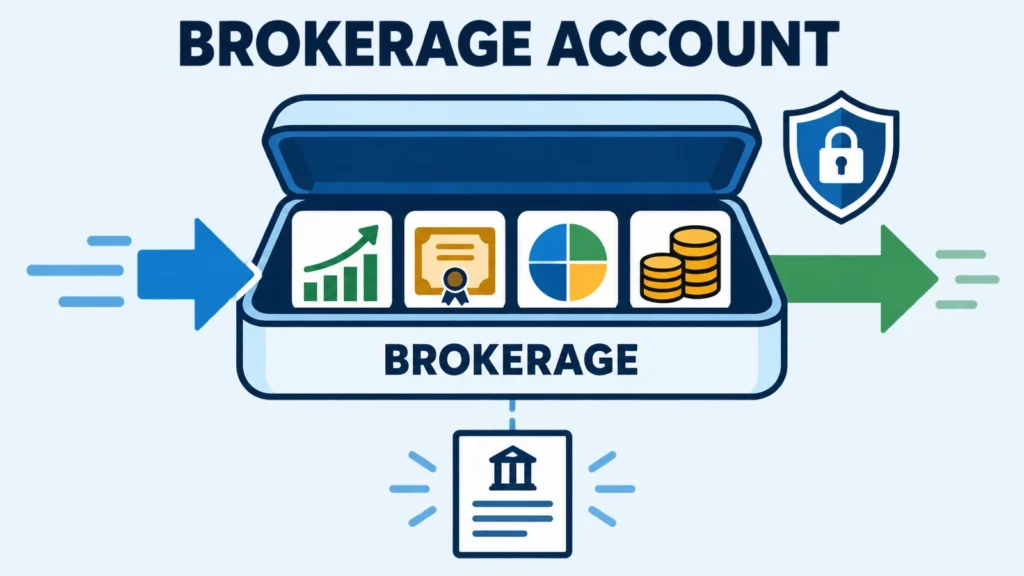
A brokerage account is a flexible account used to buy and hold investments such as stocks, bonds, exchange-traded funds and mutual funds. It has no retirement-age requirement and generally no annual contribution limit—but it also does not provide the same tax shelter as a 401(k), traditional IRA or Roth IRA.
That flexibility makes a brokerage account useful for goals before and during retirement. It can hold money for a home purchase many years away, early retirement, supplemental retirement spending, charitable gifts or any other goal that is too long-term for a savings account but should remain accessible before normal retirement-account rules allow easy withdrawals.
The plain-English definition
The brokerage account is the container. The investments are what you put inside it.
Opening the account does not invest the money. Cash transferred into it may sit in a sweep account until you choose investments. The value can rise or fall after it is invested.
How a brokerage account works
- You open an account with a brokerage firm.
- You link a bank account or transfer investments from another firm.
- You deposit cash.
- You choose what to buy.
- The brokerage holds the investments and records purchases, sales, dividends and other activity.
- You can generally sell investments and withdraw available cash without a retirement-age restriction.
- You receive tax forms for reportable activity.
A standard individual or joint brokerage account is often called a taxable brokerage account. “Taxable” does not mean the entire balance is taxed every year. Taxes generally arise from interest, dividends, capital-gain distributions and gains realized when investments are sold for more than their adjusted cost basis.
How it complements other accounts
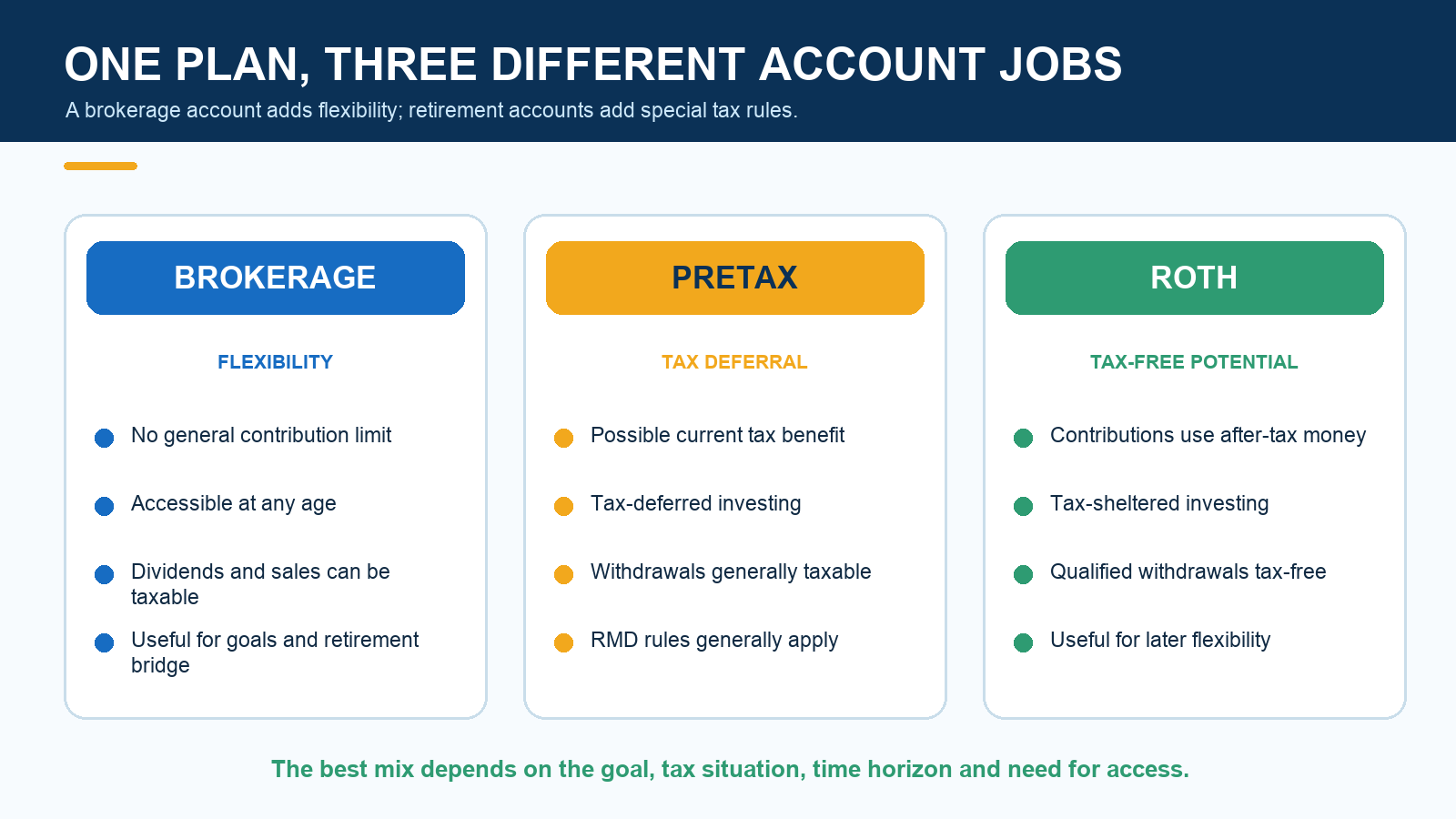
| Feature | Taxable brokerage | Traditional 401(k) or IRA | Roth account |
|---|---|---|---|
| Contribution deduction | Generally none | May receive pretax or deductible treatment, depending on the account and eligibility | Generally none |
| Annual contribution limit | No general federal contribution limit | Yes | Yes |
| Access | Generally available at any age after trades settle | Restrictions and possible additional tax can apply before eligible ages | Rules vary by Roth IRA or workplace plan and by contribution, conversion or earnings |
| While invested | Interest, dividends and fund distributions may be taxable; sales can create gains or losses | Tax generally deferred inside the account | Tax generally sheltered inside the account |
| Withdrawals | Withdrawing cash is not itself the taxable event; selling for a gain may be | Generally taxable when distributed | Qualified withdrawals generally federally tax-free |
| Required minimum distributions | No | Generally yes under current rules | Generally none for the original Roth owner under current rules |
A brokerage account usually belongs alongside emergency savings and retirement accounts. It should not replace a cash reserve because stocks can decline exactly when money is needed. It also should not cause you to miss valuable employer matching contributions. The guide to choosing between an emergency fund and a 401(k) explains that foundation.
Why use a brokerage account?
- Flexible access. There is no retirement-age gate for ordinary withdrawals.
- No general contribution ceiling. It can accept additional savings after retirement accounts are funded or when income rules limit another account.
- A wider investment menu. You are not limited to an employer plan’s selected funds.
- Support for goals before retirement. It can fund a distant home purchase, career break, education, early retirement or other long-term goal.
- Tax-planning opportunities. Long-term capital gains may receive different federal treatment than ordinary income, and losses may offset gains subject to tax rules.
- Retirement flexibility. Taxable assets can help cover spending while managing IRA withdrawals, Roth conversions and income-related healthcare costs.
- Estate and charitable planning. Appreciated investments may be donated or transferred, although tax and estate rules require individual guidance.
When it may deserve priority
A brokerage account often becomes more useful after you have:
- Built an appropriate emergency fund
- Captured the full employer match when available
- Created a plan for high-interest debt
- Used available tax-advantaged accounts to the extent that fits your goals
- Identified a goal that needs flexibility before retirement age
This is not a universal order. Someone planning to retire at 50 may deliberately build a large taxable bridge account while still contributing to retirement plans. Someone behind on retirement saving may emphasize the 401(k) and IRA first. If retirement accounts are the immediate decision, see Roth or Traditional 401(k)?
What can you invest in?
| Investment | What it provides | Main cautions |
|---|---|---|
| Broad stock index fund or ETF | Ownership in many companies and long-term growth potential | Can lose substantial value; overlapping funds may reduce apparent diversification |
| International stock fund | Exposure outside the United States | Market, political and currency risks |
| Bond fund | Income and potential portfolio stability | Interest-rate and credit risk; distributions are often taxable |
| Individual Treasury or bond | Defined maturity and promised payments if the issuer performs | Credit, inflation, interest-rate and reinvestment risks |
| Money market mutual fund | Cash-like holding for settlement or near-term use | Yield changes; it is an investment fund, not the same as an FDIC-insured bank deposit |
| Individual stock | Direct ownership in one company | Concentration risk and potentially severe or permanent loss |
| Real estate investment trust or REIT fund | Real-estate exposure and income | Rate sensitivity, sector concentration and potentially tax-inefficient distributions |
| Options or leveraged products | Specialized strategies and exposure | Complexity, expiration, leverage and losses that may exceed expectations; unsuitable for many beginners |
Availability varies by broker. Some firms also offer fractional shares, certificates of deposit, municipal bonds, commodities, cryptocurrency access and alternative investments. Availability does not make an investment appropriate. A simple diversified portfolio is enough for many people. RetireNerd’s three-fund portfolio guide explains one straightforward structure.
How to open a brokerage account
1. Choose the account owner
An individual account has one owner. A joint account has two or more owners, but the legal ownership and what happens at death depend on the registration and state law. Trust, custodial and business accounts have different authority and tax-reporting requirements. Do not choose a joint registration casually.
2. Compare brokerage firms
- Is the firm registered, and is it a SIPC member?
- What account, trading, fund, advisory, transfer and closing fees apply?
- Which investments are available without transaction fees?
- Does it support recurring deposits and automatic investing?
- How is uninvested cash handled, and what yield and protection apply?
- Can you choose specific tax lots when selling?
- What tax reports and cost-basis tools are provided?
- Are two-factor authentication, security keys and a trusted contact available?
- Can you transfer the account in kind if you leave?
- Are you opening a brokerage account or paying for an advisory account?
Read the firm’s Form CRS relationship summary and check the firm and any investment professional through Investor.gov before opening the account.
3. Gather the information
The application commonly requests your name, address, date of birth, Social Security or taxpayer identification number, government identification, employment information, financial profile, investment experience, objectives, risk tolerance, time horizon and liquidity needs. You may also name a trusted contact whom the firm can contact in limited situations without giving that person trading authority.
4. Choose cash—not margin—unless you deliberately need borrowing
In a cash account, you pay the full purchase price. A margin account permits borrowing against securities and can magnify losses, incur interest and allow the firm to sell investments without consulting you when equity falls. Some applications default to margin. A beginner who does not intend to borrow should confirm that the account is cash-only and that margin has not been enabled.
5. Review the cash sweep
Uninvested cash may be placed in a bank sweep, money market mutual fund or another cash program. Compare the yield, fees, access and whether FDIC or SIPC treatment applies. A broker may have a financial incentive to use one sweep option, and the default may pay much less than another available choice.
6. Link the bank and add beneficiaries or transfer-on-death instructions
Verify the linked bank with a small transfer if appropriate. Add beneficiary or transfer-on-death instructions when the account and state rules permit them, and coordinate those instructions with the estate plan.
How to invest after the account is open
- Name the goal. Write down the amount, date and acceptable risk.
- Keep near-term money safer. Money needed within a few years generally should not depend on a stock-market recovery.
- Choose an asset allocation. Decide the percentages for stocks, bonds and cash-like investments.
- Use diversified, understandable holdings. A few broad, low-cost funds may accomplish more than a crowded portfolio.
- Automate deposits and purchases. Make sure recurring cash is actually invested rather than accumulating in the sweep account.
- Choose dividend treatment. Reinvesting can compound automatically, while taking cash may support spending. Reinvested dividends remain taxable when received in a taxable account.
- Rebalance deliberately. New deposits can correct the allocation without selling and creating gains.
- Review annually. Check allocation, cost, taxes, beneficiaries, security and progress toward the goal.
Moving cash into the account is only half the job
A funded brokerage account can remain entirely in cash. After every deposit or transfer, confirm whether an investment purchase occurred. This is especially important after moving an account, receiving a dividend or selling an investment.
Taxes to understand
Interest and dividends
Interest and nonqualified dividends are generally taxed as ordinary income. Qualified dividends may receive long-term capital-gain rates when the requirements are met. A dividend reinvestment is still reportable income even though no cash reaches your bank account.
Capital gains and losses
Selling an investment above its adjusted cost basis generally creates a capital gain; selling below basis creates a loss. Federal treatment usually depends on whether the position was held for more than one year. Your state may treat gains differently. Capital losses can offset capital gains, and a limited amount may offset other income under current rules, with unused losses generally carried forward.
Cost basis and tax lots
Cost basis begins with what you paid and may be adjusted by reinvested distributions, stock actions, wash sales and other events. When selling part of a position, the selected tax lot can change the gain. Review the broker’s default—often first in, first out—and consider specific-share identification when appropriate. Keep records, especially for older or transferred positions whose basis may be missing.
Wash sales can cross accounts
The wash-sale rule can disallow a loss when you buy substantially identical securities within the period beginning 30 days before and ending 30 days after the loss sale. Automatic dividend reinvestment, a spouse’s purchase or activity in another account can create a problem. A replacement purchase in an IRA can be especially unfavorable because the disallowed loss may not increase recoverable basis in the same way it would in a taxable account. Coordinate tax-loss harvesting across the entire household.
Mutual funds can distribute gains you did not create
A mutual fund may make a taxable capital-gain distribution even if you did not sell shares and even if the fund’s price fell. Before buying late in the year, check the fund’s distribution schedule. ETFs often—but not always—have fewer capital-gain distributions.
Important cautions
- SIPC does not insure market value. Protection applies in a qualifying brokerage failure, subject to limits and eligibility. It does not reimburse an investment loss.
- “Commission-free” does not mean free. Funds have expense ratios, options have contract fees, bonds can have markups, advice can carry an asset-based fee and transfers may cost money.
- A brokerage account is not an emergency fund by default. Trade settlement, bank-transfer time and market losses can make invested money unavailable at the needed value.
- Margin adds leverage. Losses, interest and forced sales can compound quickly.
- Concentration can hide. Several funds may own the same large companies.
- Cash can remain idle. Check both the sweep yield and whether deposits are being invested.
- Scams imitate brokerage firms. Use the firm’s official site, strong unique credentials and multifactor authentication. Verify unexpected contact independently.
- Taxes can affect healthcare and benefits. Large gains can increase adjusted gross income and may affect Medicare income-related premiums, Marketplace savings or other calculations.
Use the RetireNerd Compass planning tool to examine diversification and withdrawal scenarios, while remembering that projections cannot determine your tax return or guarantee investment results.
Where does a brokerage account fit in the retirement withdrawal order?
You may hear a simple rule: spend taxable brokerage money first, pretax retirement money second and Roth money last. That can be a useful starting point, but it is not a complete retirement-income plan.
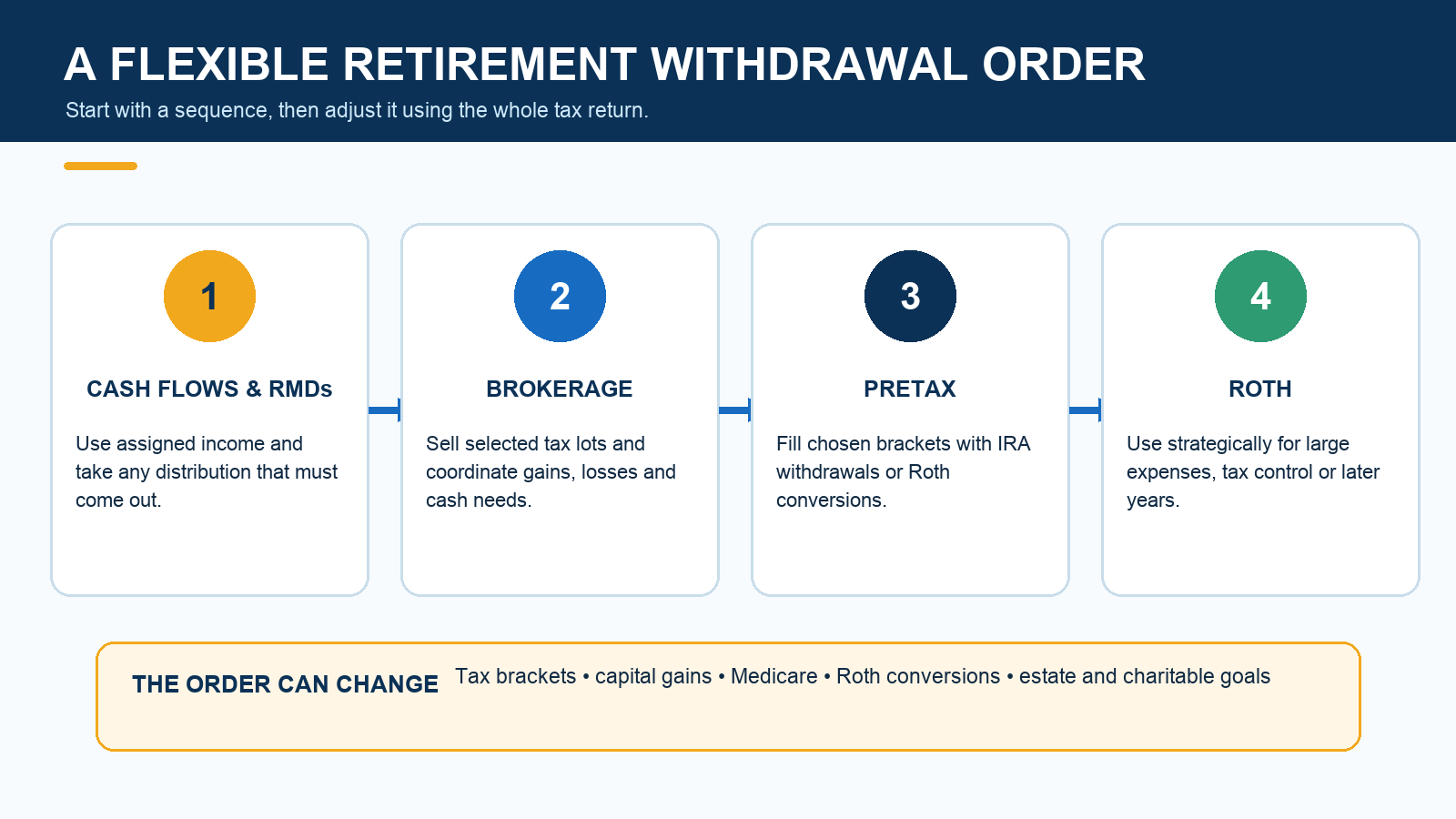
A practical starting sequence
- Use portfolio cash flows and required distributions. Spend interest, dividends, pension and Social Security assigned to current expenses. Take any RMD that must be distributed.
- Use available cash and planned brokerage sales. Sell tax lots deliberately, balancing spending needs, gains and losses.
- Fill selected tax brackets with pretax withdrawals or Roth conversions. Waiting too long can allow pretax balances and future RMDs to grow.
- Use Roth strategically. Qualified Roth withdrawals can fund a large expense without adding federal taxable income, help manage Medicare or tax thresholds, or remain invested for later years and heirs.
This sequence can change each year. A retiree in a low bracket may deliberately withdraw from an IRA while preserving brokerage investments. A retiree facing a large capital gain may use Roth money instead. Someone charitably inclined may donate appreciated shares rather than sell them. Someone holding highly appreciated assets for heirs may consider current basis rules, estate needs and tax-law risk before selling.
The brokerage account is often the bridge and tax-control account: it can support spending before retirement-account access, provide cash while completing planned Roth conversions, and help manage taxable income later. The broader retirement withdrawal strategy guide explains why the order should be coordinated rather than automatic.
A simple example
Jordan retires before required distributions begin and needs $70,000 for the year. Social Security and a pension provide $36,000. Interest and dividends provide $4,000. The remaining $30,000 could come entirely from brokerage sales, but Jordan’s tax projection shows room for a planned traditional IRA withdrawal or Roth conversion. Jordan uses $18,000 from selected brokerage lots and fills part of the chosen tax bracket with $12,000 from the IRA. The exact amounts depend on basis, gains, deductions, Social Security taxation, state tax and healthcare premiums.
The lesson is not the numbers. It is that withdrawal order should be planned using the whole tax return rather than a fixed account ranking.
Brokerage-account checklist
- Give the account a specific goal and time horizon.
- Confirm cash versus margin before signing.
- Check registration, SIPC membership and Form CRS.
- Compare all fees, the cash sweep and transfer rules.
- Use a diversified allocation you can maintain.
- Automate deposits and verify they are invested.
- Understand dividends, gains, basis and tax-lot selection.
- Coordinate wash sales across every household account.
- Protect access with strong authentication and a trusted contact.
- Review beneficiaries, statements and the withdrawal plan annually.
Frequently asked questions
Is a brokerage account the same as an IRA?
No. An IRA is a retirement account with contribution, eligibility and distribution rules. A standard brokerage account is taxable and generally has fewer access restrictions.
How much money do I need to open one?
Many firms have no account-opening minimum, but an investment may have its own minimum purchase. Check the broker’s current requirements.
Do I owe tax when I withdraw money?
Moving available cash from the brokerage account to a bank is not itself what generally creates tax. Interest, dividends, distributions and investment sales may create taxable income or gains. A sale can be taxable even when the proceeds remain inside the brokerage account.
Can a brokerage account lose money?
Yes. Stocks, bonds, funds and other investments can decline. SIPC protection does not cover ordinary market losses.
Should I use a robo-adviser or manage it myself?
A robo-adviser may create and rebalance a portfolio for a fee. A self-directed brokerage leaves investment decisions to you. Compare the total cost, services, tax features, control and whether you understand the portfolio.
Official resources
- Investor.gov: How to open a brokerage account
- Investor.gov: Brokers and selecting a firm
- FINRA: Cash and margin accounts
- SIPC: What brokerage-account protection covers
- IRS Publication 550: Investment income and expenses
- IRS: Cost basis and brokerage reporting
Reviewed September 2026. This article provides general educational information, not individualized tax, investment, legal or estate-planning advice. Account terms, investment risks and tax rules can change. Verify current information and consult appropriate professionals for decisions involving your circumstances.