
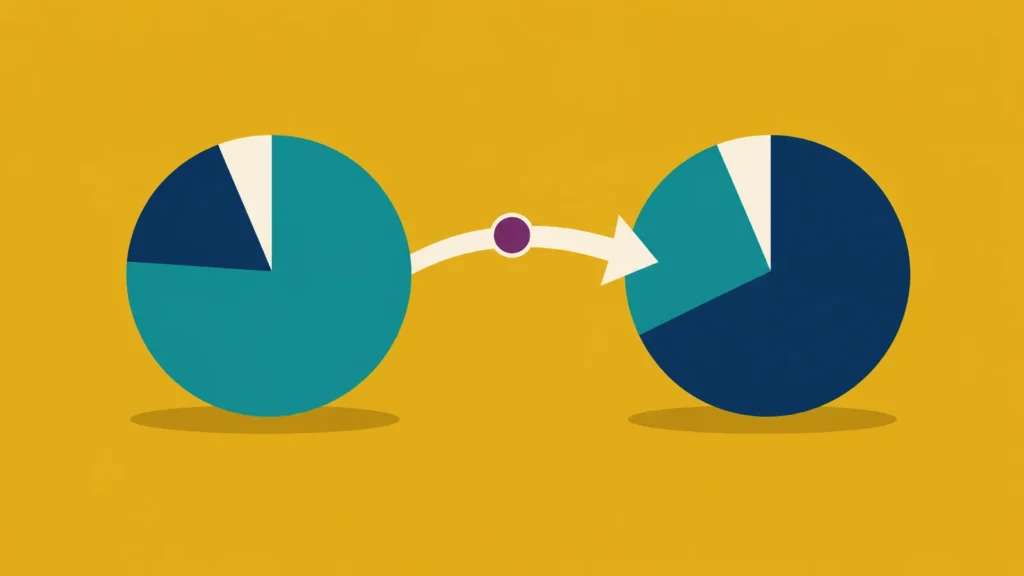
A retirement glide path is a schedule for changing an investment portfolio over time. Instead of holding the same percentage of stocks and bonds forever, the portfolio moves toward a planned allocation as retirement approaches—and sometimes continues changing after retirement begins.
The familiar version starts with more stocks while retirement is far away and gradually adds bonds and cash as the investor gets older. The idea sounds simple. The details are not. Two funds with the same retirement year can follow different paths, arrive at different stock allocations and expose investors to very different risks. A glide path is a policy, not a prediction
It does not forecast when stocks will rise or fall. It sets a planned direction for the portfolio so that risk changes deliberately rather than in reaction to headlines.
What a glide path changes
A glide path usually controls the percentage held in broad asset groups:
- U.S. and international stocks;
- investment-grade bonds;
- inflation-protected bonds;
- short-term bonds or cash; and
- occasionally other diversifiers.
It may change only the stock/bond split, or it may adjust the mix within each category. A target-date fund, for example, might reduce stocks while increasing bonds, then shift part of the bond allocation toward shorter maturities as the target year approaches.
The glide path has three basic parts:
- Starting allocation: the mix used when retirement is still distant.
- Transition: the years during which the allocation changes.
- Landing allocation: the mix reached at retirement or later.
A simple example
Consider a hypothetical investor with 80% in stocks and 20% in bonds at age 50. The plan calls for 50% stocks and 50% bonds at age 65. A straight-line glide path would reduce stocks by two percentage points a year:
| Age | Stocks | Bonds and cash |
|---|---|---|
| 50 | 80% | 20% |
| 55 | 70% | 30% |
| 60 | 60% | 40% |
| 65 | 50% | 50% |
Illustrative only. The allocation is not a recommendation.
The shift can be made gradually through new contributions, automatic rebalancing or periodic trades. A real glide path does not have to be linear. It might remain aggressive for many years, change more quickly near retirement and then level off.
Why reduce stocks as retirement approaches?
Stocks have historically offered greater long-term growth potential than high-quality bonds, but they also experience deeper short-term losses. Early in a career, an investor may have decades of contributions and time to recover from a decline. Near retirement, the portfolio is usually larger, new contributions are smaller relative to the balance, and withdrawals may begin soon.
A large loss immediately before or after retirement can be especially damaging when money must be withdrawn from a falling portfolio. This is sequence-of-returns risk: poor returns early in the withdrawal period can create a worse outcome than the same returns arriving later.
A declining glide path tries to reduce that exposure. It gives up some expected growth in exchange for lower volatility and a larger pool of assets that may be available without selling stocks after a decline.
How target-date funds use glide paths
A target-date fund holds a diversified mix of investments and automatically adjusts that mix as its named year approaches. A 2045 fund is generally designed for someone expecting to retire around 2045. The year is a guide, not a promise and not an expiration date.
According to Investor.gov, target-date funds typically move from a stock-heavy portfolio toward a more bond-oriented mix over time. Many workplace retirement plans use them as a default investment. The convenience is meaningful: the fund handles asset allocation and rebalancing in one product.
Convenience does not make every 2045 fund interchangeable. Compare:
- the current stock percentage;
- the allocation at the target year;
- the allocation 10 or 20 years after the target year;
- domestic versus international holdings;
- bond quality and duration;
- fund expenses;
- whether the fund includes nontraditional assets; and
- how often the provider can revise the glide path.
The fund’s prospectus and asset-allocation chart reveal more than its name.
“To retirement” versus “through retirement”
A to-retirement glide path reaches its most conservative allocation near the target year and then changes little or stops changing. It treats retirement as the landing point.
A through-retirement glide path continues reducing stock exposure after the target year and reaches its final allocation later. It treats retirement as a transition rather than an endpoint.
The label alone is not enough. One provider’s “to” fund can hold more stocks at retirement than another provider’s “through” fund. Look at the actual percentages and dates.
What happens after retirement?
Retirement can last 25 or 30 years, so eliminating growth assets may create another risk: inflation can erode purchasing power. A retiree may need stocks for long-term growth even while using bonds and cash for near-term spending.
There are three broad ways to handle the post-retirement allocation.
Hold the landing allocation
The portfolio reaches a chosen stock/bond mix and is rebalanced back to it. This is simple and transparent. The investor must still decide how spending will respond to poor markets.
Continue becoming more conservative
A through-retirement path may keep lowering stocks for several years. This can reduce volatility but also reduces expected growth and may increase exposure to inflation or a long retirement.
Use a rising-equity path
A less conventional strategy starts retirement with a lower stock allocation, then gradually increases stocks later. Research by Wade Pfau and Michael Kitces found that certain rising-equity paths modestly improved portfolio survival in difficult historical sequences, although they often produced less ending wealth when markets were favorable.
This is not a universal rule. A rising path can feel counterintuitive, requires disciplined rebalancing and may leave an older retiree with more stock risk. Its purpose is to reduce exposure during the early withdrawal years, when a bad sequence may be most damaging, rather than to maximize average wealth.
A bond tent is related, but not identical
A bond tent raises the bond allocation before retirement, peaks near the retirement date and then allows the stock percentage to rise later. On a chart, the bond allocation resembles a tent.
The approach concentrates protection around the retirement transition. It differs from a conventional target-date path that keeps moving toward more bonds after retirement. It also requires decisions about how high the bond allocation should rise, how long the peak should last and whether later stock increases happen through rebalancing or by spending bonds first.
How to choose a glide path
Age and retirement year are useful inputs, but they are not enough. Consider the whole retirement plan.
How much of spending depends on the portfolio?
A retiree whose pension and Social Security cover most essential expenses may be able to tolerate more investment risk than someone who must fund every bill from savings. Guaranteed income can behave like a bond-like resource in the household plan, but it does not make market losses painless.
How flexible is spending?
A household able to postpone travel or reduce discretionary withdrawals after a poor market may support a different allocation from a household with fixed medical, housing and family obligations.
How large is the portfolio relative to the goal?
An investor with substantially more than required may choose less risk because additional growth is unnecessary—or more risk because essential spending is already secure and legacy goals matter. Capacity and willingness to take risk are separate questions.
When will withdrawals begin?
The target year printed on a fund may not match the first withdrawal. Someone retiring at 62 but delaying portfolio withdrawals until 70 has a different exposure from someone drawing heavily at 60.
What other assets exist?
Evaluate the entire household. A target-date fund inside a 401(k) can appear balanced while a spouse’s account, company stock, rental property or large cash position pushes the overall allocation in another direction.
Can the investor stay with it?
A theoretically efficient plan fails if a 25% decline causes the investor to sell stocks and abandon it. The glide path should use a level of risk the household can maintain through an unpleasant market.
How to build a simple custom glide path
- Set the scope. Include every investment account that serves the retirement goal.
- Choose the current allocation. Measure what you own rather than relying on fund labels.
- Choose a landing allocation. Connect it to spending needs, guaranteed income, time horizon and loss tolerance.
- Choose the landing date. It may be the retirement date, first withdrawal, Social Security start or several years after retirement.
- Set the transition. Decide whether changes occur annually, quarterly or within rebalancing bands.
- Write a rebalancing rule. For example, review annually and rebalance when an asset class is more than five percentage points from target.
- Coordinate taxes. Use contributions and withdrawals where possible before creating taxable gains. Asset location and allocation are related but different decisions.
- Review when the plan changes. A retirement-date change, pension election, major inheritance, health event or permanent spending shift may justify a new path.
A schedule should prevent emotional trading, not force pointless transactions. Small target changes can often be achieved with new contributions, dividends or withdrawals.
Common mistakes
- Choosing by year alone. Funds with the same date may have materially different stock exposure.
- Mixing a target-date fund with many overlapping funds. The result may be less diversified than it appears and difficult to monitor.
- Ignoring accounts outside the workplace plan. A glide path should reflect the household portfolio.
- Assuming bonds cannot lose money. Bond prices respond to interest rates and credit conditions; maturity and quality matter.
- Becoming too conservative too early. A long retirement still needs growth and inflation protection.
- Changing the path after every market move. That turns a policy into market timing.
- Confusing allocation with a complete income plan. A glide path does not determine the withdrawal amount, tax sequence, Social Security decision or healthcare budget.
Glide path versus a fixed portfolio
A fixed 60/40 portfolio is not automatically inferior to a glide path. It is another policy. Its strength is simplicity: rebalance to the same target and avoid guessing how risk should change with age.
A glide path is most useful when the household has a reason for risk capacity to change. The approach to withdrawals, the loss of wage income, the start of guaranteed benefits and the desire to protect near-term spending can all provide that reason.
The better comparison is not “automatic versus sophisticated.” It is whether the chosen policy matches the household and can be followed consistently.
Questions to ask before using one
- What is the stock allocation today, at retirement and 10 years afterward?
- Is the path designed to retirement or through it?
- What assumptions does it make about retirement age and withdrawals?
- How does it fit with pensions, Social Security and assets outside this account?
- What loss could occur near retirement?
- How will withdrawals and rebalancing work after a market decline?
- What would cause the policy to change?
The path should serve the plan
A glide path can turn asset allocation into a repeatable process. It can also create false confidence if the investor sees the retirement year and assumes every important decision has been made.
Use the RetireNerd Compass retirement analyzer to test how an equity glide path changes projected outcomes. Compare it with a fixed allocation, different retirement dates and flexible spending assumptions. For the underlying portfolio structure, see the three-fund portfolio guide and stocks, bonds and cash asset-mix guide.
The goal is not to discover a perfect curve. It is to choose a risk policy that supports spending, remains understandable and still works when markets refuse to cooperate.
This article is educational and does not provide individualized investment, tax or legal advice. Investments can lose value, and no asset allocation or glide path guarantees income or prevents loss.